creative sparks in Armenia

Combining a design career with an academic role often means my weeks are busy and varied, but I had a week at the beginning of this month that was very different to the rest! I’ve been lucky enough to be given an amazing experience as academic at Norwich University of the Arts – a trip to Armenia. The university was successful in securing a British Council bid to work with students at the Tumo Institute in Yerevan, Armenia to help students to create design work with the aim of making products to sell when they come to work at the university in a few weeks time. This is speed educating! A team of three of us, Will – a business mentor from the university, Mia – a graduate from the BA in Textile Design and me – the lead subject academic. Fortunately we all got on brilliantly, complimenting each others’ skills and all being very happy to adapt in order to make the most of the experience. I was only able to be there a few days, while the other two stayed longer.

The journey was long, transferring in Istanbul and we arrived in Yerevan in the middle of the night so it wasn’t until the morning that we could see what the city looked like. We had some time to rest, so we didn’t! … and instead got up and explored … of course! The architecture was a mix of Modernist Brutalism, Art Deco and Post-Modernism mainly and a pink stone was dominant. Many of the buildings featured wonderful carvings and at many points all three of us were heads and cameras up capturing the city. The food in Yerevan was a complete hit with us and I could have stayed far longer and become far wider. Everywhere we went there was wonderful fresh produce: cheeses and meats, pastries, vegetables and breads, all beautifully presented. Luckily we were all happy to share the dishes to ensure we could try as much as possible.
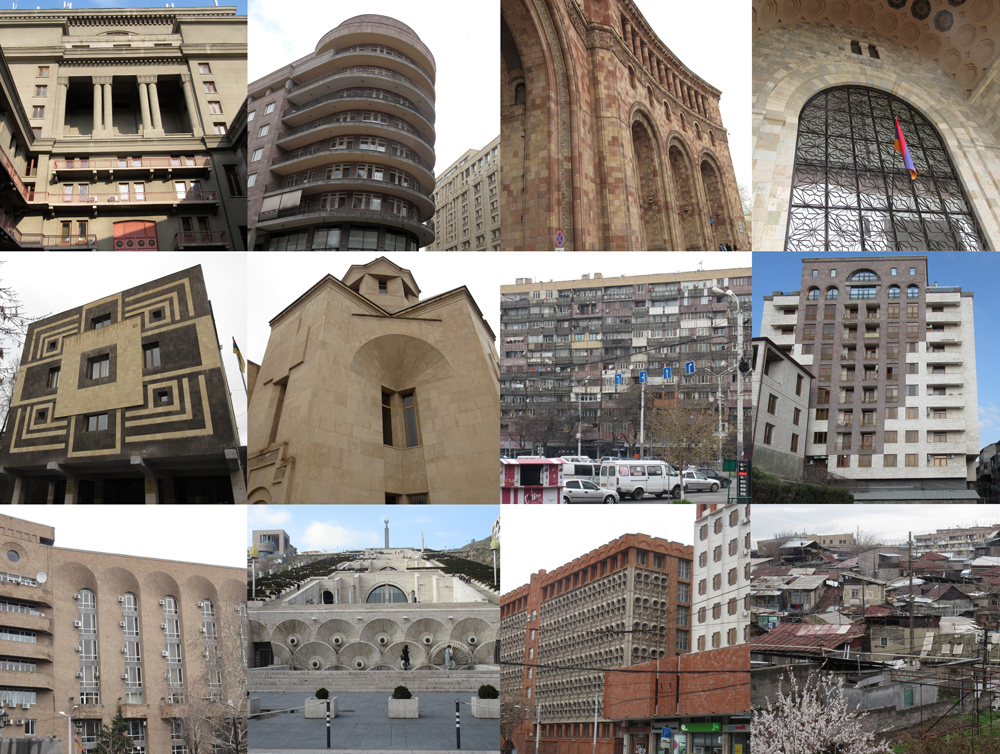
Armenia_architecture_1000

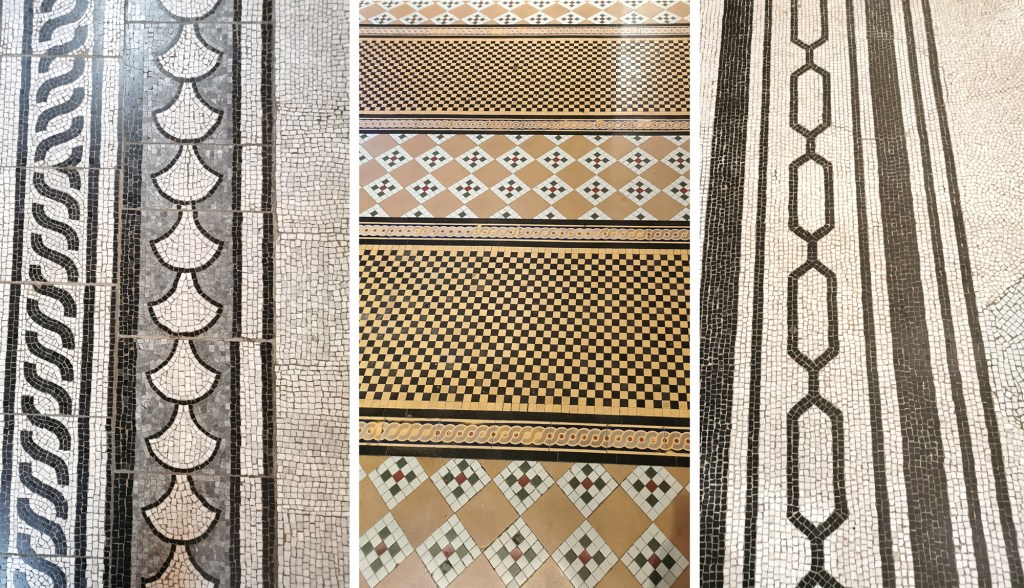
There was much excitement as we went to meet the team of students we were going to be working with, and we took examples of our work to introduce ourselves as well as a general plan, and open ears, so we could discuss with them all their own creative ambitions. These first few days were really important to get the project up and running before I had to return to the UK. Tumo studios was set up on the first floor of what was previously home to a wealthy family and there were signs of the better days including murals on the ceilings and ornate tiles. The workshop spaces were really inspiring, catering for print, ceramics, jewellery, sewing and more. Products made by students were available for sale too.

Everyone was very friendly and helpful, as well as really excited to get stuck in. We shared our ideas and thoughts about the project and Mia and I talked briefly through some of our own work. The first afternoon went by quickly and then the three of us were off to explore the city again – I really wanted to see Mount Ararat – the mountain taller than Mont Blanc, (and apparent resting place of Noah’s ark) that has in history been on Armenian soil, but is now behind a Turkish border. We climbed steps and more steps to the highest part of the city giving us views over the varied levels of prosperity in the capital . With sunglasses on, when there was a break in the clouds we could just spot the snow and shady top of Ararat, but sadly the view was not easily captured on camera – Wikipedia has better pics!

The next day was a very long but hugely inspiring one. With our local guides and our researcher eyes in we set off to visit three fabulous places to gain inspiration. The city museum presented the history of Armenia. We learned about traditions, society, historic events and politics, and of course the section about the Armenian genocide was hugely upsetting. We were not allowed to take photographs there but we had other places to go so we crossed the city, including a short trip on the metro (it has one line) to get to the Folk Museum. This was a smaller museum but packed with so much beauty! Here we heard about and saw the traditional crafts and our guide explained the processes, tools and materials involved. I took many photographs! The lace and filigree were particular favourites of mine.
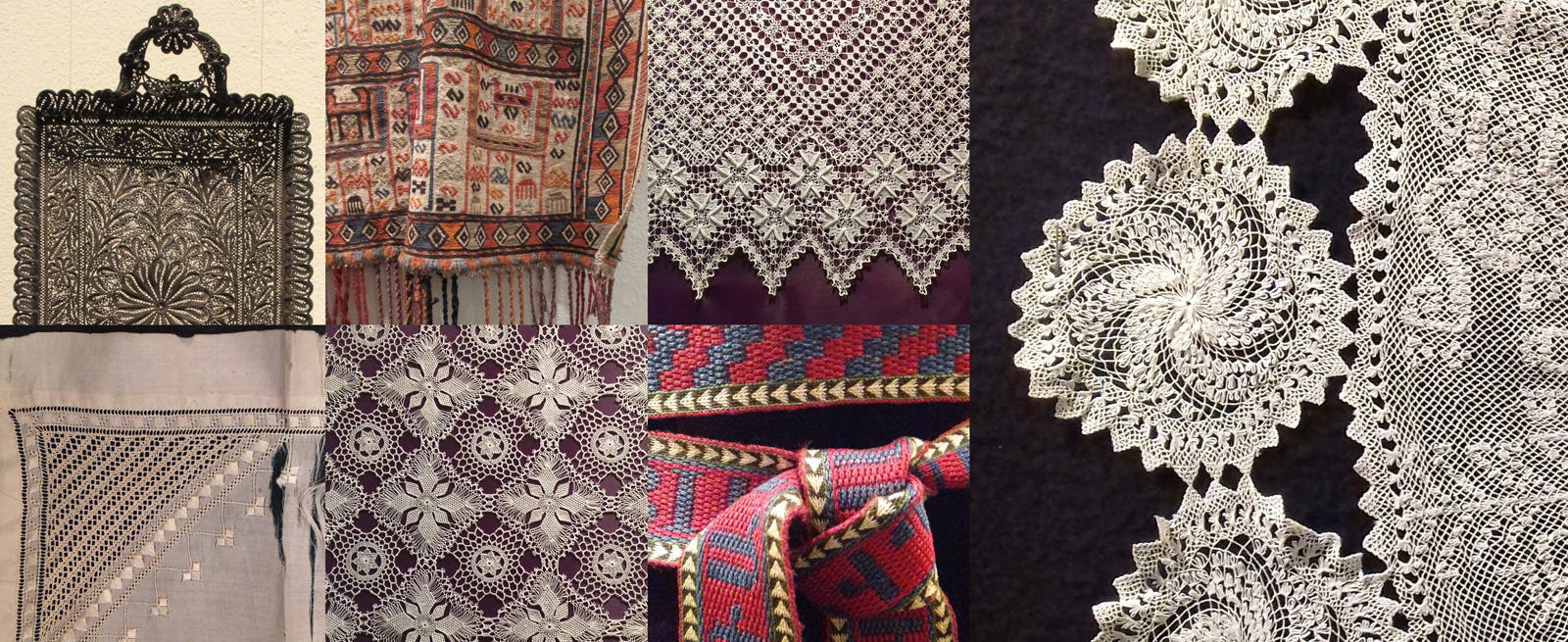
KFarley_folkmuseum_blog1600

We were full of inspiration but needed energy so lunch was in a restaurant with our hosts helping us to navigate a menu of local dishes – I had lamb soup with pomegranate and mint – it was very good! Soon we were whisked off to the carpet museum / factory and the journey was a great opportunity to see more of the city and suburbs. It was fascinating to hear the history of carpet / rug making in Armenia and I even had a go at learning the right knot but I was very slow in comparison – there is video footage somewhere – and in the picture below, top row, right hand side, you can see my four cream coloured tufts that they have no doubt got rid of once I turned my eyes!
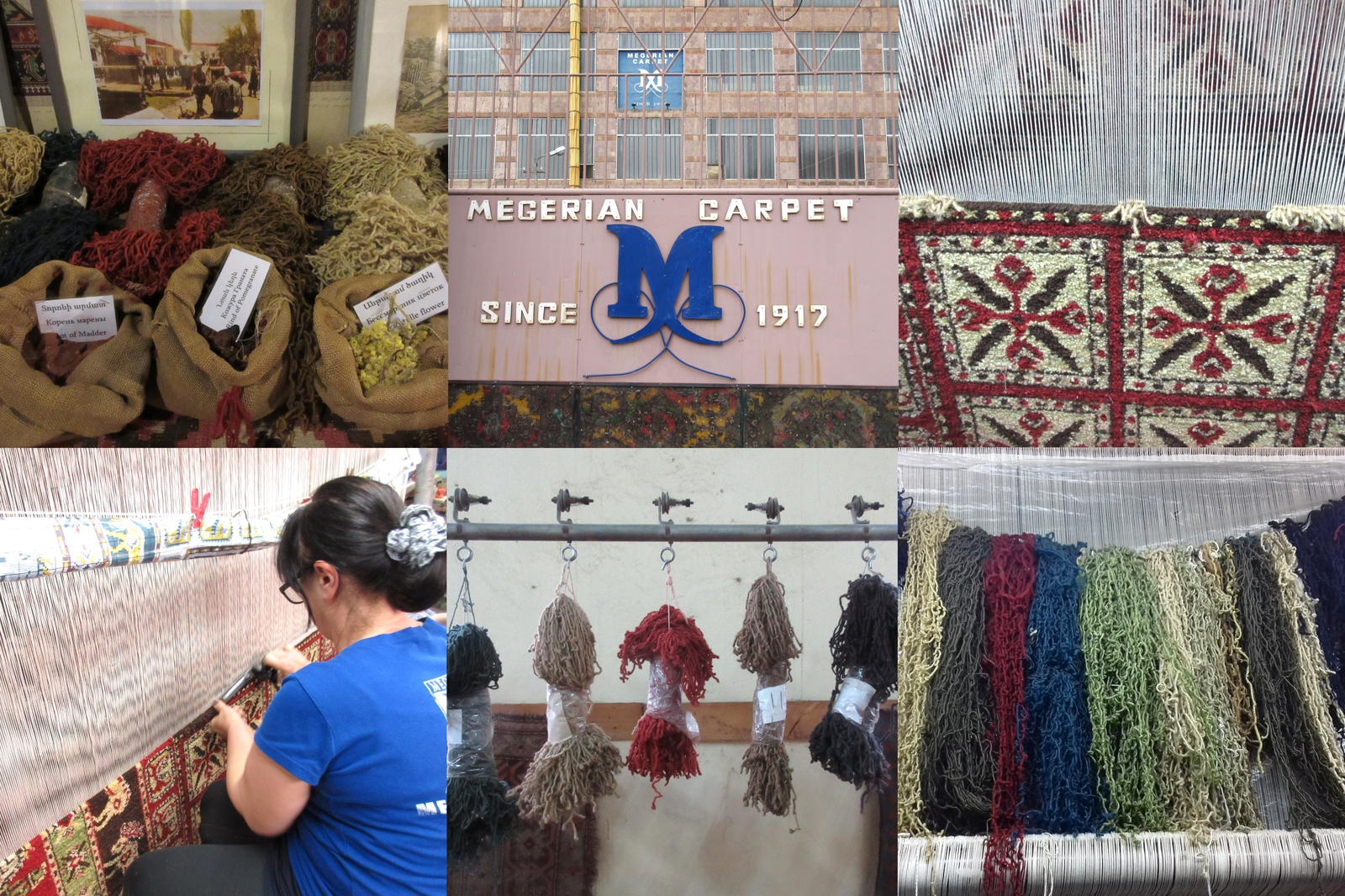
KFARLEY_Megerian_carpets_blog1600

The colours used to dye the yarns are still made from natural ingredients and it was right up Mia’s street! There were some secret ingredients of course! We were all inspired by the sights, stories and the motifs, border patterns and processes involved. What an amazing day. We headed back to the studio to think about what we had seen, captured some ideas on some post-it notes and discussed the plans for the next day. Another evening of foraging fabulous food in the restaurants of Yerevan did us well – we all ate too much again.

My final full day was spent in Tumo studios leading some workshops to develop the projects. Will, Mia and I planned the next week of workshops and activities, sharing all our different knowledge and experience, alongside talking through the individual ideas with the participants. I ran a session about motif and composition development and it was fascinating to see how differently these young people took on the challenge compared to the undergraduates in England I have worked with. These students were far happier to play with the process and not worry about it not working, and gave the testing much more time. Can this be the different schooling? Several attempts at the same thing, sharing and much discussion, lots of giggling and trying again got us to where we needed to be, lunch!
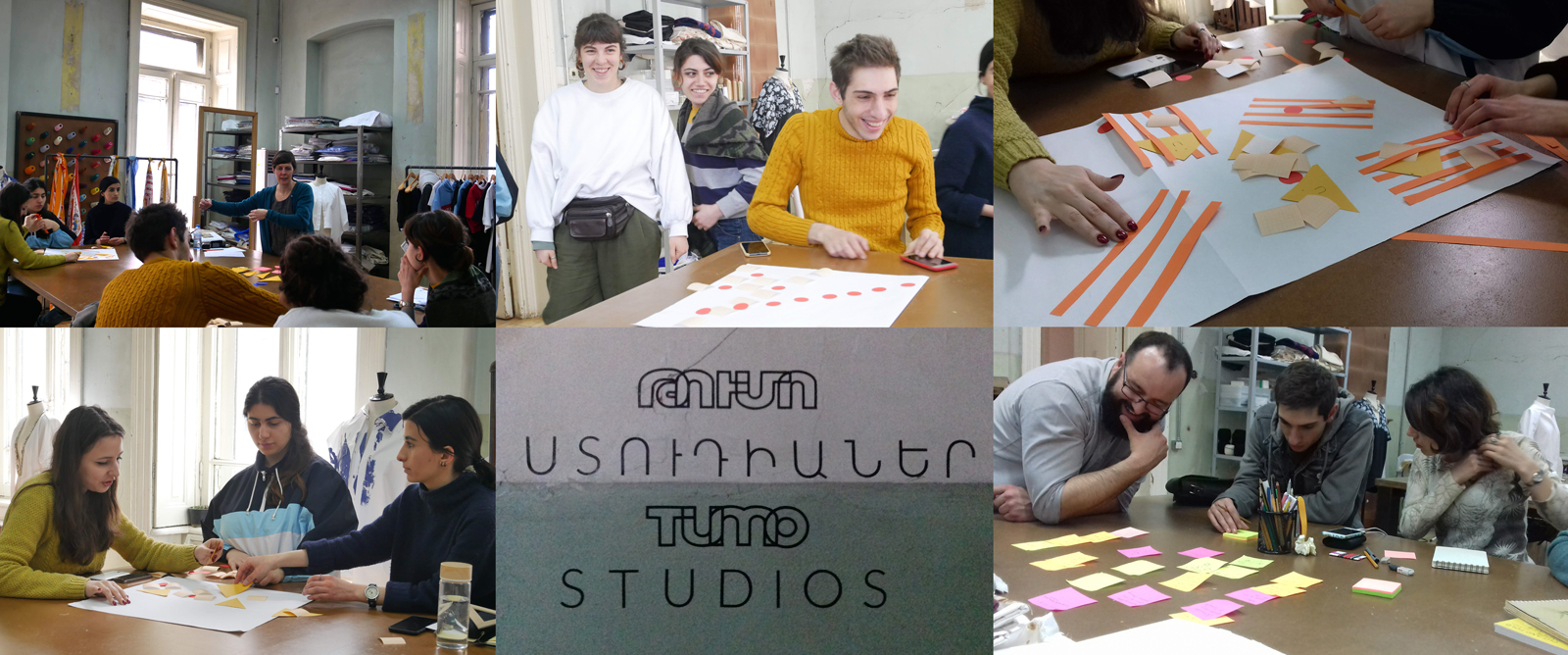
KFARLEY_tumo_workshops_blog

We decided to eat all together in the studio so we ordered in food, (I tried cheese soup – it really is like fondue) and as we sat together we tried to learn some of the language … we laughed a lot. We were also bought a local honey cake to try which was very good. In the afternoon I led a practical session about repeat patterns and design rhythms, and again we talked through individual ambitions for design ideas and product potential. The participants will be heading to Norwich next month to develop and resolve product outcomes to test in a commercial setting. We discussed differences between Norwich and Yerevan and about the next phase of the project. At times we had visitors popping in to see what was going on but we kept on track and too soon I was having to say my farewells and leave the group – with the silver lining of knowing I’d see them in Norwich in May.

One more meal, a final evening with Will and Mia, a supermarket sweep around a 24/7 shop to buy gifts, back to the hotel to pack up, a twenty minute nap and that was that, it was Thursday – I flew out of Yerevan in the very early hours, swapping ‘planes in Istanbul and on to home.

I was so sad to leave the people and city, and was so envious that Mia and Will had another week to see more. In only a few days I had experienced somewhere so interesting that before getting there had felt daunting. Everyone we met were so friendly, helpful and proud of the city and country. I had the chance to learn about a different country and textile culture while working on a really different project, testing my teaching in a very different situation. It really was a great opportunity, hooray for saying yes!

factory_groupimage_blog

Thanks to Will and Mia for some of the photography and being such great team mates!
weaver extraordinaire: Anni Albers

If you are interested in textiles and haven’t heard about the Anni Albers show now on at Tate Modern in London, then a.) where have you been? and b.) get there fast if you can!

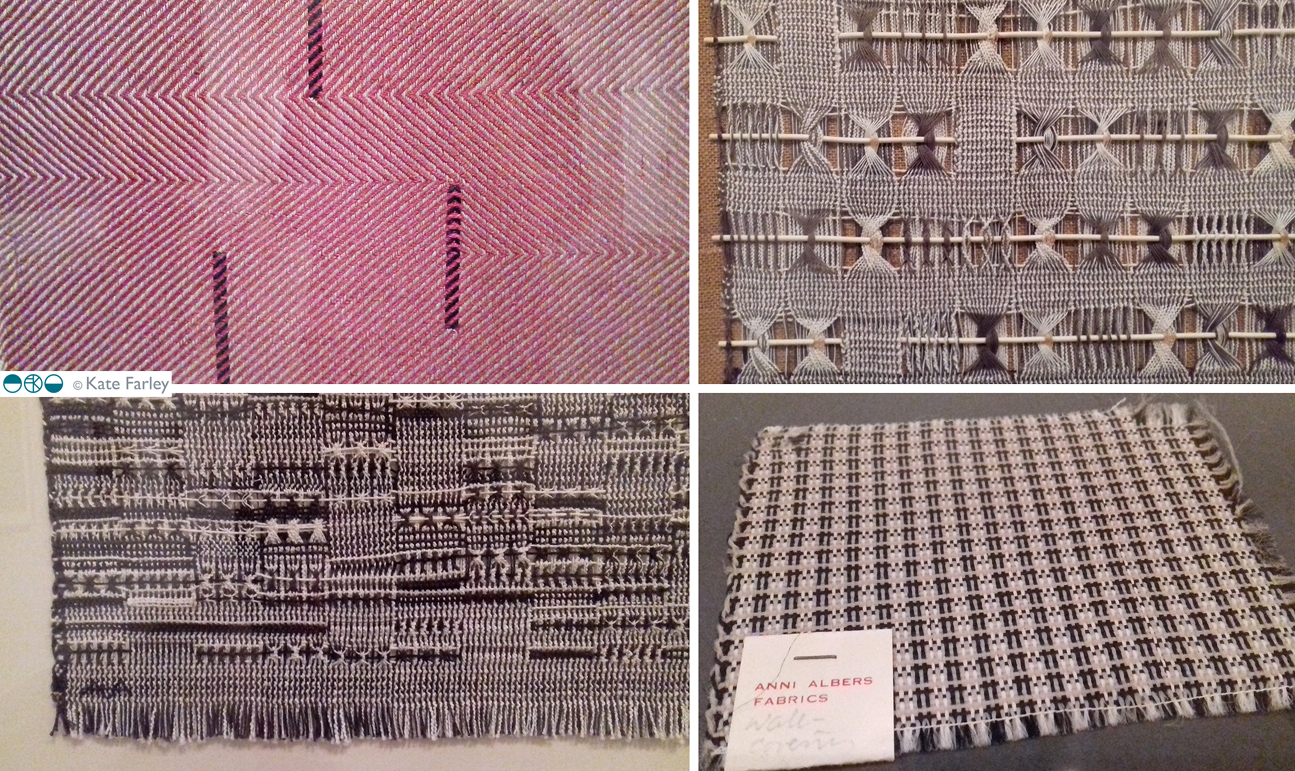
This has been a much anticipated show for me. Having been enjoying many other people’s pictures via Instagram since the exhibition opened I was most excited to get to the show and I’m so glad I did – I went round it several times and breathed in the history I had learned as an art student myself; typewriter patterns from Bauhaus lessons, the infamous diploma piece with sounds absorbing properties in the yarn, and those classic Bauhaus photographs, but there was so much more. Colour, cloth, pattern, rhythms, photographs, works on paper, products … The woven structures and yarns drew everyone in for a closer look – so much so that the alarms kept being set off and the guilty took a sheepish step back! There was a fascinating display of the research of historical textiles from Albers’ own collection that made perfect sense in how she interpreted and worked with the process of weaving.

annialbers_s

Experimental, commercial commissions, religious pieces and jewellery are some of the aspects of this considerable show. As with most well-received shows, the audience conversations themselves were fascinating; lots of discussions about experiences of weaving, hours at the loom as well as working out what she must have done.

It has been the architects, the painters and the product designers, usually men, who have become far more well known from the Bauhaus, including Anni’s husband Josef Albers. The avant-garde German art school’s first director Walter Gropius stated there were equal opportunities for all when it was established in 1919 and yet women were generally encouraged towards the textiles workshop, a place and craft deemed more suitable. Anni never let this distract from her focus despite wanting to be a painter. Her creative output of a lifetime, as edited in this exhibition, goes a long way to demonstrate her will to explore both the context of design and the development of art. She will have no doubt inspired many who have been introduced to her as a result of the show and her legacy will continue to influence far beyond the context of textiles as a craft for women. I came away with many notes and a head filled textile excitement – happy weaving everyone!

Exhibition ends: 27th January 2019

women designers, lost and found

Sometimes themes seem to rattle around in my head, connecting with other dialogues I have had. Last week I attended a really interesting Study Day at the House of Illustration as part of the Women in Print series organised by Desdemona McCannon on the theme of Enid Marx and contemporaries. The subject of women’s careers, and specifically their profile compared with their male counterpoints was discussed – not a new idea, but as a recurring theme I thought it worth revisiting here. In the same week Stylist magazine featured an article about the price of artwork made by women compared to men. It was such a coincidence I’ll expand some thoughts here.

It’s not a secret that women often have a harder time gaining recognition in many lines of work in comparison to their male peers. I wrote in a previous blog post about Eric Ravilious and friends at Compton Verney that it certainly wasn’t lack of skill that kept the women such as Helen Binyon from comparable public attention, and therefore further opportunities through their careers. There are highly talented women in history who we are only just giving air-time to, but the fact is their careers may not have excelled in the way their male counterparts did, or if they did they may well have been paid less for the work because they were women.

Enid Marx chose not to take issue with gender-bias in her career, and got on with a multi-disciplined design portfolio, with impressive outputs including books, textiles and patterns which were beautifully communicated through the exhibition at the House of Illustration (sorry it’s just ended!) – but you can visit Compton Verney instead. We got to see the exhibition as well as listen to knowledgeable speakers such as Enid Marx expert Lottie Crawford giving a really insightful illustrated paper about the legacy that Enid Marx and her peers have created for us today, as well as Jane Audas taking us through a fascinating journey of clients and sales put in to a broader context of who’s who.

I have heard people wonder why we need to make a point about this being a gender issue, but I would say that this has been said from a male perspective, and not from those being subjected now and in the future to selective opportunities due to gender. As a woman designer, and female academic training mostly women to have design careers where there is a history of undervaluing female contribution, I remain concerned.

EnidMarx_patterns

It is sometimes the case that research can be discovered more easily about men because they were promoted more and as a result have a higher profile, whether through greater self-confidence, the social / commercial networks or marketing material, from family or company archives, past exhibitions or publications. During the study day in London the point was made that there was also a sense that women got on with the designing, often alongside raising a family or carrying out other domestic tasks. Did they lack the opportunity to promote themselves, didn’t see the need, or couldn’t find the time? Working in isolation at home can certainly challenge one’s self-belief compared to working in an office with colleagues who can praise you and your work as and when required. This reminds me of the freelance work of Sheila Bownas, almost accidentally discovered and collected by Chelsea Cefai, and brought to a new appreciative public in the last few years. The family knew little of the extent of her prolific output of designs as a textile designer until Chelsea pieced the jigsaw together, and thank goodness we know of her now!

There is another consideration here. Does the discipline these women are working in make a difference to their profile? Enid Marx worked across illustration and textiles, but her illustrations are better known. Is this because as an illustrator your name is usually on the cover of the book, even if it is on the inside, or on the poster? For freelance textile designers it can be quite different. The name of the company is usually printed as legend details on the selvedge, but historically not always the name of the designer. If this is the case we may never trace the designer. This remains the case today in industry when big name brands buy in freelance patterns and the designer’s name is not carried through.

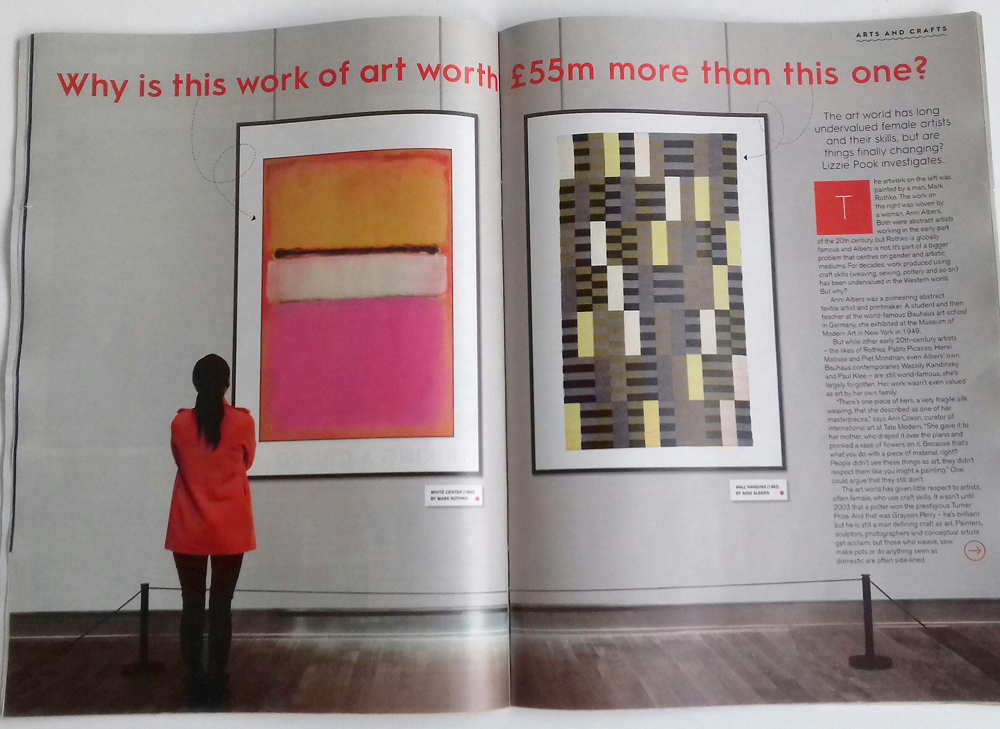
The article in Stylist compares Mark Rothko and his fine art paintings to Anni Albers’ textile practice; the subject of a show coming to Tate this Autumn. When the Bauhaus opened its doors in Germany in the Twentieth century the founder, Walter Gropius, stated anyone could study any discipline, and yet the women were rather heavily steered towards the weaving workshop, considered suitable for women. That was where Anni Albers learned her skill, fell in love with the teacher Josef Albers, took his name on marriage and continued to live in his shadow; he led a fine art practice of painting while she made textiles. I can’t wait to see the Anni Albers show – and for Anni to have the publicity men with lesser creative careers have had before.

stylist_magazine_Sept18

Craft, seen as a second-rate subject to Fine Art is part of the discussion throughout the article in Stylist, and it also makes the point that textiles is seen as a domestic activity, thanks to the increased leisure time during Victorian era. Grayson Perry has made significant strides in opening up the conversation about value of craft, but far more needs to be done to change opinions. As an academic one of my biggest concerns is the lack of respect textile design currently receives as a subject in the education curriculum and agenda. It’s becoming one of my catch phrases but I really mean it – we all wear pants! How can textiles be seen predominantly as a past-time, a hobby – when we all wear textiles, sleep under textiles and protect ourselves with textiles? How dare this government puts at risk the supply chain of future textile designers because it doesn’t see it as important enough to be a GCSE? Fashion is nothing without textiles, and this industry is one of the big ones on the global stage – don’t get me started on that!

Refocusing back on the study day, we also discussed the nature of research carried out by women, and that the particular approach / nature of research writing holds a female voice that may not be considered intellectual enough; often relating to social networks, domestic arrangements and family life. Several female audience members agreed that they doubted their own confidence when finding their research voice alongside the traditional academic tone / content they believed was expected by their male counterparts. Are women undermining themselves and lacking confidence in their own abilities?

I don’t have the answers but this is not a conversation that should stop. More dialogues involving men and women about historical and contemporary design practice, craft and textiles are needed. There is not one way, this is not binary, but we need to make sure the different voices, approaches, strategies and practices in the creative subjects and beyond are given a platform. The diverse ways of being whatever it is we are should be valued, and represented by a diverse community. Wouldn’t it be lovely if talent and opportunity were really the key ingredients for building profiles, gaining opportunities, and writing about it!

Save

Save

woven landscape

It seems right to me that as someone keen to draw images I chose print as my medium of design rather than weave but I do think there is a strong sense of the spirit of woven cloth in how I see things, and for that I thank my upbringing in Norfolk. The strong horizontal line of the sky meeting the fields interrupted by vertical fence posts or reeds creating visual rhythms can leave me feeling utterly complete. Back in Norfolk this Easter, once again I breathed in the space, the horizontal and vertical of Horsey; one of the most perfect places.

I removed colour from this image as I wanted to clearly show the structure of the stripes, but colour is much of the joy in this landscape – the purples, greens, yellows, varying from minute to minute in the ever-changing light. I add them below. One day I will weave again.

Horseyreeds_weave130

KFarley_Horsey_palette

Pattern appreciation at the Whitworth

The Barbara Brown exhibition at the Whitworth in Manchester is really worth catching, especially if you like patterns.
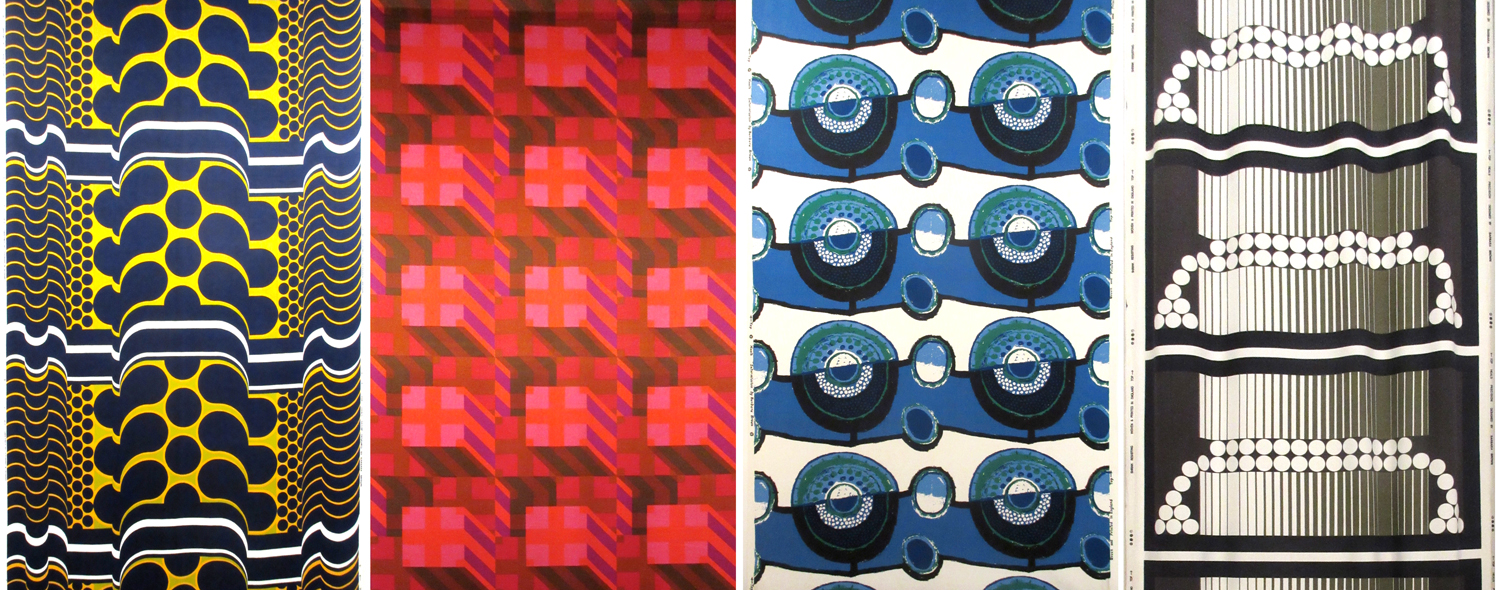
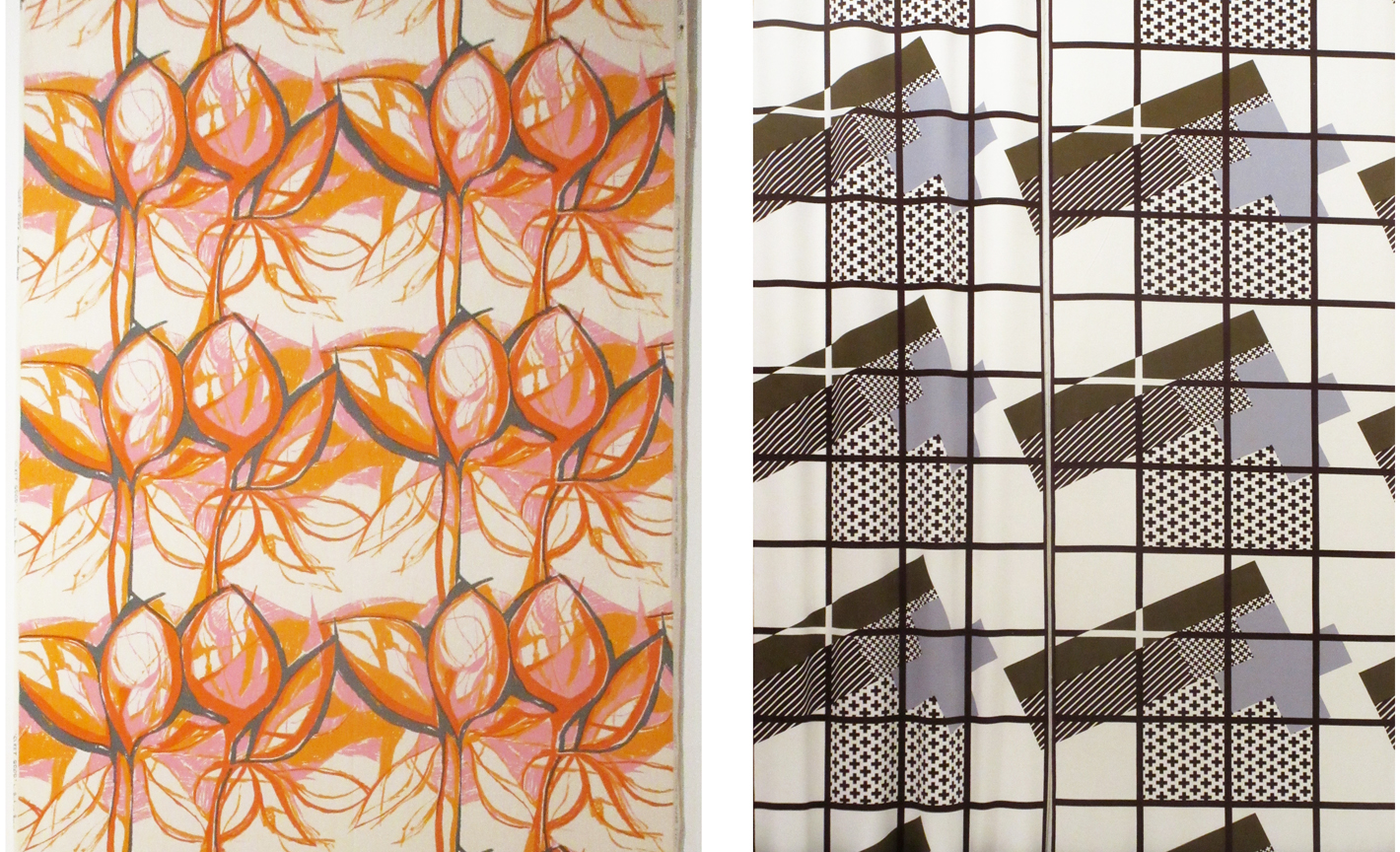
The layout of the gallery enables an overview; the broad visual statement of the textiles designed by Barbara Brown during the 1960s and 1970s, to be seen straight away and makes for a striking sight. Large-scale pattern in different colour-ways jostle for attention and yet the small gatherings of textile designs within the gallery also create more local dialogue for consideration. The repeats are large, not in the Marimekko sense but larger than we often see, taking the full width of the fabric to do the talking. Seeing the textile lengths on exhibition really shows off the bold rhythms of each pattern.

BarbaraBrown_prints

The designs on show demonstrate a variety of motif units across the fabric, some halved, some quartered, others full width. The corner of the gallery most impressive in my opinion was the monochrome series that really pushed her design prowess forward. Although strong graphic statements, these are far from flat patterns. The curves in Ikebana (below left) and Automation (below, third from right), both from 1970, differ in how they control and divide the space, toying with depth and dimensions. There is a sense of sci-fi and computer generated environments across this mono-chrome series. Escher should also get a mention as the optical illusions on the architectural scale appear to pay homage to him too.

BarbaraBrown_mono1_120

I have my favourites, but I really want to highlight the breadth of pattern compositions here. The design statements include many geometrics with cubes, columns and dots. There are stripes, spots, architectural themes and florals. I see more than a hint of Op Art, Psychedelia and modernism across the printed fabrics, some more than others, but the designs appear experts at communicating the populist aesthetic of those years.

BarbaraBrown_3

As a teaching aid for textile design, this exhibition does rather well. Design students can understand the potential to grow large repeats rather than stop at small ‘plonk – plonk’ designs we see far too much of – maybe a result of designing on computer screens. Designers need to understand that even domestic interiors can cope with so much more than a motif 10cm in diameter. Brown’s shapes are also not always contained by outlines, and this presents bold, solid shapes that hold their own. Colour statements include monochrome and full-on colour including oranges and blues. There is a sense of the colour palette dating the patterns but the combinations communicate bravery. The monochrome designs have a very formal spirit, and although different in style do remind me of some of the black and white, large classical columns Timney Fowler print designs of the 1980s.

BarbaraBrown_textiles

Barbara Brown was working in a very different time, and artwork was not created in Adobe Illustrator or Photoshop. Hand drawing full-scale repeats gives you a very different relationship with pattern compositions. Some designs appear not to show signs of drawing, but others do, almost standing out for doing so – particularly Sweet Briar, 1959 (above left).

The exhibition was dominated by the printed fabric lengths but a couple of later knitted pieces offered an insight in to the designer’s creative career progression, and reminded me of the direction Lucienne Day took with her silk mosaics, making a clear distinction away from the commercial print designs. The juxtaposition of some small ceramic pieces next to fabric lengths offered an interesting pause for thought too. Would you have matching china and curtains? Maybe not, but the patterns held their own at both scales and on the different surfaces.

BarbaraBrown_dots_120

This is one of those examples of why you need to see exhibitions in the flesh, and not rely on the computer or phone screen to do the job. Seeing Barbara Browns patterns are eye-catching on a small screen, but they are far more impressive in this setting.

The exhibition is on show until January 2018 (and they always have several interesting things on at the same time – and I can recommend the cafe!) NOW EXTENDED UNTIL MARCH 2018

http://www.whitworth.manchester.ac.uk/whats-on/exhibitions/currentexhibitions/barbarabrown/

contexts build connections

Over the last twenty years the contexts for which I have made work has varied considerably. The intimate space of a page in a book, a sequence of doors in public conveniences, a gallery wall, patterns made in gravel on three large roof-scapes of a hospital or the humble tea towel; they all require different considerations. The client, the audience, the buyer and the customer, each has different agendas, budget requirements, aesthetics and expectations – I enjoy each challenge and added dimension that brings. The opportunity to consider my practice in these differing environments creates a chance to reflect and develop a greater understanding of possibility and relationship with the context of known work while developing an understanding of those different people and their agenda and perspectives.

More recently I’ve been working on design projects away from gallery walls, but I was delighted to be asked to be involved with Ambiguous Implements, a touring show featuring 17 practitioners across a wide range of creative disciplines, exploring domestic and familiar objects in alternative ways.

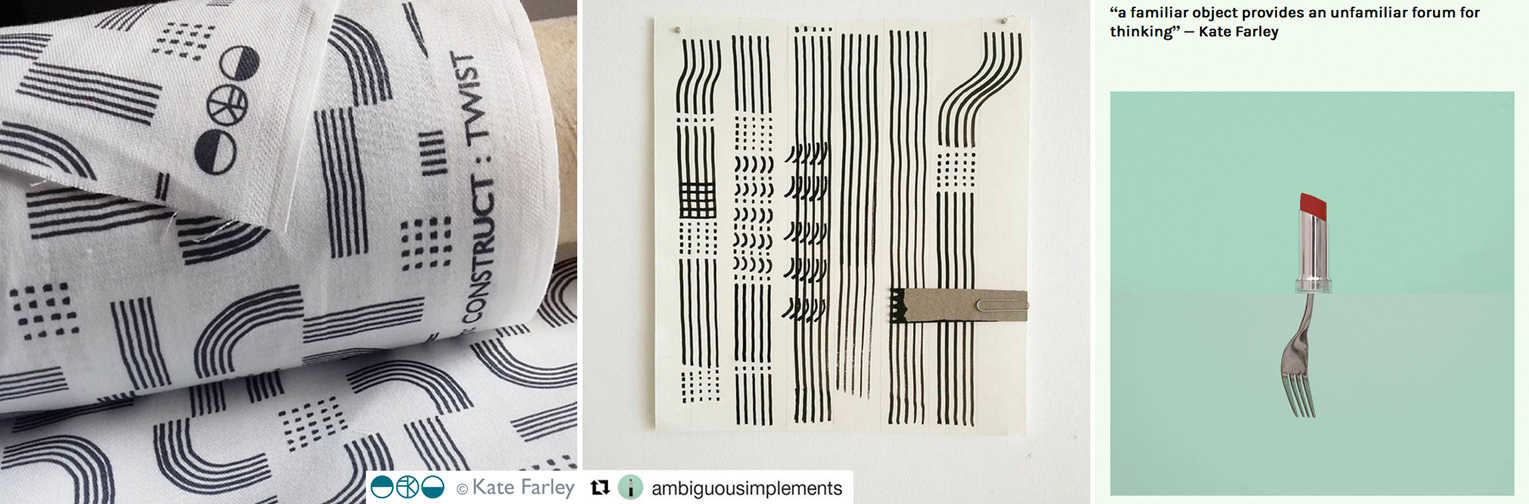
The contact came from a journal my ‘construct’ design work was reviewed in called Feast. I had been pleased with the care Laura Mansfield and the team had taken with understanding my work for the article in Feast, and for this new invitation I was delighted to include both some original drawings from my ‘Construct’ project, as well as metres of Construct: twist, in a bespoke colourway, as the nod to domestic interiors for the gallery settings. I was also asked if they could use my words, spoken casually during a conversation over the phone, but seemingly capturing the essence of the exhibition.

“a familiar object provides an unfamiliar forum for thinking” — Kate Farley

It’s funny how little conversations, and apparent one-off opportunities build networks to develop, support and enable both parties in different ways. I’ve been grateful to Laura and her team to be so considerate and inclusive, and to allow my work to sit in a very different context, thereby enabling me to consider the work further, evolving and existing in new ways. The other practitioners make very different work but the conceptual connections and mutual respect for others practices can also grow further understanding beyond the single opportunity. I’m pleased to be involved, for the development of my practice and the context of ‘construct’.

ambiguousimplements

Information:

Ambiguous Implements has been curated by Laura Mansfield in collaboration with Rachael Colley and Nuala Clooney. Funded by Arts Council England, supported by Dust and Simon Taylor Designs.”  https://ambiguous-show.tumblr.com/about

Ambiguous Implements is at The Bl_nk Space Gallery, Roco Cooperative Sheffield  until Saturday 15th July opening Tuesday to Saturday 11am- 6pm. Other venues

“Bringing together 17 practitioners from the fields of design, jewellery, ceramics, metalwork and sculpture Ambiguous Implements presents a collection of contemporary works that playfully reconsider the familiar objects of our day to day domestic life. Re-thinking the tools we use for eating, grooming, cooking and cleaning, the exhibiting artists have employed and subverted traditional craft techniques, reframed existing tools in new sculptural assemblages, or given seemingly banal objects new functions and effects. The collection of works present a twist on the familiar, bringing new perspectives to bare on the objects that populate contemporary domestic life.

Rob Anderson, Aimee Bollu, Caroline Broadhead, David Clarke, Nuala Clooney, Rachael Colley, Rosie Deegan, Kate Farley, Daniel Fogarty, Kate Haywood, Jasleen Kaur, Julie Mellor, Maria Militsi, Rebecca Ounstead, Matt Rowe, Jonathan Trayte and Abbie Williams each present new and existing works.”

text from https://ambiguous-show.tumblr.com/about


seeing red

My world is pretty colourful; on a daily basis I’m in contact with colourful textures, materials and surfaces from fashion, interior and architectural contexts. Not only do I work with hard and soft surfaces in my design practice, I also teach undergraduates to work with colour in relation to textile design. It’s important to see beyond the broad definition of colour by name and to think about the context of colour; the surface qualities in that colour, the effect the material has on colour, such as gloss, matt and opaque for example.

Last week I managed to update some colour charts in my studio resources and it made me think about how we tend to have particular favourites when it comes to colour. I certainly have a comfort zone in sections of the colour charts and other areas I’d have to be persuaded to go near. Commissions often include discussions with clients about the intended colours of products, and I enjoy the challenges of pushing the boundaries of my comfort zone – within reason! I have a different palette I’m happy to wear compared with what I’d live with, and I certainly dress in colour relating to the mood. I remember many years ago dressing in very colourful clothes only to receive a rejection for something that mattered. I felt gutted I’d dressed for the wrong outcome!

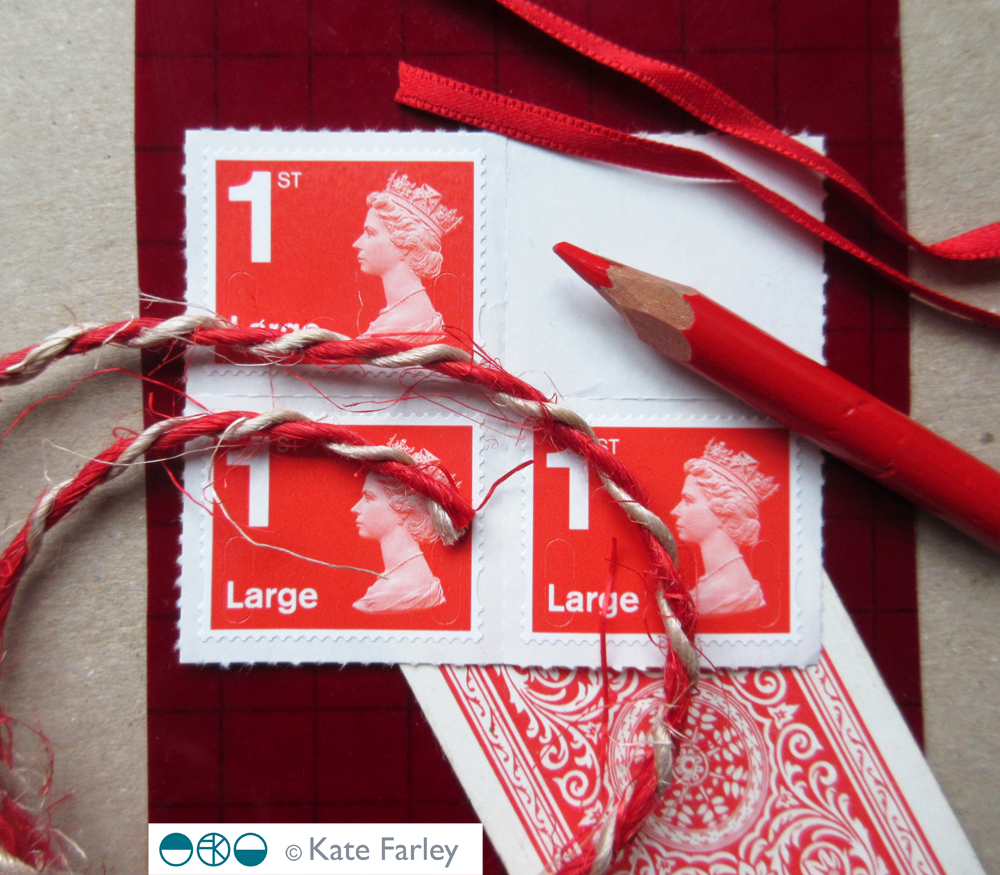
Here are some REDs… I love the border colours between red and orange.

katefarley_red_100


learning with archives

Recently I have been sharing joys from the fabulous archive of textile samples belonging to Birmingham City University’s library, some dating back from 1901. Myself and a colleague have been showing these treasures to our students, helping them to see their own learning as part of a history of design practices. In an age of the digital file it’s been fabulous to see how much interest these portfolios have generated with our students. It’s a tough call as we worry for the protection of these fragile items, and yet value being able to see and interact with them.

bcu_textiles1901_1

Being able to turn the pages, and reveal the hundreds of printed swatches is really an exciting journey and the students really engaged with the quality and preciousness of the items. The fact that all the samples are beautifully hand mounted and labelled adds to the beauty and experience. The range of design compositions is considerable, and the detail stunning. Tiny little flecks of print; an anchor, a petal of a flower, or coral texture printed on fine cloth demonstrate quality of the day. We noted the generosity of many designs, and discussed commercial appeal and production methods available before screen printing and digital printing possibilities. Of course this is pertinent at this time of financial cuts in the support to local and national libraries and associated archives, and with arts and culture being sold to the nation as a rather nice hobby we just can’t afford at the moment.

Seeing things with our own eyes helps to engage with the subject, making things real, and adding value to the experience. I spent an extremely insightful day at London College of Communication’s Learning Through Objects event #UALOBL last month discussing this subject with fellow academics, researchers and archivists. Yes it’s easier to deliver another ppt to a large group of students, but sessions with objects and physical activity are the ones that are likely to make far more impression, and make the difference to learning we are aiming for.

bcu_textiles1901_2