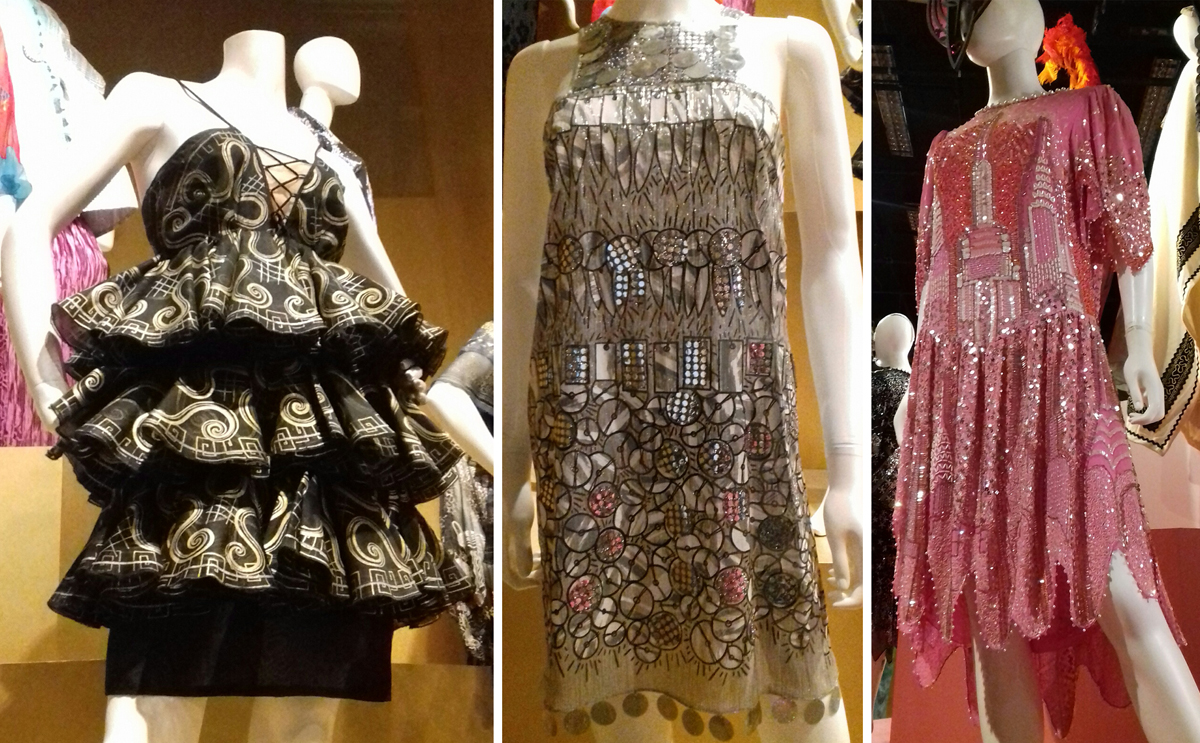
London Pattern Day: Paint! Pattern! Print!

Having visited the Women in Print, 150 years of Liberty textiles at the William Morris Gallery, I headed to Liberty to see the latest fabrics and bought myself a Merchant & Mills pattern and Liberty Tana Lawn printed fabric as a holiday project, which I can proudly share I have completed and am waiting for warmer weather to show it off!

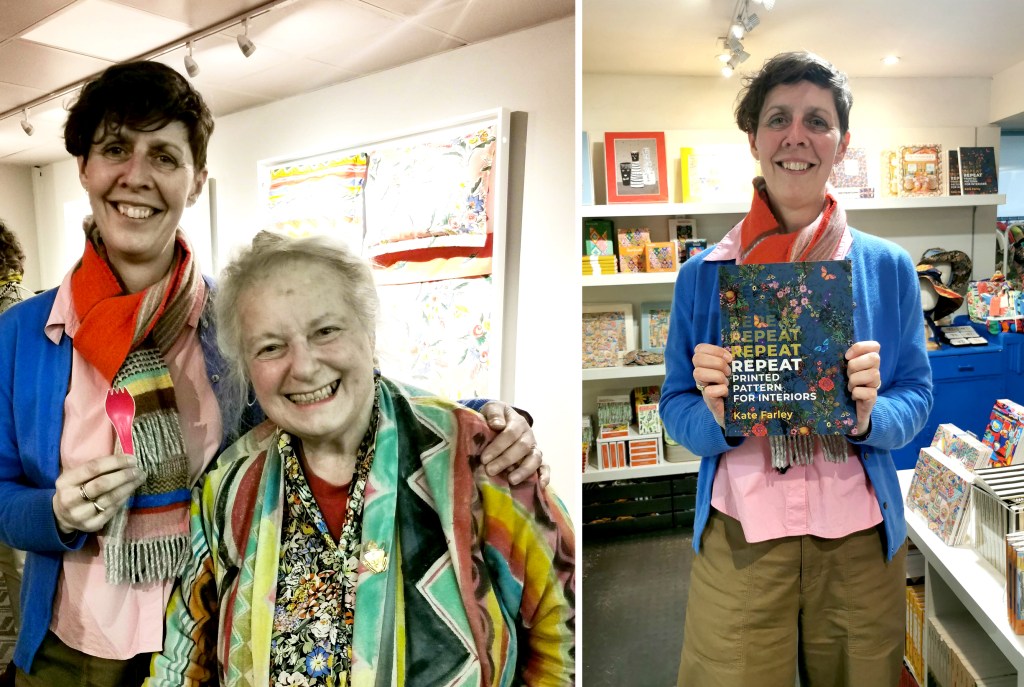
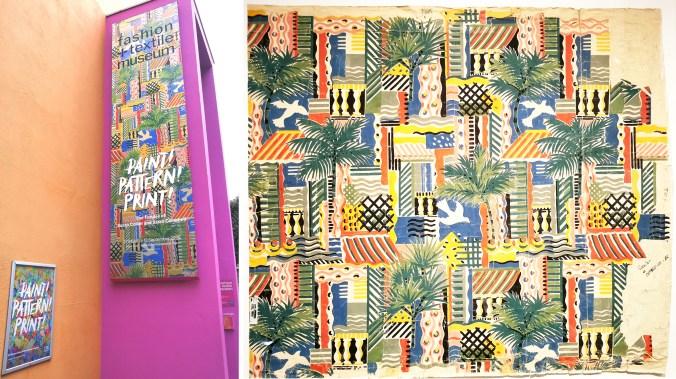
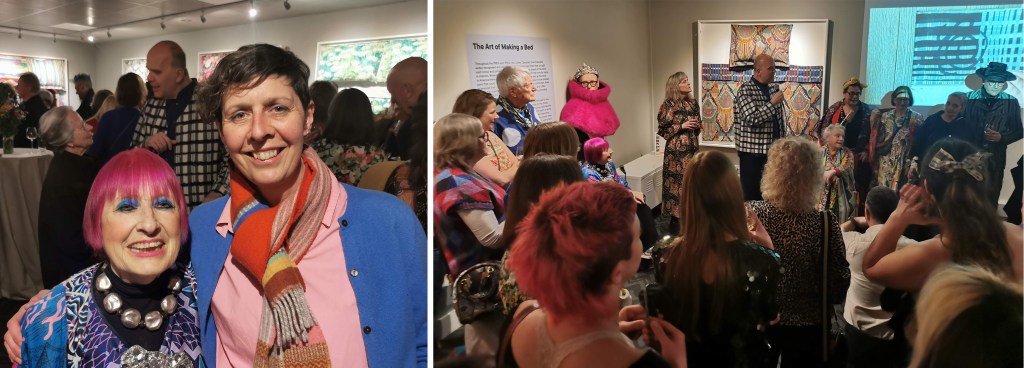
The primary reason for visiting London at the end of last month was to attend the Private View of the exhibition: Paint! Pattern! Print – The Textiles of Susan Collier and Sarah Campbell at the Fashion and Textile Museum, so I headed to Bermondsey, near London Bridge for the evening. Thanks Sarah for the invite! On arrival at the museum we were greeted by Sarah and much to my amusement she presented me with a pink takeaway fork from her pocket – for my fork collection!

I first met Sarah in London about ten years ago, having got in touch with her via Twitter when that was a nice place to be! Someone had the nerve to copy some of Sarah’s work, so I reached out to offer my sympathy and we decided to meet up the next time I was in London. As an academic I was in the capital for New Designers, the graduate showcase at the Business Design Centre, so we arranged to meet. We spent well over an hour putting the world of pattern in its place and we have stayed in touch ever since, with Sarah judging student awards for me, and joining me on an industry panel I was chairing at New Designers in 2023, having been kind enough to allow me to feature her work in my book, Repeat Printed Pattern for Interiors, published by Bloomsbury in 2023. I was delighted to see this book stocked at the Fashion and Textile Museum – thanks to the Liberty team for taking the picture of me and my book!

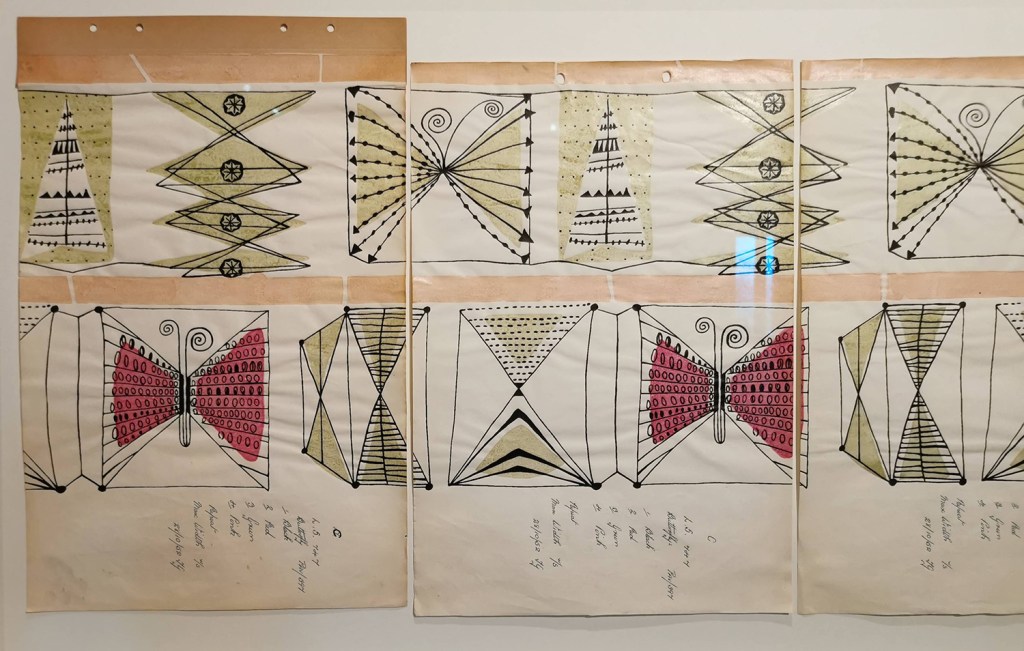
On entering the exhibition it was a complete feast for the eyes … with pattern and colour everywhere, appearing from around corners, up above and room after room. This was a true dive into the archives of Collier Campbell textiles over decades of working together, two sisters and a shared vision for joyous textiles. The exhibition included a wide range of items designed by Susan and Sarah, from the drawing and painting tools, to loose sketches and scaled painted designs on paper to lengths of printed fabrics, interior products and dresses. There were examples of Sarah’s more recent collaborations with Magpie and West Elm, alongside press cuttings featuring both Susan and Sarah at home and wielding paint brushes.

As a child growing up in the 1980s the look of home textiles, if not Laura Ashley, was likely to be Collier Campbell. With bolder and colourful brush marks suggesting the joy of Les Fauves artists, Matisse and Derain, rather than the Victorian Gothic tight sprigs Laura Ashley celebrated. I remember visiting the exhibition at London’s National Theatre in 2011, celebrating fifty years of sisters Susan and Sarah designing in 2011, shortly after Susan died. I recall loving the energy in the painting and bold use of colours.

In this current exhibition, as is the legacy of the archives, the patterns are rhythmic in their flow and scale; musical in spirit. Motifs are often geometrics, florals and birds, and famously designs such as Cote d’Azure, evoke summer scenes in Europe as the sisters worked to deadlines only imagining the holiday season. It was wonderful to see the paperwork for this piece, having included it in my book, Repeat … that features an interview with Sarah and images of key pieces by Collier Campbell.

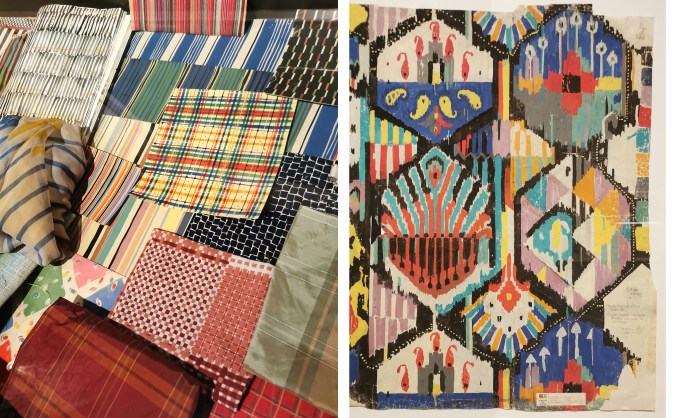
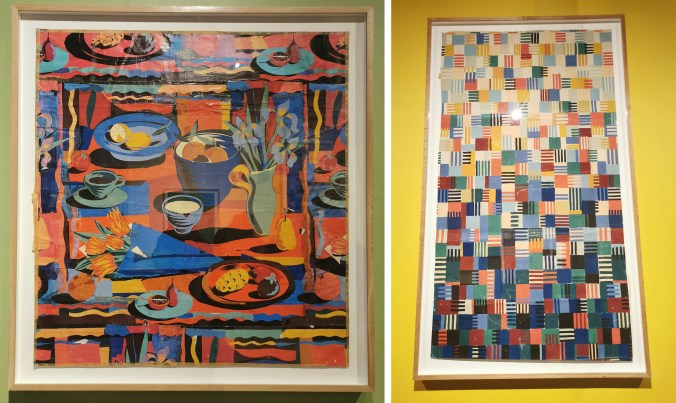
A design new to me that I really enjoyed seeing was Dancing Squares, from 1990 for American company UTICA (Stevens). This huge length of hand printed paper over two and a half metres long features painted squares evolving from dark to light up the design (right hand image below). The design on the left, again one I wasn’t familiar with, was a huge collage of a table of food and drink, in warm reds and oranges complemented by blue and turquoise.

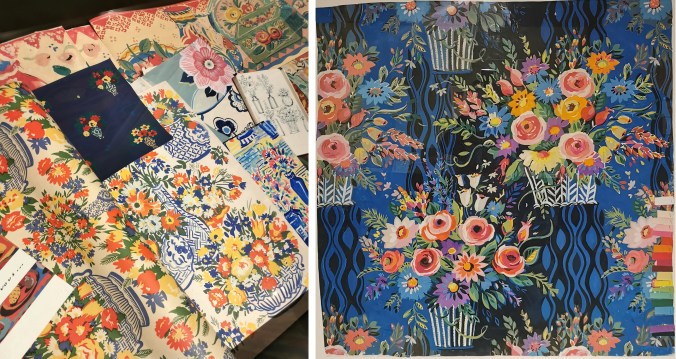
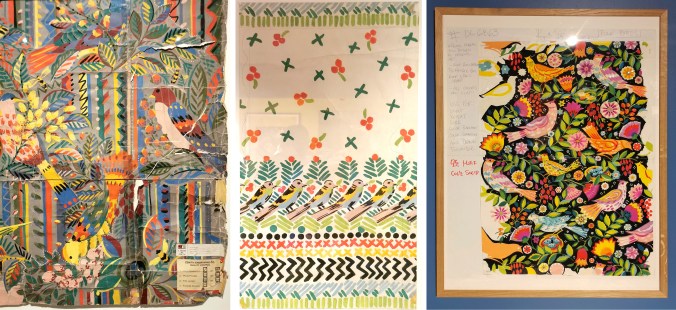
The florals and bird designs were full of life, with painted textures and pattern. It was also good to see the colour chips on the sides of some designs to guide the printers for production, as well as notes for the artworks and printers. The designs have depth as Susan and Sarah played with backgrounds and foregrounds as equal importance. Display cabinets showcased works on paper and coordinating designs alongside their hero prints as large statements on the wall and hanging as lengths.

Everyone was friendly. I chatted to several people during the evening as we shared our joy of the work on show and the speeches by the curator as well as Sarah celebrated the pure joy that pattern, colour and creativity can provide. I was excited to have the opportunity to talk to Zandra Rhodes, the founder of the museum, and who continues to inspire us all, including the students I teach at Norwich.

I have only shared some of the many photographs I took on the evening, but I strongly recommend the show to anyone who loves printed pattern. It is the perfect tonic for the times we are living in, and a beautiful reminder of the joy to be found in painted and printed pattern! Congratulations to Sarah and the curatorial team of Teresa Collenette and Dennis  Nothdruft at the Fashion and Textile Museum.

I sat on the train back to Norwich with my heart filled with excitement for the world of pattern I belong in, energised to support the next generation of designers I am working with at Norwich over the coming months. It was a day of celebrating Sarah and her sister Susan, having seen so many of their designs in the two exhibitions I visited – what a truly impressive legacy to be inspired by!

London pattern day: Liberty / Women in Print

I spent a busy day in London this week, with focus on print and pattern. It was fabulous! My first destination was the William Morris Gallery, Walthamstow in east London. I can thoroughly recommend the exhibition, Women in Print: 150 years of Liberty Textiles, on until Sunday 21st June 2026, in conjunction with Liberty Fabrics.

The exhibition spread across two floors of the gallery with a number of rooms and corridors showcasing some old favourites of printed textiles and related works on papers, alongside some lesser known pieces and associated garments.

The introductory video for the exhibition gave an insight to the role of women at Liberty with old photographs and recent interviews. I thoroughly enjoyed seeing old favourites throughout the exhibition, with works by Sonia Delaunay, Althea McNish, Jacqueline Groag and Susan Collier & Sarah Campbell as well as being introduced to names I wasn’t aware of, including Mrs Stoneley and Winifred Mold. I hadn’t realised Lucienne Day only designed one design (Fritillary) for Liberty, with it being agreed she would design for Heals while Robert Stewart would design for Liberty!

There was a second video upstairs, filmed in the 1970s that showcased the print and dye work with some rather random models in Liberty clothes wandering in and out of shot, by the print tables and dye vats in swimwear! When I discussed this with Sarah Campbell later that evening she joked it was her and Susan, the design duo behind Collier Campbell – exhibition now on in London’s Fashion and Textile Museum and featured in my next blog post!

The exhibition is free to attend, with donations to the gallery gratefully received.

Congratulations to curators, Rowan Bain and Róisín Inglesby.

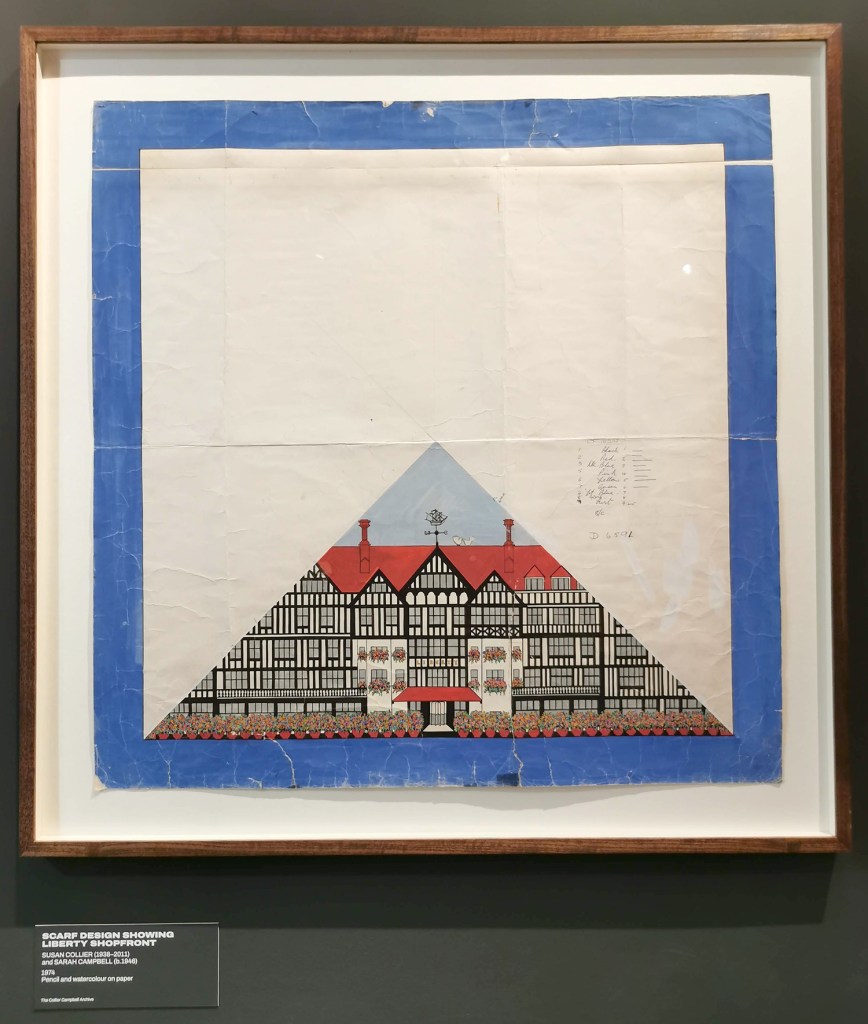
Susan Collier & Sarah Campbell, scarf design featuring the Liberty shopfront

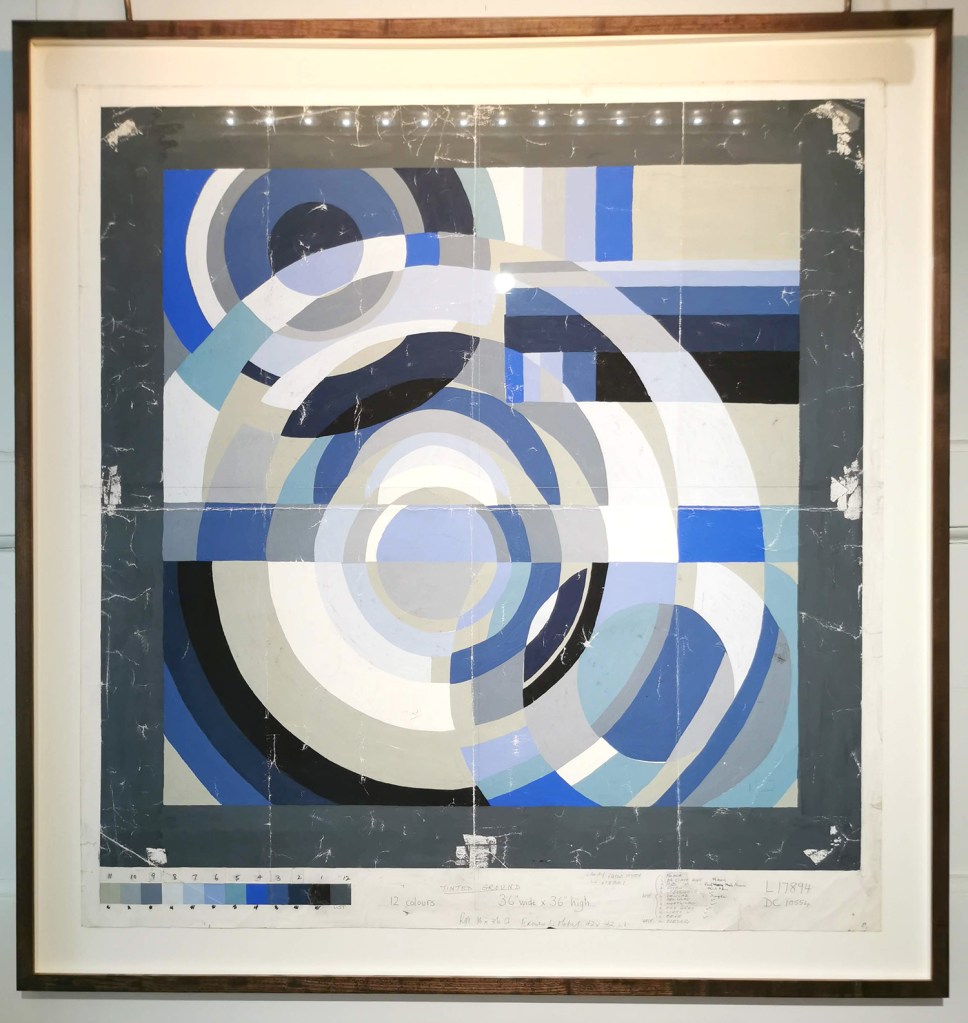
Sonia Delaunay scarf design

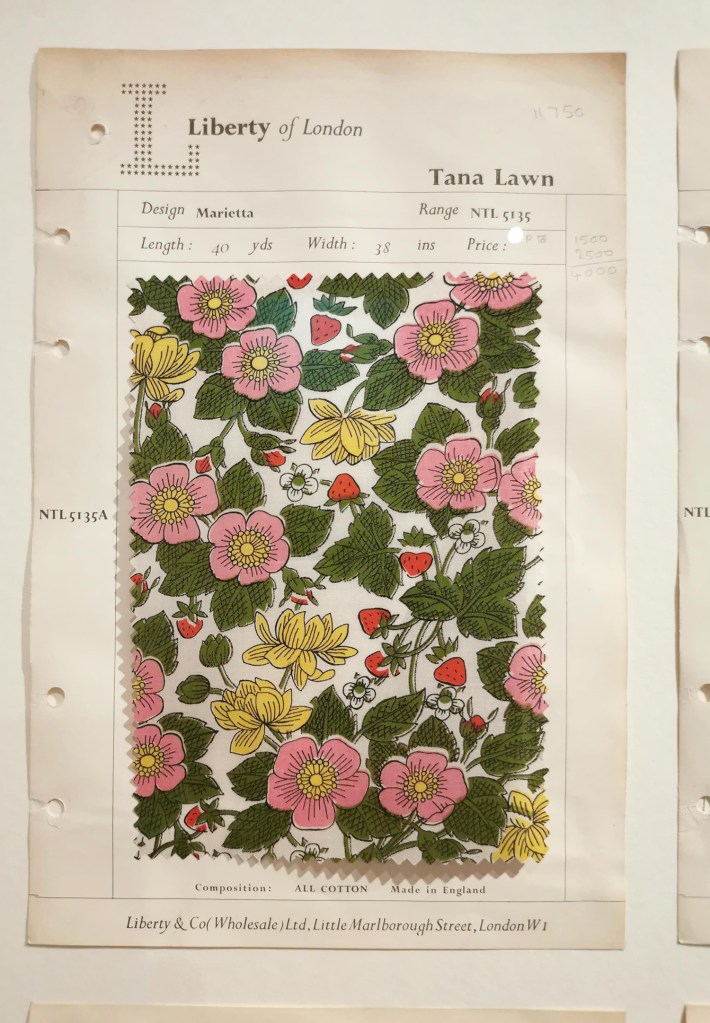
Liberty swatch

Lucienne Day’s ‘Fritillary’, her only design for Liberty

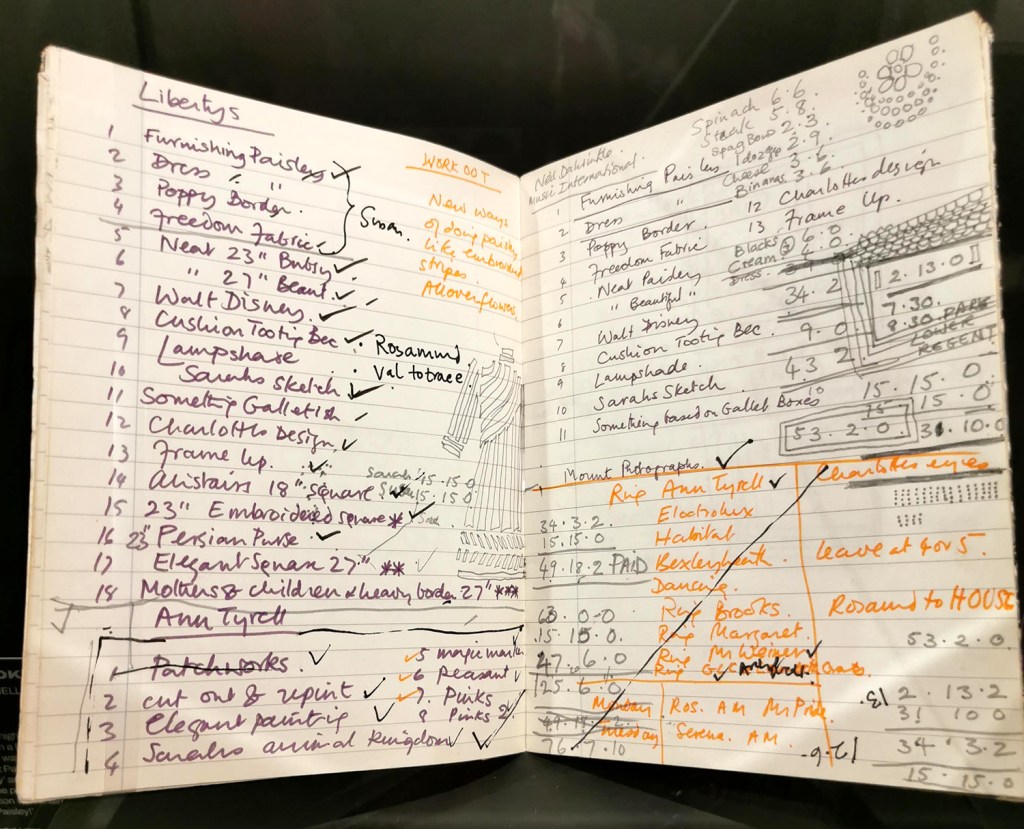
Sarah Campbell’s notebook, double-spread

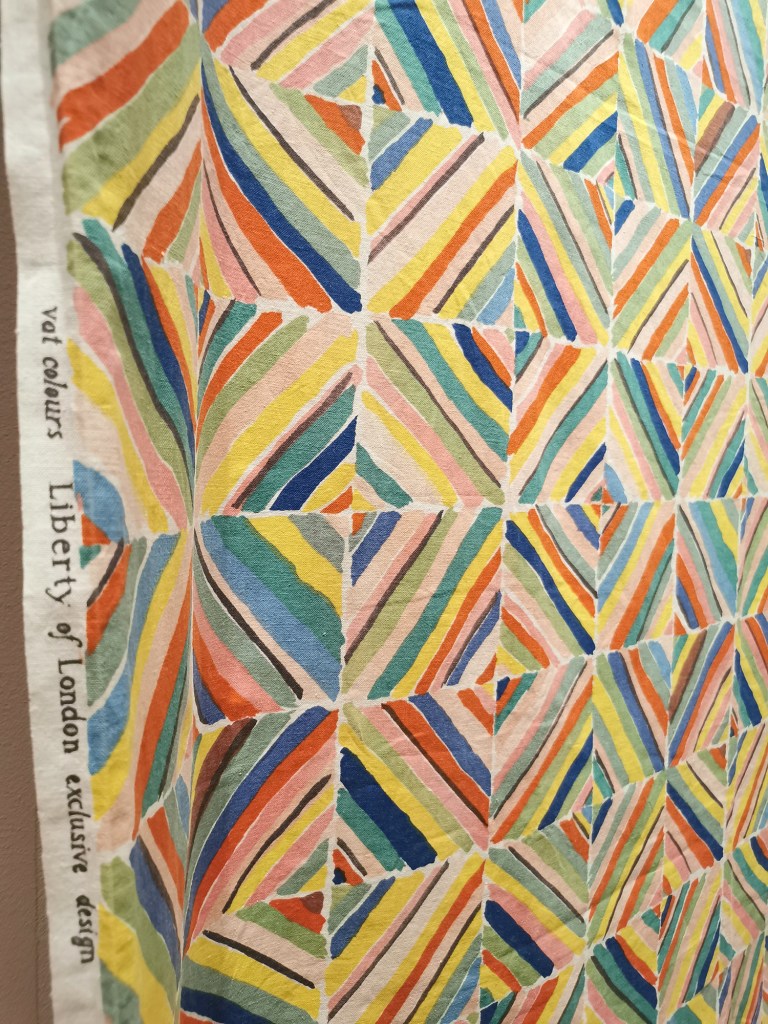
Collier Campbell ‘Kazak’ design

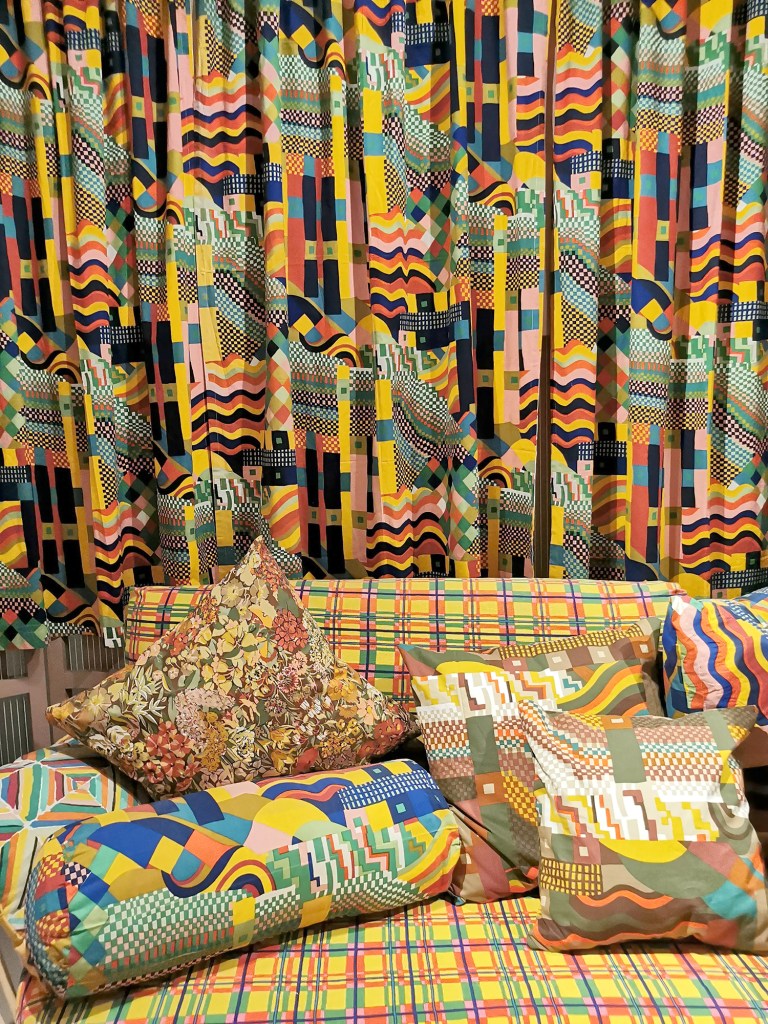
Collier Campbell for Liberty, featuring Bauhaus, inspired by Gunta Stolzl, the weave master at the Bauhaus, Germany

sharing my pattern research

I’ve been busy printing and presenting my ongoing pattern research over the last few months, testing the design and print process, and receiving useful feedback – which may explain the lack of blog posts recently!

Last September I presented my work at the Fashion and Textiles Courses Association conference, Futurescan 6, held at De Montfort University in Leicester, and had a small exhibition of the work in progress during the conference. It was great to formalise my ongoing work at that time, and receive external feedback from the audience. It was useful to consider how I communicate the research, as the principle is simple but the process complex. I have also discussed this research as part of other presentations over the last few months, for colleagues, for undergraduate students as well as the audience of the Costume and Textiles Association’s programme of Heritage Open Week talks at the Forum in Norwich.

Last week I presented this research to the British Association of Paper Historians as part of their Spring Meeting held at St. Bride Foundation, having been invited to do so by the Wallpaper History Society. My fellow presenters covered wide ranging topics, from paper conservation, Japanese paper as cloth, the College of Arms and the current situation of the paper industry in the global context. It was a fascinating day with lots of common ideas and interests, and I received some very positive feedback to keep me on track.

I have further opportunities to share my research in a couple of months, so more news on that in due course!

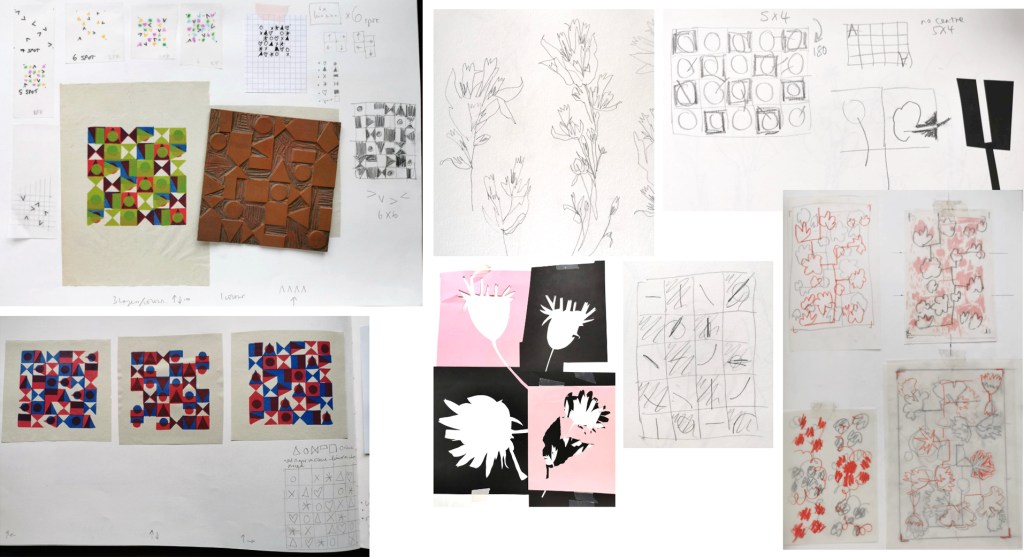
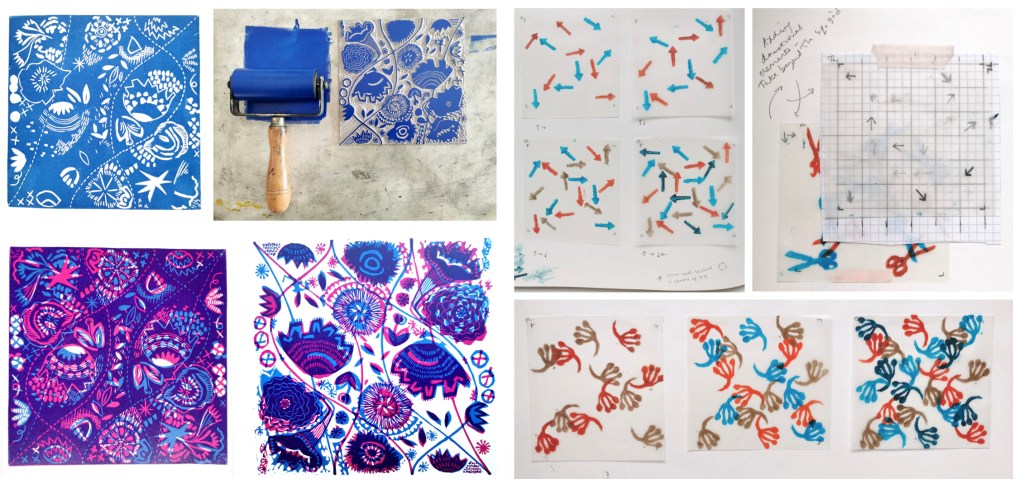
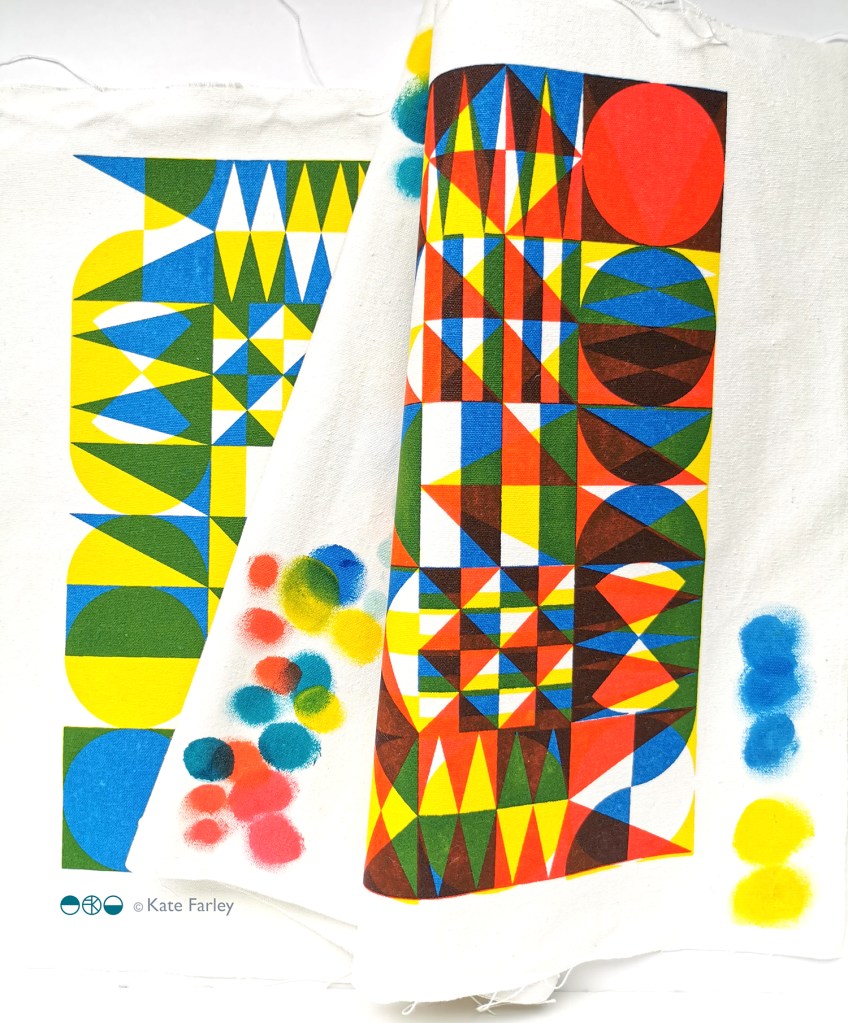
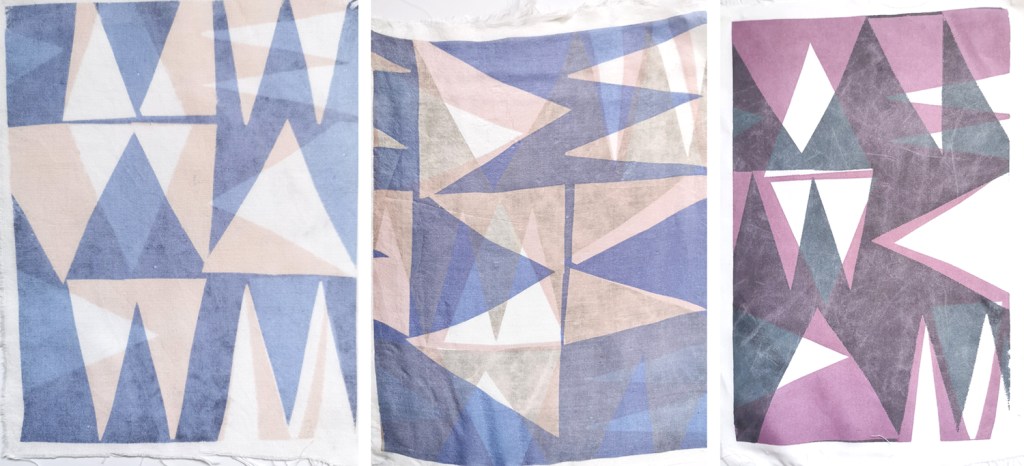
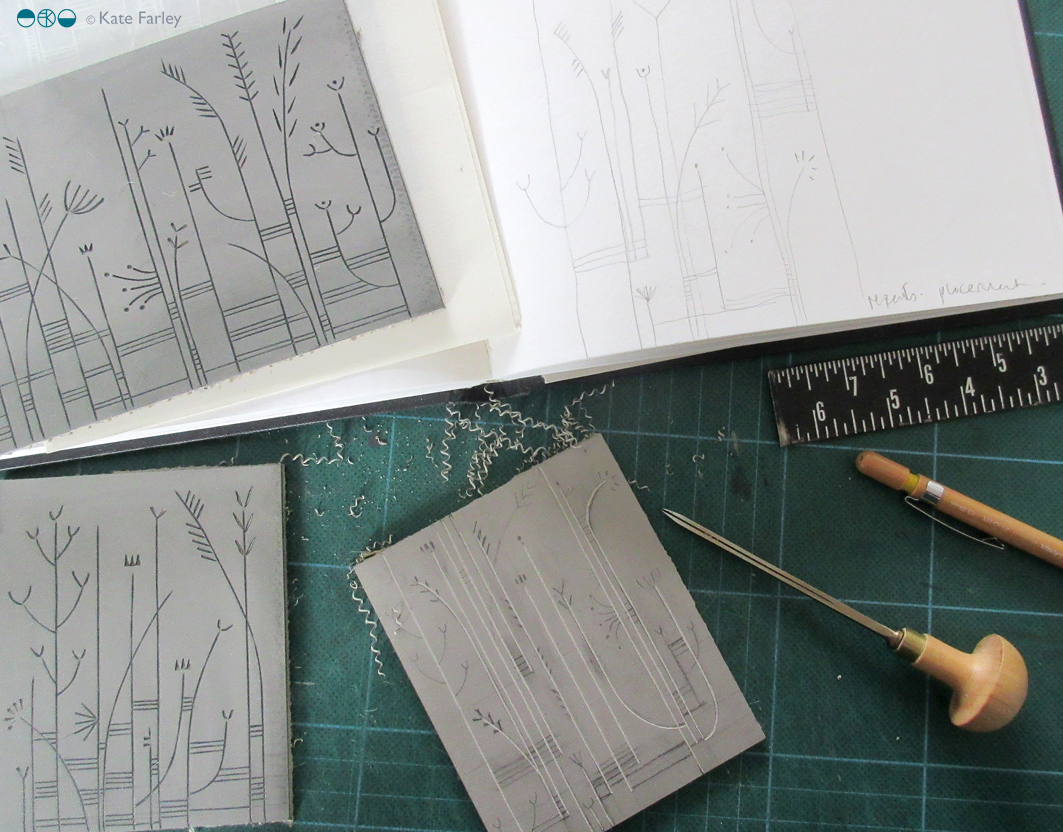
I am continuing to develop both lino blocks as well as artwork for screen printing, which enables me to test different colour handling and substrate options, for wallpaper and cloth. Colour is an important element of this research and particularly the transparency of colour in the overprinting, so the palettes will continue to evolve as I continue the exploration of primary and secondary colours.

As I gear up to making larger work for an upcoming showcase opportunity I look forward to sharing more of the work in progress.

sketchbook development
pattern development

print / pattern / cloth

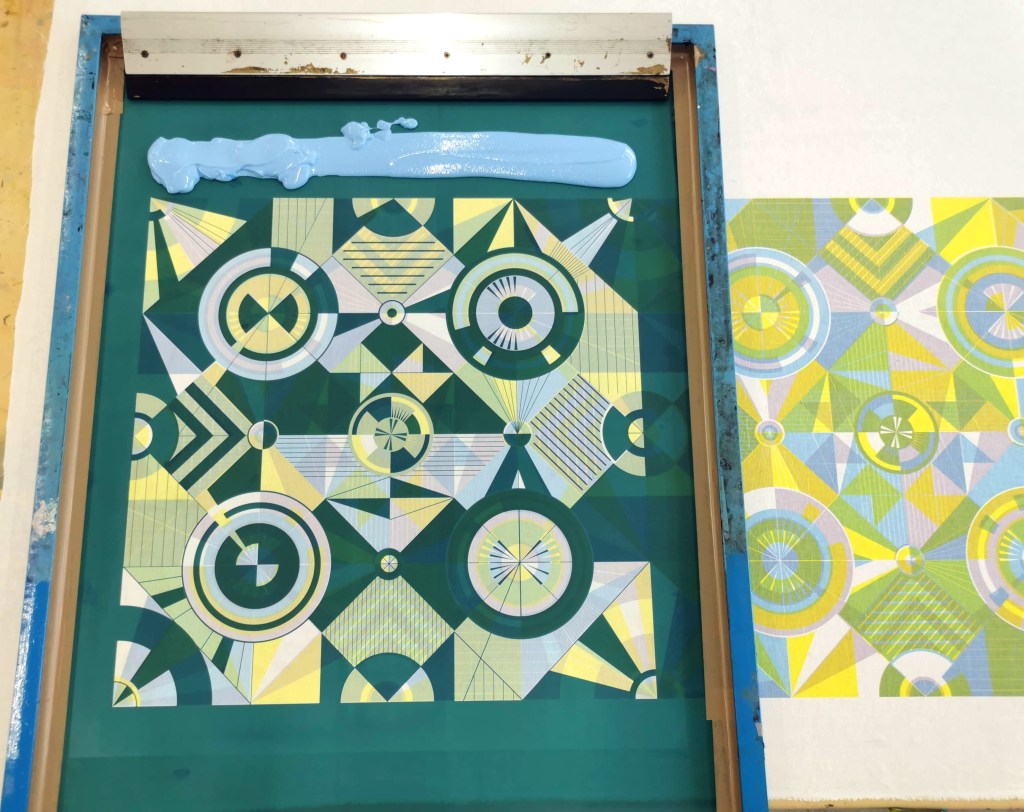
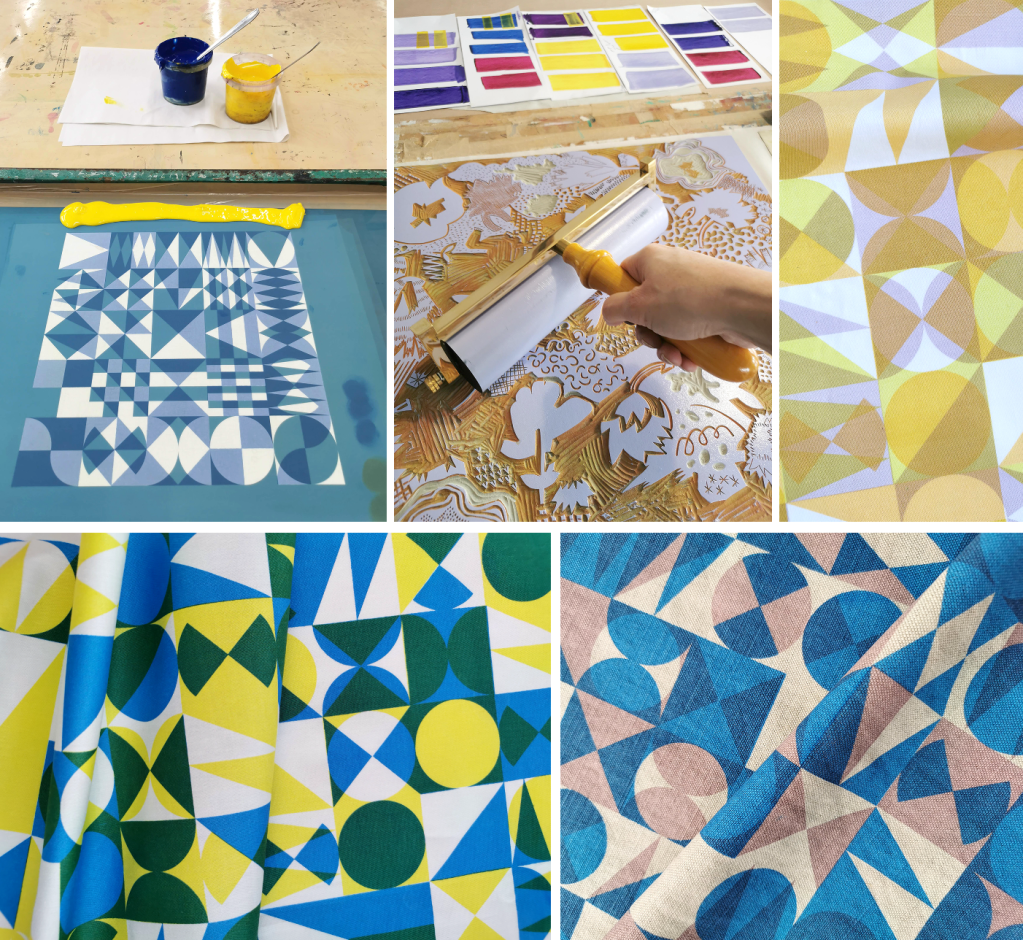
After a long academic term leading the Textile Degree at Norwich University of the Arts I finally found some time to get in to the workshop and sample some designs on fabrics. I developed the patterns rather a while ago. I love the process of screen printing, from mixing the colours, exposing the screens, pulling the squeegee and of course lifting the screen to see the new print. I even enjoy washing the screens ready for the next time!

I’m not going to share all the outcomes at this point, but here’s a taster of the colours and a glimpse of one of the designs. I was working with transparencies in the pigment and binder to create the extra colours… and I’m really excited about the results!

bacterial colour workshop

For a number of years I’ve been aware of the fascinating work of Colorifix, an award winning bacterial dye biotech start-up organisation based in Norwich leading the way for a more sustainable dye practice. Following some planning and support from our technical team I was able to host PhD researcher Ruth Lloyd in partnership with Colorifix to share with us their work and to lead a workshop for our BA3 students. Ruth is carrying out practice-based research “to develop and commercialise bacterial dyes, where she will further explore the capacity of colour producing microorganisms to create human designed patterns”.

We were treated to a insightful presentation by Ruth about the science and development of the colours, before we were able to have a go at printing with the bacterial dye colours. The students and staff tested painting the colour directly on to the fabric as well as painting on the screen then transferring the colour, as well as using paper stencils with the open screens.

The range of colours is limited at the moment, so this is something being worked on by Ruth and the team at Colorifix. The different fibre content of the fabrics printed on can significantly impact on how the colour appears so we were testing natural and synthetic fabrics to build our technical files and our own understanding of colour and textiles. Thanks Ruth and Colorifix!

international pattern collaboration

It all began in an email with the subject line, ‘Hello from Tokyo’ I received in November 2017, letting me know how much my tea towels for David Mellor were admired in a Japanese design company. The email went on to ask if we could discuss a potential collaboration for a capsule fashion collection featuring a print designed by me. Firstly I was excited to think my patterns had made their way to Japan, but secondly, that sounded a great idea, tell me more! A few email exchanges later, and we agreed to meet the next time the company director of Stamps Inc. was in London so I could show him my portfolio to discuss the idea for the new pattern they would like to commission for their fashion collection.

The meeting with Shu and his colleague Yoko in a central London hotel was exciting; I showed my work and it was met with positive discussion. I was also reintroduced to the tea towels that had made it to Japan all the way from my studio, via a David Mellor Design shop! We sat at a large table and I showed them my portfolio, spreading the many sheets out covering the whole surface. Having shown all the other work and following some discussion in Japanese between colleagues, the director chose the very first page he had seen – the cover page! The choice was not what I was expecting but we shared and developed ideas for me to sample: colours, time-lines and garments. We then took some photographs to record the start of the project together, for when we would be able to share our story – and even asked the hotel doorman to take a pictures of the three of us with a London bus behind us.

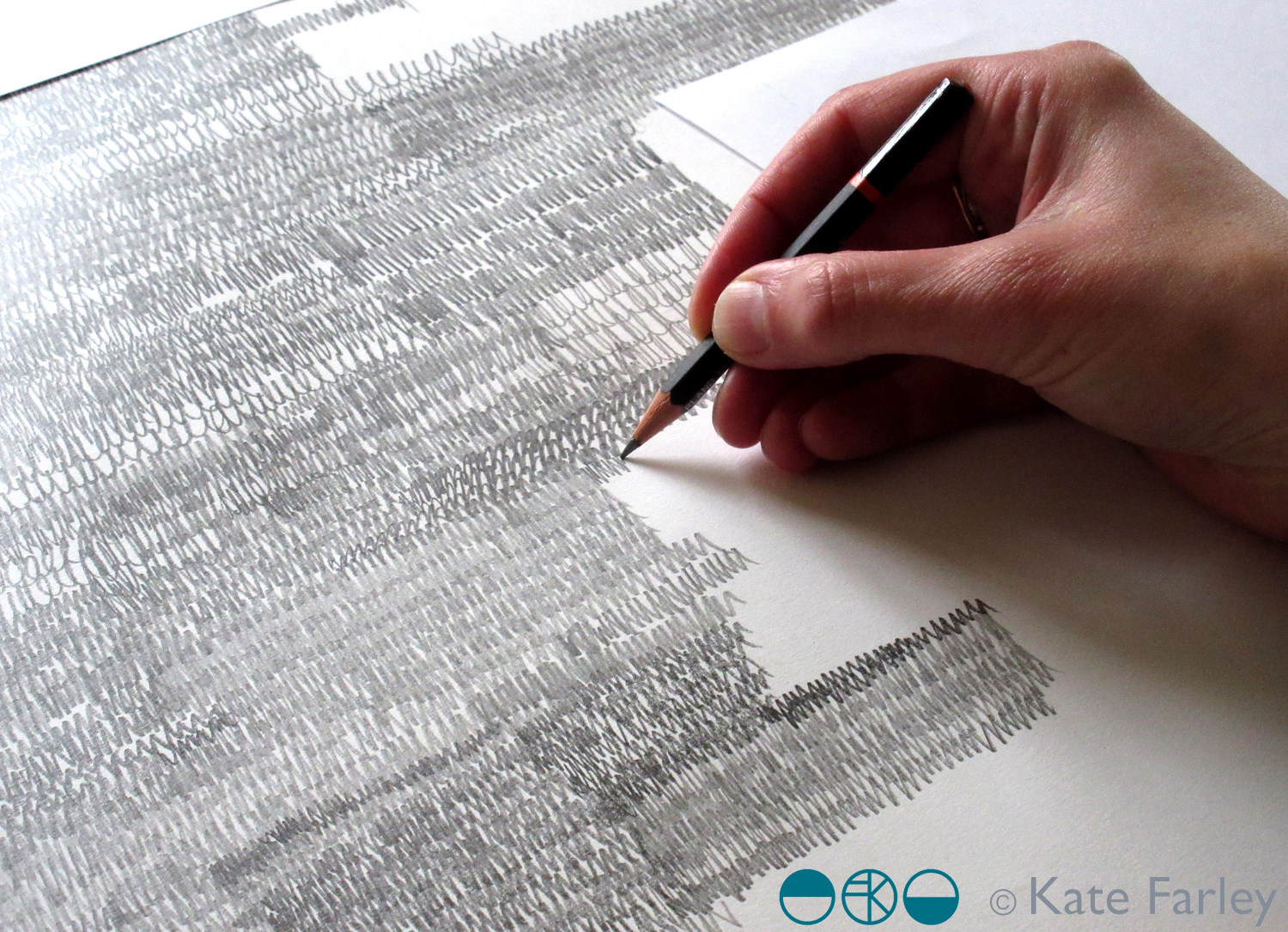
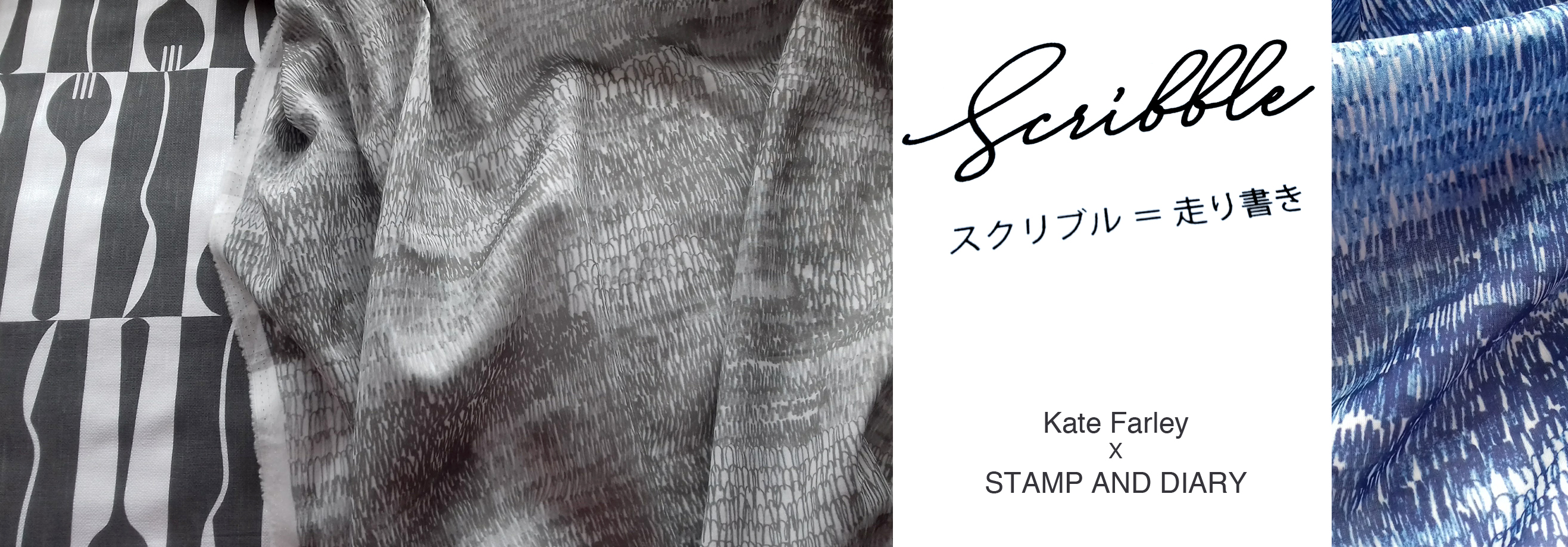
The selected design was a graphite pattern of pencil scribbles of varying tones and rhythms, later to become the title of the collection: Scribble. There are lots of variables such as scale, rhythm, tone and  overall order in the pattern we had to make decisions before I set about creating the final artwork. I emailed across some small sketches to explain the repeat process for production to check we were understanding each other as we had to ensure we understood the terminology that each of us used in our different languages.

KateFarley_SCRIBBLEwip_1_1500

I shared several images of new drawings to provide the variations / considerations over email before committing to the final design. The final fabrics were to be screen printed so I planned to draw out the whole design in full repeat by hand (approximately 60 x 90cm), scan it in and transfer it to Japan for screen print production. I started the large final drawing twice as I wasn’t happy with the first one. Initially the marks I drew appeared tense, but I also had to work out how to create the different qualities with the pencils across a vast piece of paper, and how not to smudge the areas I had drawn. I drew the design at 80% scale to make scanning it in possible, meaning I had to take in to account the slight increase in the size of the marks in the final result. I also had to ensure the top of the design matched the bottom, as the edges were to act as a cut-through for the screen printing process of repeating the pattern, fitting like a jigsaw, top to bottom. The design was edge to edge, left to right, fitting the width of the fabric so there was no horizontal pattern-repeat.

KFARLEY_SCRIBBLEwip_1500crop

The final artwork took almost ten hours to draw, and I did that mainly over two long evenings. I had it scanned in at a very high resolution, adapted the size of artwork to 100% and sent the digital file to Japan – with my fingers crossed that the printer could work their magic, including colour separating the graphite tones for the two screens each colourway would require!

There was a wholesale launch in Tokyo so I sent some of my original drawing samples over to feature as framed artwork in the exhibition and I was sent photographs of the lengths of fabric on show. Very exciting! Orders were placed and there was a good response. A further email request came from Japan, to meet again in London to see the fabric. Another exciting moment – also scary – what if I didn’t like the results!? In the stylish interior of the St Pancras Renaissance Hotel lounge there was no need to worry. Great care had been taken to translate my drawing to screen printed cotton lawn fabric, in two colours – referencing the two colours of my David Mellor patterns Chelsea, in grey, and Pride in blue. The fabric felt beautiful and the printing fabulous. It was a special meeting.

I was able to see the marketing material including my name alongside Japanese text I couldn’t decipher, describing our meeting and the collaboration. I have had to be patient while the wholesale launch orders were being produced before we can promote the project I’ve had to keep under wraps for well over a year … until now!

It has been an absolute pleasure working with Shu and Yoko, learning about the company and their pride in who they work with including the products they develop. It has been a highly successful collaboration from my perspective in that we have discussed all the aspects of the process and trusted each other to do the best for it, each learning about the other and having good communication throughout. We have shared news of the differing seasons and national events over the course of the project, and they’ve watched via instagram as I’ve moved homes and jobs. I’ve loved having this connection with people in another corner of our world, created as a result of some tea towels I designed over five years ago!

mellor_scribble_1500_banner

Save

pattern informs the piece: Zandra Rhodes exhibition review

Finding a couple of hours to spare in London last month I took the decision to head across the river to the Fashion and Textile Museum, and specifically, the Zandra Rhodes: 50 years of Fabulous exhibition. It proved to be a perfect visit for where my head was at; juggling fashion and textile design in both a design commission and my academic life.

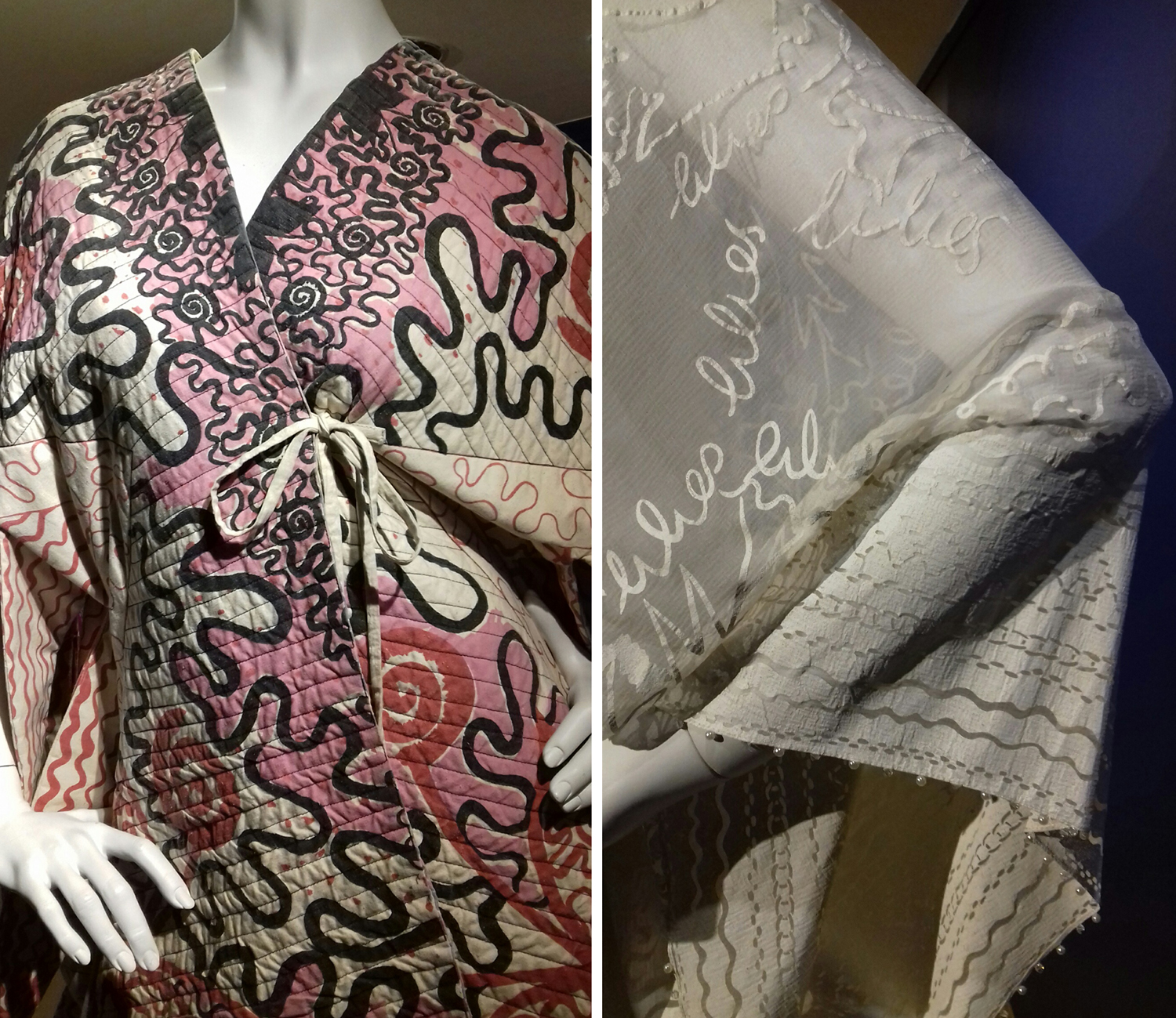
Zandra Rhodes is first and foremost a textile designer although it is her fashion designs that carry the printed and embroidered pattern she is famous for. The silhouettes of the garments, constructed often from multi layered draping fabrics are guided in their execution, in fact dictated by, the pattern design of Zandra’s strong handwriting or pattern, and executed using print processes and surface manipulation.

I’ve included plenty of images of these outfits in university design lectures over the years, discussing how the designer maintains the focused design style and aesthetic but also manages to evolve the work through the decades.

As ever it is very different when you get the chance to see the fabrics in real life. The white printed pigment on chiffon from the ‘Lovely Lilies’ collection (below right) and the quilting over screen printing of her signature swirling motifs as borders and placement prints provides the evidence that Zandra Rhodes is first and foremost exploring fabrics to lead garment design.

ZH_highlights

The variety of fabric manipulation and surface embellishments was fascinating to see, some rather crude and some pieces held their own more than others. The ease in which the textiles worked as one with the garment design is certainly demonstrated throughout the exhibition, and it was useful to see the screens for printing to see the composition of the designs later on in the exhibition.

ZR_patterns

The theatricality of Zandra Rhodes’ work was a perfect match for opera costumes, and upstairs in the gallery a number of interesting examples were showcased. I also enjoyed seeing original sketchbooks alongside a film of the designer talking about how important drawing is to her. I hope many textile design students visit the show and take her advice.

ZR_dresses

There is a significant body of work on exhibition here and it is important to view it as a considerable output of a single designer with a thirst for carnival. Her practice spans fifty years, hence the exhibition title and although her style is not for everyone, her contribution of bravery, exuberance and fabric play should inspire others to take creative risks and find a way to make the work they want to make.

I would also recommend the small showcase of company overview and embroidery work by Norman Hartnell as you enter the gallery – stunning pieces from a different era.

The show is on until the 26th January, 2020.

women designers, lost and found

Sometimes themes seem to rattle around in my head, connecting with other dialogues I have had. Last week I attended a really interesting Study Day at the House of Illustration as part of the Women in Print series organised by Desdemona McCannon on the theme of Enid Marx and contemporaries. The subject of women’s careers, and specifically their profile compared with their male counterpoints was discussed – not a new idea, but as a recurring theme I thought it worth revisiting here. In the same week Stylist magazine featured an article about the price of artwork made by women compared to men. It was such a coincidence I’ll expand some thoughts here.

It’s not a secret that women often have a harder time gaining recognition in many lines of work in comparison to their male peers. I wrote in a previous blog post about Eric Ravilious and friends at Compton Verney that it certainly wasn’t lack of skill that kept the women such as Helen Binyon from comparable public attention, and therefore further opportunities through their careers. There are highly talented women in history who we are only just giving air-time to, but the fact is their careers may not have excelled in the way their male counterparts did, or if they did they may well have been paid less for the work because they were women.

Enid Marx chose not to take issue with gender-bias in her career, and got on with a multi-disciplined design portfolio, with impressive outputs including books, textiles and patterns which were beautifully communicated through the exhibition at the House of Illustration (sorry it’s just ended!) – but you can visit Compton Verney instead. We got to see the exhibition as well as listen to knowledgeable speakers such as Enid Marx expert Lottie Crawford giving a really insightful illustrated paper about the legacy that Enid Marx and her peers have created for us today, as well as Jane Audas taking us through a fascinating journey of clients and sales put in to a broader context of who’s who.

I have heard people wonder why we need to make a point about this being a gender issue, but I would say that this has been said from a male perspective, and not from those being subjected now and in the future to selective opportunities due to gender. As a woman designer, and female academic training mostly women to have design careers where there is a history of undervaluing female contribution, I remain concerned.

EnidMarx_patterns

It is sometimes the case that research can be discovered more easily about men because they were promoted more and as a result have a higher profile, whether through greater self-confidence, the social / commercial networks or marketing material, from family or company archives, past exhibitions or publications. During the study day in London the point was made that there was also a sense that women got on with the designing, often alongside raising a family or carrying out other domestic tasks. Did they lack the opportunity to promote themselves, didn’t see the need, or couldn’t find the time? Working in isolation at home can certainly challenge one’s self-belief compared to working in an office with colleagues who can praise you and your work as and when required. This reminds me of the freelance work of Sheila Bownas, almost accidentally discovered and collected by Chelsea Cefai, and brought to a new appreciative public in the last few years. The family knew little of the extent of her prolific output of designs as a textile designer until Chelsea pieced the jigsaw together, and thank goodness we know of her now!

There is another consideration here. Does the discipline these women are working in make a difference to their profile? Enid Marx worked across illustration and textiles, but her illustrations are better known. Is this because as an illustrator your name is usually on the cover of the book, even if it is on the inside, or on the poster? For freelance textile designers it can be quite different. The name of the company is usually printed as legend details on the selvedge, but historically not always the name of the designer. If this is the case we may never trace the designer. This remains the case today in industry when big name brands buy in freelance patterns and the designer’s name is not carried through.

The article in Stylist compares Mark Rothko and his fine art paintings to Anni Albers’ textile practice; the subject of a show coming to Tate this Autumn. When the Bauhaus opened its doors in Germany in the Twentieth century the founder, Walter Gropius, stated anyone could study any discipline, and yet the women were rather heavily steered towards the weaving workshop, considered suitable for women. That was where Anni Albers learned her skill, fell in love with the teacher Josef Albers, took his name on marriage and continued to live in his shadow; he led a fine art practice of painting while she made textiles. I can’t wait to see the Anni Albers show – and for Anni to have the publicity men with lesser creative careers have had before.
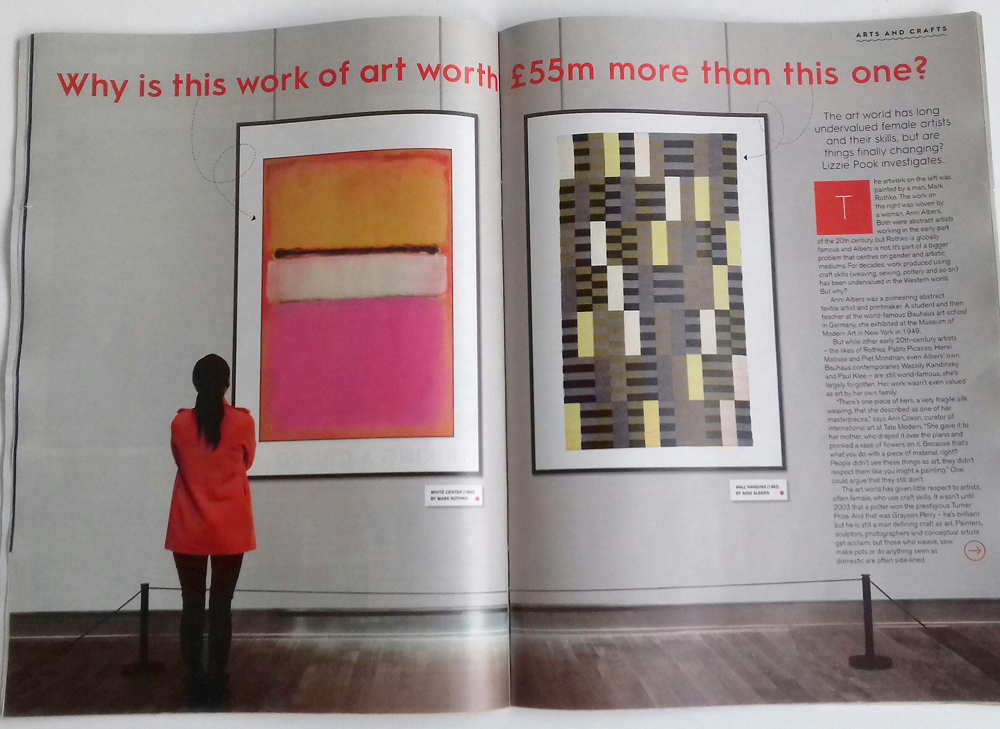
stylist_magazine_Sept18

Craft, seen as a second-rate subject to Fine Art is part of the discussion throughout the article in Stylist, and it also makes the point that textiles is seen as a domestic activity, thanks to the increased leisure time during Victorian era. Grayson Perry has made significant strides in opening up the conversation about value of craft, but far more needs to be done to change opinions. As an academic one of my biggest concerns is the lack of respect textile design currently receives as a subject in the education curriculum and agenda. It’s becoming one of my catch phrases but I really mean it – we all wear pants! How can textiles be seen predominantly as a past-time, a hobby – when we all wear textiles, sleep under textiles and protect ourselves with textiles? How dare this government puts at risk the supply chain of future textile designers because it doesn’t see it as important enough to be a GCSE? Fashion is nothing without textiles, and this industry is one of the big ones on the global stage – don’t get me started on that!

Refocusing back on the study day, we also discussed the nature of research carried out by women, and that the particular approach / nature of research writing holds a female voice that may not be considered intellectual enough; often relating to social networks, domestic arrangements and family life. Several female audience members agreed that they doubted their own confidence when finding their research voice alongside the traditional academic tone / content they believed was expected by their male counterparts. Are women undermining themselves and lacking confidence in their own abilities?

I don’t have the answers but this is not a conversation that should stop. More dialogues involving men and women about historical and contemporary design practice, craft and textiles are needed. There is not one way, this is not binary, but we need to make sure the different voices, approaches, strategies and practices in the creative subjects and beyond are given a platform. The diverse ways of being whatever it is we are should be valued, and represented by a diverse community. Wouldn’t it be lovely if talent and opportunity were really the key ingredients for building profiles, gaining opportunities, and writing about it!

Save

Save
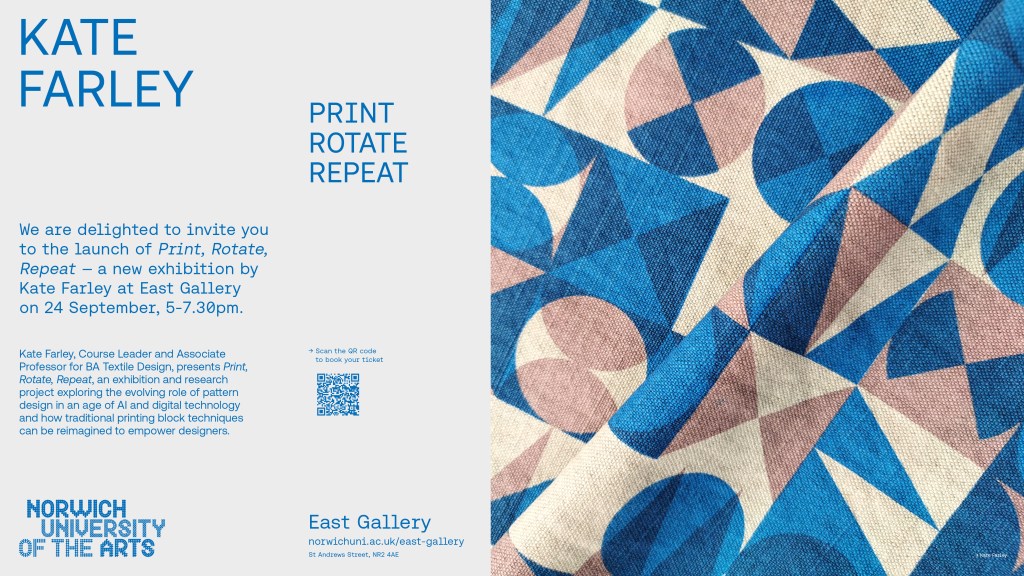
talking to myself through teaching

I’ve spent many hours over the last couple of years reflecting on my teaching career that stands at about 18 years, give or take a bit. In order to apply for Senior Fellow of the Higher Education Academy I had to write thousands of words that explain and reflect on the impact I have made on not only the students I have taught but the colleagues and peers across the industry I relate to in my professional practice. It has been a big ask to fit my diverse experiences in to the word count along with the cross referencing required, but I’m delighted to say my hard work over the ‘holidays’ and the work of my colleagues in writing supporting references has meant I achieved Senior Fellow and I’m rather relieved / proud. (I was however disappointed to discover that rather than receiving a fine water-marked, embossed and foil blocked certificate I had to download it! … I digress.)

I’ve written many times about how important it is for me to combine my design practice with my academic career and although it doesn’t make my life easier, it certainly makes it more fulfilling. They really are mutually supportive. The reason I am so driven to support the students in reaching their goals is because I know how rewarding a career in design can be. From having the confidence to draw in a different way, to picking up the phone to a new client, to realising your dream of seeing designs commercially available…, to be paid to do what you love doing… why would I not want to help others to do those things?

roller_fabric_blog

It’s also important to hear myself saying these things to students. It’s as if I am telling myself as well as the students! Yes I must chase that lead, make sure I’m paid a fair rate or keep my website up to date! Each creative has different ideas about how and where to move forward with their ambitions and the art of teaching is to work out how to nurture, support, push and challenge positively. Being creative is not easy. You put your sensitivities on the line to be judged, sometimes by those with less creativity than yourself, but who holds the budget. There are certainly pages in my sketchbook I wouldn’t choose to share at a group tutorial, but the process of knowing you are not alone in learning the creative process is so valuable. It’s also the case that it’s often easier to critique someone else other than yourself! Would you listen? Maybe one mis-perception is that once you graduate you stop learning – I plan to keep learning forever! Each project I work on is an excuse to learn more, not only about myself as a creative, but new practical or technical skills to take on board for me, as well as sharing with colleagues and students.

I’m very aware the reality behind social media may be far different than the stories being told online. I make sure students are made to think about that, – use the benefits of social media while considering the stories they read and the stories they create. While I like the way we can find out so much more about what’s going on, and who we need to know (can you imagine only having the yellow pages?!) there are complications with so many aspects of our practice being shared. Copying, audience expectation, peer competition versus mutual support, networking and peer validation are ups and downs of today’s design world. I approach my teaching very much like my designing. Honesty, integrity, and fulfillment…. support, encouragement and creative ambition! Even writing this is like giving myself a tutorial! What’s my homework?

KateFarley_grasslines_WIP_blog


Modernist patterns in the making

Over the last few months, actually for most of this year, I’ve been working on a commission with the Barbican Centre London to create bespoke patterns for products in their newly developed retail space, ready to launch in the Autumn. It’s been a fabulous project as I’ve developed the designs with plenty of dialogue with Head of Retail, Adam Thow, to-ing & fro-ing by email. The brief has altered only slightly since the beginning and I feel really proud of what we’ve produced. There’s a more detailed interview about the project over on their blog.

The idea was to explore the Barbican Centre, famous for its architecture, but to also include its activities as a cultural centre of music and performance. I explored lots of ideas and pattern compositions but settled on the idea of a sheet of music, and ended bottom right with the bold double bar lines. Within the patterns I referred to musical notation, and made links between the architectural features and those of instruments, including a violin and oboe, to create a sense of narrative, playing with strong negative and positive shapes. Each of the motifs were hand cut in paper, scanned in, and combined using Adobe Photoshop.

KF_Barbican_print_paperBLOG

Last week we shared the first images of the design work so I thought I’d share here too. The images here show my developmental design work above, and the final limited edition screen print and pattern for products. Visit @barbicancentre on instagram for more final product shots.

KateFarley_BarbicanPRINTPATTERN1200


Save