London Pattern Day: Paint! Pattern! Print!

Having visited the Women in Print, 150 years of Liberty textiles at the William Morris Gallery, I headed to Liberty to see the latest fabrics and bought myself a Merchant & Mills pattern and Liberty Tana Lawn printed fabric as a holiday project, which I can proudly share I have completed and am waiting for warmer weather to show it off!

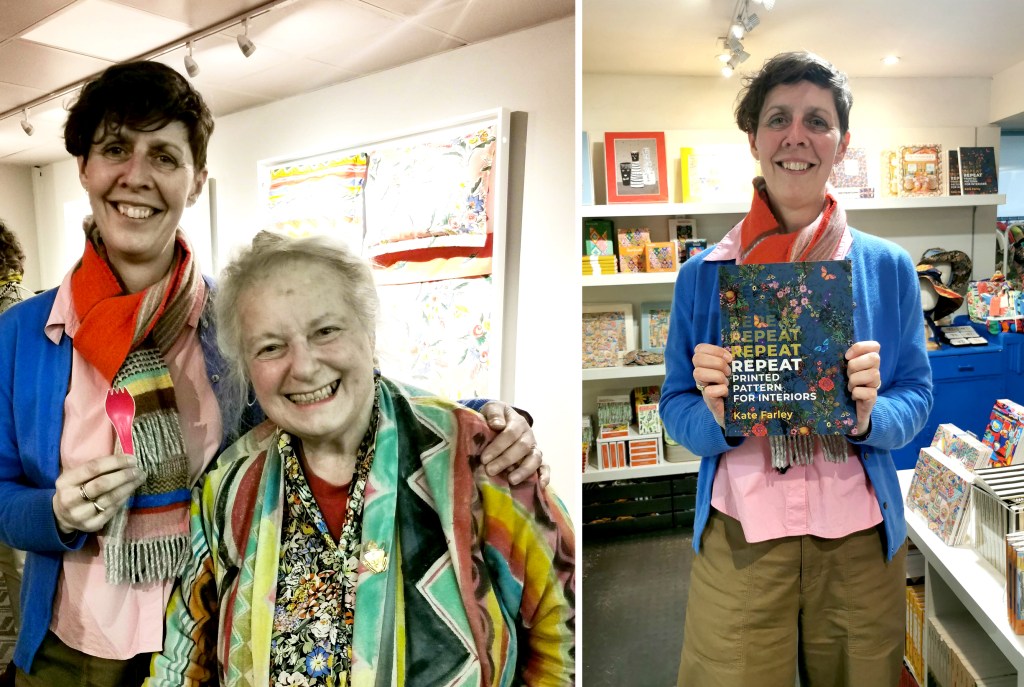
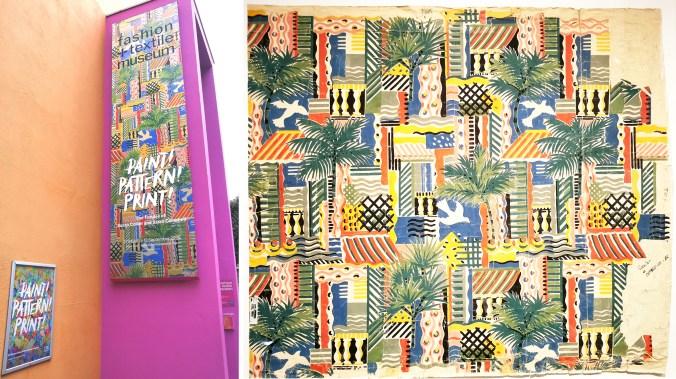
The primary reason for visiting London at the end of last month was to attend the Private View of the exhibition: Paint! Pattern! Print – The Textiles of Susan Collier and Sarah Campbell at the Fashion and Textile Museum, so I headed to Bermondsey, near London Bridge for the evening. Thanks Sarah for the invite! On arrival at the museum we were greeted by Sarah and much to my amusement she presented me with a pink takeaway fork from her pocket – for my fork collection!

I first met Sarah in London about ten years ago, having got in touch with her via Twitter when that was a nice place to be! Someone had the nerve to copy some of Sarah’s work, so I reached out to offer my sympathy and we decided to meet up the next time I was in London. As an academic I was in the capital for New Designers, the graduate showcase at the Business Design Centre, so we arranged to meet. We spent well over an hour putting the world of pattern in its place and we have stayed in touch ever since, with Sarah judging student awards for me, and joining me on an industry panel I was chairing at New Designers in 2023, having been kind enough to allow me to feature her work in my book, Repeat Printed Pattern for Interiors, published by Bloomsbury in 2023. I was delighted to see this book stocked at the Fashion and Textile Museum – thanks to the Liberty team for taking the picture of me and my book!
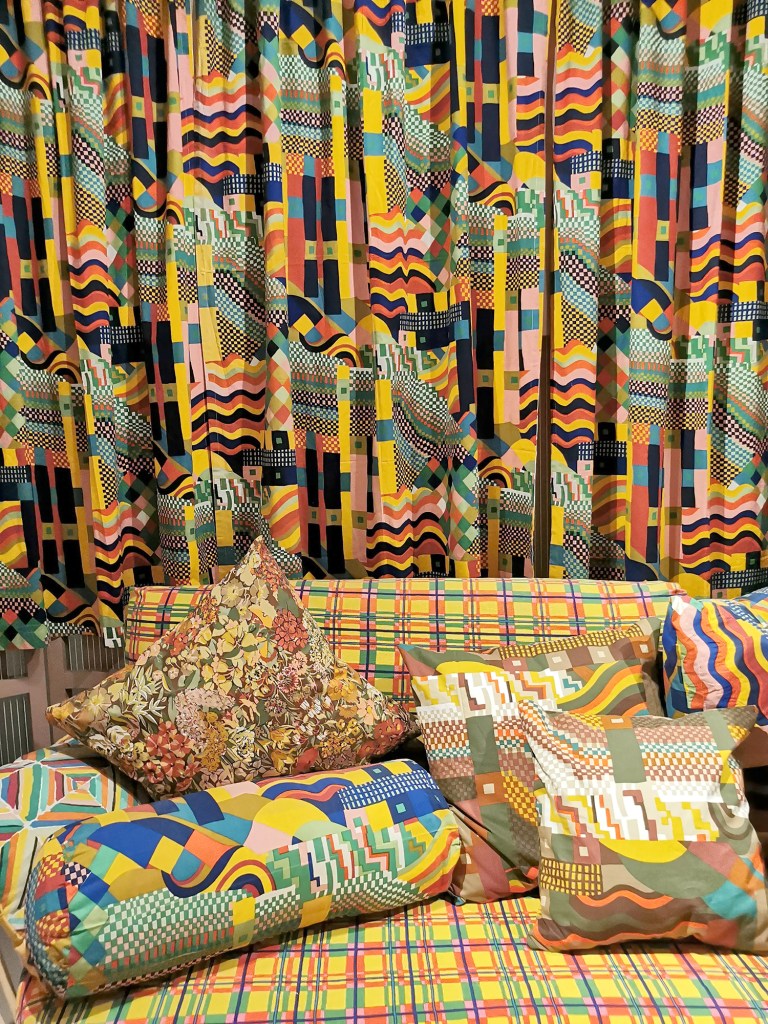
On entering the exhibition it was a complete feast for the eyes … with pattern and colour everywhere, appearing from around corners, up above and room after room. This was a true dive into the archives of Collier Campbell textiles over decades of working together, two sisters and a shared vision for joyous textiles. The exhibition included a wide range of items designed by Susan and Sarah, from the drawing and painting tools, to loose sketches and scaled painted designs on paper to lengths of printed fabrics, interior products and dresses. There were examples of Sarah’s more recent collaborations with Magpie and West Elm, alongside press cuttings featuring both Susan and Sarah at home and wielding paint brushes.
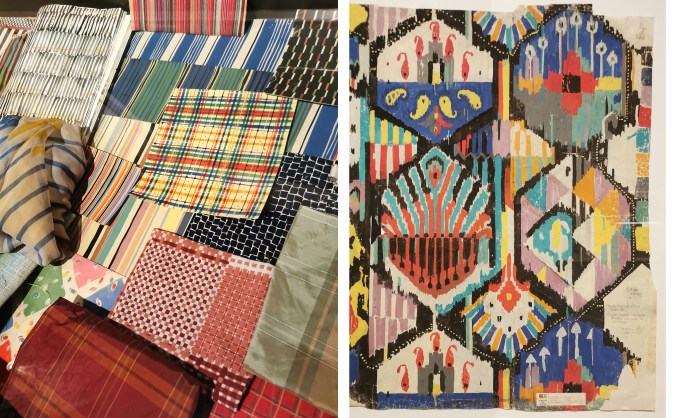
As a child growing up in the 1980s the look of home textiles, if not Laura Ashley, was likely to be Collier Campbell. With bolder and colourful brush marks suggesting the joy of Les Fauves artists, Matisse and Derain, rather than the Victorian Gothic tight sprigs Laura Ashley celebrated. I remember visiting the exhibition at London’s National Theatre in 2011, celebrating fifty years of sisters Susan and Sarah designing in 2011, shortly after Susan died. I recall loving the energy in the painting and bold use of colours.

In this current exhibition, as is the legacy of the archives, the patterns are rhythmic in their flow and scale; musical in spirit. Motifs are often geometrics, florals and birds, and famously designs such as Cote d’Azure, evoke summer scenes in Europe as the sisters worked to deadlines only imagining the holiday season. It was wonderful to see the paperwork for this piece, having included it in my book, Repeat … that features an interview with Sarah and images of key pieces by Collier Campbell.
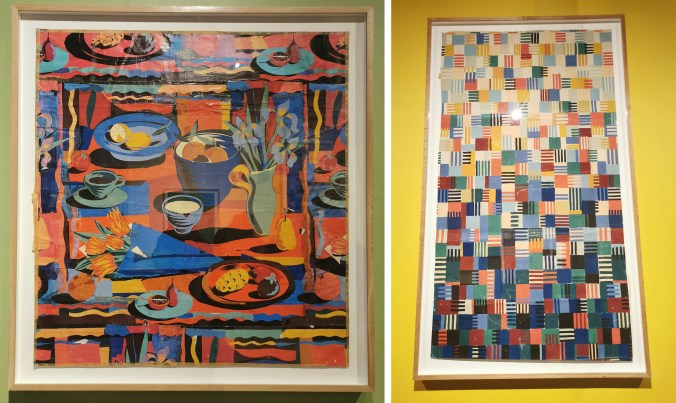
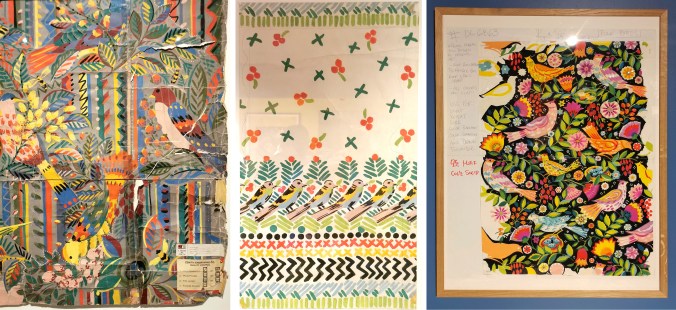
A design new to me that I really enjoyed seeing was Dancing Squares, from 1990 for American company UTICA (Stevens). This huge length of hand printed paper over two and a half metres long features painted squares evolving from dark to light up the design (right hand image below). The design on the left, again one I wasn’t familiar with, was a huge collage of a table of food and drink, in warm reds and oranges complemented by blue and turquoise.
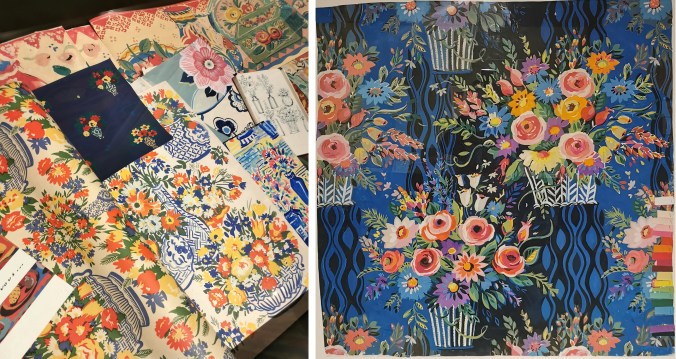
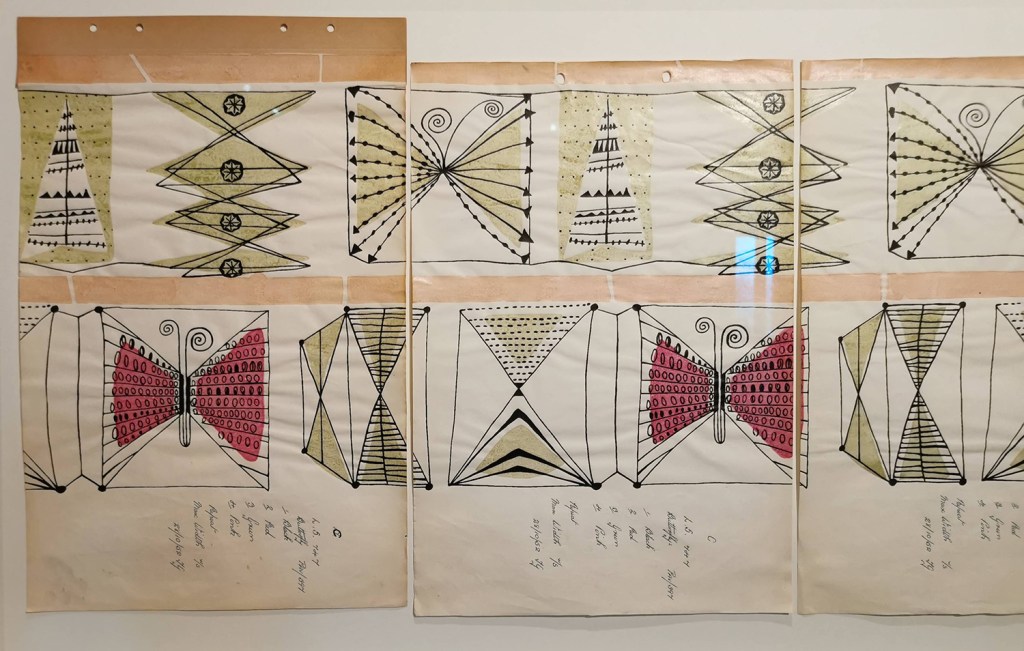
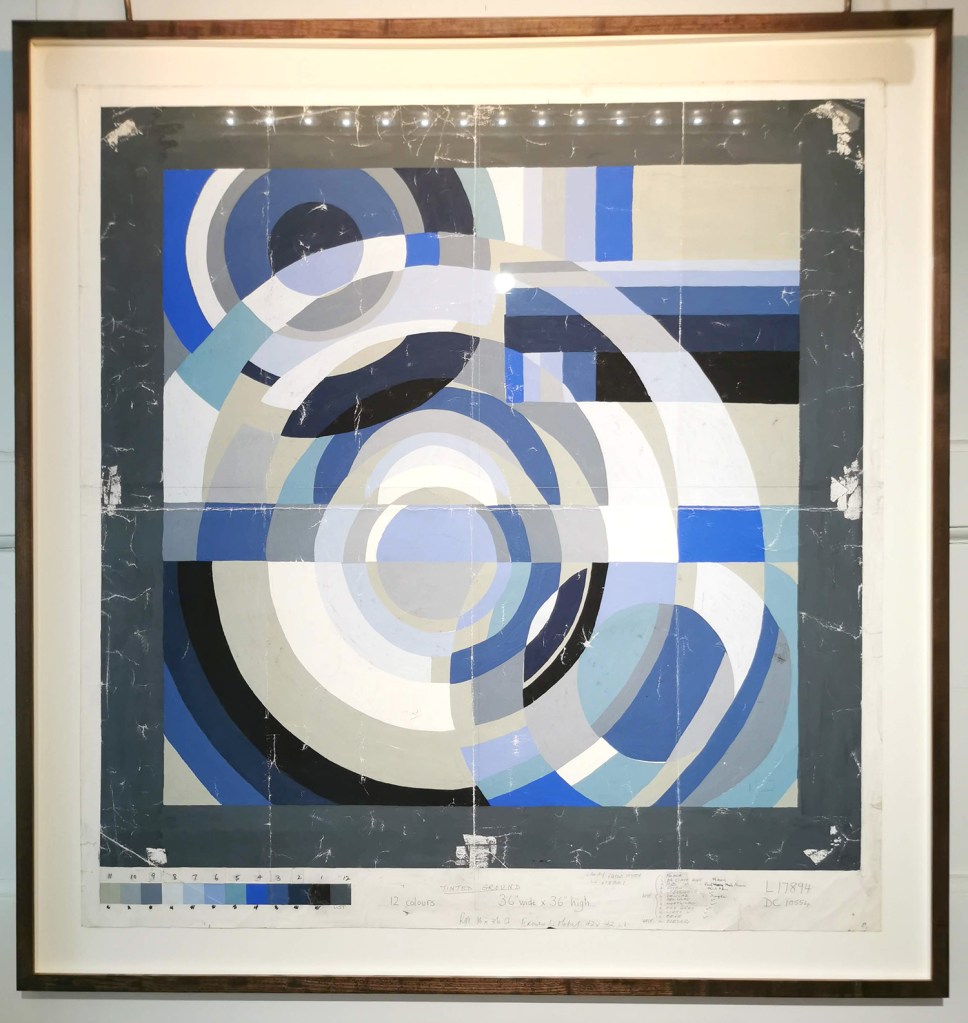
The florals and bird designs were full of life, with painted textures and pattern. It was also good to see the colour chips on the sides of some designs to guide the printers for production, as well as notes for the artworks and printers. The designs have depth as Susan and Sarah played with backgrounds and foregrounds as equal importance. Display cabinets showcased works on paper and coordinating designs alongside their hero prints as large statements on the wall and hanging as lengths.
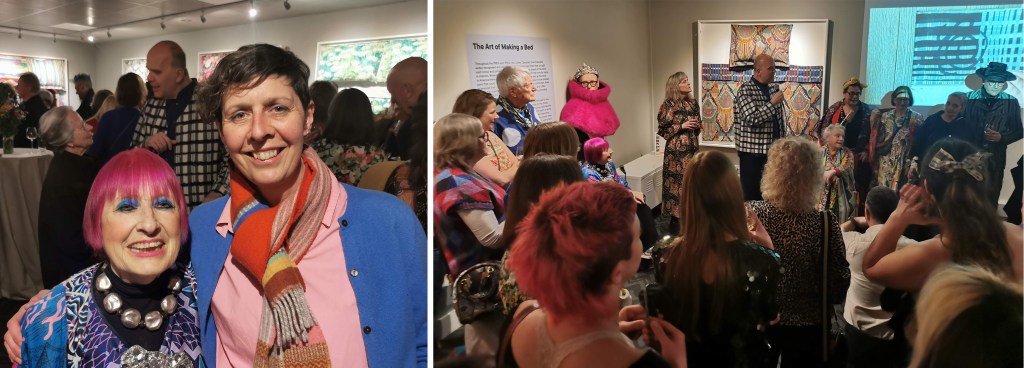
Everyone was friendly. I chatted to several people during the evening as we shared our joy of the work on show and the speeches by the curator as well as Sarah celebrated the pure joy that pattern, colour and creativity can provide. I was excited to have the opportunity to talk to Zandra Rhodes, the founder of the museum, and who continues to inspire us all, including the students I teach at Norwich.
I have only shared some of the many photographs I took on the evening, but I strongly recommend the show to anyone who loves printed pattern. It is the perfect tonic for the times we are living in, and a beautiful reminder of the joy to be found in painted and printed pattern! Congratulations to Sarah and the curatorial team of Teresa Collenette and Dennis  Nothdruft at the Fashion and Textile Museum.

I sat on the train back to Norwich with my heart filled with excitement for the world of pattern I belong in, energised to support the next generation of designers I am working with at Norwich over the coming months. It was a day of celebrating Sarah and her sister Susan, having seen so many of their designs in the two exhibitions I visited – what a truly impressive legacy to be inspired by!
London pattern day: Liberty / Women in Print

I spent a busy day in London this week, with focus on print and pattern. It was fabulous! My first destination was the William Morris Gallery, Walthamstow in east London. I can thoroughly recommend the exhibition, Women in Print: 150 years of Liberty Textiles, on until Sunday 21st June 2026, in conjunction with Liberty Fabrics.

The exhibition spread across two floors of the gallery with a number of rooms and corridors showcasing some old favourites of printed textiles and related works on papers, alongside some lesser known pieces and associated garments.

The introductory video for the exhibition gave an insight to the role of women at Liberty with old photographs and recent interviews. I thoroughly enjoyed seeing old favourites throughout the exhibition, with works by Sonia Delaunay, Althea McNish, Jacqueline Groag and Susan Collier & Sarah Campbell as well as being introduced to names I wasn’t aware of, including Mrs Stoneley and Winifred Mold. I hadn’t realised Lucienne Day only designed one design (Fritillary) for Liberty, with it being agreed she would design for Heals while Robert Stewart would design for Liberty!

There was a second video upstairs, filmed in the 1970s that showcased the print and dye work with some rather random models in Liberty clothes wandering in and out of shot, by the print tables and dye vats in swimwear! When I discussed this with Sarah Campbell later that evening she joked it was her and Susan, the design duo behind Collier Campbell – exhibition now on in London’s Fashion and Textile Museum and featured in my next blog post!

The exhibition is free to attend, with donations to the gallery gratefully received.

Congratulations to curators, Rowan Bain and Róisín Inglesby.

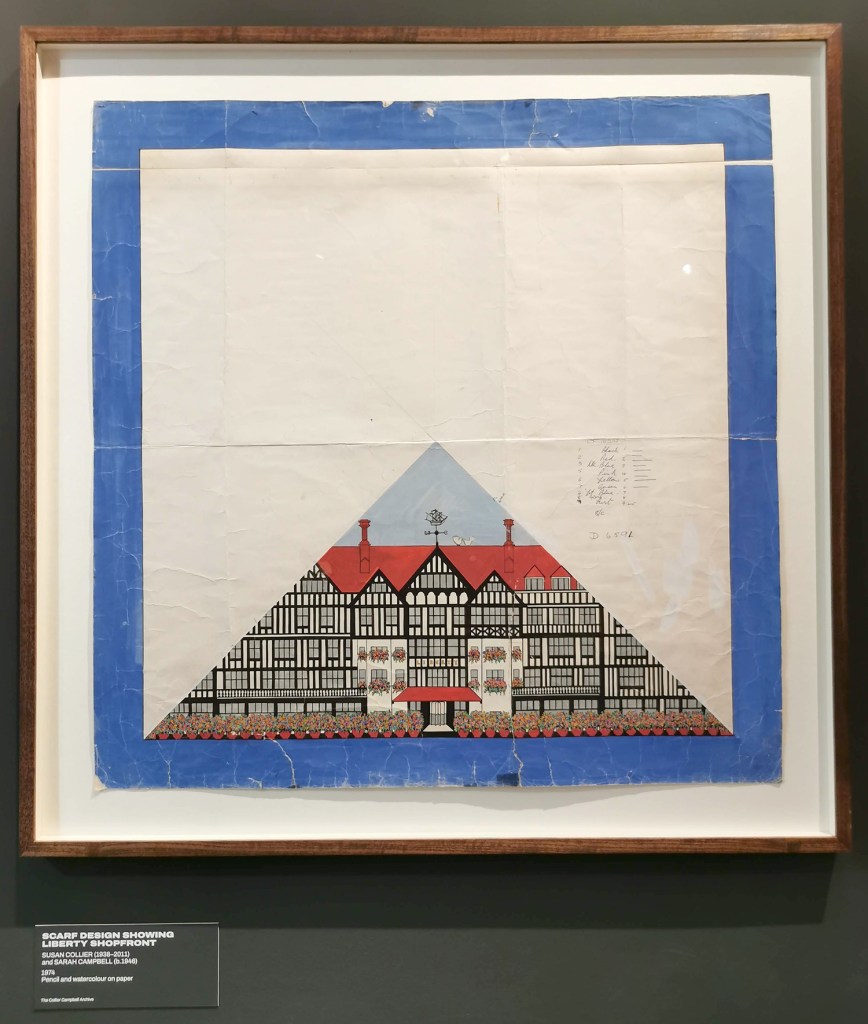
Susan Collier & Sarah Campbell, scarf design featuring the Liberty shopfront

Sonia Delaunay scarf design

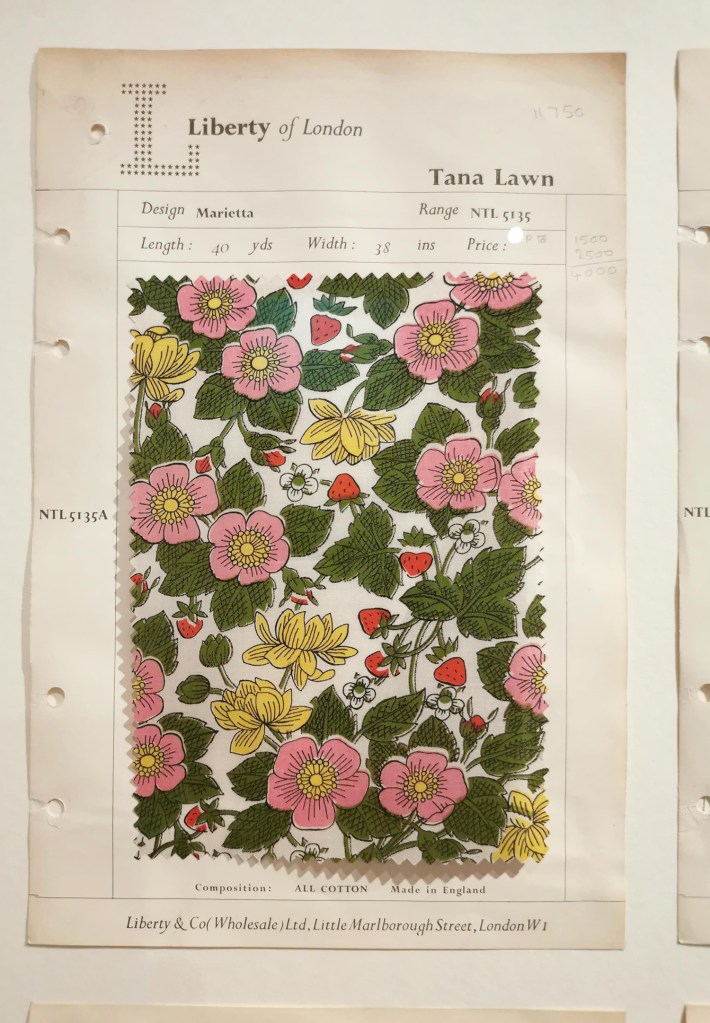
Liberty swatch

Lucienne Day’s ‘Fritillary’, her only design for Liberty

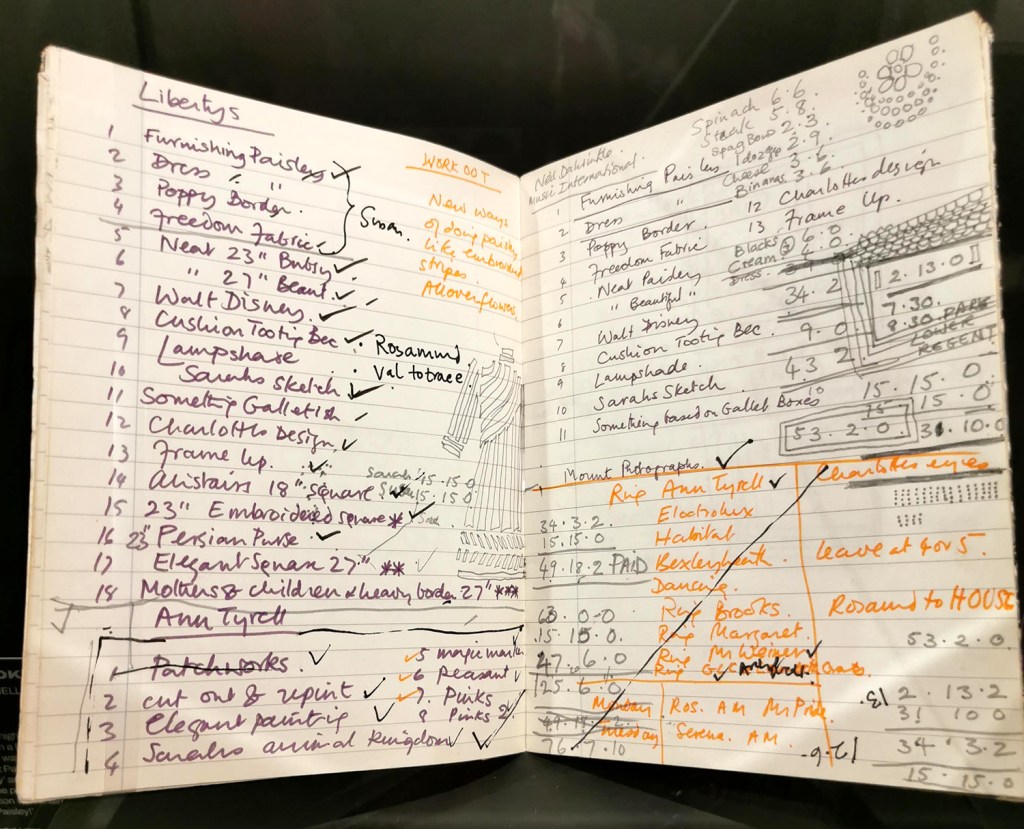
Sarah Campbell’s notebook, double-spread

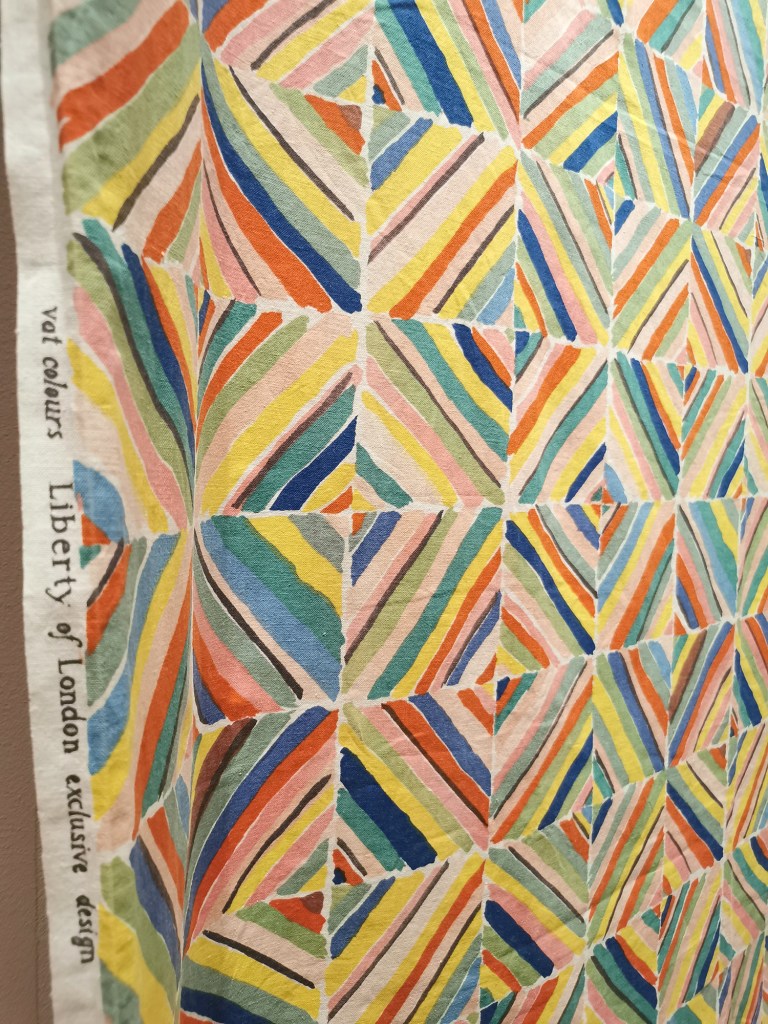
Collier Campbell ‘Kazak’ design

Collier Campbell for Liberty, featuring Bauhaus, inspired by Gunta Stolzl, the weave master at the Bauhaus, Germany

sharing my pattern research

I’ve been busy printing and presenting my ongoing pattern research over the last few months, testing the design and print process, and receiving useful feedback – which may explain the lack of blog posts recently!

Last September I presented my work at the Fashion and Textiles Courses Association conference, Futurescan 6, held at De Montfort University in Leicester, and had a small exhibition of the work in progress during the conference. It was great to formalise my ongoing work at that time, and receive external feedback from the audience. It was useful to consider how I communicate the research, as the principle is simple but the process complex. I have also discussed this research as part of other presentations over the last few months, for colleagues, for undergraduate students as well as the audience of the Costume and Textiles Association’s programme of Heritage Open Week talks at the Forum in Norwich.

Last week I presented this research to the British Association of Paper Historians as part of their Spring Meeting held at St. Bride Foundation, having been invited to do so by the Wallpaper History Society. My fellow presenters covered wide ranging topics, from paper conservation, Japanese paper as cloth, the College of Arms and the current situation of the paper industry in the global context. It was a fascinating day with lots of common ideas and interests, and I received some very positive feedback to keep me on track.

I have further opportunities to share my research in a couple of months, so more news on that in due course!

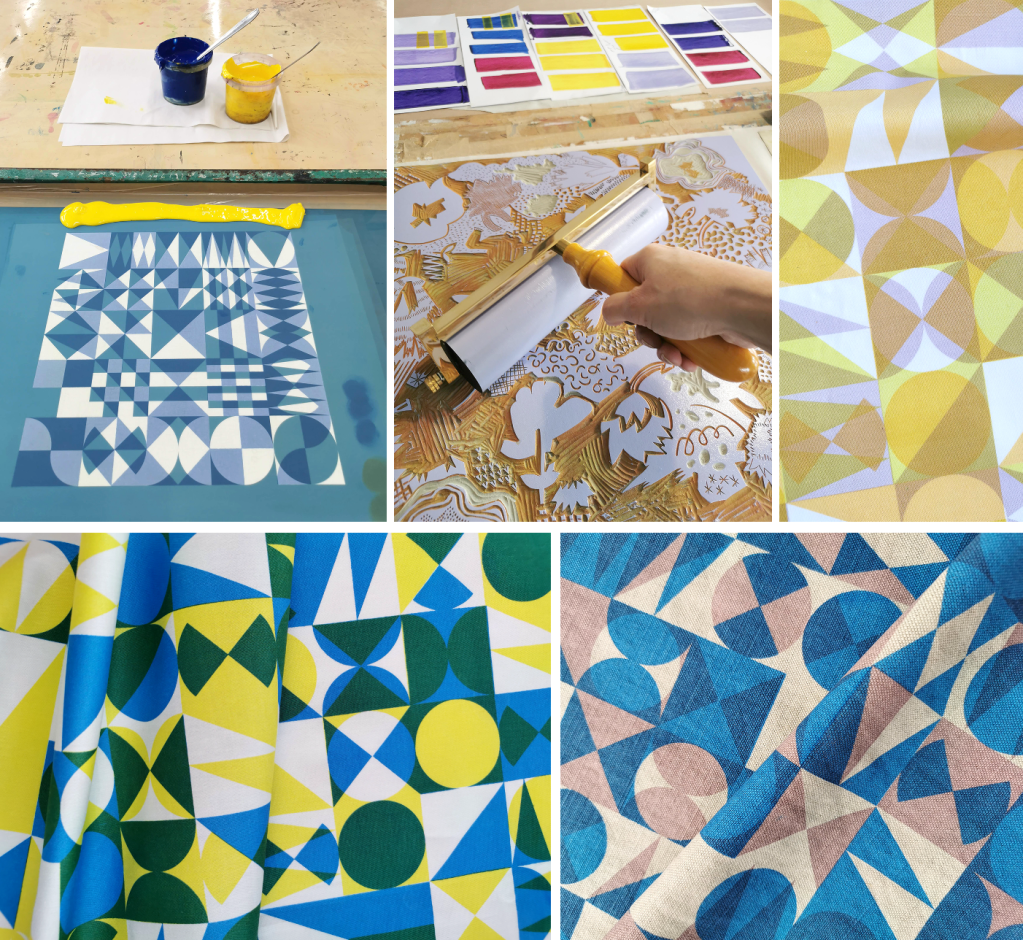
I am continuing to develop both lino blocks as well as artwork for screen printing, which enables me to test different colour handling and substrate options, for wallpaper and cloth. Colour is an important element of this research and particularly the transparency of colour in the overprinting, so the palettes will continue to evolve as I continue the exploration of primary and secondary colours.

As I gear up to making larger work for an upcoming showcase opportunity I look forward to sharing more of the work in progress.

sketchbook development
pattern development

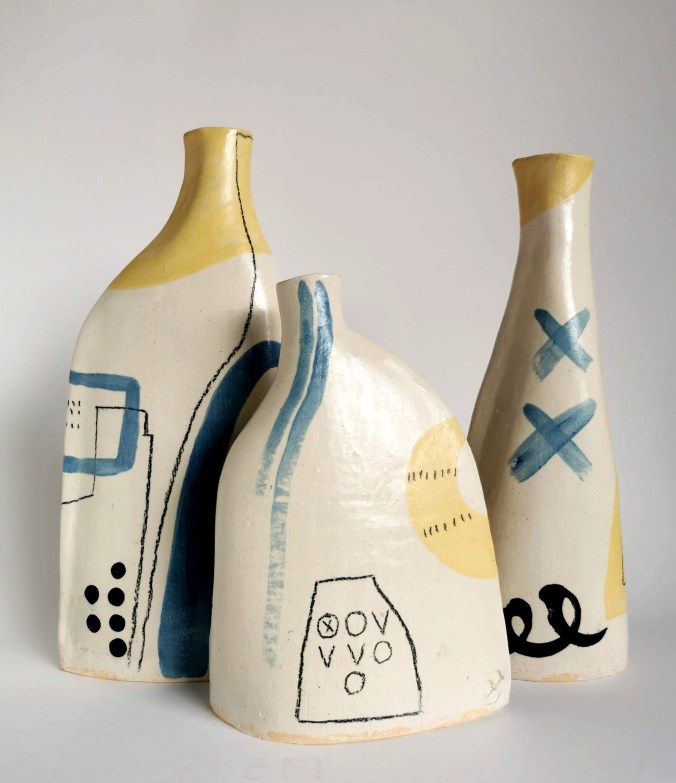
pottery collaboration: form and mark

A little over a year ago I started to collaborate with my mum on a very special creative project. My mother has been a potter all of my life and family meals at home would mean eating from hand-thrown stoneware bowls, plates and cups made by her. During the 1970s and early ’80s she exhibited her goods at craft fairs in and around Wymondham, Norfolk and we would hang around watching as mum demonstrated her craft alongside her creative friends. We were lucky enough to have personalised birthday gifts made by mum during our childhood, and when I left home I was given a homemade teapot, cups and bowls that I still have, three decades later! My sister and I used to play at the potter’s wheel and hand build the odd ornament. I vividly remember the smell of burning clay dust on the bar heater and the feeling of dry clay on my hands.

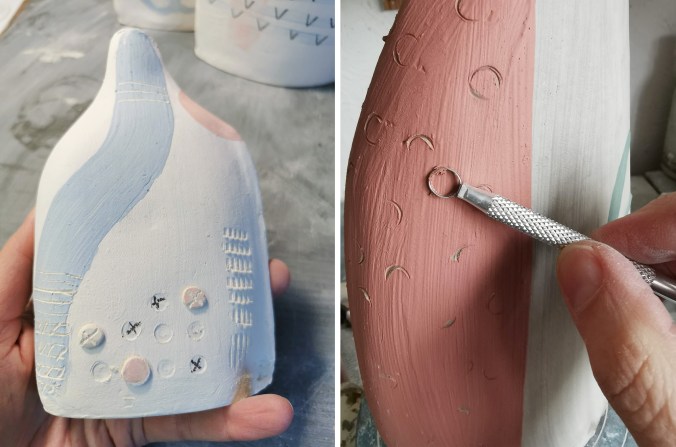
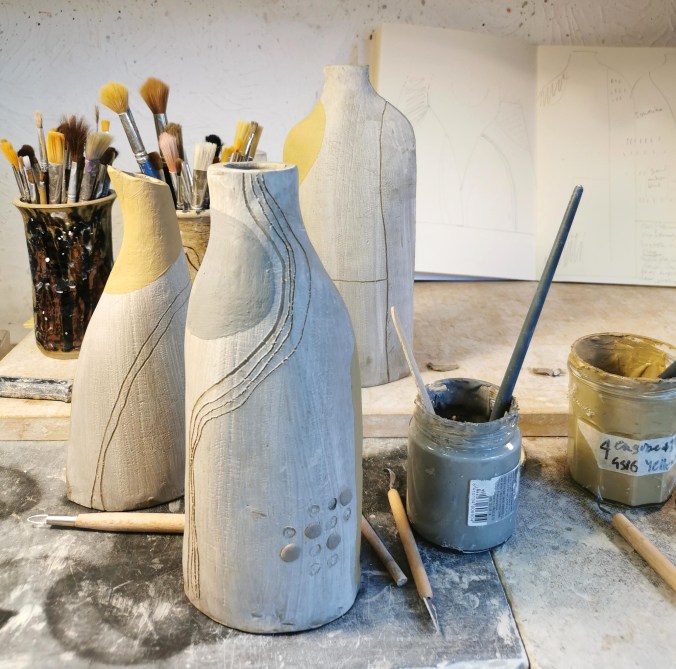
Last winter, as a way to spend time together at a sad time of family loss, I suggested we try collaborating, sharing our skills to see what we could come up with. I made a project sketchbook to outline a few thoughts and approaches to form and visual language, and handed it over for mum to think about what chimed with her. Although I’m a surface pattern designer, I’ve no experience of hand painting on ceramics beyond art school. Mum has switched to hand building her vessels in recent years so this was how we started. After a morning in my studio pressing tools into damp clay, drawing forms and testing colours, the project was underway.

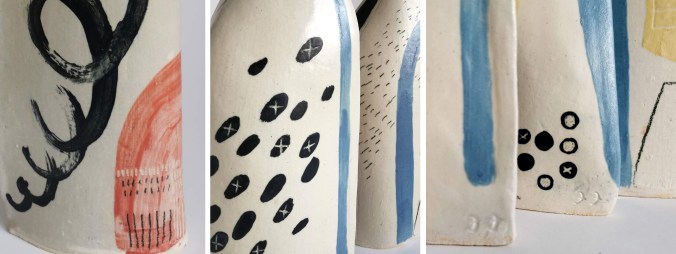
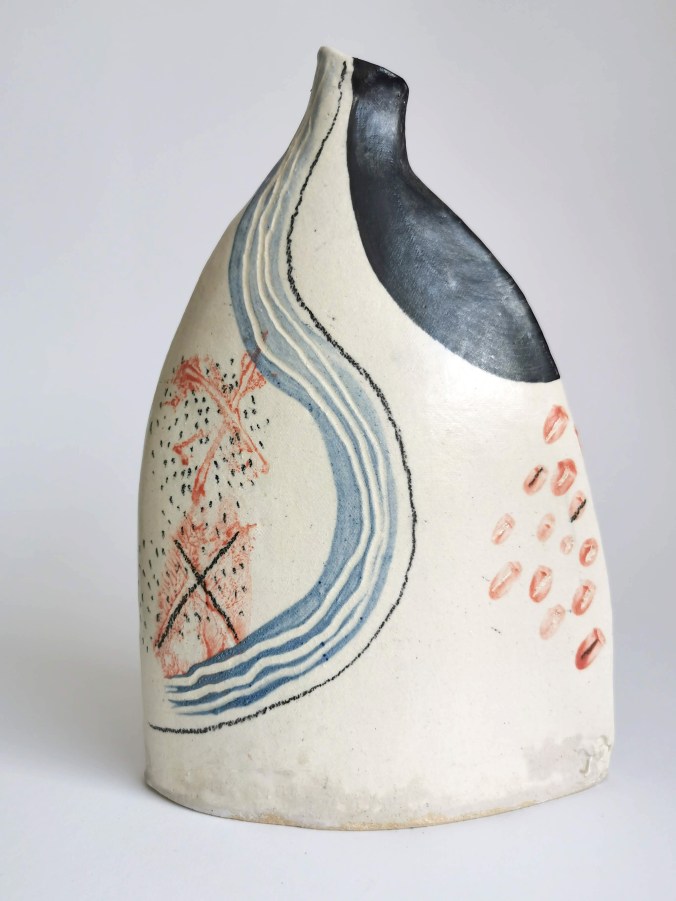
Mum tested a few ways to construct the vessels and I responded to the forms with drawn and painted marks inspired by our mutual appreciation for landscape. I had to learn how to load the brush and use the colour on the clay. I monoprinted texture and marks by painting newspaper with colour then drawing on the back of it on the damp clay. I drew with the ceramics pencil and scratched through shapes of colour with different tools. I’d hold my breath in anticipation as I planned a long line of colour, top to bottom, over the neck and shoulders of the form. We also added buttons as visual and textural interest. We had some gentle discussions about my preference for marks mum was less keen on, and we egged each other on each time we returned to the pottery. I’d receive a message, “Kate darling, I’ve made some more for you!” and soon the weekend arrived and we were nattering away, having our creative fun together again.

We have learned lots about what we have both wanted with the shapes and surface pattern of the pots, and I’ve tried my best to understand slips, engobes and underglazes. Our techniques have been refined, and standards raised during the year. I’ve definitely got better at drawing on three-dimensional forms – I’m even more in awe of Clarice Cliff! There are three series so far, exploring different forms, colourways and surface decoration, with approximately ten flasks in each.

I’ve thoroughly enjoyed the opportunity to work with mum on this project, it genuinely feels an absolute privilege to be able to work in this way. This collaboration has been one of united adventure, sharing each other’s creative decision making and discipline expertise to guide us, learning to make more than we could individually, sitting beside each other in a conversation between clay form and mark making.

I also think we may not be done yet … we shall see! We are looking at options to exhibit them and would very much like to share them with others.

draw, design, cut & print

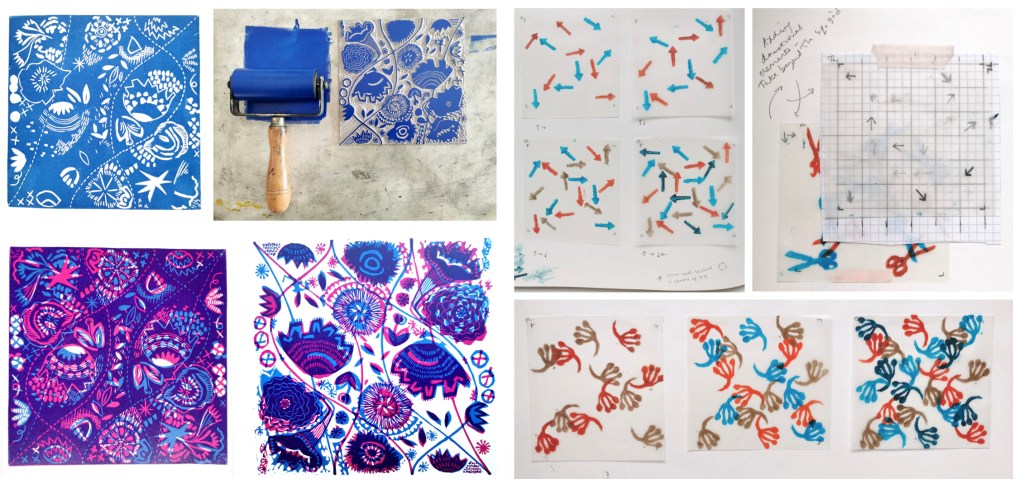
I’m currently working on some large scale lino blocks to print floral patterns as part of my continuing pattern research. At the same time I’m also teaching our BA2 group how to create repeating printed patterns, so it’s always nice when there is some parallels between what I’m up to and what the students are doing.

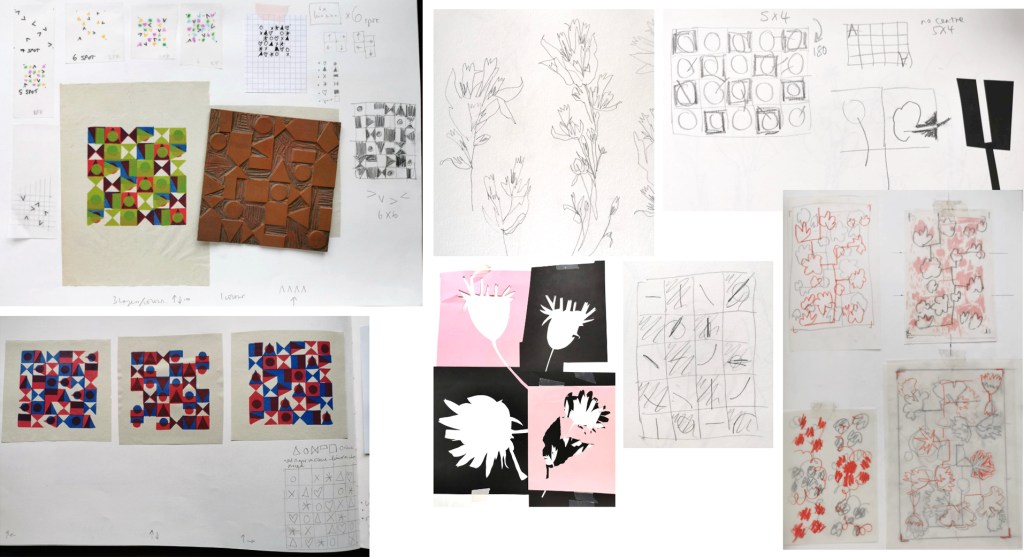
I have been returning to my sketchbook of floral drawings I made from my trip to the Italian Alps, and exploring them again with new paper cutouts as I think about overprinting and block rotation. I’ve not proofed the plate yet, but here’s some work in progress images from the studio.

Moving pattern – 16mm cameraless animation

I’m always looking for other ways to explore my pattern ideas and have been keen to consider options for film making to explore sequential narratives. Animation processes fit well with the work I’ve been doing with pattern evolution I have been testing across pages of books over the years.

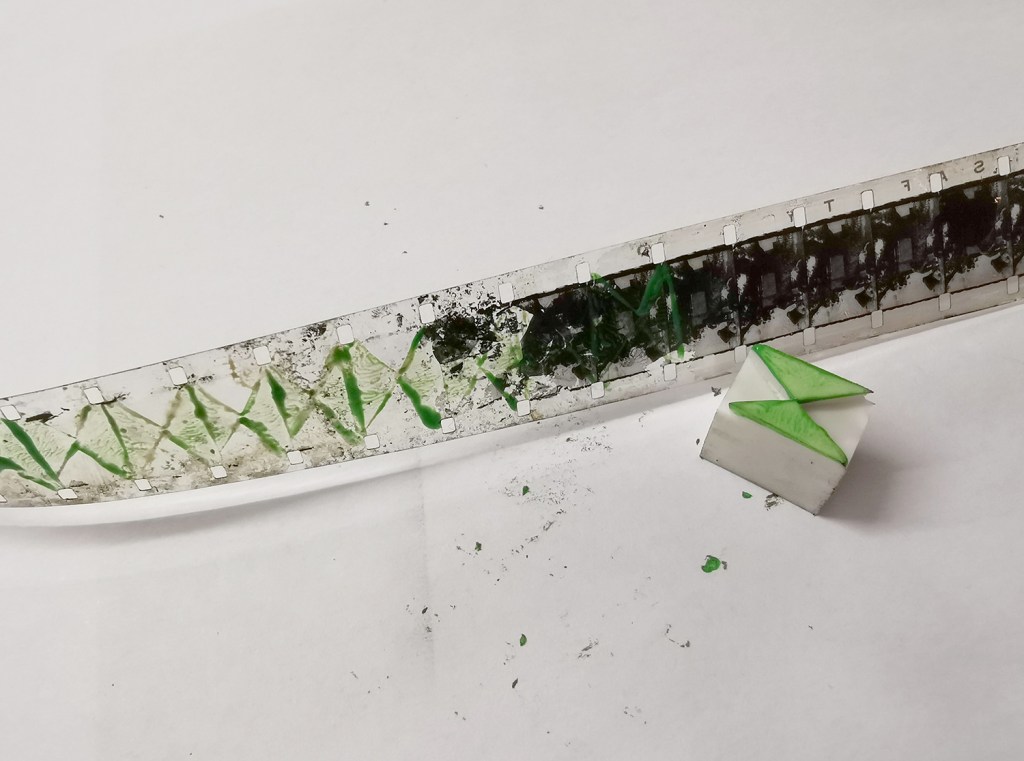
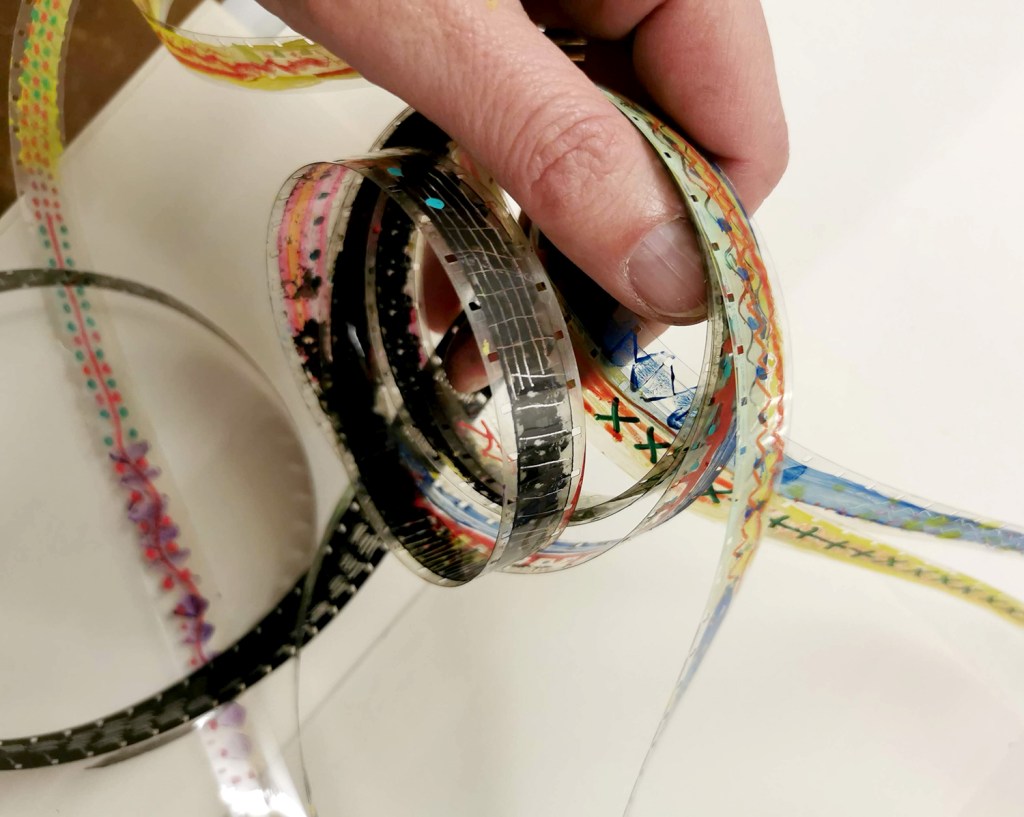
Having been a fan of Len Lye’s paintings on film from the 1930s, including A Colour Box from 1935 commissioned to promote the General Post Office I was pleased to be able to attend a workshop in Norwich to to spend a few hours working on strips of 16mm film to make my own experimental animation. We were shown some examples of other people’s films and could then explore the process ourselves. The workshop was led by Jacob Watkinson and was hosted by The Holloway in Norwich.

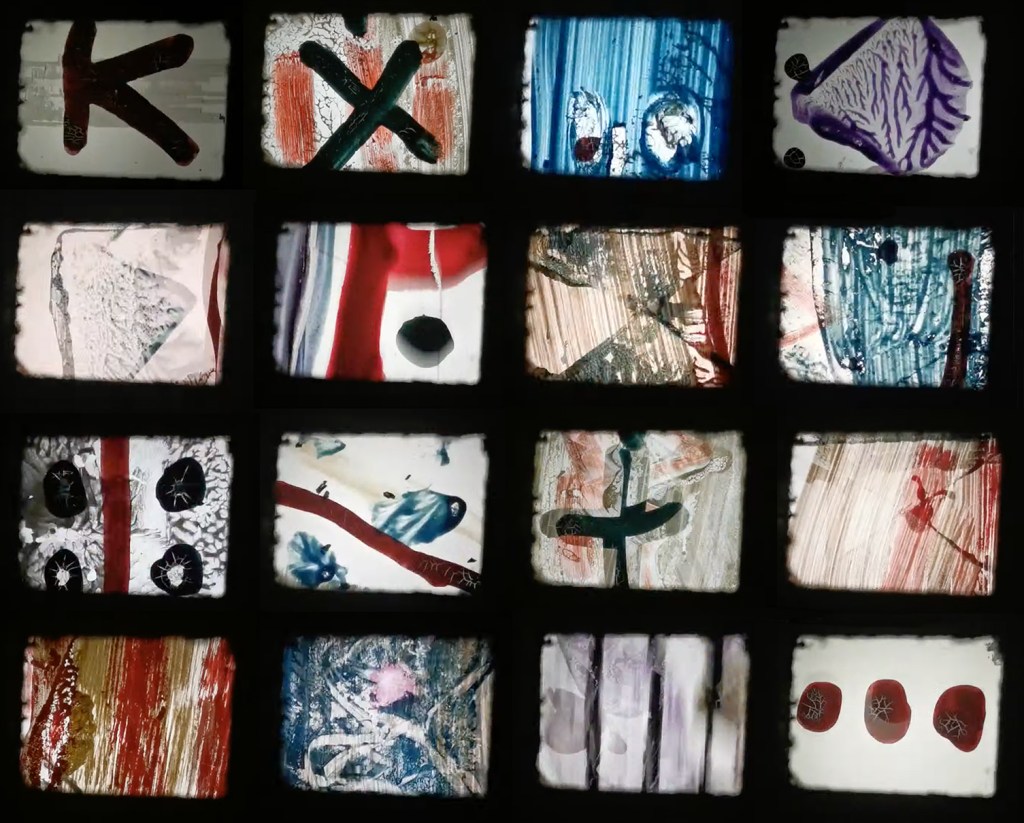
We were given strips of clear 16mm film I was able to use pens, paint, rubber stamps and Letraset on, as well as pre-exposed film with archive films that we could scratch away the black with a scalpel beautifully. I know it’s obvious to say, but 16mm is tiny, and I’d forgotten my glasses, so that added to the issue of seeing what I was working on! It’s a tiny space to include anything too complex and I was unsure initially how many times to repeat motifs and at what pace to move motifs across the film, but I just had a go and tried not to be too precious. 

Once we’d all had a chance to work on several pieces Jacob spliced the pieces of film together and we ended the session with a screening of everybody’s efforts – it was great to see individual approaches with the same processes and the outcomes have certainly got me thinking about taking my pattern evolution ideas in this direction again. The image below shows some stills from the film I made – all 20 seconds of it! Len Lye’s films are brilliantly paired with music so maybe I need to think about that too – but I’m not sure today’s Post Office will be knocking on my door anytime soon!

If you want to read more about Len Lye this article from the Tate is a good one.

drawing, looking and seeing

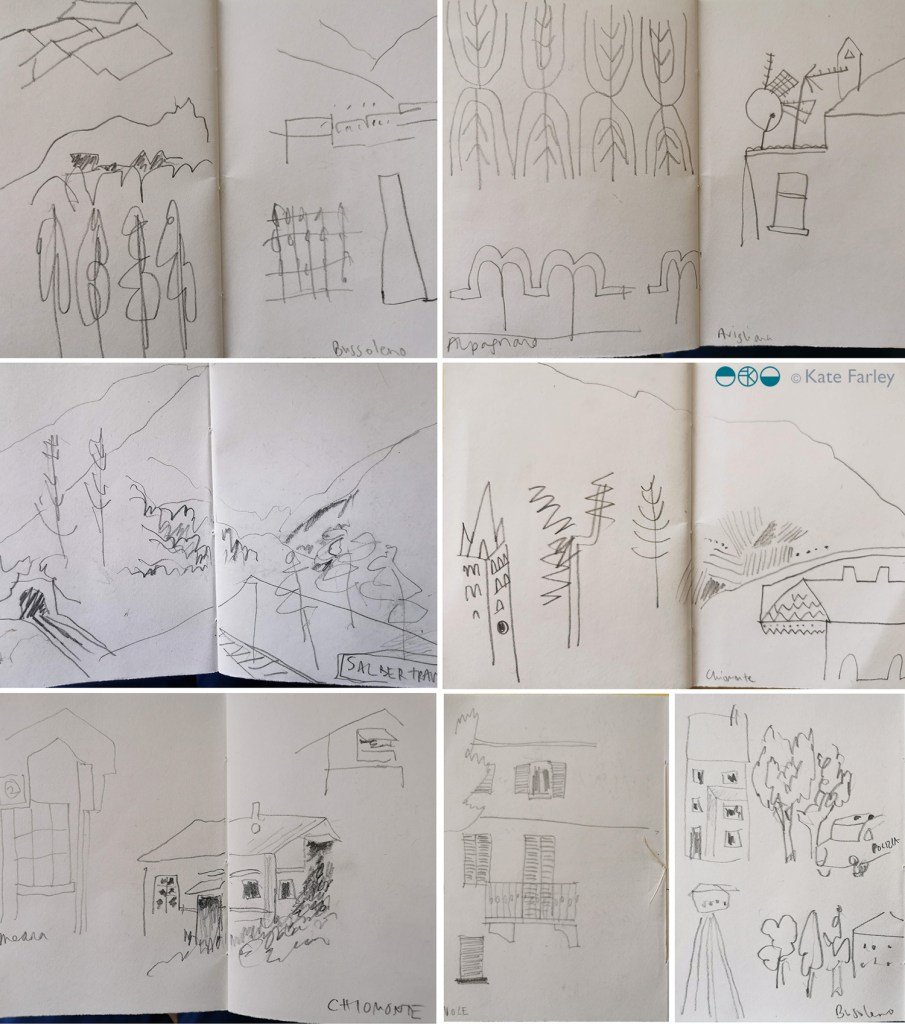
I’ve recently returned from a lovely family holiday, traveling by train from Norfolk to London and via Paris through France to the south and on in to Italy, up into the foothills of the Alps via Turin … and back again. I made lots of small sketchbooks so I could have one close at hand at all times, with a selection of pens and pencils. I’ve always enjoyed drawing from trains, preferably sitting backwards, looking, identifying shapes and details, then hastily capturing what I saw in a few lines.

It’s a great exercise to keep the hand, brain and eyes in check, and although I have previously used this sort of drawing for my design work – including my degree Final Major Project back in 1997 – I only really do it now as a good activity to check in with the view and focus on the places, stations and landscapes I journey between, and as exercise for keeping my drawing practice fit and healthy. A gable-end of a barn, a cluster of trees or mountain horizons can be documented and it’s amazing how these drawings are then able to capture and remind me of the journey years later.

Here are some of the drawing from the trains. I sometimes get a bit more detail down if we sit in the station for a few minutes, and I jot the station name down for interest.

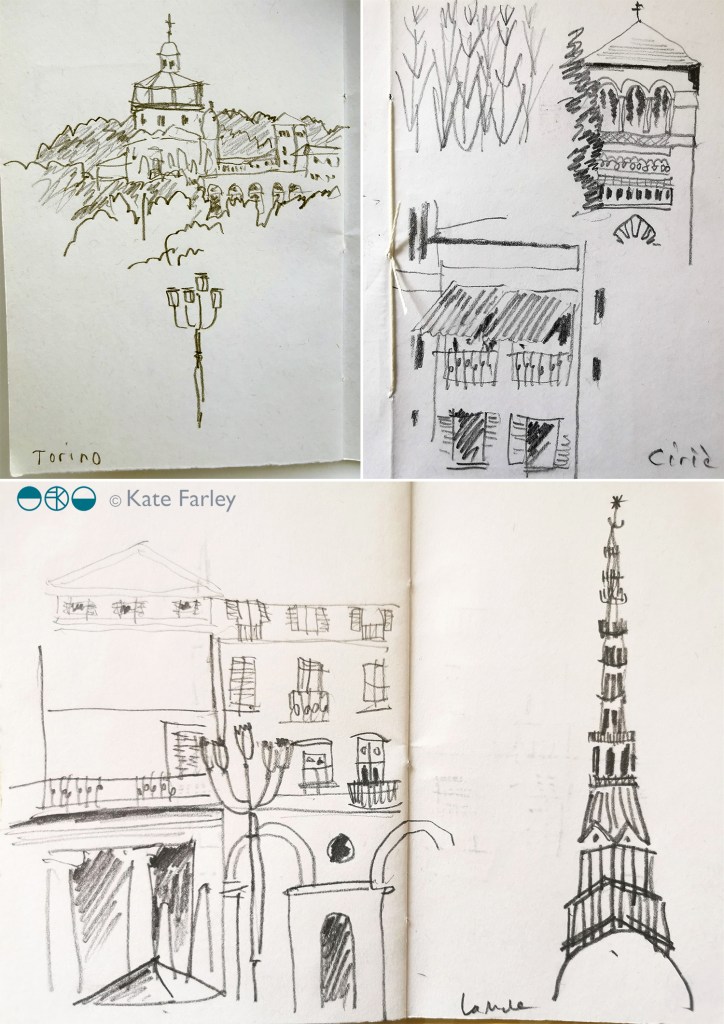
I also managed to do a small amount of drawing while sat in cafes or sheltering from sun while other family members were up to something else. They take a few minutes each, so still pretty quick observations. It’s clear my interest in pattern comes in to how I see the world. Rhythms of windows and balconies, railings, ornamental buildings….

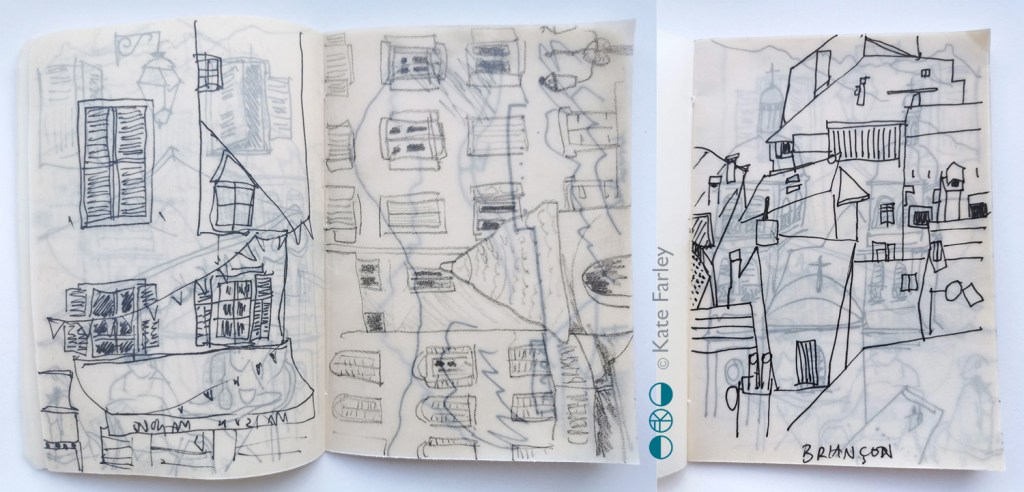
I also made a couple of sketchbooks using tracing paper as I was interested to see how I worked with the transparent pages as the drawings built. I quite like the results and reminds me of how I plan lino blocks and screen prints with the layers of tracing paper.

It was definitely good to spend time drawing and I’m thinking of revisiting some in the studio, no pressure, just a few ideas. I hope you like them, let me know if / how you make drawings from trains!

Research chapter published: pattern evolution

In the first term of arriving at Norwich University of the Arts I was welcomed as a member of the Pattern and Chaos research group. Colleagues from across the university would meet and discuss individual research practices and shared ambitions relating to the themes of the group. During one of those early meetings the idea of a Reader, a book featuring many contributions on the themes related to the research group, was being discussed. I enjoyed being involved in setting out early ambitions and five years on the book, edited by Sarah Horton and Victoria Mitchell, is a reality, having been published by Intellect Books in late 2023. Congratulations to Sarah & Victoria!

I’m delighted to be a contributor alongside many other researchers and practitioners, some I have the pleasure to know, others I shall get to know through their text and images in the book.

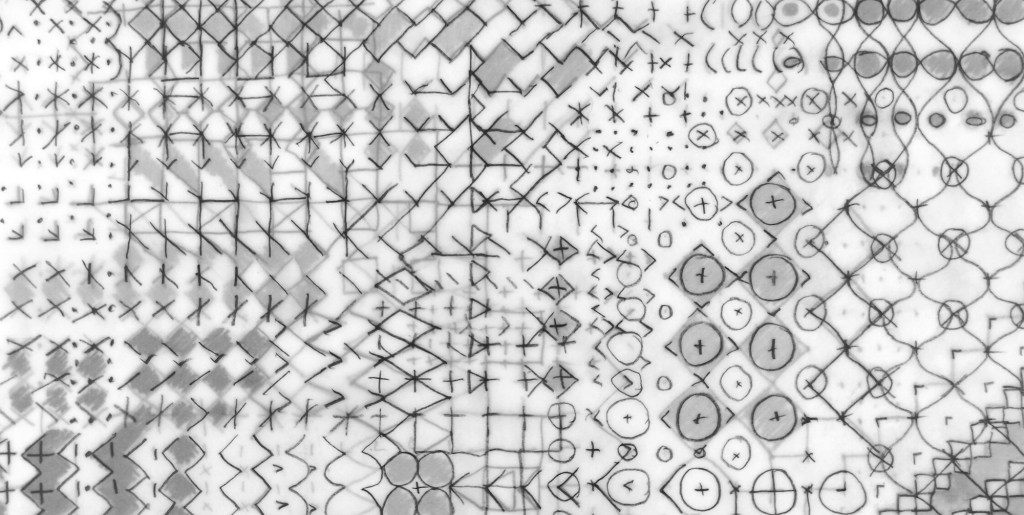
My contribution to the project is chapter ten. In conversation with both Sarah and Victoria several years ago I shared my ideas of pattern evolution, of taking motifs from one to another, an ogee to a diamond for example, through the process of drawing, transforming them from one to another across the sheet of paper. I gave them a quick sketch as part of my proposal and they patiently waited for more as I worked on the larger body of drawings. The link between themes and variations in music was apparent and I played with this idea as I made the drawings, layering tone and form, as a composer would do in building the greater composition.

The chapter explores the practical research process of drawing and evolving the motifs across formal grids structures and across layers of tracing paper. Although the visual language of these drawings are significantly different to my current research the ideas initiated here were the seeds of my current investigation – I’ll share that progress soon!

A huge thank you to Sarah and Victoria for the ongoing support they provide, both to me and my practice. Between the two of them they always ask the pertinent questions and offer sound advice and encouragement.

drawing breath

Drawing has always been an important element of my design practice. It gives me time to refocus, to get away from everything else, to appreciate the beauty in things and keeps my eyes and hand working together in my lifelong investigation of how I look and how I record what I see.

The flowers drawn here were some of the last from the summer borders, consisting of dahlias, sunflowers, hollyhocks and verbena, captured quickly in pen, while I sat by the window, enjoying the warmth of the sun and the shadows that the flowers created while I drew.

drawn ideas of pattern

My ongoing research practice of drawing and design regularly explores pattern structures within the family of geometrics. I enjoy testing motifs and rhythms that belong to traditional compositions, and deconstruct the scaffolding to look for new iterations.

In this recent work I am looking to the concept of themes and variations in music to drive the visual investigation. Repeat doesn’t feature, but it’s certainly a consideration for the future.

layers of tracing paper with graphite drawing

With a short break between academic years, and the book in production I hope to find some time to take this project forward over the coming few weeks.