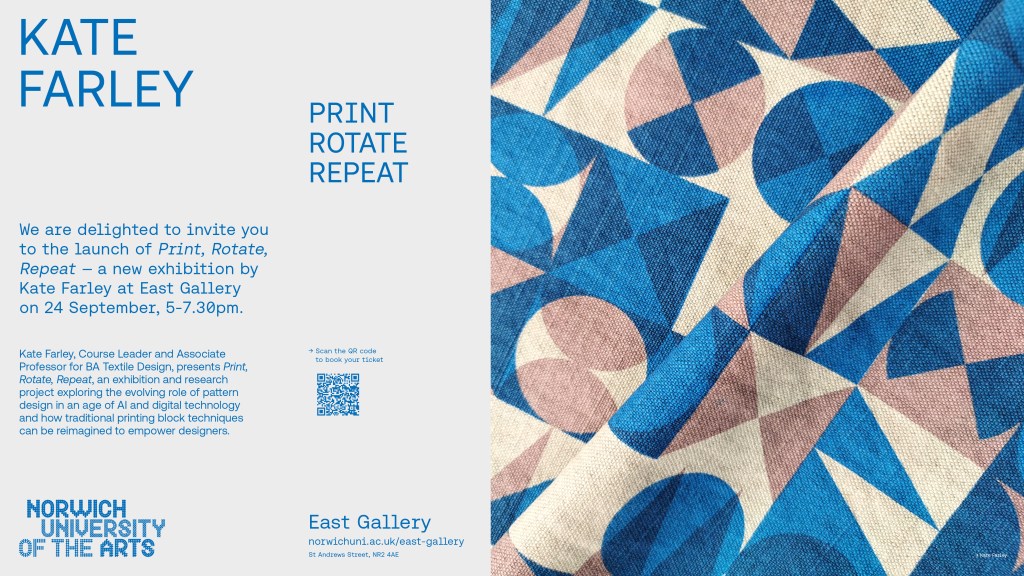
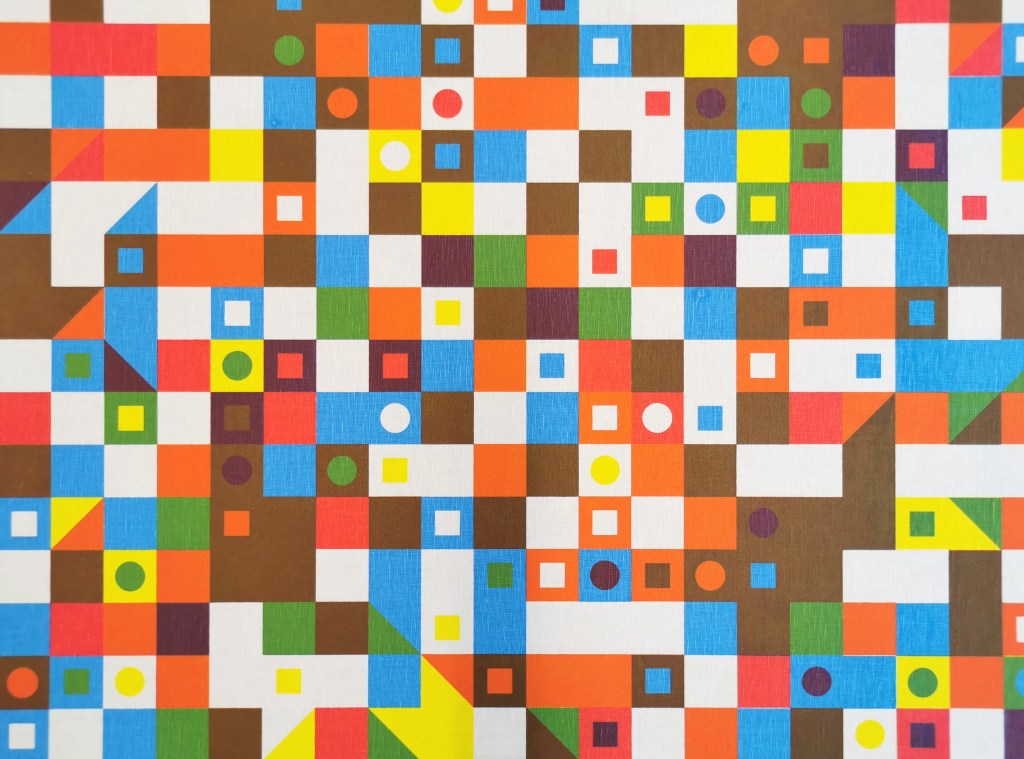
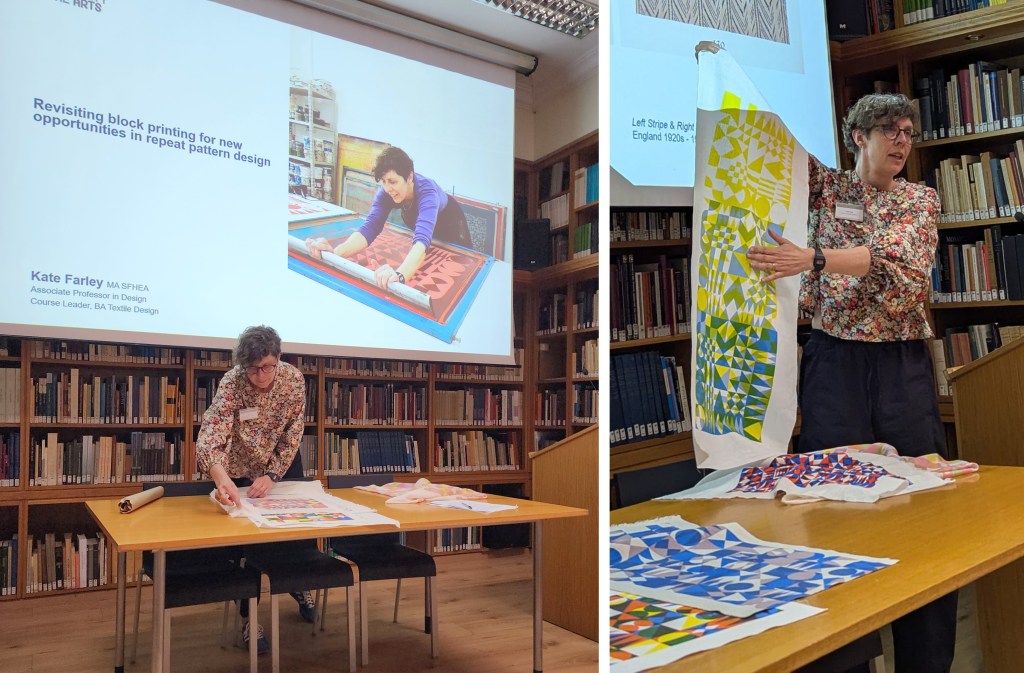
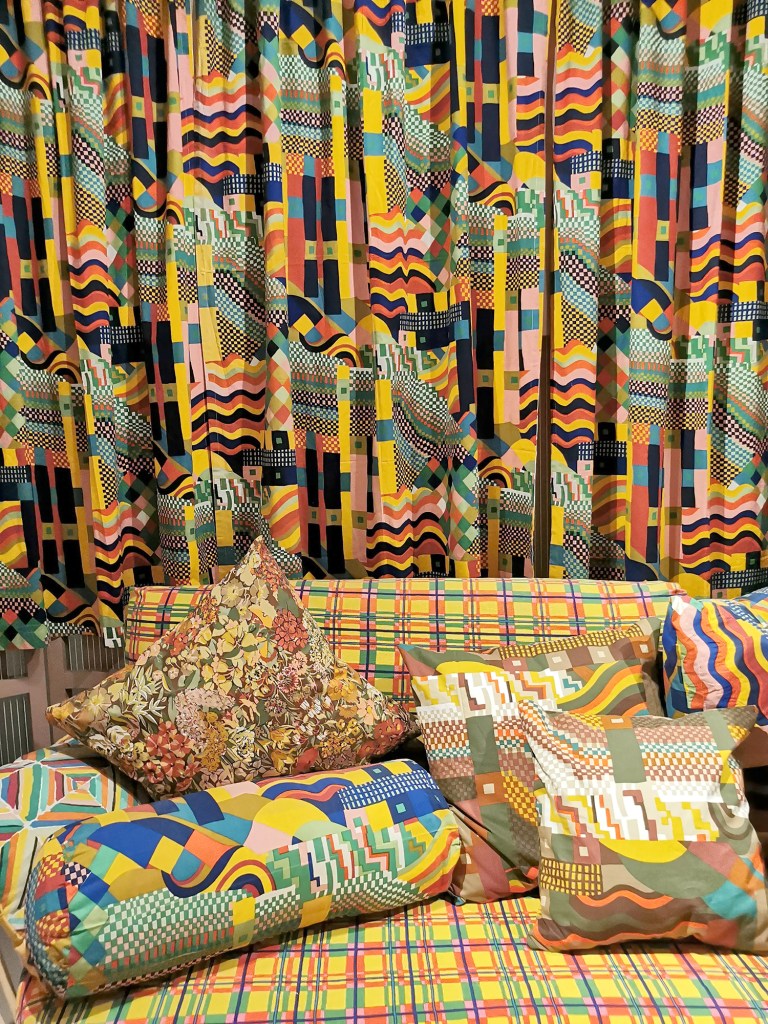
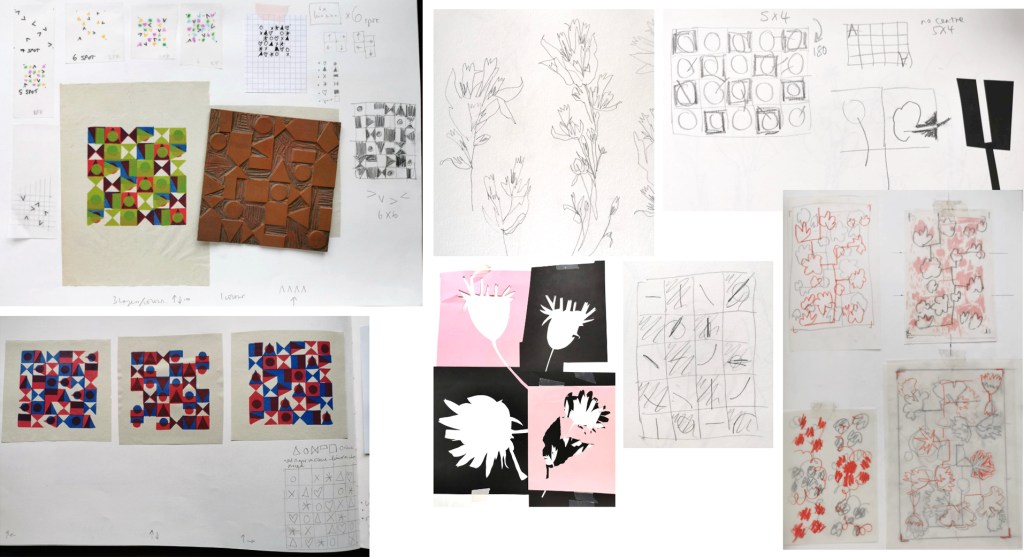
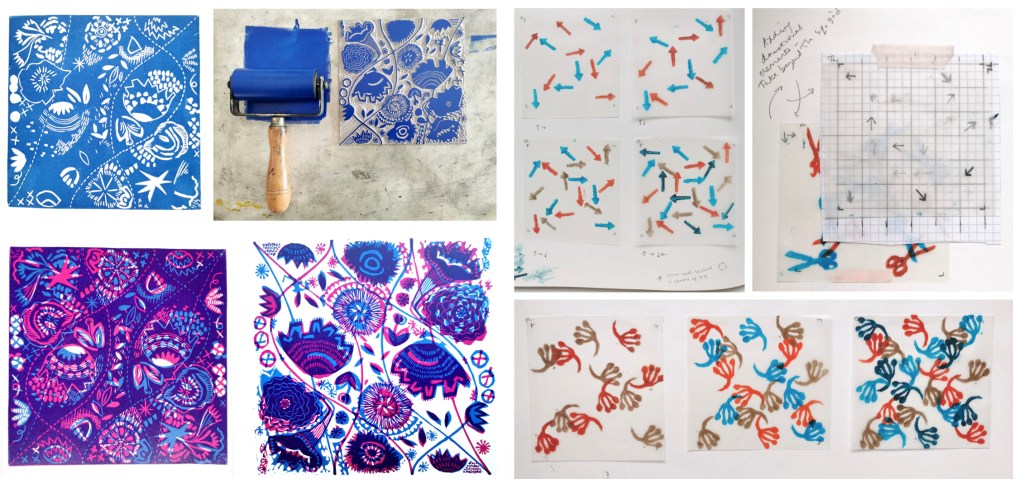
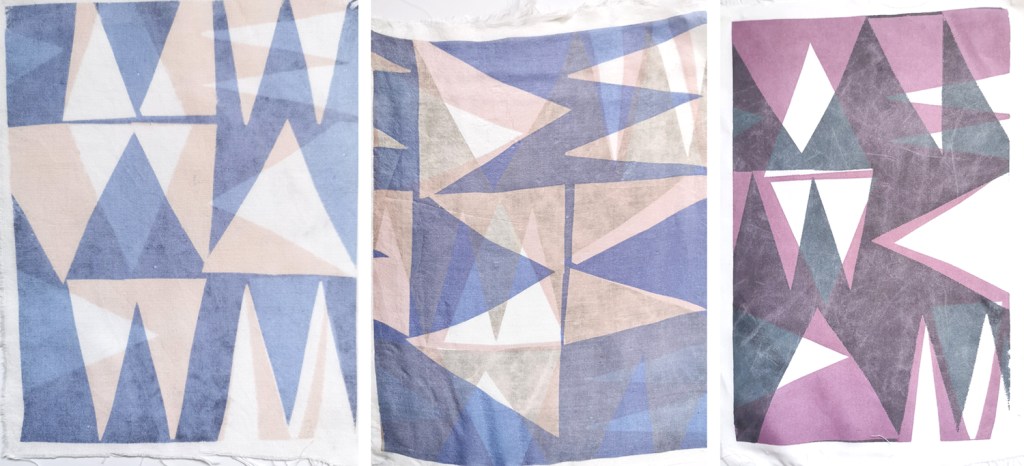
As I’ve mentioned on the blog before, I’ve been developing a new relationship with pattern design based on traditional block printing over the last three years. I’m delighted to announce I have a solo show at the East Gallery, at Norwich University of the Arts opening in three weeks time, open for a month. I’ve printed about one hundred metres of fabric over the last few months and I can’t wait to see much of it installed.
This summer our family holiday took us to Slovenia via rail from Norwich, via London, Brussels on a sleeper train to Salzburg, and our final train to the capital, Ljubljana. Once in the Slovenia we hired a car and spent a few nights in a few different regions to explore what the country had to offer. We ventured from high in the Julian Alps with the mighty Triglav mountain and lakes, to Idrija, famous for lace making and mining mercury, through the Karst region and towards and along the Croatian and Hungarian borders in the south and east.
We walked high in the mountains under blue skies and sometime above the ravens, through hillsides and woods of wild flowers, butterflies and birds. It was good to watch through binoculars from a neighbouring summit as climbers ascended Triglav, the highest mountain in the country and a few days later catch a glimpse across to the Adriatic Sea.
We enjoyed visiting towns including Ptuj, Idrija and Maribor, learning about local industries and histories. Ljubljana was a very manageable city, with walks beside the river and through the parks and gardens, a climb to the castle, wandering through pretty streets and catching site of the parliament building. We ate well throughout the fortnight, sampling national dishes of dumplings and meats, and for puddings the famous Gibanica cake and Bled cream cake. I can thoroughly recommend sampling the wines from across the country too.
Slovenian Ethnographic Museum There was an excellent exhibition about Ukrainian traditional dress, as well as many rooms of Slovenian crafts, traditional trades and folk artefacts. The textiles was fabulous to see, with lace, embroidery, weaving and printing to admire.
Ptuj Clock Tower The longest wooden pendulum in action in Europe
The weather was hot, above the average for a summer, with temperatures above 35 degrees Celsius for our last few days which was pretty hard going. I loved the Ljubljana weather system – a cold spray of water in the city centre.
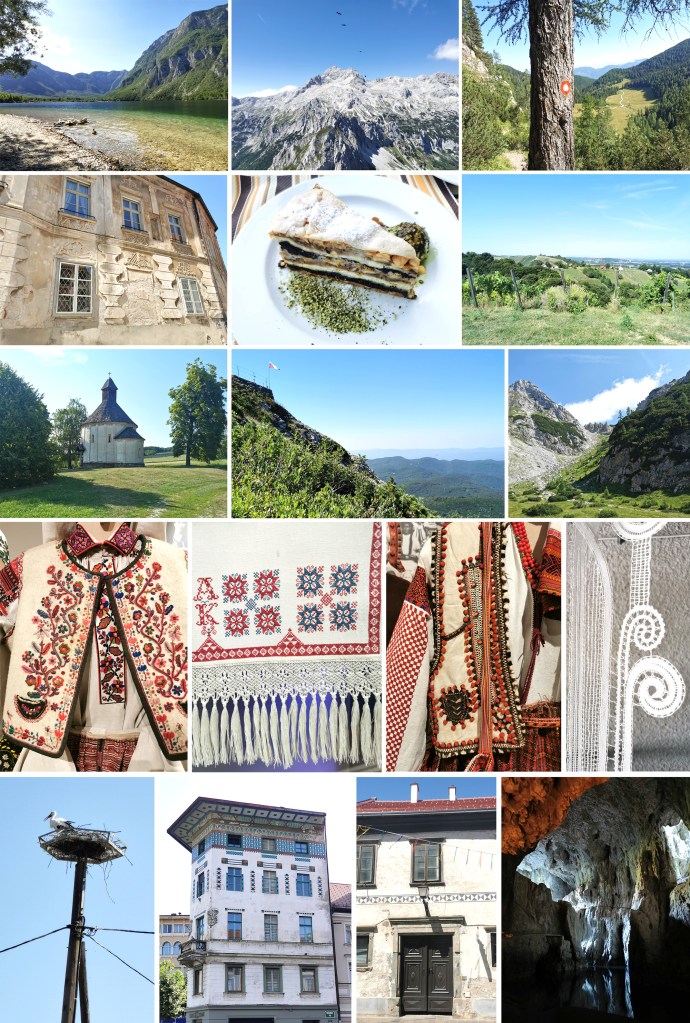
We returned home with a sleeper train from Ljubljana to Stuttgart, on to Paris, London and home to Norwich. Here are a few shots of the beautiful country – I can thoroughly recommend it!
In May I was lucky enough to have a paper accepted at a conference organised by the Netherlands Institute Athens on the subject of Textiles Production and Representation: From Pre- to Postmodernity. It was an incredible three-day event with truly international delegates and it was fascinating to hear about so many aspects of textiles. From spinning to weaving and knitting, from personal narratives to shared histories, from craft practices to industrial production, I learned so much. Everyone was sharing with their research and supportive of each others. I presented my ongoing practical research and received great interest and feedback too. It is a time I won’t forget easily and I’m sure we will cross paths again.
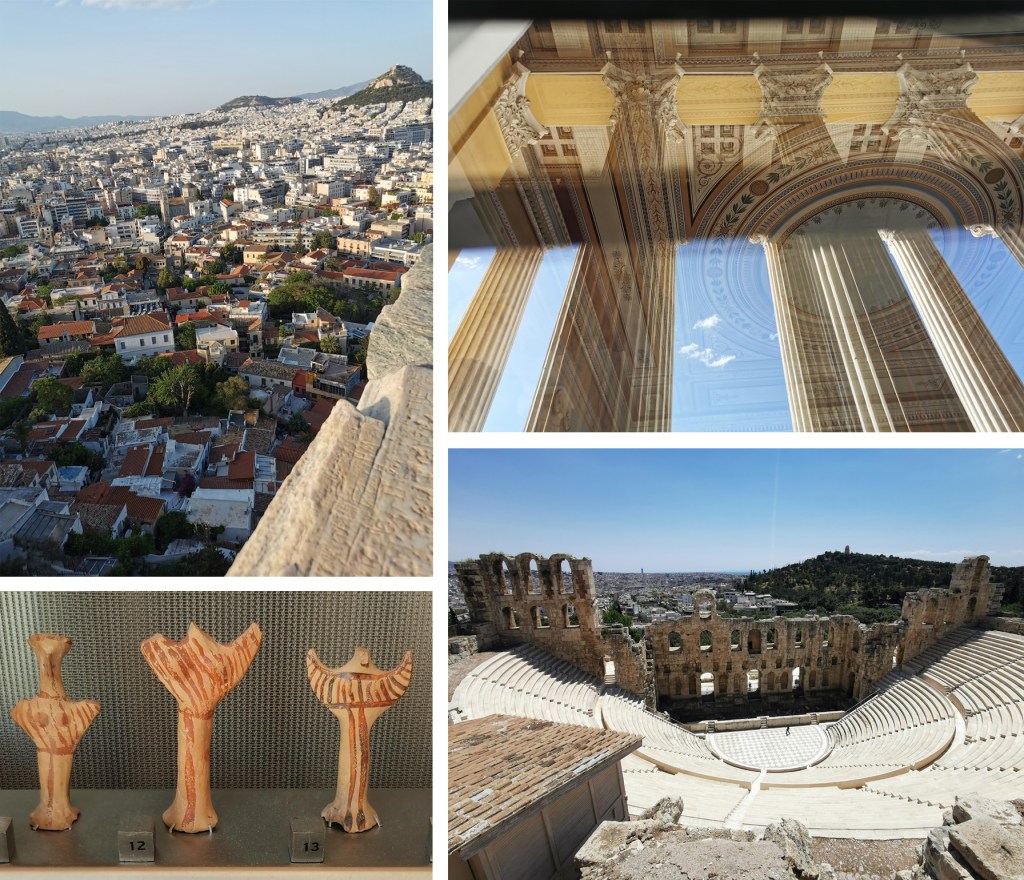
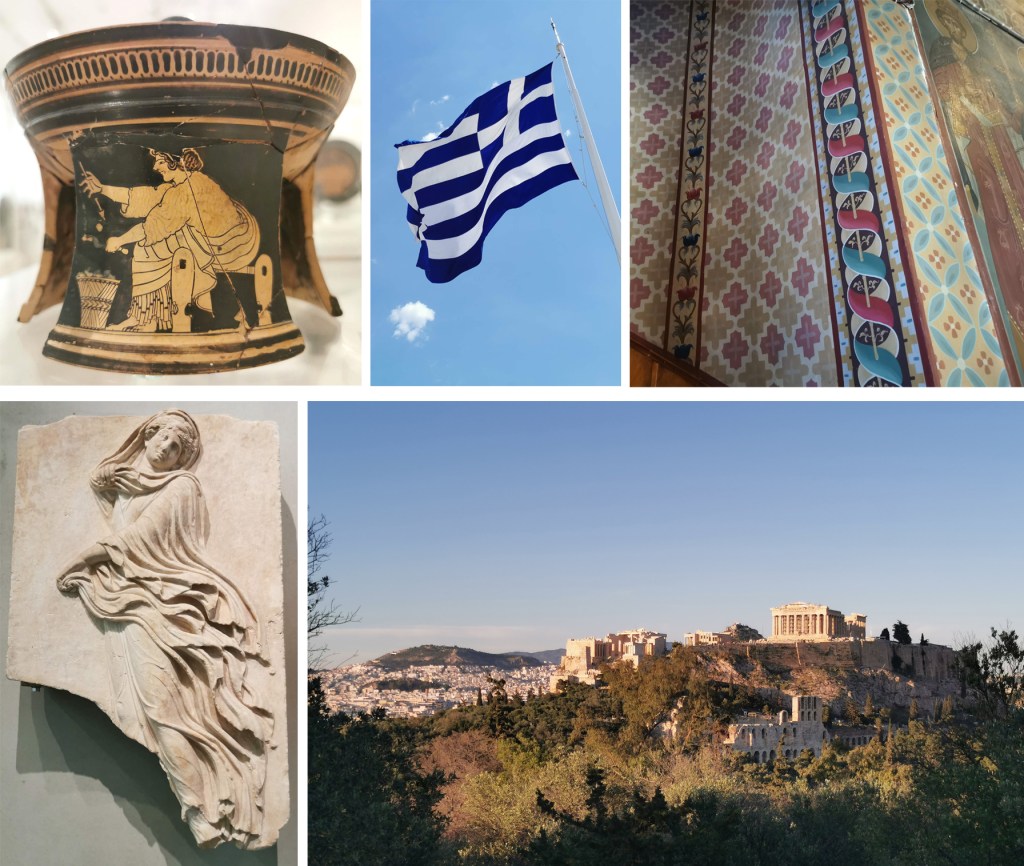
I was able to tag a couple of days of leave on to my trip so there was enough time to explore Athens. I’ve transferred flights over recent years and was last in the city as a young child with memories of intense heat and traffic, but my experience this time was very different. I explored the city on foot, through small alleys and back streets, up and down steps as well as hills. I sat watching sunsets, and took in the sites, including the Acropolis twice! I was completely taken with this city.
I walked miles, visited museums and landmarks, ate wonderful food and took lots of photographs! The dates of some of the artefacts I saw was mind blowing, as was the incredible craftsmanship. I can thoroughly recommend the Benaki museum, the Ghika museum, the Acropolis museum, the Archaeological museum, the stadium, the small squares, the classical ruins, the changing of the guards and botanical gardens, as well as Lycabettus Hill. My photos can only hint at the joyful time I had there – I can’t wait to go back!
Having visited the Women in Print, 150 years of Liberty textiles at the William Morris Gallery, I headed to Liberty to see the latest fabrics and bought myself a Merchant & Mills pattern and Liberty Tana Lawn printed fabric as a holiday project, which I can proudly share I have completed and am waiting for warmer weather to show it off!
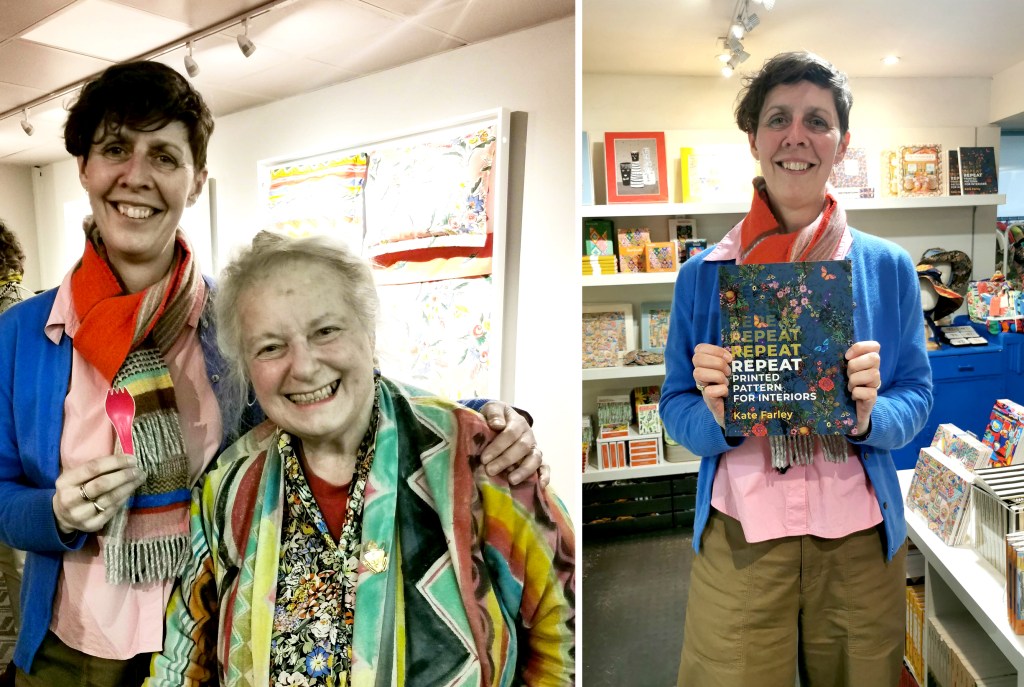
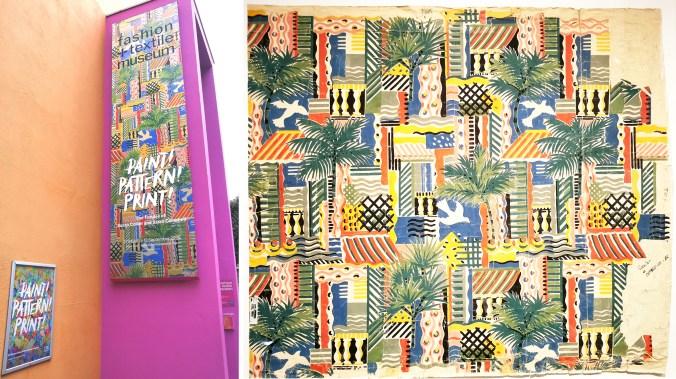
The primary reason for visiting London at the end of last month was to attend the Private View of the exhibition: Paint! Pattern! Print – The Textiles of Susan Collier and Sarah Campbell at the Fashion and Textile Museum, so I headed to Bermondsey, near London Bridge for the evening. Thanks Sarah for the invite! On arrival at the museum we were greeted by Sarah and much to my amusement she presented me with a pink takeaway fork from her pocket – for my fork collection!
I first met Sarah in London about ten years ago, having got in touch with her via Twitter when that was a nice place to be! Someone had the nerve to copy some of Sarah’s work, so I reached out to offer my sympathy and we decided to meet up the next time I was in London. As an academic I was in the capital for New Designers, the graduate showcase at the Business Design Centre, so we arranged to meet. We spent well over an hour putting the world of pattern in its place and we have stayed in touch ever since, with Sarah judging student awards for me, and joining me on an industry panel I was chairing at New Designers in 2023, having been kind enough to allow me to feature her work in my book, Repeat Printed Pattern for Interiors, published by Bloomsbury in 2023. I was delighted to see this book stocked at the Fashion and Textile Museum – thanks to the Liberty team for taking the picture of me and my book!
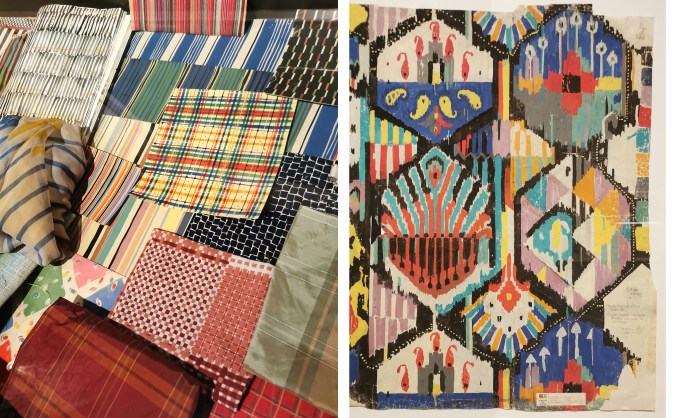
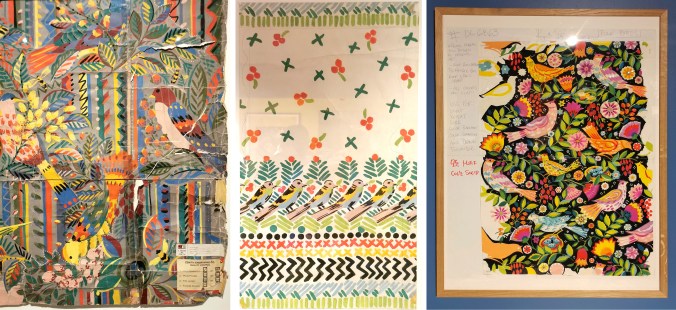
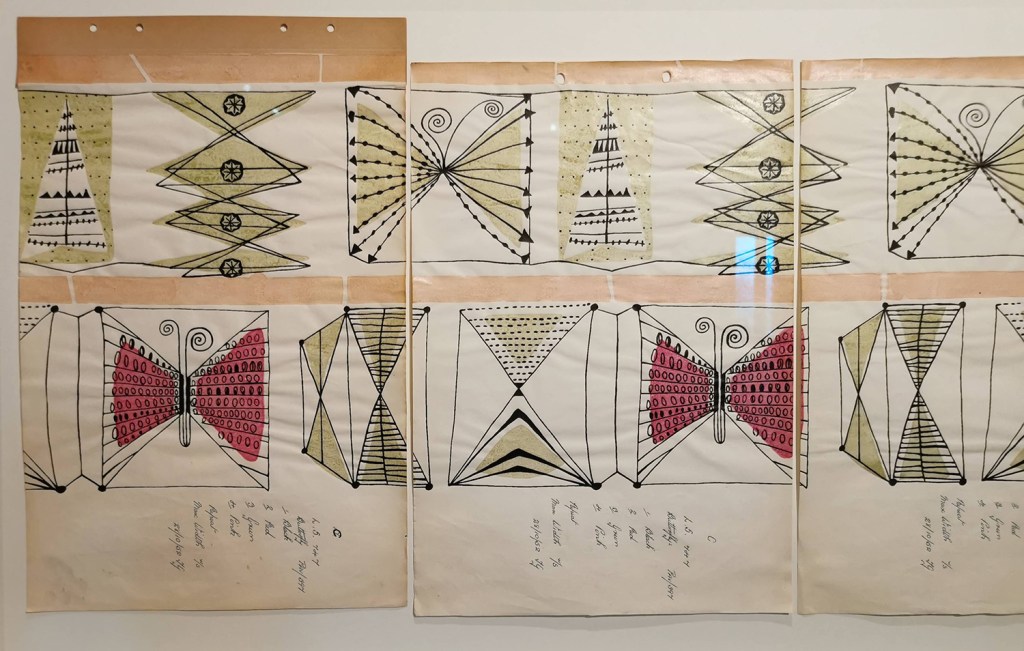
On entering the exhibition it was a complete feast for the eyes … with pattern and colour everywhere, appearing from around corners, up above and room after room. This was a true dive into the archives of Collier Campbell textiles over decades of working together, two sisters and a shared vision for joyous textiles. The exhibition included a wide range of items designed by Susan and Sarah, from the drawing and painting tools, to loose sketches and scaled painted designs on paper to lengths of printed fabrics, interior products and dresses. There were examples of Sarah’s more recent collaborations with Magpie and West Elm, alongside press cuttings featuring both Susan and Sarah at home and wielding paint brushes.
As a child growing up in the 1980s the look of home textiles, if not Laura Ashley, was likely to be Collier Campbell. With bolder and colourful brush marks suggesting the joy of Les Fauves artists, Matisse and Derain, rather than the Victorian Gothic tight sprigs Laura Ashley celebrated. I remember visiting the exhibition at London’s National Theatre in 2011, celebrating fifty years of sisters Susan and Sarah designing in 2011, shortly after Susan died. I recall loving the energy in the painting and bold use of colours.
In this current exhibition, as is the legacy of the archives, the patterns are rhythmic in their flow and scale; musical in spirit. Motifs are often geometrics, florals and birds, and famously designs such as Cote d’Azure, evoke summer scenes in Europe as the sisters worked to deadlines only imagining the holiday season. It was wonderful to see the paperwork for this piece, having included it in my book, Repeat … that features an interview with Sarah and images of key pieces by Collier Campbell.
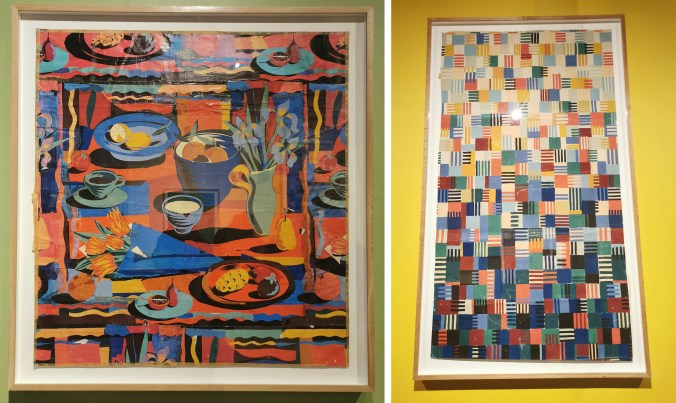
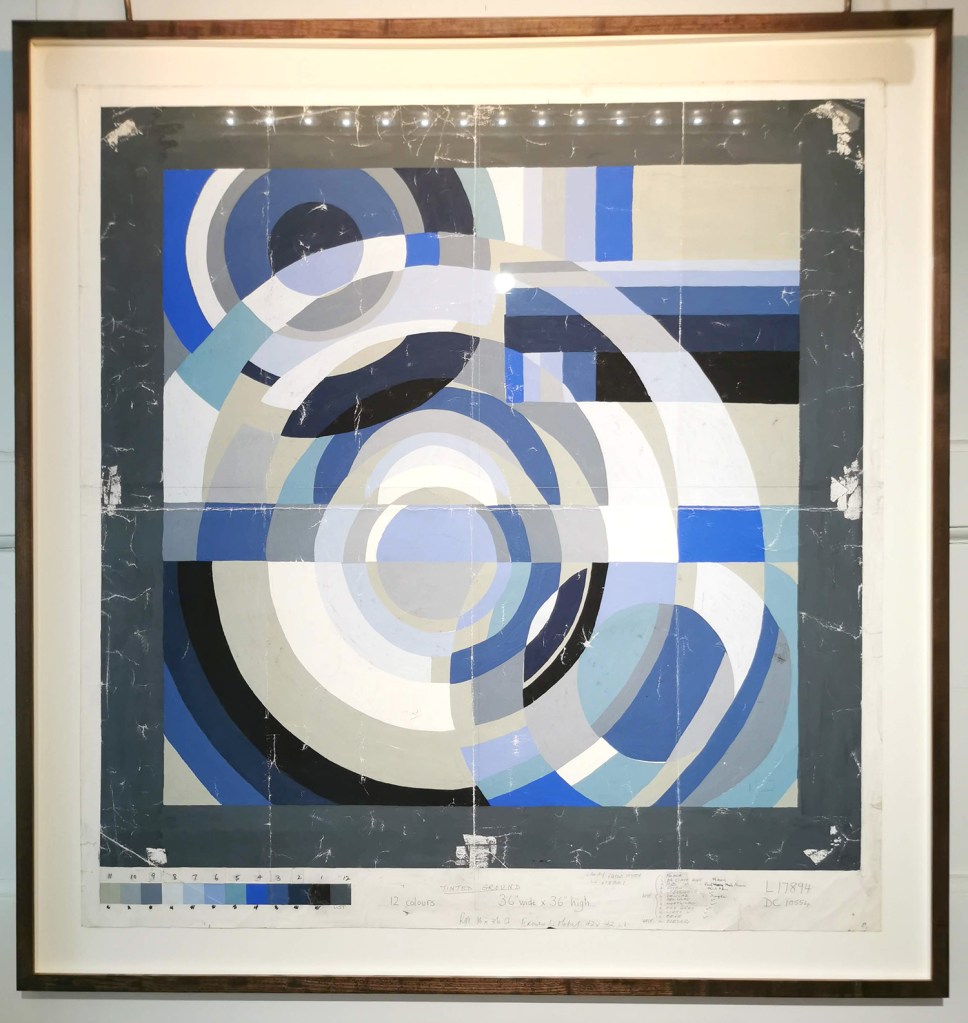
A design new to me that I really enjoyed seeing was Dancing Squares, from 1990 for American company UTICA (Stevens). This huge length of hand printed paper over two and a half metres long features painted squares evolving from dark to light up the design (right hand image below). The design on the left, again one I wasn’t familiar with, was a huge collage of a table of food and drink, in warm reds and oranges complemented by blue and turquoise.
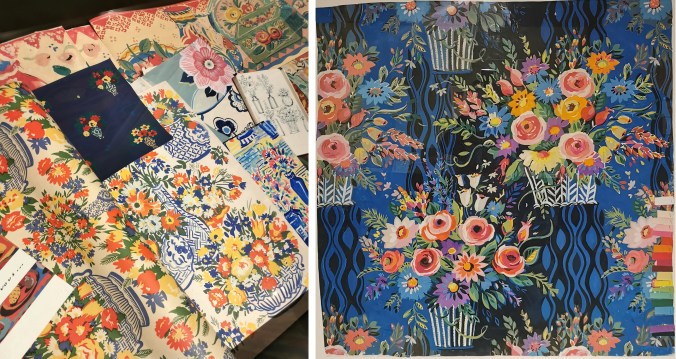
The florals and bird designs were full of life, with painted textures and pattern. It was also good to see the colour chips on the sides of some designs to guide the printers for production, as well as notes for the artworks and printers. The designs have depth as Susan and Sarah played with backgrounds and foregrounds as equal importance. Display cabinets showcased works on paper and coordinating designs alongside their hero prints as large statements on the wall and hanging as lengths.
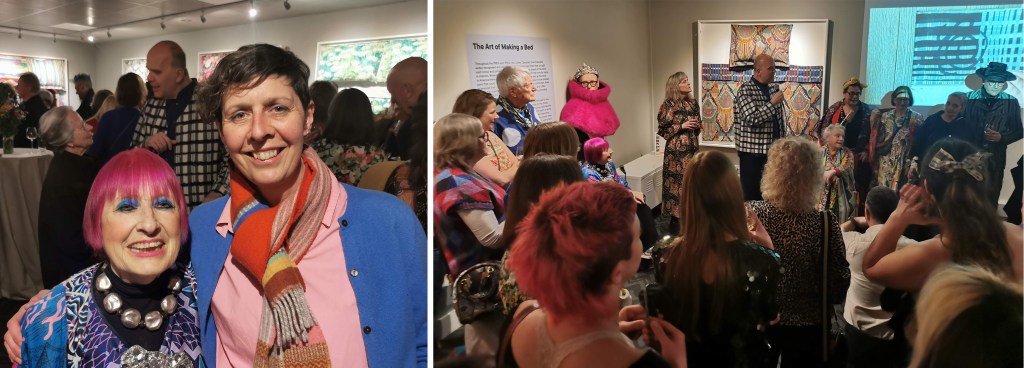
Everyone was friendly. I chatted to several people during the evening as we shared our joy of the work on show and the speeches by the curator as well as Sarah celebrated the pure joy that pattern, colour and creativity can provide. I was excited to have the opportunity to talk to Zandra Rhodes, the founder of the museum, and who continues to inspire us all, including the students I teach at Norwich.
I have only shared some of the many photographs I took on the evening, but I strongly recommend the show to anyone who loves printed pattern. It is the perfect tonic for the times we are living in, and a beautiful reminder of the joy to be found in painted and printed pattern! Congratulations to Sarah and the curatorial team of Teresa Collenette and Dennis Nothdruft at the Fashion and Textile Museum.
I sat on the train back to Norwich with my heart filled with excitement for the world of pattern I belong in, energised to support the next generation of designers I am working with at Norwich over the coming months. It was a day of celebrating Sarah and her sister Susan, having seen so many of their designs in the two exhibitions I visited – what a truly impressive legacy to be inspired by!
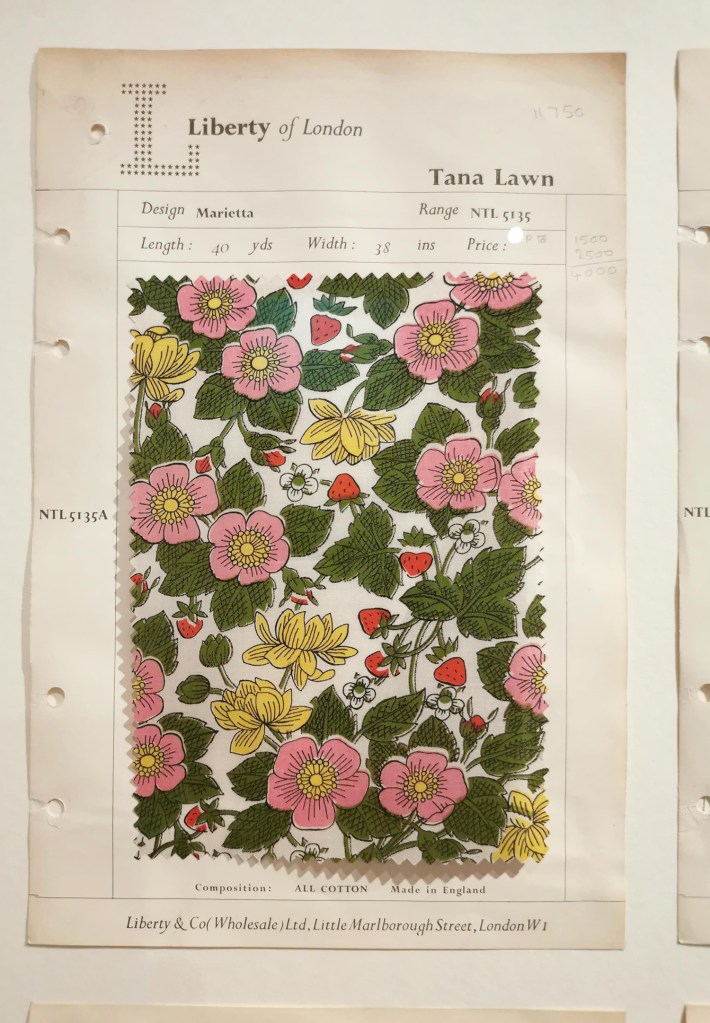
I spent a busy day in London this week, with focus on print and pattern. It was fabulous! My first destination was the William Morris Gallery, Walthamstow in east London. I can thoroughly recommend the exhibition, Women in Print: 150 years of Liberty Textiles, on until Sunday 21st June 2026, in conjunction with Liberty Fabrics.
The exhibition spread across two floors of the gallery with a number of rooms and corridors showcasing some old favourites of printed textiles and related works on papers, alongside some lesser known pieces and associated garments.
The introductory video for the exhibition gave an insight to the role of women at Liberty with old photographs and recent interviews. I thoroughly enjoyed seeing old favourites throughout the exhibition, with works by Sonia Delaunay, Althea McNish, Jacqueline Groag and Susan Collier & Sarah Campbell as well as being introduced to names I wasn’t aware of, including Mrs Stoneley and Winifred Mold. I hadn’t realised Lucienne Day only designed one design (Fritillary) for Liberty, with it being agreed she would design for Heals while Robert Stewart would design for Liberty!
There was a second video upstairs, filmed in the 1970s that showcased the print and dye work with some rather random models in Liberty clothes wandering in and out of shot, by the print tables and dye vats in swimwear! When I discussed this with Sarah Campbell later that evening she joked it was her and Susan, the design duo behind Collier Campbell – exhibition now on in London’s Fashion and Textile Museum and featured in my next blog post!
The exhibition is free to attend, with donations to the gallery gratefully received.
Congratulations to curators, Rowan Bain and Róisín Inglesby.
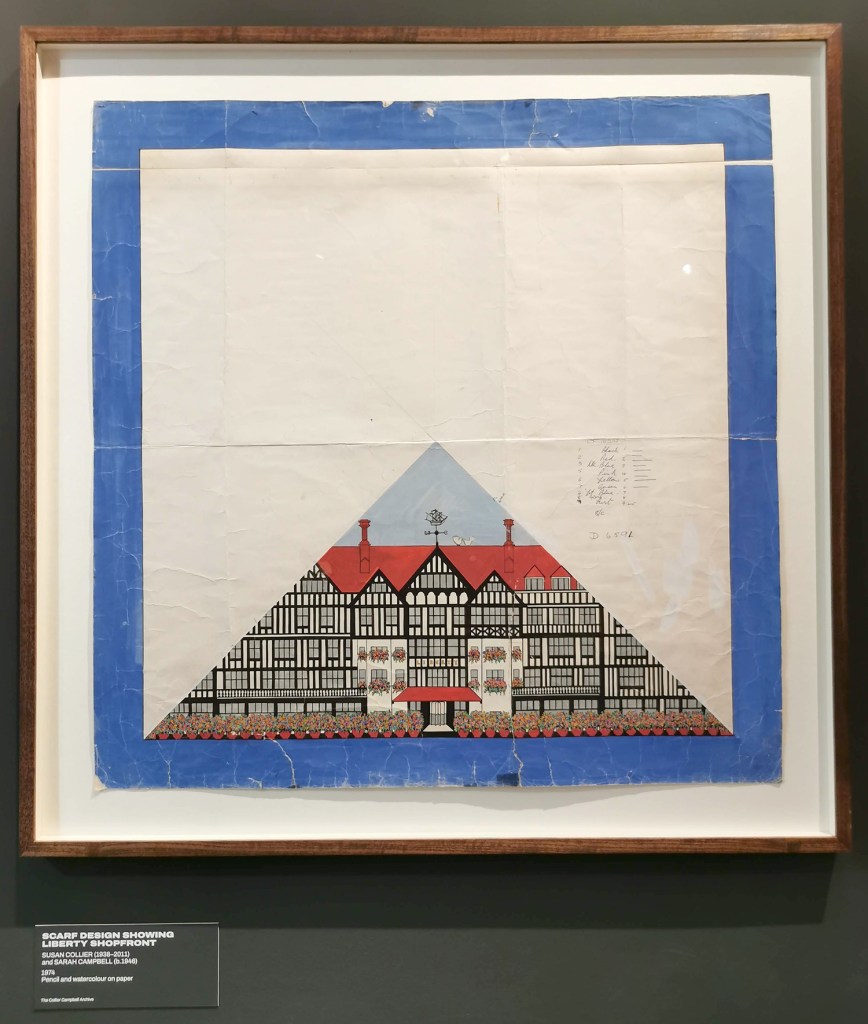
Susan Collier & Sarah Campbell, scarf design featuring the Liberty shopfront
Sonia Delaunay scarf design
Liberty swatch
Lucienne Day’s ‘Fritillary’, her only design for Liberty
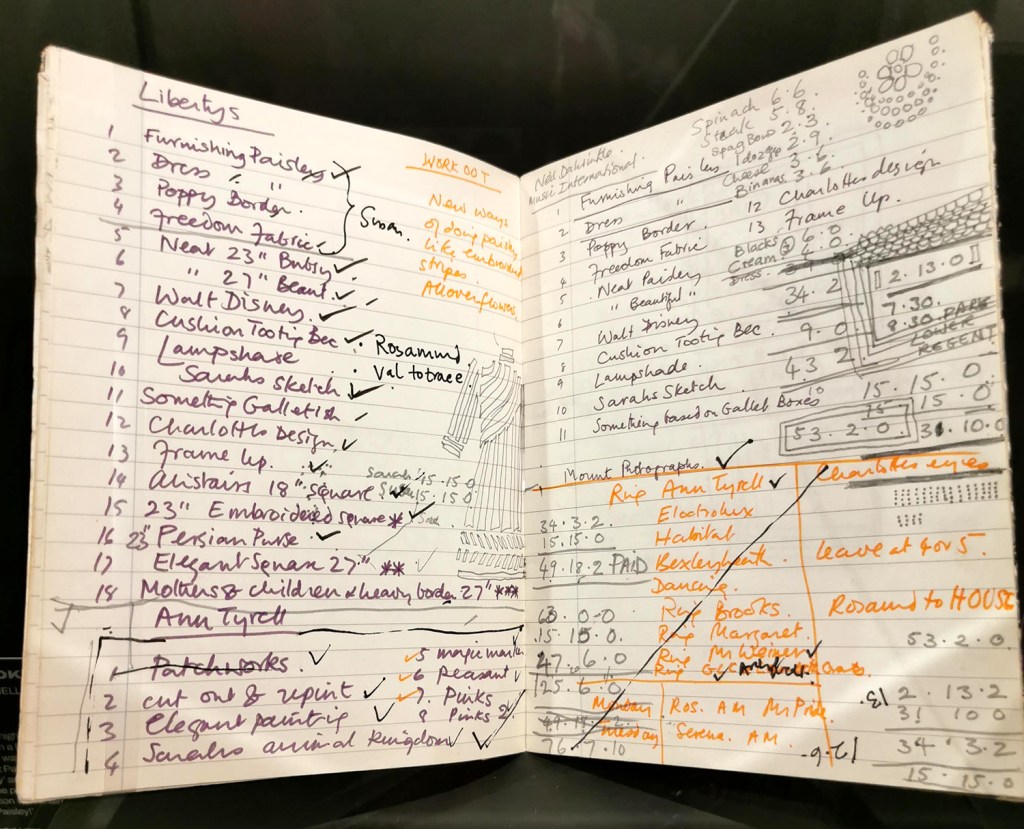
Sarah Campbell’s notebook, double-spread
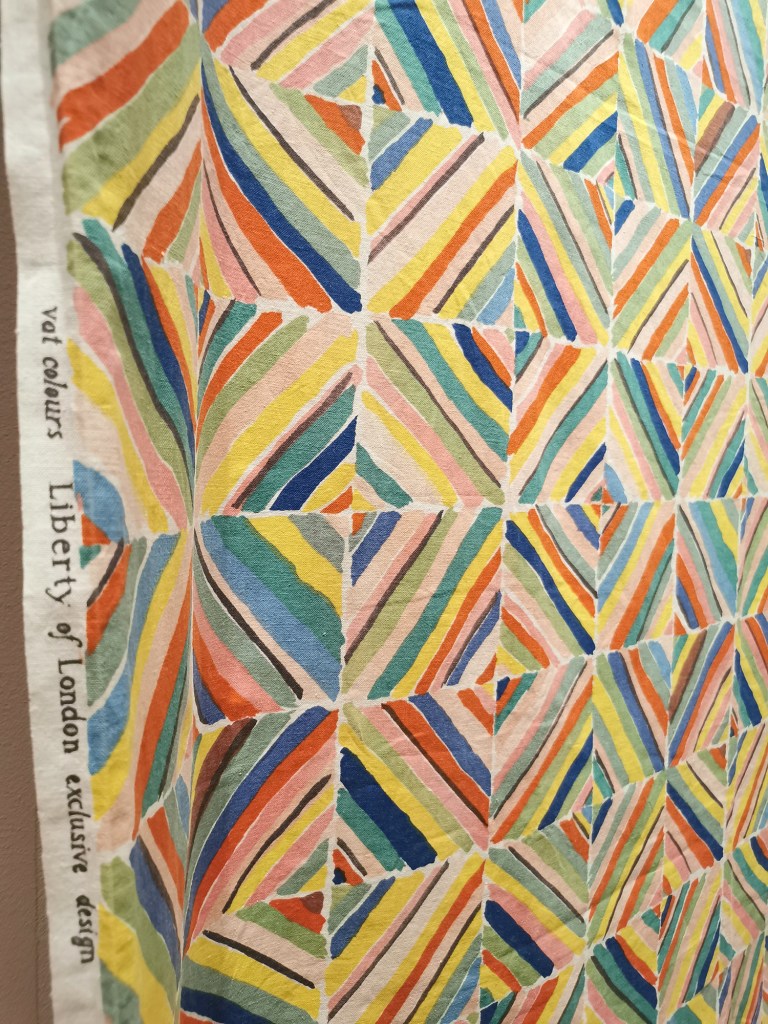
Collier Campbell ‘Kazak’ design
Collier Campbell for Liberty, featuring Bauhaus, inspired by Gunta Stolzl, the weave master at the Bauhaus, Germany
I’ve been busy printing and presenting my ongoing pattern research over the last few months, testing the design and print process, and receiving useful feedback – which may explain the lack of blog posts recently!
Last September I presented my work at the Fashion and Textiles Courses Association conference, Futurescan 6, held at De Montfort University in Leicester, and had a small exhibition of the work in progress during the conference. It was great to formalise my ongoing work at that time, and receive external feedback from the audience. It was useful to consider how I communicate the research, as the principle is simple but the process complex. I have also discussed this research as part of other presentations over the last few months, for colleagues, for undergraduate students as well as the audience of the Costume and Textiles Association’s programme of Heritage Open Week talks at the Forum in Norwich.
Last week I presented this research to the British Association of Paper Historians as part of their Spring Meeting held at St. Bride Foundation, having been invited to do so by the Wallpaper History Society. My fellow presenters covered wide ranging topics, from paper conservation, Japanese paper as cloth, the College of Arms and the current situation of the paper industry in the global context. It was a fascinating day with lots of common ideas and interests, and I received some very positive feedback to keep me on track.
I have further opportunities to share my research in a couple of months, so more news on that in due course!
I am continuing to develop both lino blocks as well as artwork for screen printing, which enables me to test different colour handling and substrate options, for wallpaper and cloth. Colour is an important element of this research and particularly the transparency of colour in the overprinting, so the palettes will continue to evolve as I continue the exploration of primary and secondary colours.
As I gear up to making larger work for an upcoming showcase opportunity I look forward to sharing more of the work in progress.
Dates and anniversaries matter to me, personally and professionally. They record the passing of time, the gaining of experience, the rhythms of life and death. I bemuse my family & friends by remembering apparently irrelevant dates, including the birthday of Roland Rat, (12th March if you are wondering!).
Seven years ago this week I started working at Norwich University of the Arts as Course Leader of both the Fashion and Textile Design degree courses. I undertook this role for four years before focusing on the BA Textile Design course for the last three. I am immensely proud of the course and community I lead, with a strong network of colleagues supporting me with the wobbles while celebrating the wins.
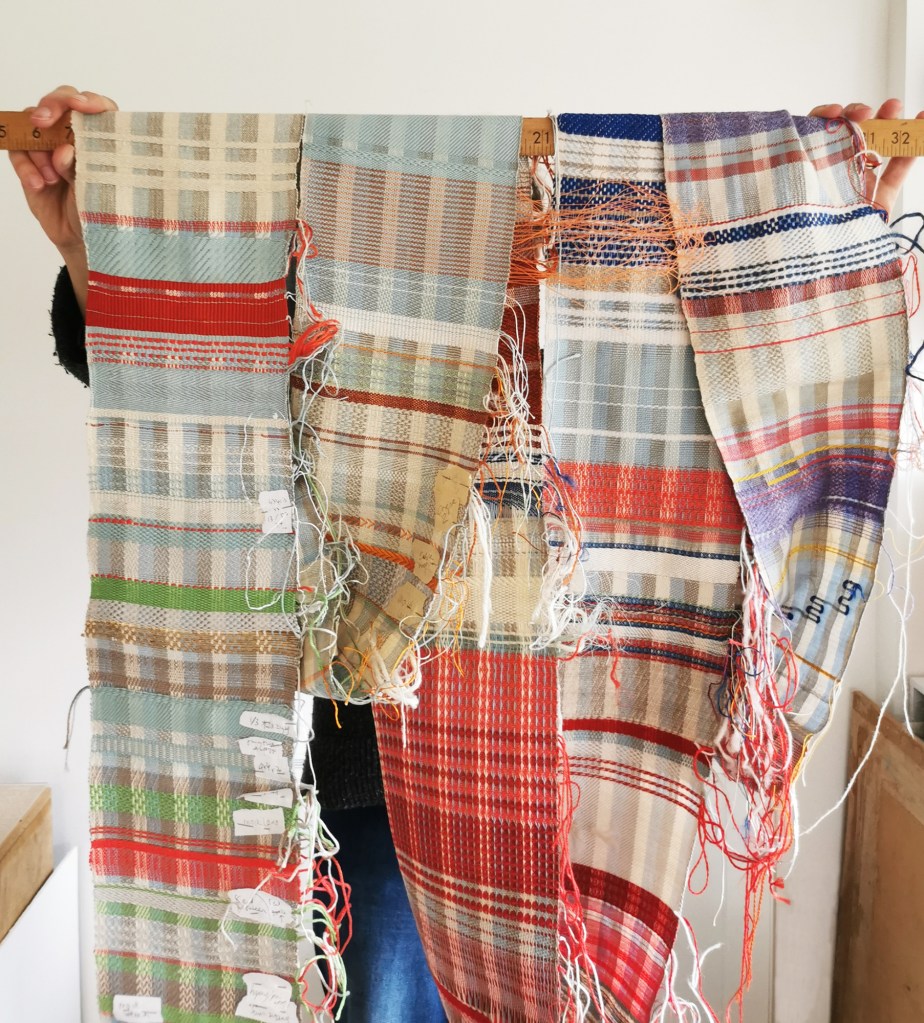
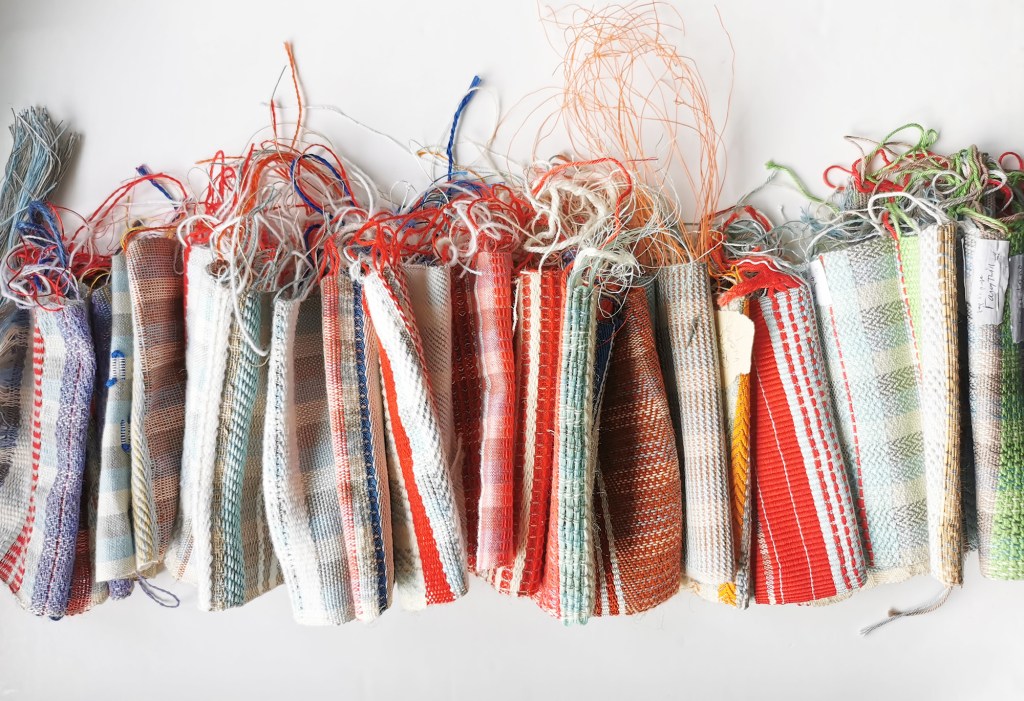
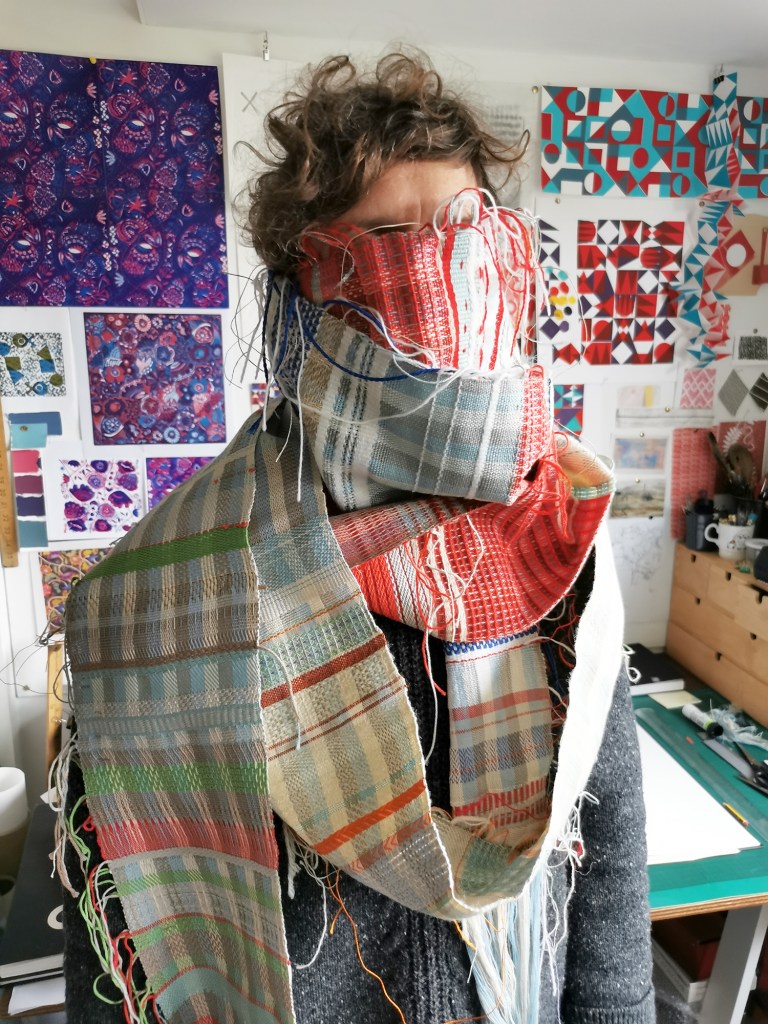
One of my leaving gifts from my colleagues at Birmingham City University back in 2018 was a warped-up 8-shaft Harris loom – it’s important to note I’m a printed textile designer, not a weaver! This week I have finished weaving the warp – over 5 and a half metres of weaving – certainly not a commercially viable rate! I haven’t committed a huge amount of time, more short bursts over the years when the mood took me. I was surprisingly sad as well as excited that there was no more cloth to weave and I’d be able to see the entirety of the weaving away from the loom.
The completion of the warp coinciding with this work anniversary has made me reflect on these years, there have been highs and lows in both work and life. Learning to weave has given me a process to occupy my head with away from everything else, without any pressure but to play and explore. It has been so helpful for me to have this space and activity. As I cut the warp threads and unwound the length the bands of colour and materials I selected at various times revealed themselves, reminding me of how I was feeling as well as specific experiences.
In parallel to making this cloth, I’ve developed my role in academia – developing curriculums and strong student experience, achieving the title of Associate Professor in Design, writing a book, and developing my role of advocate for others and the discipline of textiles both in education and industry. It’s nice to have something tangible to mark these years. I’m ready to get stuck into the next chapter of academia but I’ll have to find another hobby or learn how to warp the loom up myself … here’s to the next year of learning and teaching!
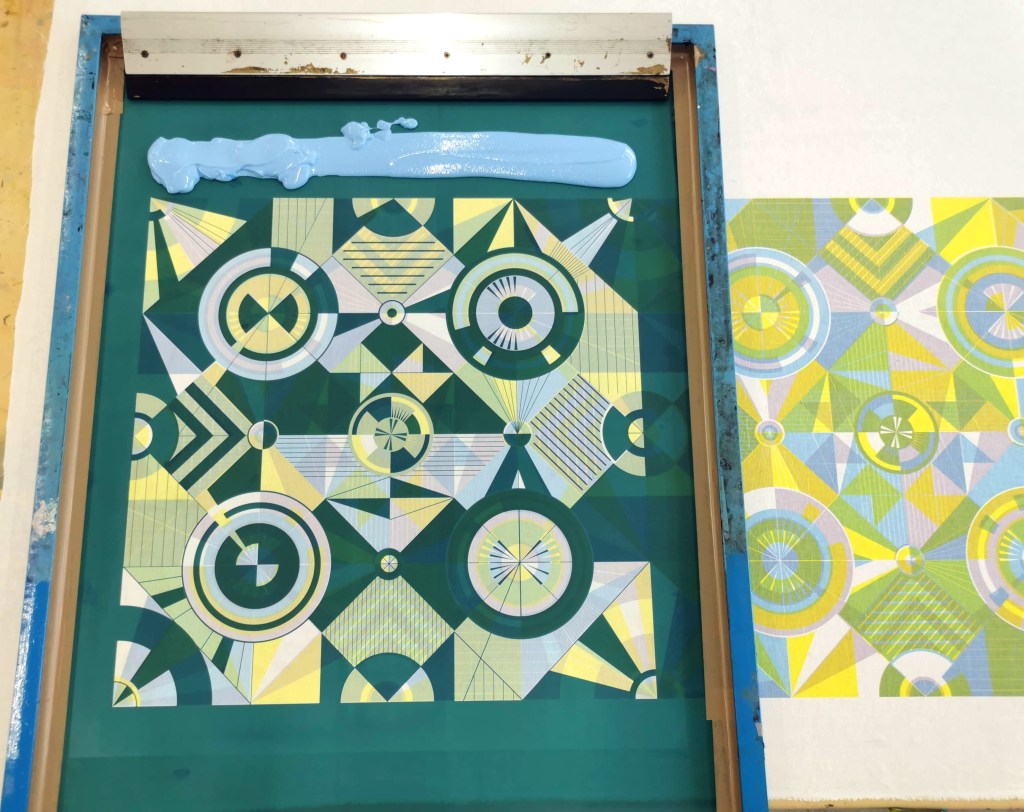
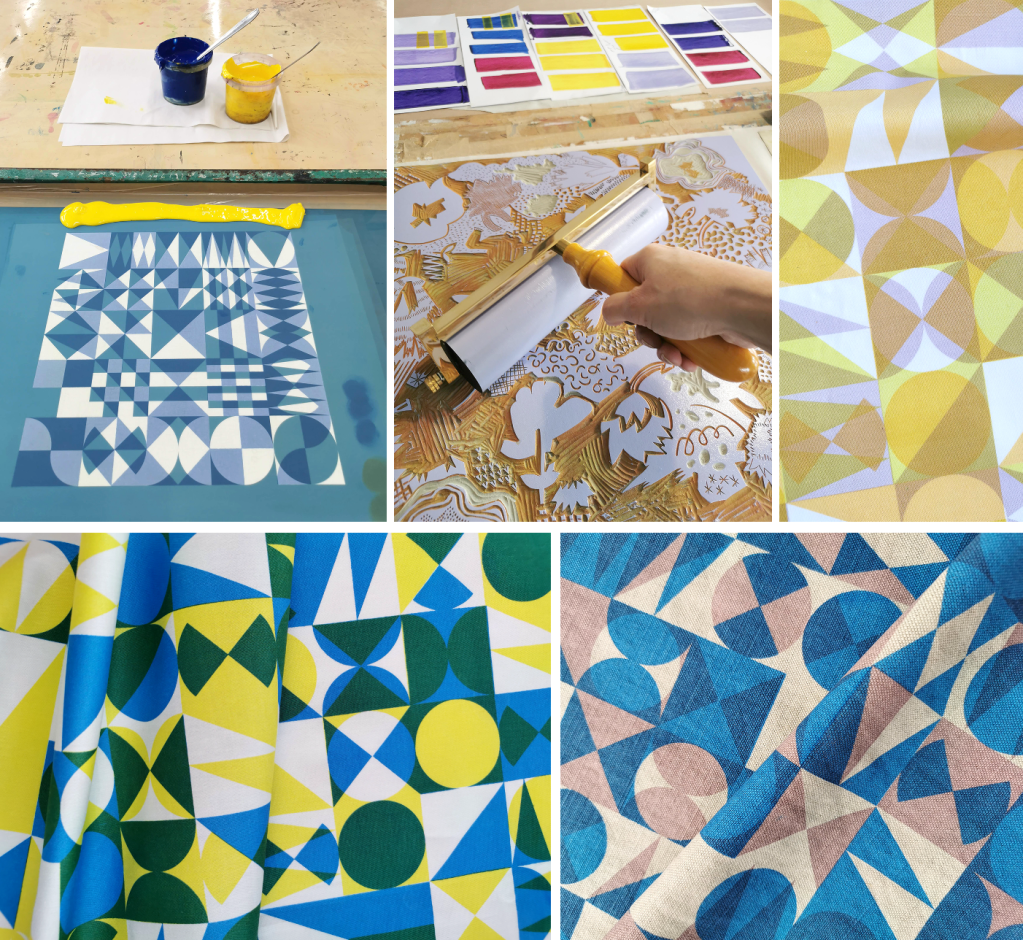
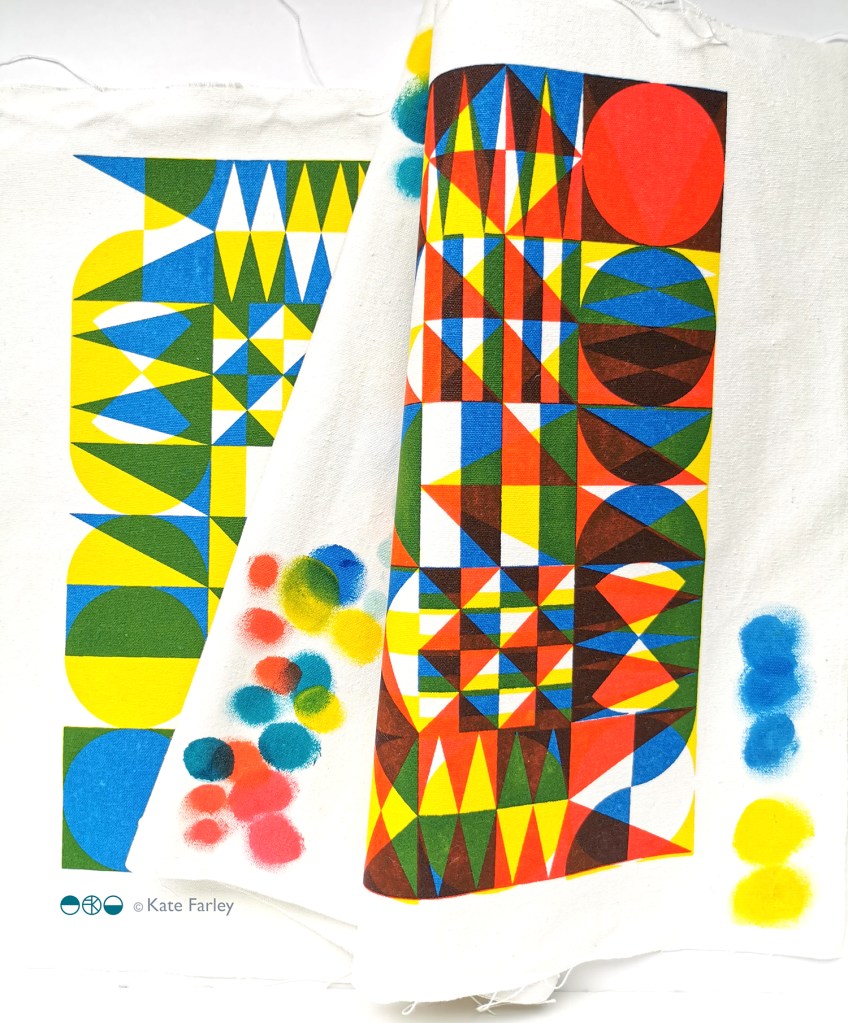
After a long academic term leading the Textile Degree at Norwich University of the Arts I finally found some time to get in to the workshop and sample some designs on fabrics. I developed the patterns rather a while ago. I love the process of screen printing, from mixing the colours, exposing the screens, pulling the squeegee and of course lifting the screen to see the new print. I even enjoy washing the screens ready for the next time!
I’m not going to share all the outcomes at this point, but here’s a taster of the colours and a glimpse of one of the designs. I was working with transparencies in the pigment and binder to create the extra colours… and I’m really excited about the results!
As a result of my current pattern research practice, I’ve been keen to get out and discuss print production methods with designers and manufacturers, particularly as I was restricted in doing so while writing my book during the pandemic. A couple of weeks ago I had the opportunity to visit designer Marthe Armitage in her showroom in west London, showing her my sketchbook / design work and discussing each of our design and production processes.
I’m not sure when I first became aware of Marthe’s patterns on wallpaper and cloth, but I’ve used her designs in my university lectures for the last few years to illustrate economic principles of building pattern, using a single block (one colour) to provide flowing and complex patterns, featuring varieties of visual texture within motifs. I bought the book on her life / design career, The Making of Marthe Armitage (published in 2019 by Graphical House) and was impressed by the beautiful drawings that accompany and support the design work I was familiar with. It is a thoughtfully produced book, with some copies available with a hand printed wallpaper wrap cover.
I’ve written before here about the time my ‘phone rang and Marthe was at the other end, ready to discuss her inclusion in my book and we went on to put the process of pattern design to rights. Meeting her more recently and showing her my sketchbook was a wonderful experience. There was straight talking about the current state of patterns available on the market and we agreed with each other about drawing on paper to map out the design on a grid to establish the composition for repeat. She was intrigued by my investigation in to block repeat and rotation of the tile and suggested some of my ideas more fruitful than others – I agree! We were joined by Marthe’s daughter Jo who leads the hand printing and is key to the future direction of the business, as well as Harriet, the Creative Project Manager and Christine, the hand printer who supports Jo in production. I was interested to learn of some new plans in development and gain an understanding of their experiences of print production in the UK.
The showroom in Brentford is a beautifully designed space which includes the printing press for hand printing their wallpapers and plenty of samples to admire, and is open to the public regularly. Tins of ink are displayed alongside samples of designs in progress and colour testing. It was also interesting to see the lino blocks featuring the designs cut by Marthe backed on metal plates ready for the press. Check out the instagram account for up to date news.
As our meeting came to an end, I grabbed the opportunity to ask Marthe for a photograph of her alongside the beautiful designs and to sign the copy of my REPEAT book in which I’m collecting signatures from the contributors. I am very grateful to Marthe and the team for making time to meet with me, thank you!
For a number of years I’ve been aware of the fascinating work of Colorifix, an award winning bacterial dye biotech start-up organisation based in Norwich leading the way for a more sustainable dye practice. Following some planning and support from our technical team I was able to host PhD researcher Ruth Lloyd in partnership with Colorifix to share with us their work and to lead a workshop for our BA3 students. Ruth is carrying out practice-based research “to develop and commercialise bacterial dyes, where she will further explore the capacity of colour producing microorganisms to create human designed patterns”.
We were treated to a insightful presentation by Ruth about the science and development of the colours, before we were able to have a go at printing with the bacterial dye colours. The students and staff tested painting the colour directly on to the fabric as well as painting on the screen then transferring the colour, as well as using paper stencils with the open screens.
The range of colours is limited at the moment, so this is something being worked on by Ruth and the team at Colorifix. The different fibre content of the fabrics printed on can significantly impact on how the colour appears so we were testing natural and synthetic fabrics to build our technical files and our own understanding of colour and textiles. Thanks Ruth and Colorifix!