A while ago I received a message from a friend over in America, and knowing of my career and personal interest in textiles, she was writing to see if I’d like to receive some old but special textiles she had spare that made her think of me… I was intrigued what might arrive in the post… How could I refuse!? A few days later two beautiful squares of cloth arrived, one with a woman and the other a man stitched in to the cloth across one corner, with gently ornate decorative edges and corner details.

She thinks they are napkins, they are very light weight cloth. Accompanying the two pieces was a note sharing what she knew of the provenance, and how she had acquired them to share with me. Emily remembers them in her mother’s ‘stash’ of things in the 1970s, when she must have been only about 4 years old, so they made an impression on her.
They were possibly bought by her Grandma Daisy (an accomplished and frankly, rather compulsive ‘antiquer’), at an estate sale, maybe a farmhouse estate sale. She had a good eye and built an impressive hoard! Emily told me there is a sizeable German-American population in Wisconsin, so this might be part of the story too.
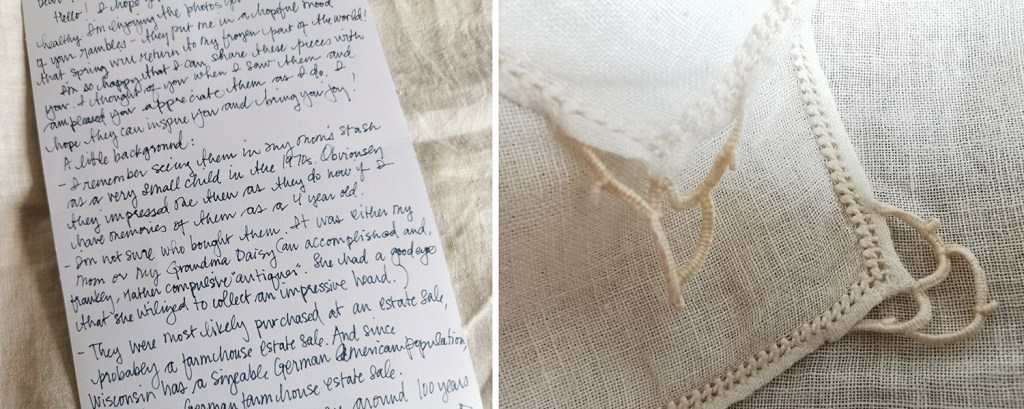
I’ve consulted my panel of experts as I’m no embroidery expert myself, and they’ve been a great help (thanks particularly to Grainne & Liss) … I think it’s safe to say it’s a combination of techniques, including cut work and stump work. One of my experts suggests stump work is the overarching technique, particularly to create the woven style stitches of the figures. Often more three-dimensional than these examples, stump work can be highly ornate with raised areas, but these squares appear rather low in relief.
We can also see whitework embroidery, a broad term including a number of different techniques, working with white thread, often linen, pulling the warp and weft threads to form motifs. Pulled or drawn thread work are examples of whitework where no cuts are made. Cutwork is a form of whitework where areas of woven cloth are cut away and stitched in new configurations. These samples include cutwork featuring buttonhole stitch & buttonhole bars with detached needlelace. I hope I’ve got all this down correctly!
There is an amazing online Royal School of Needlework resource here for more stitch information – you might be lost for hours!
A detail to note is that the figures have been created on the bias of the cloth, set diagonally on the weave near the corners, rather than the straight line of the weave. This may be a specific approach preferred by a particular maker, region or process, so might help identify the provenance.
The figures are wonderfully stylised as a result of the stitching process, naive and full of character. They remind me of folk art examples I’ve seen before and historic world textile samples at the Pitt Rivers collection in Oxford only a week or so ago. Also the characters are not dissimilar to the figures on the Asafo flags of the Asante in Ghana I’ve written about before. Once again, the process of stylising and representing imagery as motifs is shown to be one of my favourite subjects!
Textiles, although fragile, can survive in the right conditions for centuries, and can hint at stories of society, status, lifestyle and identity. The textile skills required to make these pieces are likely to be far more commonplace at the time these pieces were made too. Lightweight, portable and often with specific uses, textiles have been transported all over the world with people travelling for all manner of reasons. These two pieces have their own history I’d love to know more about, not only to understand where they were made and by whom, but also to understand the journey they have been on since their creation.
Despite not knowing more I shall continue to enjoy them, and in the process of writing this post I’ve learned a bit more about embroidery too… I am grateful to have been sent them to care for. Thanks Emily!
 Kate Farley - drawn to design
I have a set of four of these charming napkins. I found them in antique store. I was so excited to find you had some as well. They are my favorites