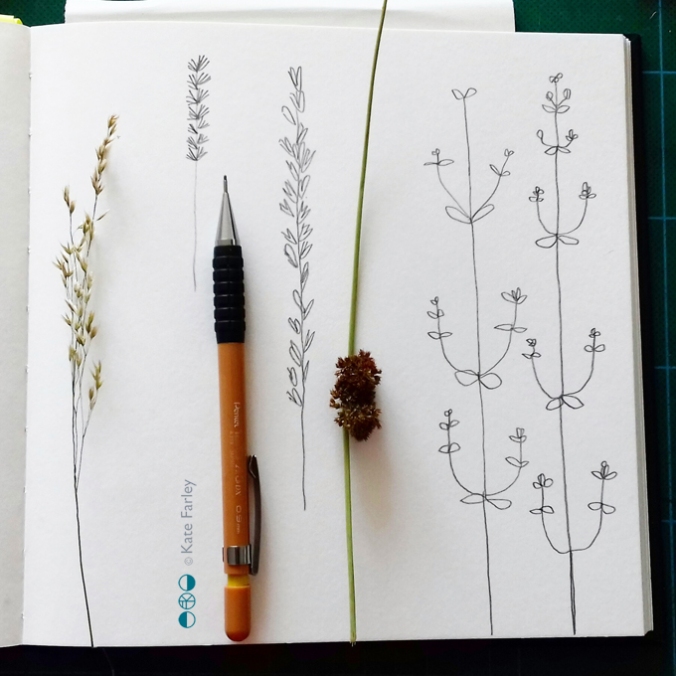
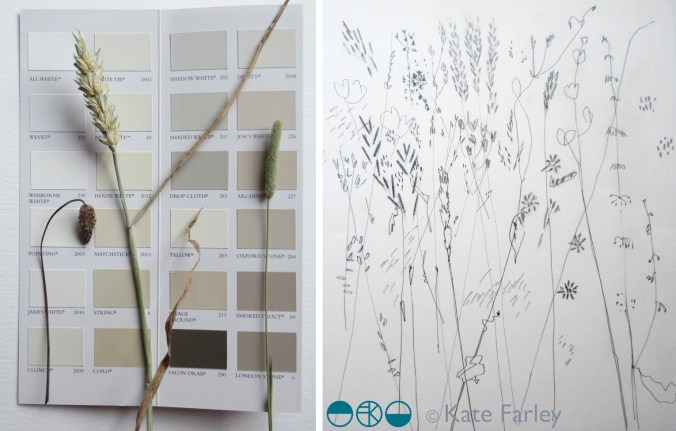
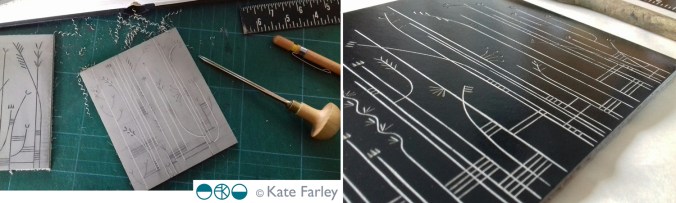
drawing grass lines

I’ve written many times over the years on this blog about the themes that underpin my work, the approaches I take to develop new work, and the things that inspire me. Here I look again at the process of evolving ideas and visual language, to introduce my latest series of prints.

As I develop ideas, often in series of works on paper before any design solutions are considered, I explore the visual language of the subject through drawings, photography and printmaking. The aesthetic nature of the new work evolves and is tested in relation to compositions and rhythms. My knowledge of pattern design, in particular in relation to textiles, feeds this investigation. The motifs, the linking forms, the negative and positive shapes and the quality of line can suggest relationships with historical styles, international influence and contemporary trends. As a designer I use this knowledge to sometimes avoid, and sometimes align to this language, communicating a context far beyond the printed paper I create.

On a cycling and camping tour around Denmark back in 2004 we came across a small book shelf in the campsite shelter containing a range of books. I can’t read Danish. We picked out a few, judging them purely on the graphic design of the spine, and I found a science book of beautiful diagrams of plant structures. I have a photograph somewhere, but the impression those diagrams made on me does not require me to see that page again. I remember the look of those diagrams, and they have fed in to this collection many years from then.

Mid C20th pattern is also something I am interested in, and for this new body of work, particularly the development of stylised florals and diagrammatic interpretation of plants. Lucienne Day was particularly expert at creating designs in that manner, with simple black lines, herself inspired by Miro, Kandinsky and Klee. This is why it’s important to be aware of what has gone before. Not to imitate the past, but to take courage from previous developments in drawing, stylising and pattern making, so we don’t recreate the past, but so we push forward with our own journeys, liberated by not inventing the wheel. I was amused to discover the current exhibition at the brilliant Whitworth Art Gallery in Manchester is Lucienne Day: A sense of Growth – it seemed uncanny!

My photograph collection, both in print and digital form, contains many pictures of reeds; Danish reeds, Norfolk reeds, anywhere else reeds. I also have many records of grasses, and have always been attracted to the structure of such plants. These are often the unloved weeds that may be irrelevant and overlooked by many, but I come back from walks with handfuls of lines, some with seed heads, some without, but always lines of grass, as if nature had fun drawing them. Different stems, leaves and weights of line, and some suggesting very distinct natural habitats. I’ve always been more interested in line quality than texture, and my work over the last two decades demonstrates that very clearly.

KFarley_drawngrass

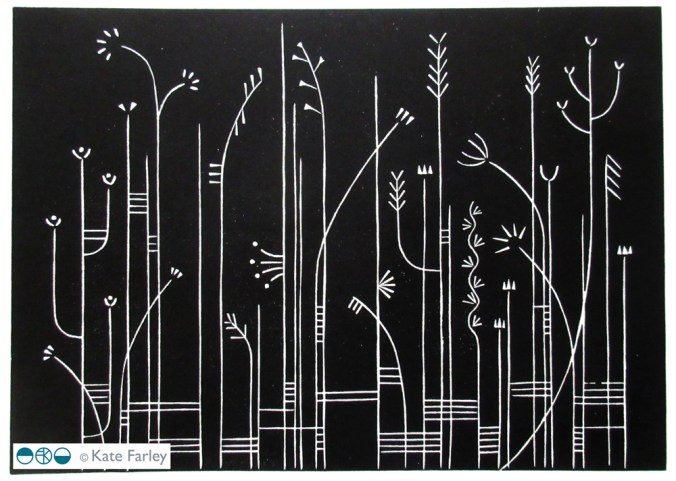
So that was a long-winded way of saying that this new series of works has been a long time coming, but makes perfect sense to me. I didn’t set out to create drawings of grasses, in fact I started screen printing flowers, but this evolved as part of the create process that is play. Colour came and went too, so as not to detract from the lines. There are some similarities with my threads printed editions and I have had the prints next to each other today – I think they make an interesting dialogue. This is the journey of idea development, by mixing drawing, thinking, printing, reflecting, contextualising, and doing it all again. By the way, this bit of the creative process is one that is very difficult to teach design students, more so with less and less studio time, and a full to bursting curriculum, but knowing your own creative process is halfway to success in my world. Take risks (it’s not rocket science we say) and work at playing.

KateFarley_grasslineslino

I digress. These few prints are only the start of this series, I already have new work evolving, but other projects are jostling for my time in the studio, so for now, I introduce you to Grasslines… and now you know a bit about how they came to be.

KateFarley_Grassline3

learning with archives

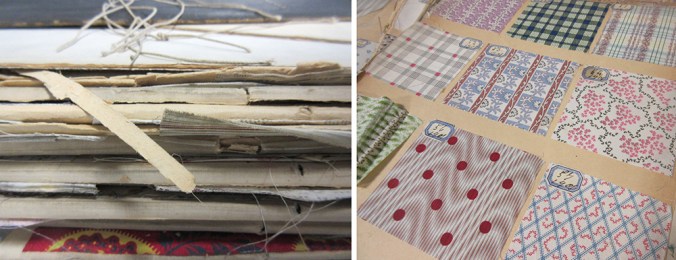
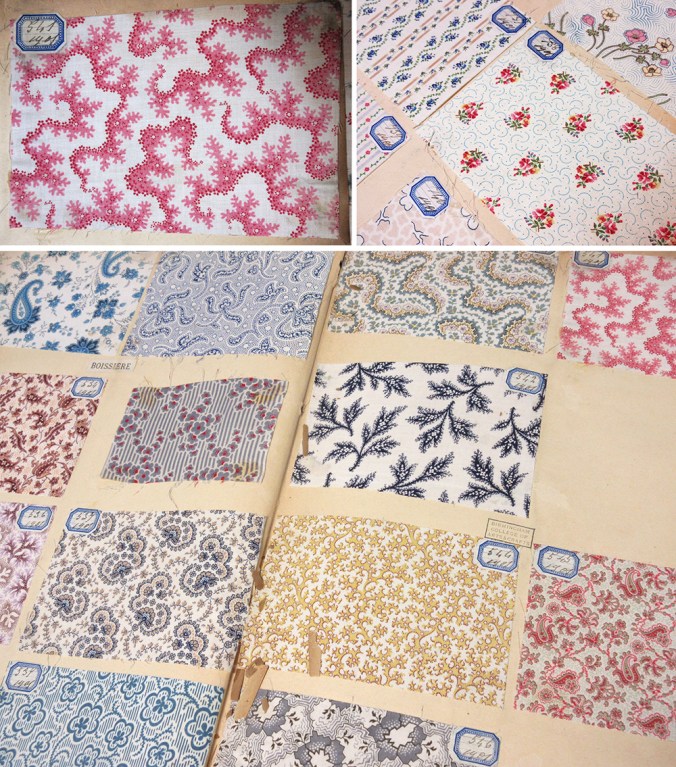
Recently I have been sharing joys from the fabulous archive of textile samples belonging to Birmingham City University’s library, some dating back from 1901. Myself and a colleague have been showing these treasures to our students, helping them to see their own learning as part of a history of design practices. In an age of the digital file it’s been fabulous to see how much interest these portfolios have generated with our students. It’s a tough call as we worry for the protection of these fragile items, and yet value being able to see and interact with them.

bcu_textiles1901_1

Being able to turn the pages, and reveal the hundreds of printed swatches is really an exciting journey and the students really engaged with the quality and preciousness of the items. The fact that all the samples are beautifully hand mounted and labelled adds to the beauty and experience. The range of design compositions is considerable, and the detail stunning. Tiny little flecks of print; an anchor, a petal of a flower, or coral texture printed on fine cloth demonstrate quality of the day. We noted the generosity of many designs, and discussed commercial appeal and production methods available before screen printing and digital printing possibilities. Of course this is pertinent at this time of financial cuts in the support to local and national libraries and associated archives, and with arts and culture being sold to the nation as a rather nice hobby we just can’t afford at the moment.

Seeing things with our own eyes helps to engage with the subject, making things real, and adding value to the experience. I spent an extremely insightful day at London College of Communication’s Learning Through Objects event #UALOBL last month discussing this subject with fellow academics, researchers and archivists. Yes it’s easier to deliver another ppt to a large group of students, but sessions with objects and physical activity are the ones that are likely to make far more impression, and make the difference to learning we are aiming for.

bcu_textiles1901_2

building aesthetics

For the last few years, I’ve been lecturing on the subject of design history to first year students of Textile Design at Birmingham City University as part of a module aimed at introducing historical design considerations. Styles specific to an era, the influence of globalisation, the role of Fine Art, architecture, film and graphic design in shaping textile design, and where we are now, in context to where we have come from are presented alongside social commentary, introductions to colourful characters, controversy and a spot of light entertainment! It’s a huge ask to expect students to remember all the information I share, but my main focus is showing them how much it matters that what has gone before are the results of the times in which things were designed, whether it be superfluous decoration or trailblazing technology. From contemporary trends in fashion, to why we don’t choose certain colours for our bedrooms, I think it vital that our students have a working knowledge of design history as a foundation of understanding, as designers themselves. This knowledge feeds back in to their studio projects in the working knowledge of aesthetics, linking the look of something with the connotations that others might bring to a piece. Is it beautiful? Now there’s a rather complex question!

katefarley_buildingdetail_blog100

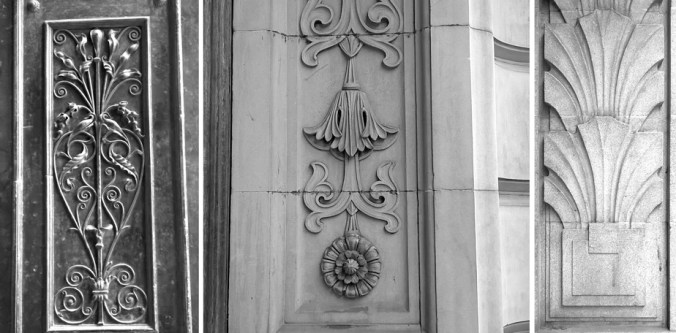
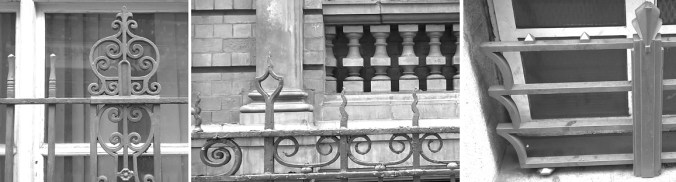
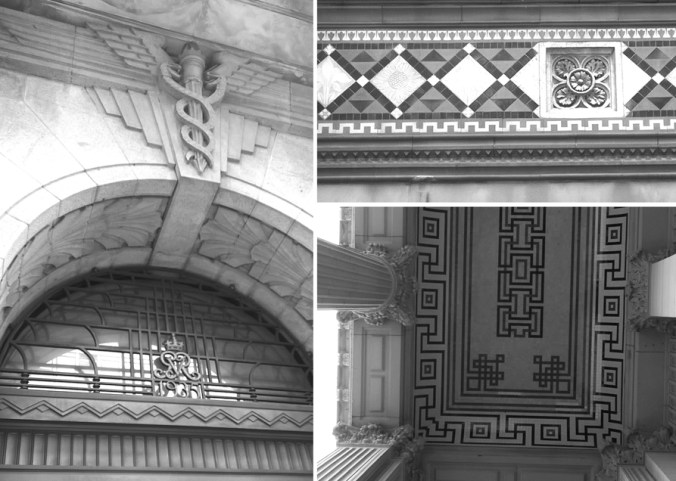
Last week I shared my ‘interest’ in forks, and more can be read on that matter here. As I move towards the present day, bit by bit each week – Arts & Crafts, Morris et al, Art Nouveau etc this Friday, I introduce words to help grow their critical vocabulary, and help them to see and read this history that remains around us. Walking through Birmingham demonstrates how different styles of ornamentation jostle for attention. Arts and Crafts flourishes appear fussy in contrast to the rather robust Deco motifs. Twenty first century obsession with flimsy superficial solutions such as the facade of New Street station’s mirror panels, and other examples not far away, are put to shame by the care and craftsmanship of carved stone, worked iron, and intricate tile work of over a century ago – still intact. Now as the wrong library remains standing (in my opinion) I dread the day I hear that the concertina signal box loses the fight to stand. I digress…

katefarley_buildings1blog

I’m fascinated in how something can contain the belonging of a time, a style, a movement, just in the detail of a line, or a point in a curve – I’m specifically referring to pattern and decoration here but this observation can also be made with architectural detail. The shape of a leaf, the ‘stylisation’ of a flower, has the ability to communicate its belonging or differences in a glance. As a designer it’s important to know these references, especially in relation to a client’s brief – you wouldn’t want to offer Baroque when Neo-Classical is required! This knowledge of visual language crosses design disciplines and it’s fascinating to identify the same aesthetic approach on printed cloth that is also worked in silver with a terrine.

I enjoy the challenge of creating design motifs that tell the story, the unwritten references in the pattern, making a statement to belong. My recent commission for the Barbican shop illustrates this point; that architectural styles, in this case Brutalism, and the approach in which I take to the design process is fundamental in demonstrating through the aesthetic, the design language of the project.

It’s difficult for me to imagine not being able to hear the jazz age when spying an Art Deco border, or to think of Athens with the hint of the Greek key pattern. Despite not exactly loving history at school I now see the importance of it in adulthood. It’s a sad week as it’s announced we lose Art History A-Level as a subject in school, making it harder still for those with an interest in art and design to learn their passion. In Birmingham we have examples of Pugin’s design work in St. Chads cathedral and the hand of the Pre-Raphaelites in St. Phillips.  I hope my lectures feed the students’ imagination to want to know more, to feel proud when they differentiate the Deco from the Nouveau, and to go on to be informed designers, telling the right stories with the curve of a line and the style of a flower.

All photos taken in Birmingham by ©Kate Farley 2016

katefarley_buildingdetail1_blog100

katefarley_buildingdetail3_blog100

geometrics out and about: PLAIDS

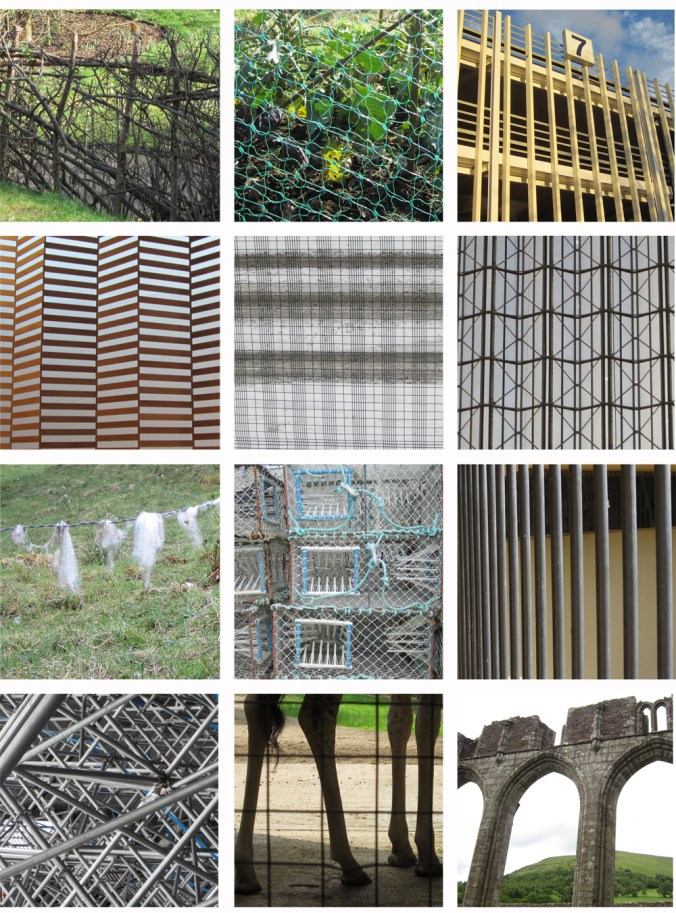
There are particular visual rhythms I seem to collect as photographs when out and about and so I thought it worth while putting them together as collections of patterns. I’ll leave you guessing what might also feature over the coming months but here’s the first: plaids.

Some are more obvious than others, and while you are looking, keep an eye out for the friendly robin. There’s a list of locations below for those who might be interested.

plaids_blog

1a Botanical Gardens, Birmingham
1b Plot 8, our allotment, Birmingham
1c University of Warwick car park

2a Aeneas Wilder, Mead Gallery, University of Warwick
2b Heeley Rd. Birmingham
2c Olympia, London

3a Newtonmore, Scotland
3b Hastings
3c Dudley Zoo

4a Hockey arena, London 2012
4b Dudley Zoo
4c Llanthony Priory, Wales