exploring Slovenia

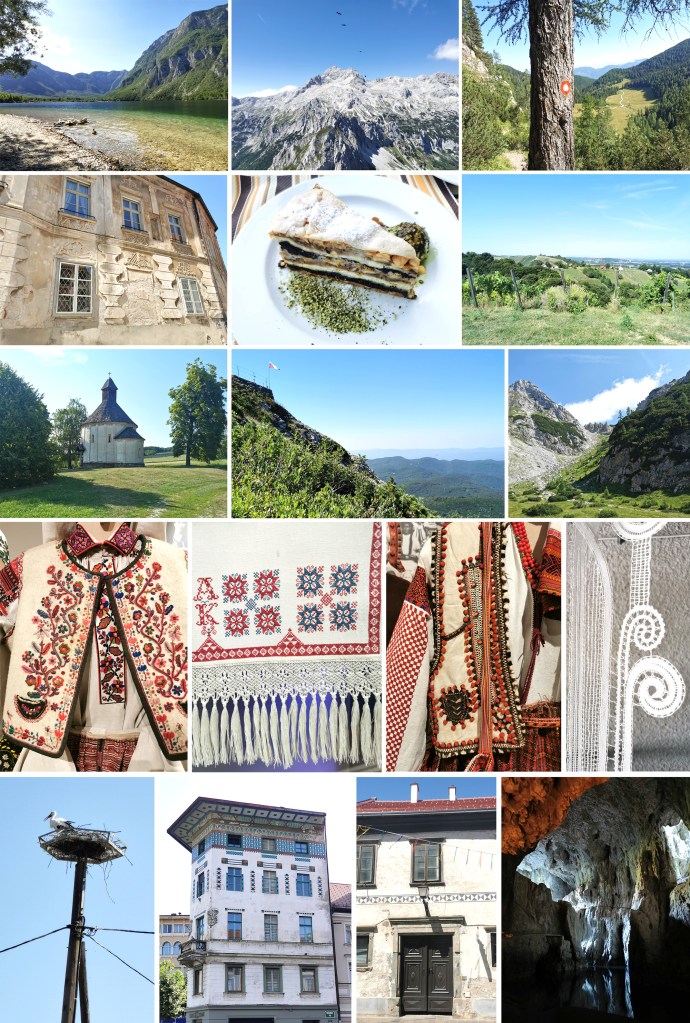
This summer our family holiday took us to Slovenia via rail from Norwich, via London, Brussels on a sleeper train to Salzburg, and our final train to the capital, Ljubljana. Once in the Slovenia we hired a car and spent a few nights in a few different regions to explore what the country had to offer. We ventured from high in the Julian Alps with the mighty Triglav mountain and lakes, to Idrija, famous for lace making and mining mercury, through the Karst region and towards and along the Croatian and Hungarian borders in the south and east.

We walked high in the mountains under blue skies and sometime above the ravens, through hillsides and woods of wild flowers, butterflies and birds. It was good to watch through binoculars from a neighbouring summit as climbers ascended Triglav, the highest mountain in the country and a few days later catch a glimpse across to the Adriatic Sea.

We enjoyed visiting towns including Ptuj, Idrija and Maribor, learning about local industries and histories. Ljubljana was a very manageable city, with walks beside the river and through the parks and gardens, a climb to the castle, wandering through pretty streets and catching site of the parliament building. We ate well throughout the fortnight, sampling national dishes of dumplings and meats, and for puddings the famous Gibanica cake and Bled cream cake. I can thoroughly recommend sampling the wines from across the country too.

Highlights of museums:

National Museum of Contemporary History of Slovenia in Ljubljana Fascinating introduction to Slovenian poet Srečko Kosovel, as well as C20th history or war and peace.

Slovenian Ethnographic Museum There was an excellent exhibition about Ukrainian traditional dress, as well as many rooms of Slovenian crafts, traditional trades and folk artefacts. The textiles was fabulous to see, with lace, embroidery, weaving and printing to admire.

Ptuj Clock Tower The longest wooden pendulum in action in Europe

Idrija for lace and mercury A town with a lace school and fascinating mercury mine and museum.

The weather was hot, above the average for a summer, with temperatures above 35 degrees Celsius for our last few days which was pretty hard going. I loved the Ljubljana weather system – a cold spray of water in the city centre.

We returned home with a sleeper train from Ljubljana to Stuttgart, on to Paris, London and home to Norwich. Here are a few shots of the beautiful country – I can thoroughly recommend it!
drawing, looking and seeing

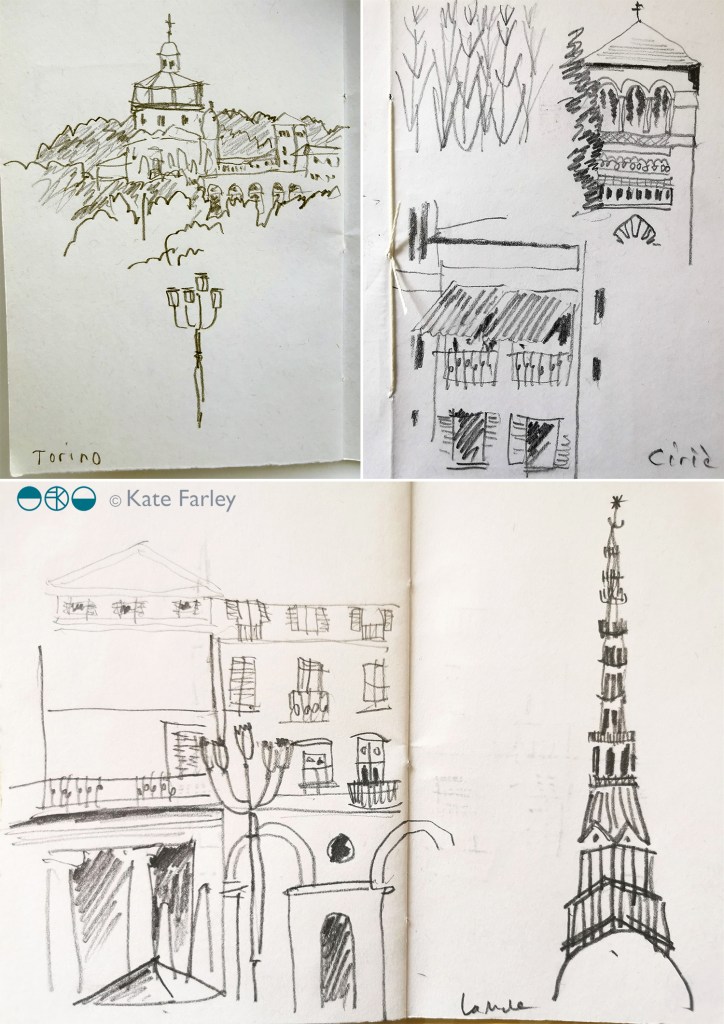
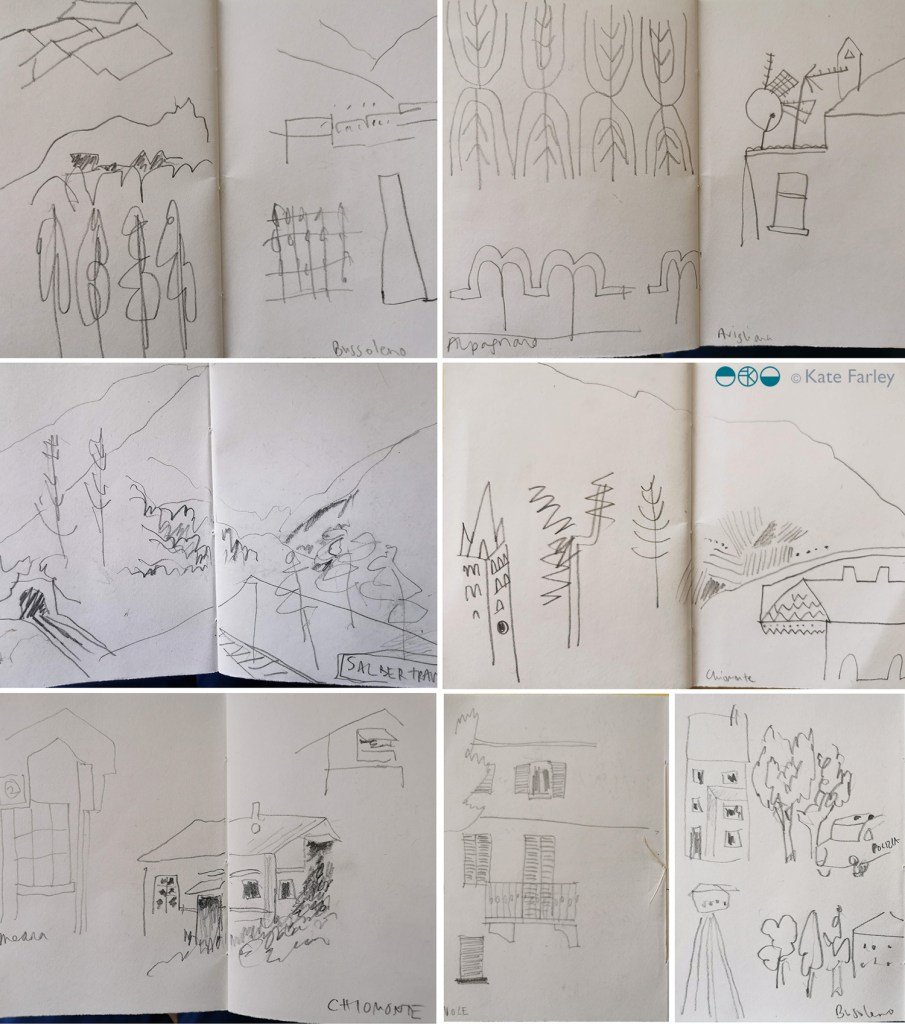
I’ve recently returned from a lovely family holiday, traveling by train from Norfolk to London and via Paris through France to the south and on in to Italy, up into the foothills of the Alps via Turin … and back again. I made lots of small sketchbooks so I could have one close at hand at all times, with a selection of pens and pencils. I’ve always enjoyed drawing from trains, preferably sitting backwards, looking, identifying shapes and details, then hastily capturing what I saw in a few lines.

It’s a great exercise to keep the hand, brain and eyes in check, and although I have previously used this sort of drawing for my design work – including my degree Final Major Project back in 1997 – I only really do it now as a good activity to check in with the view and focus on the places, stations and landscapes I journey between, and as exercise for keeping my drawing practice fit and healthy. A gable-end of a barn, a cluster of trees or mountain horizons can be documented and it’s amazing how these drawings are then able to capture and remind me of the journey years later.

Here are some of the drawing from the trains. I sometimes get a bit more detail down if we sit in the station for a few minutes, and I jot the station name down for interest.

I also managed to do a small amount of drawing while sat in cafes or sheltering from sun while other family members were up to something else. They take a few minutes each, so still pretty quick observations. It’s clear my interest in pattern comes in to how I see the world. Rhythms of windows and balconies, railings, ornamental buildings….

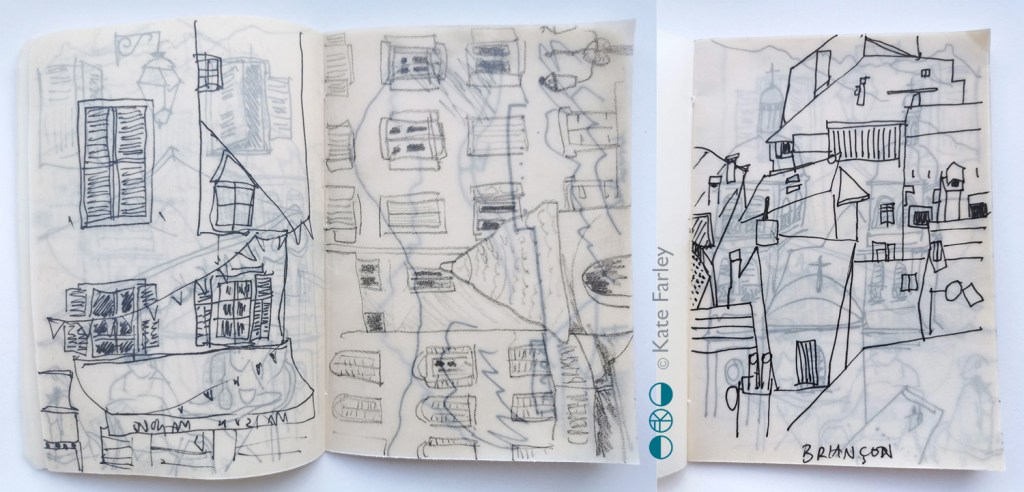
I also made a couple of sketchbooks using tracing paper as I was interested to see how I worked with the transparent pages as the drawings built. I quite like the results and reminds me of how I plan lino blocks and screen prints with the layers of tracing paper.

It was definitely good to spend time drawing and I’m thinking of revisiting some in the studio, no pressure, just a few ideas. I hope you like them, let me know if / how you make drawings from trains!

drawing evolution – perspective and mapping

Several weeks ago I started, with no other intention other than to pass the time, making drawings of the trees across the fields I could see as we waited our turn at the farm shop. This was simply about making time for me to clear my head of all the other stuff and pressures of this new routine we find ourselves in. Drawing is such a key part of what makes me tick, whether it’s for rest or work.

Week 2 came so I took my sketchbook and made new drawings that naturally evolved from the first week’s observations. In the second week I also took scissors to capture the shapes as paper cutouts in contrast to the lines I had focussed on in pencil. Each week I’ve made these drawings and over time I’ve noticed the growth of leaves, making it harder to focus on the tree structures, but I’ve also moved the drawing on as a familiarity of my subject is developing. I wrote a blog post on those first weeks here.

I’ve spent the last quarter century drawing landscapes with trees and remember a significant moment as a student of design, when I discovered the water colours by Crome and Cotman in the gallery in Leeds – particularly strange given they were from the Norwich School and I’d left Norwich to study in Yorkshire, but maybe that was the initial pull. I studied the way they divided the landscape with brushed areas of paint and they helped me to see that I too could explore ways to stylise the way I saw the landscape.

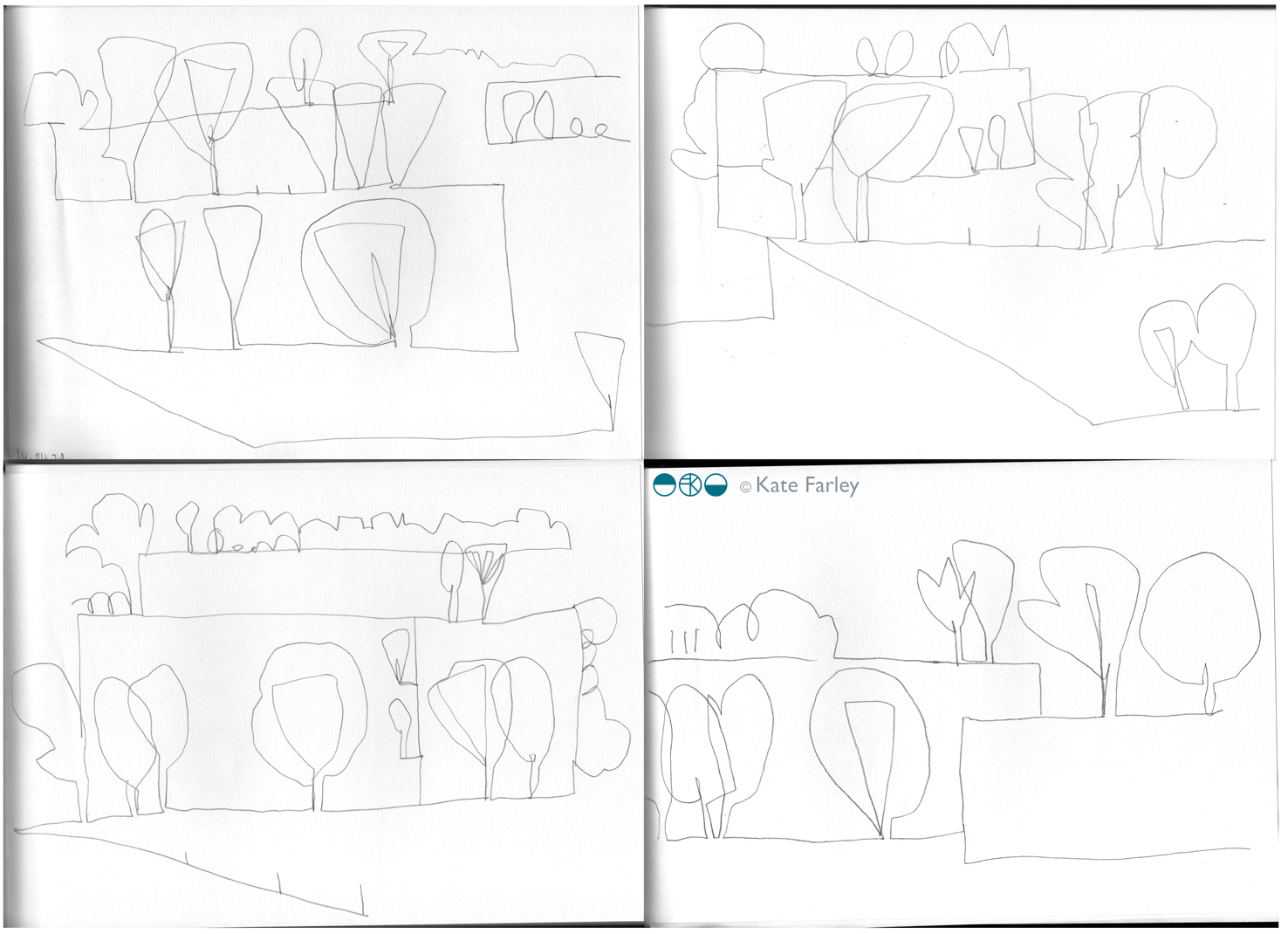
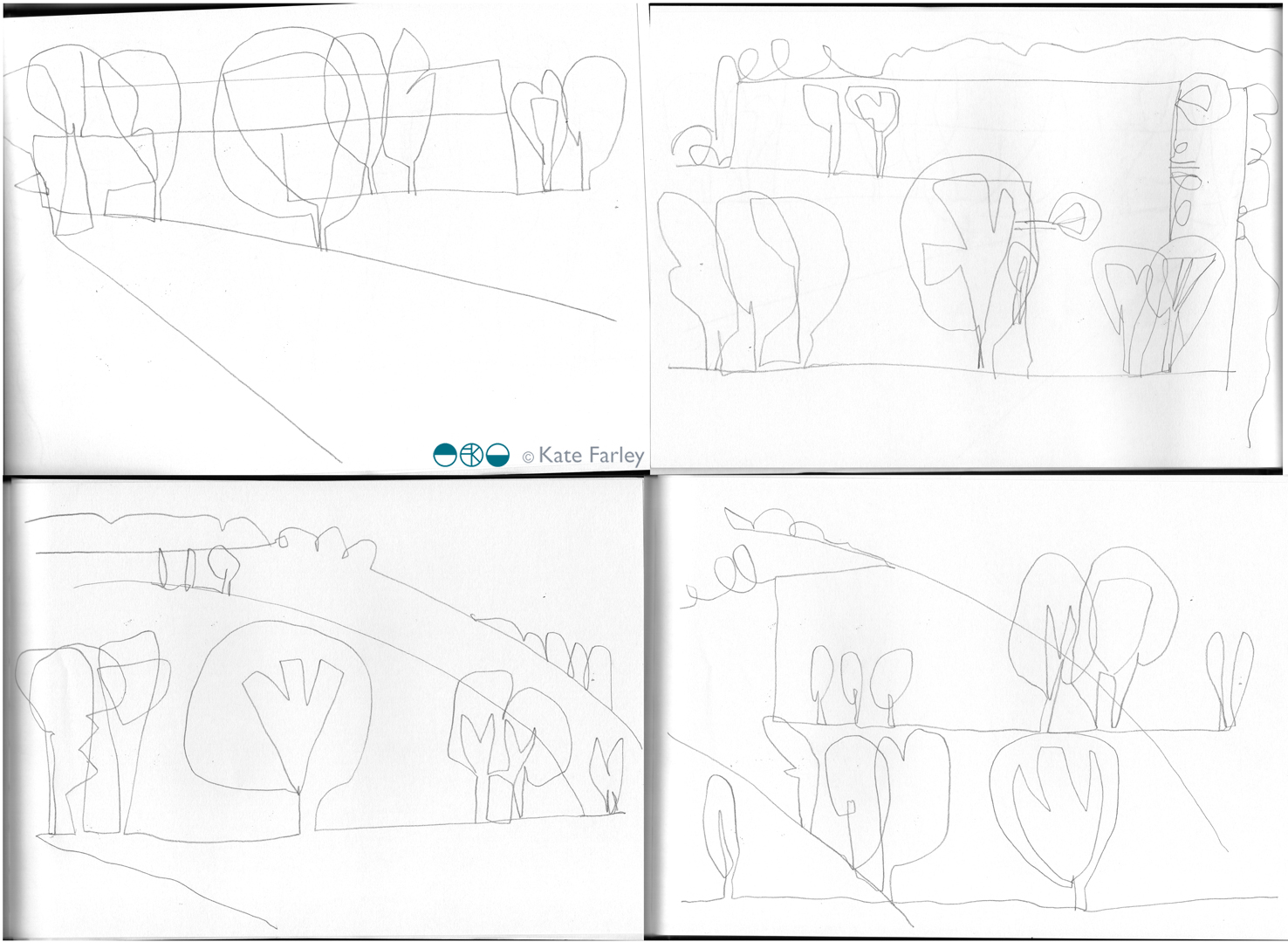
The drawings included in this post are all from week 5. I’ve added hints of fields containing the trees and those lines of containment are the edges holding the paths of trees. I’ve used the horizons from both a vertical and horizontal viewpoint and continued to stylise the tree forms throughout the five weeks. It’s getting harder as the trees flesh out their forms and we lost the details of the branches. I’m also suggesting depth of field with the scale of the trees near and far although I’m pulling the composition down to stretch out and extend the foreshortened landscape.

KFarley_Wk5_1_4

Throughout my career I’ve toyed with ways to map the perspective of landscape and use diagrammatic language, perspective and distorted elevations to represent viewpoints of 3D in 2D. The intention of the arcs was to suggest the sweeping viewpoint but in fact I think it hints at hillsides, and that really isn’t the case here in Norfolk. An undulating landscape maybe, but certainly not rolling hills – still, we can’t get it all right!

KFarley_wk5pics_4-8

I’ve thoroughly enjoyed this drawing exercise so far and look forward to week 6 and what the drawings will discover next time. I’m also, rather naturally I suppose thinking about pattern evolution and how these may become design work. I have lots of ideas to mull over and be excited by … but there’s no rush.

Having posted some of the drawings on instagram over the weeks I’ve received lovely comments and messages from people enjoying the drawings and I’m so grateful for the votes of confidence in what I am doing, I really appreciate that. Many thanks, I hope you continue to enjoy the drawing! ….

Save