I’ve written many times over the years on this blog about the themes that underpin my work, the approaches I take to develop new work, and the things that inspire me. Here I look again at the process of evolving ideas and visual language, to introduce my latest series of prints.
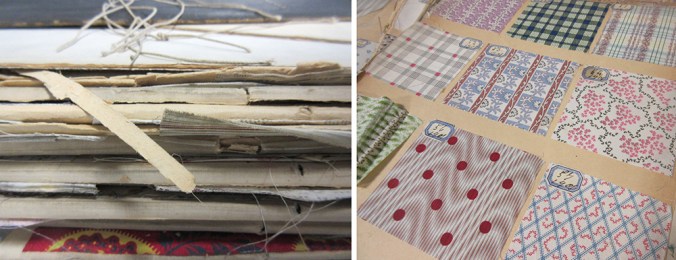
As I develop ideas, often in series of works on paper before any design solutions are considered, I explore the visual language of the subject through drawings, photography and printmaking. The aesthetic nature of the new work evolves and is tested in relation to compositions and rhythms. My knowledge of pattern design, in particular in relation to textiles, feeds this investigation. The motifs, the linking forms, the negative and positive shapes and the quality of line can suggest relationships with historical styles, international influence and contemporary trends. As a designer I use this knowledge to sometimes avoid, and sometimes align to this language, communicating a context far beyond the printed paper I create.
On a cycling and camping tour around Denmark back in 2004 we came across a small book shelf in the campsite shelter containing a range of books. I can’t read Danish. We picked out a few, judging them purely on the graphic design of the spine, and I found a science book of beautiful diagrams of plant structures. I have a photograph somewhere, but the impression those diagrams made on me does not require me to see that page again. I remember the look of those diagrams, and they have fed in to this collection many years from then.
Mid C20th pattern is also something I am interested in, and for this new body of work, particularly the development of stylised florals and diagrammatic interpretation of plants. Lucienne Day was particularly expert at creating designs in that manner, with simple black lines, herself inspired by Miro, Kandinsky and Klee. This is why it’s important to be aware of what has gone before. Not to imitate the past, but to take courage from previous developments in drawing, stylising and pattern making, so we don’t recreate the past, but so we push forward with our own journeys, liberated by not inventing the wheel. I was amused to discover the current exhibition at the brilliant Whitworth Art Gallery in Manchester is Lucienne Day: A sense of Growth – it seemed uncanny!
My photograph collection, both in print and digital form, contains many pictures of reeds; Danish reeds, Norfolk reeds, anywhere else reeds. I also have many records of grasses, and have always been attracted to the structure of such plants. These are often the unloved weeds that may be irrelevant and overlooked by many, but I come back from walks with handfuls of lines, some with seed heads, some without, but always lines of grass, as if nature had fun drawing them. Different stems, leaves and weights of line, and some suggesting very distinct natural habitats. I’ve always been more interested in line quality than texture, and my work over the last two decades demonstrates that very clearly.
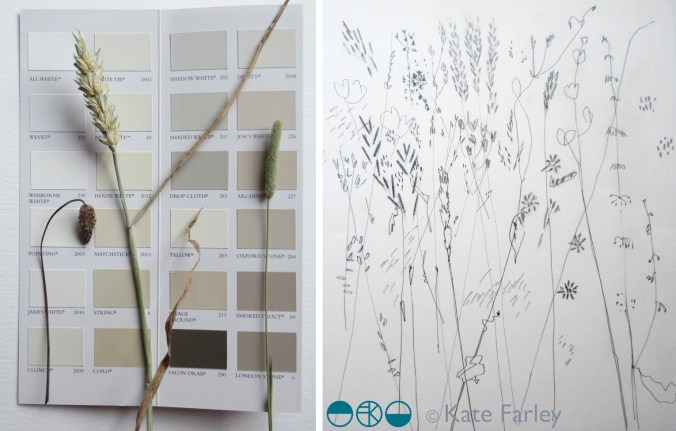
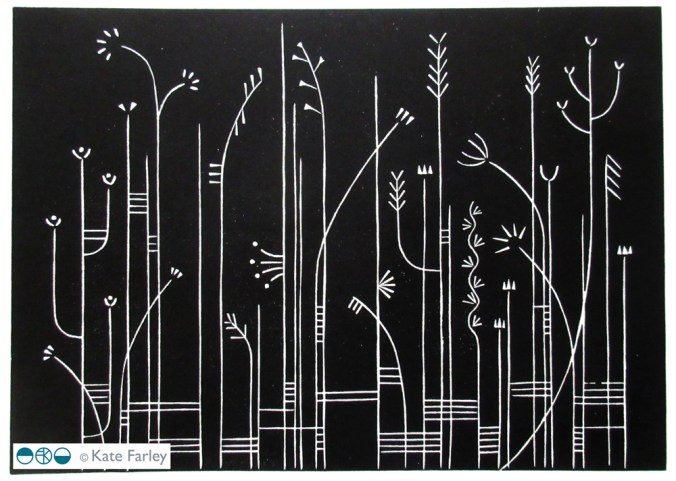
So that was a long-winded way of saying that this new series of works has been a long time coming, but makes perfect sense to me. I didn’t set out to create drawings of grasses, in fact I started screen printing flowers, but this evolved as part of the create process that is play. Colour came and went too, so as not to detract from the lines. There are some similarities with my threads printed editions and I have had the prints next to each other today – I think they make an interesting dialogue. This is the journey of idea development, by mixing drawing, thinking, printing, reflecting, contextualising, and doing it all again. By the way, this bit of the creative process is one that is very difficult to teach design students, more so with less and less studio time, and a full to bursting curriculum, but knowing your own creative process is halfway to success in my world. Take risks (it’s not rocket science we say) and work at playing.
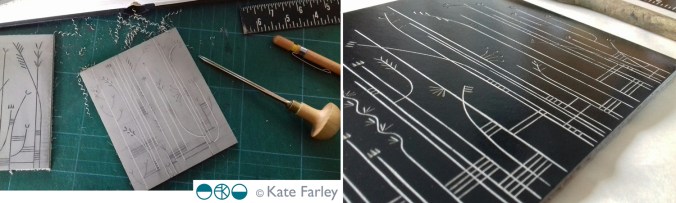
I digress. These few prints are only the start of this series, I already have new work evolving, but other projects are jostling for my time in the studio, so for now, I introduce you to Grasslines… and now you know a bit about how they came to be.
 Kate Farley - drawn to design