talking to myself through teaching

I’ve spent many hours over the last couple of years reflecting on my teaching career that stands at about 18 years, give or take a bit. In order to apply for Senior Fellow of the Higher Education Academy I had to write thousands of words that explain and reflect on the impact I have made on not only the students I have taught but the colleagues and peers across the industry I relate to in my professional practice. It has been a big ask to fit my diverse experiences in to the word count along with the cross referencing required, but I’m delighted to say my hard work over the ‘holidays’ and the work of my colleagues in writing supporting references has meant I achieved Senior Fellow and I’m rather relieved / proud. (I was however disappointed to discover that rather than receiving a fine water-marked, embossed and foil blocked certificate I had to download it! … I digress.)

I’ve written many times about how important it is for me to combine my design practice with my academic career and although it doesn’t make my life easier, it certainly makes it more fulfilling. They really are mutually supportive. The reason I am so driven to support the students in reaching their goals is because I know how rewarding a career in design can be. From having the confidence to draw in a different way, to picking up the phone to a new client, to realising your dream of seeing designs commercially available…, to be paid to do what you love doing… why would I not want to help others to do those things?
roller_fabric_blog

It’s also important to hear myself saying these things to students. It’s as if I am telling myself as well as the students! Yes I must chase that lead, make sure I’m paid a fair rate or keep my website up to date! Each creative has different ideas about how and where to move forward with their ambitions and the art of teaching is to work out how to nurture, support, push and challenge positively. Being creative is not easy. You put your sensitivities on the line to be judged, sometimes by those with less creativity than yourself, but who holds the budget. There are certainly pages in my sketchbook I wouldn’t choose to share at a group tutorial, but the process of knowing you are not alone in learning the creative process is so valuable. It’s also the case that it’s often easier to critique someone else other than yourself! Would you listen? Maybe one mis-perception is that once you graduate you stop learning – I plan to keep learning forever! Each project I work on is an excuse to learn more, not only about myself as a creative, but new practical or technical skills to take on board for me, as well as sharing with colleagues and students.

I’m very aware the reality behind social media may be far different than the stories being told online. I make sure students are made to think about that, – use the benefits of social media while considering the stories they read and the stories they create. While I like the way we can find out so much more about what’s going on, and who we need to know (can you imagine only having the yellow pages?!) there are complications with so many aspects of our practice being shared. Copying, audience expectation, peer competition versus mutual support, networking and peer validation are ups and downs of today’s design world. I approach my teaching very much like my designing. Honesty, integrity, and fulfillment…. support, encouragement and creative ambition! Even writing this is like giving myself a tutorial! What’s my homework?
KateFarley_grasslines_WIP_blog


window film wins gold

In my design practice spanning over almost twenty years I’ve been really keen to test my design skills in relation to different products and this has resulted in me working with some really great companies. I’ve learned lots and have got to test my pattern making skills for the different applications I’m working in relation to, learning from industry partners with their experience and expertise.

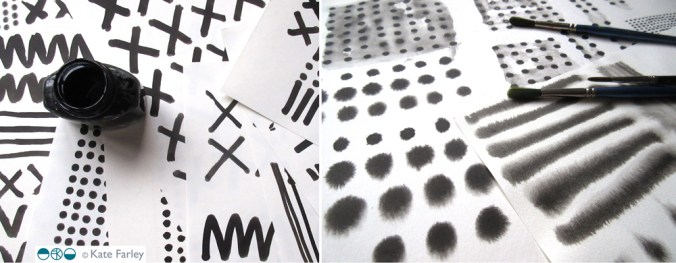
I’m really proud of my Construct collection as I set out to combine my interest in constucted cloth (weave in this instance) to inspire a print language, with the final surface designs being applied to hard surfaces. I was inspired by Augustus Pugin’s phrase “truth to materials”, in defiance against fake digitally printed wood-effect interior surfaces and I was interested in presenting a subversive outcome. My designs are not copies or imitations, they are a creative response to the material. I made tools to draw with; forks dipped in ink, relating to the threads of cloth and then manipulated the scans of the drawings in Photoshop to generate the repeat patterns.

KF Construct_blog_p2

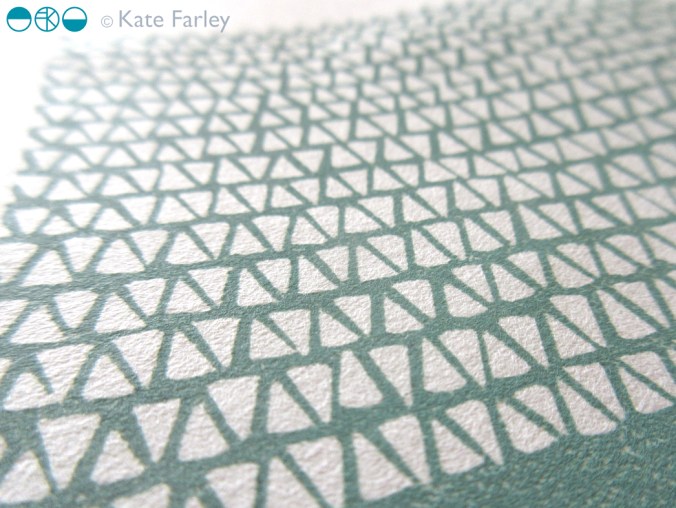
When the opportunity came to work with The Window Film Company I was really impressed with their willingness to sample a range of designs and to discuss what worked. We explored the scale of the designs and sampled a number of patterns, resolved the repeating artwork to create the final collection. The products are brilliant, the window film is so easy to install and looks great. The idea of placing the woven textile inspired patterns on the window relates to the idea of hanging curtains. The graphic patterns are soft and calm, and yet provide privacy at the window. I then went on to develop my Threads collection to extend this idea further but employed lino cutting as the visual process, also available at The Window Film Company.

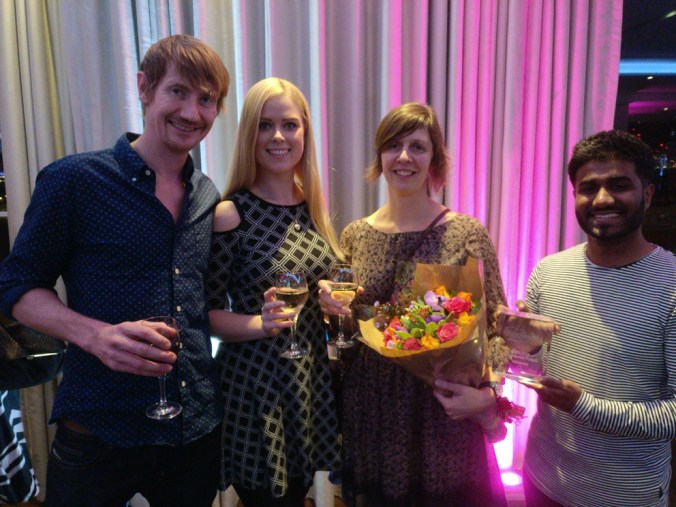
I was delighted to learn back in September that we had been shortlisted in the Best home improvement category at the House Beautiful awards 2017, for both mine, and the designs by Layla Faye, and they were going to be held in central London in November. Last week I went along with some of the The Window Film Company team to the awards and we are delighted to have won gold! It was a complete surprise as the category had some stiff competition, but we are so pleased to have this work recognised.

In the words of Micky Calcott, Director of The Window Film Company, “We’re thrilled to have won gold at such a prestigious and well respected awards ceremony. We work hard to provide customers with products that are practical, but also inspiration and stylish. We’re incredibly proud of our designer ranges and are delighted that our Kate Farley collection has been recognised as delivering something that customers want, enjoy and appreciate.”

My designs have been created with lots of consideration to hand-generated imagery, and in relation to the material it is printed on. The patterns appear straight forward but have involved many decisions along the way, testing the combination of marks and the rhythms that are created, as well as the repeat structures and the positive / negative details. I know the customers don’t have to know the entire creative process to like the designs, but I’m delighted to have the opportunity to reflect on this collection. Winning with this great company is something I’m really proud of. Thank you to Micky and the team, as well as to House Beautiful!WindowFilm_awards17

time and sketchbook time

At the moment I’m juggling lots of different projects; one has been years (really!) in the making, another much quicker, straightforward and some more ‘surprise’ projects. They all have different requirements of my time, and in each week there may be a telephone call to a manufacturer to discuss things with, an email exchange between a client and myself to clarify details of a brief, or a call to a stylist / marketing team to plan a scheme for the future with, and the usual trade show sales team call! This all takes time, and different skills to manage.

A different skill altogether is to maintain a practice that, at the heart of it, seeks to challenge, engage and inspire the creative self that was the reason I set off in this direction at the start, twenty years ago. The sketchbook is the place I go back to, the safe place I can explore those ideas in, old and new, that keeps the journey going, the continuum that is my creative practice. Ideas do evolve over time, and the sketchbooks are testaments to the ongoing inquiry that may lend itself to something commercial in due course, but is not the reason I do the drawing in the first place.

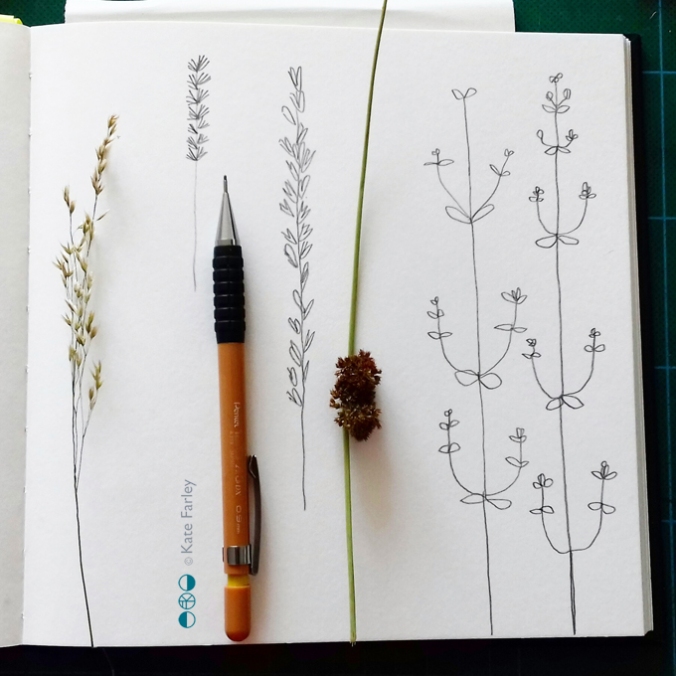
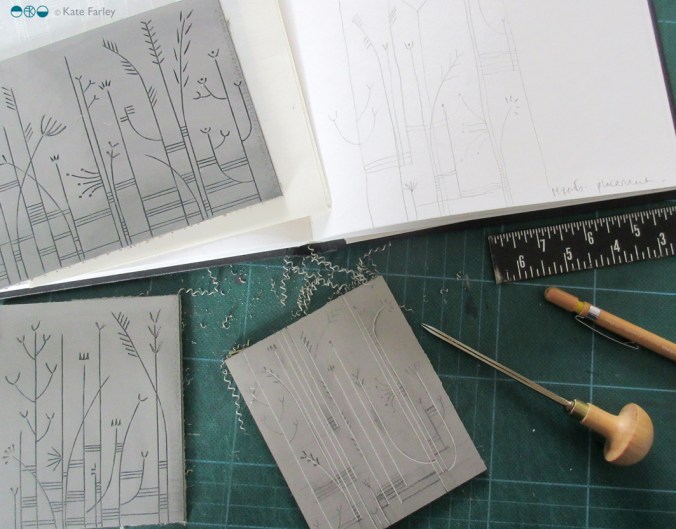
In my role of design lecturer I regularly explain the uses of a sketchbook, the hows and whys a designer may approach the mental and physical task of working in a sketchbook. Retro-filling the pages that have post-its in saying ‘research’ needing to be completed the day before a hand-in lacks rigour and purpose, a scrap-book mentality is not necessarily the best use of printer credits unless you really do look and reflect on the relationship between your work and someone else’s. Dare I say it, I enjoy the task of working on a new white page, and see the potential, not the fear. I don’t often share pages of my sketchbooks, but here’s one page from this week in the studio, having gathered new ‘material’ at the weekend, furthering my ideas for my Grasslines print series…

I say let’s celebrate the sketchbook, the real one with paper pages that doesn’t require likes, favourites of retweets to be justified, the one you do for you. Why / how do you use your sketchbook?

sketchbook_grasslines

Modernist patterns in the making

Over the last few months, actually for most of this year, I’ve been working on a commission with the Barbican Centre London to create bespoke patterns for products in their newly developed retail space, ready to launch in the Autumn. It’s been a fabulous project as I’ve developed the designs with plenty of dialogue with Head of Retail, Adam Thow, to-ing & fro-ing by email. The brief has altered only slightly since the beginning and I feel really proud of what we’ve produced. There’s a more detailed interview about the project over on their blog.

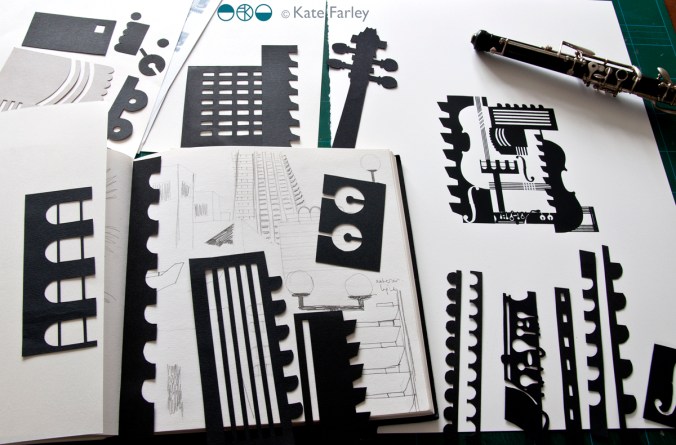
The idea was to explore the Barbican Centre, famous for its architecture, but to also include its activities as a cultural centre of music and performance. I explored lots of ideas and pattern compositions but settled on the idea of a sheet of music, and ended bottom right with the bold double bar lines. Within the patterns I referred to musical notation, and made links between the architectural features and those of instruments, including a violin and oboe, to create a sense of narrative, playing with strong negative and positive shapes. Each of the motifs were hand cut in paper, scanned in, and combined using Adobe Photoshop.

KF_Barbican_print_paperBLOG

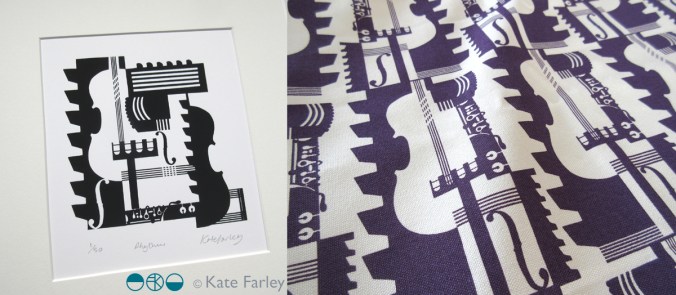
Last week we shared the first images of the design work so I thought I’d share here too. The images here show my developmental design work above, and the final limited edition screen print and pattern for products. Visit @barbicancentre on instagram for more final product shots.

KateFarley_BarbicanPRINTPATTERN1200


Save

patterned walls and windows

They have been a while in the making, with lots of drawing, designing, discussions and sampling over the last ten months but my designs for Tektura Wallcoverings have been launched, and I’m delighted to be able to share them here. There are five in total so do visit the Tektura website to see them all. The images of the drawings are mine, the product shots are courtesy of Tektura.

I was working on the designs at the same time that I was developing my ‘construct’ collection and Tektura really liked the look and potential of those designs but I needed to build two distinct looks to avoid a conflict of interest. You will see similarities but I utilised different drawing tools and pattern systems to explore a variety of options in my markmaking. I created many sheets of paper full of inky motifs that eventually, after a lot of design development over several weeks both on paper and at the computer screen, became digital artwork to hand-over for production. At Tektura the colours and scale of pattern were sampled and marketing / sales information was created for the launch. One thing I find hard is naming the designs, and this was no exception. The thesaurus was called upon, as was Google to check existing references, and a colleague at BCU also contributed – thanks Clare! In the end the names pretty much describe the pattern. I won’t be a poet anytime soon!

KFarley_TekturaDrawings_blog

My past experiences of working on large interior / public art projects enabled me to work with the scale of the potential interior environments that Tektura provide for in my mind the whole time. These designs for Tektura can be customised and applied to wall and glass surfaces and so as I designed I maintained modular components that can be re-coloured or omitted for each client’s specifications. This is a wonder that digital production can provide; enabling bespoke solutions.

KFarley_point_tektura_blog

For me this project highlights key values in my practice: the importance of drawing and hands on image-making, knowledge and understanding of digital production and product context, and the value of working relationships and good communication. Each client I’ve had the pleasure of working with over the last fifteen years or more, whether it’s the design director, art officer or buyer can really shape the design process they are commissioning. From outlining the brief, to negotiating the design direction as well as final sign off, these things make a big difference to the designer, often working far beyond the hours intended in order to allow sufficient time to reflect on the design process and outcomes. Digital communication allows artwork and thoughts to be shared and discussed in minutes, and decisions can be made together.

The great thing about working with companies such as Formica and Tektura is that they are industry experts with fabulous products, trusted by the market. By working with this expertise I learn more and get to understand the design world from their standpoint. Who would have thought my patterns would be on such a stunning shiny surface as Glint (below)! Working with Tektura Wallcoverings has been a pleasure and I’m proud to show the designs off. Thanks to Angela and the team!

KFarley_splodgeTektura_Blog

passing on pattern passion

In my role of academic as well as a designer I am regularly required to enthuse about print and pattern, and to be honest that’s fine, as I love designing and teaching pattern for print. This last week has seen me out and about to pass on my passion for pattern, firstly to Wolverhampton Embroiderers’ Guild where I was invited to talk about my practice. It’s always interesting having to consider what bit of the last twenty years to focus on, requiring reflection and evaluation, and how to tell the most relevant story without missing the bits that might be the most informative to others even if they didn’t seem so to me when living them. The audience were really generous with praise, and were really interested in my creative process, so sharing my sketchbooks, and anecdotes felt very easy to such an interested group of makers.

Tuesday saw me overseeing a morning of filming at Birmingham City University (BCU) with Laurence Llewelyn-Bowen and TV crew, working with our third years and our fabulous Print Technician. It was a morning of celebrating the Arts and Crafts legacy, William Morris in particular, and the importance of understanding the value of drawing to the process of pattern making. It was a pleasure promoting our talented third years, in the closing stages of their time with us.

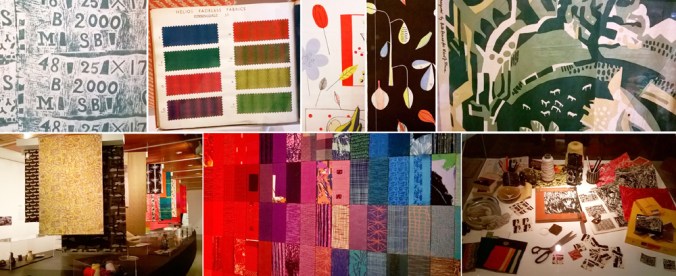
This leads me to yesterday when I and a colleague took a coach of second year Textile Design degree students to Manchester, specifically the Whitworth Art Gallery to see several exhibitions. On walking in to the first gallery and the exhibition ‘Revolutionary Textiles 1910-1939′ I noticed a number of pieces that I had featured in my Historical Textiles lectures when I had taught this group of students as first years, including Barron & Larcher, Josef Hillebrand and Omega Workshops. It was fabulous to see the students’ excitement on recognising patterns and names of designers that had, until then remained theoretical, and not ‘actually real’. Their knowledge meant something tangible, and I think was empowering to them. It was an honour to share that excitement of learning, and understanding.

Having worked on the Tibor Reich show at BCU it was great to be reunited with the collection, also on show at the Whitworth, and to see the different emphasis this exhibition made to an amazing and extensive archive owned by the family. The students really responded to the way Tibor worked to create pattern, and explored pattern through drawing with layers of colour and line. I couldn’t help but point out Tibor’s excellent use of a sketchbook to explore ideas.

Image below: top row from Revolutionary Textiles, bottom row Tibor Reich

KFarley_whitworth_May16_100

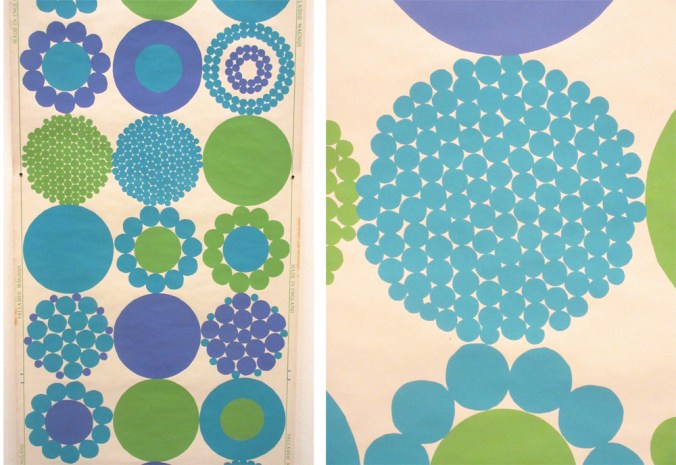
The room that wowed me most was the wallpaper gallery upstairs, and again, this exhibition was exciting and inspiring to the students, leading to some really interesting conversations. There is of course no comparison between seeing metres of wallpaper stretching skywards, to a small screen of Google images. We talked about print production, the scale of motifs useful to a domestic space rather than in relation to a sketchbook page, and why thinking big should be embraced. We admired the Lucienne Day patterns that are so familiar to us, alongside new discoveries, and that is why a curated exhibition, unlike an online search can be so beneficial; the selection provides context. I encouraged the students to question how they would make the marks, the shapes and patterns without computers, and why the variation of hand-made can offer something that digital software excludes. I include an example below to illustrate my point – beauty in the irregular.

KFarley_PalladioMagnus_blog

We did have time to enjoy the beautiful surroundings of the cafe but also took in a quick trip to see the newly opened Fashion & Freedom exhibition at Manchester City Art Gallery, one I really do recommend too.

So, more pattern inspiration for me, and hopefully some more people inspired by pattern too…

print progress

Recently I have been really busy with a variety of academic duties in Birmingham and further afield, taking me away from studio time, my freelance design practice, and of course blog writing. Also, in my teaching of Textile Design at Birmingham City University I have been leading a module of professional practice, assisting the students in learning about the life of a freelance designer. It’s definitely a double-edged sword, as the discussions between students and staff illustrated: It’s great to be your own boss, but you take all the blame when things don’t work out! You can get up when you want, but nobody pays you for just waking up!

The rhythm of freelance work is varied. Somehow it’s often the way of things that several deadlines coincide, and when you have a schedule to stick to, an urgent press request comes in. On the day you have time to make calls, those people are out of the office, and obviously you don’t get paid when you take a holiday. Yes there can be tough times, but I really like the variety of the weeks’ activities that freelancing gives me, certainly set in tandem with the academic life of very different demands. Each practice informs the other. Obviously there are freelance tasks I prefer and other ones I procrastinate over, lists are created, social media is checked and Radio 4 is listened too!

KFarley_knit1_blog.jpg

With so much to-ing and fro-ing on trains this last month or two and with several commercial projects on slow-cook I decided to give myself time to make, test and resolve some ideas that I have been exploring, with paper and print. The activity of printmaking is a fabulous discipline to work with. I love the excitement of planning a new print, and composing the plate, often taking me back to sketchbooks and previous ideas. The physical process of cutting the block can also be absorbing, and therapeutic and I have to decide the paper stock, the ink colour, and edition size too. It is important to maintain an experimental, inquiring practice and my prints and drawings are the evidence of ideas that have sustained my creative practice for the last twenty years. Between the commercial constraints of projects shaped by clients, costs and repeat patterns, printmaking can seem so free from limitations. This is why I make sure I keep printing – the creative sort, not just the invoices!

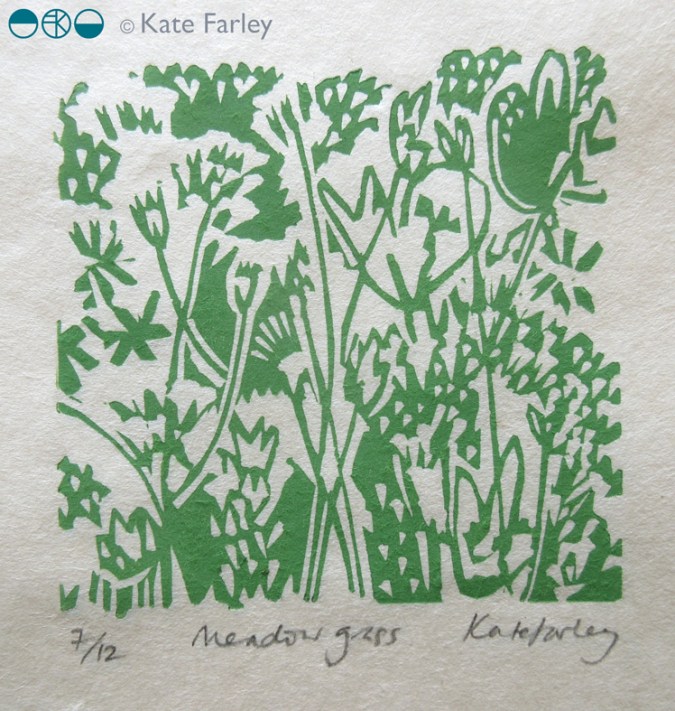
both prints featured here are available to buy, at £46 each unframed.

Knit 1, edition of 15, lino print, 9.5 x 9.5 cm print size

Meadow Grass, edition of 12, lino print, 9.5 x 9.5 cm print size

KFarley_meadowgrass_print_blog


printed mapping

Printed interpretations of landscape have been a challenge in my practice from the beginning, and really formed the backbone of my practice during my degree course in Printed Textiles at Leeds College of Art and Design in the 1990s. I explored various ways to represent the world around me, and although it might seem odd for those aware of my drawing, as there is little similarity now, I was really inspired by the Norwich School and painters such as Cotman and Crome. I saw the way they formed shapes of colours as elements in the landscape and I set about creating contemporary versions of Kirkstall Abbey in Leeds in term-time, and rural Norfolk in the holidays.

Over the years my focus has shifted from rural to urban, resulting in more geometric, grid-like patterns, fighting the urge to be illustrative. As Print Technician at Central Saint Martins I used to create mono-prints including embossed features, representing the Farringdon skyline and dominant buildings. I also explored experimental processes, such as liquid emulsion and photograms of drawings on acetate in the photographic darkroom. I had a fantastic year on a part-time printmaking course at the London College of Printing (now Communication) at Elephant & Castle, and despite a broken elbow I produced many prints including lithographs, screen prints, collagraphs, etchings and lino prints. The expertise of the staff, and the discipline of the day a week of technical experimentation was a brilliant thing.

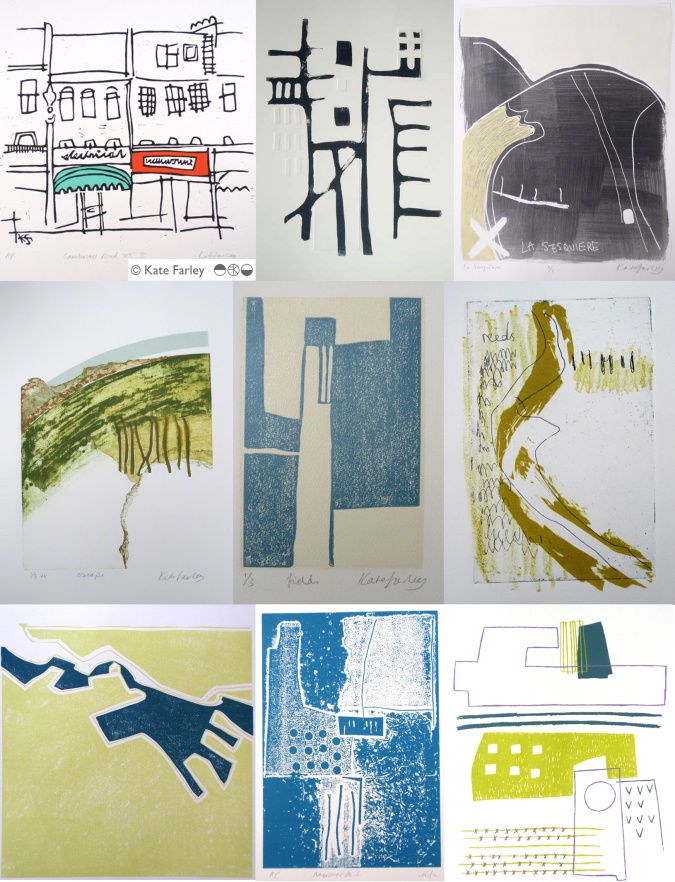
KFarley_landscapePRINTSweb

The images above include some of the many ways I have printed the landscapes I’ve experienced, and show some of the ways that I play with line, shape, texture and colour. Those of you who have seen my drawing evolve will probably recognise a preferred line quality, or mark I favour, the economy of mark, and visual rhythms. I am also interested in perspective, elevations and mapping interpretations. I continue to explore landscape in my ongoing sketchbooks, as part of commissions, but also because I simply want to draw and capture the flat fields, the lines of fence posts, and sweeping hills interrupted by a barn.

KFarley_landscapePRINTSbooksweb

I’ve also created many editions of bookworks over the years, and although I’ve written about them here before, I thought I’d include the ones predominantly featuring printed journeys. I love the way the sequence of pages, and folds of paper creates narratives through a landscape. Again there is maybe a familiarity of line quality, and drawn shape, as drawings, prints and books are often developed together, as part of the same creative process. Working summers in France, familiar territory in London and train journeys are regular inspiration for the books shown here. It is a challenge to design the book to work with a particular sized printing plate or sheet size of paper, considering grain direction and readability, but I enjoy the problem solving. Drawing and image has to work with structural content.

Often what is occupying my time in terms of design collections actually grow from ideas explored in those pages many years before. I like to see my relationship with landscape as the constant in the variety of what I do. Having spent some days in the country during the recent holiday I have refuelled that desire to draw horizons again.In hearing of the death of Ellsworth Kelly I am reminded of how instrumental he was at showing me how to see pattern in the environment we live in. I owe the excitement of the journey to many artists who themselves have worked hard to capture the places they know… Patrick Heron, Ben Nicholson, Eduardo Chillida, Eric Ravilious, to name a few.

Since creating these works on paper I show here (some over fifteen years old) I’ve launched ‘Plot to Plate’ and ‘Construct’, but they wouldn’t be here without the many sheets of paper before them. Who knows what else is in store in the next few years…

Visual proverbs – in Ghana and Cheltenham!

As a young student in the 1990s I became aware of the amazing Asafo flags of the Fante, from Ghana. I’d seen an article in a magazine in the college library about an exhibition on at the time, and unable to afford the trip to London I telephoned Peter Adler, curator of the exhibition, as his number was listed in the article, to share my enthusiasm. I’m not sure what I thought I’d achieve but we did have a conversation and I was inspired to find out more about the colourful appliqued flags.

asafo_flags_croc100

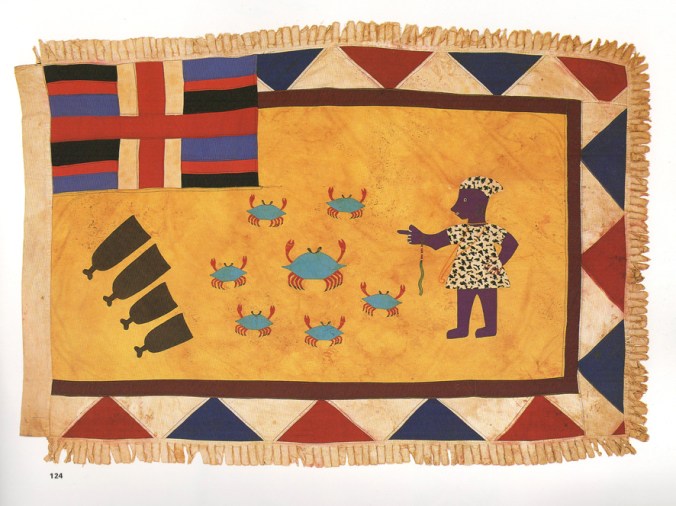
What struck me about the flags was the bold shapes of animals and people that were communicating warnings to other units of warriors of the Fante people. Proverbs such as ‘The crab is feared for its claws’, or ‘Fish grow fat for the benefit of the crocodile’ attempt to ridicule the rival warrior groups and set a tone of fear, as if toying with opponents. With influence from the European flags they had seen as adventurers explored West African coastlines and from international trading ships the flags also featured elements of geometric borders and the Union Jack. I like the stylised imagery, but particularly the visual communication of a story in one textile image. I remember I wrote an essay on the subject for a Contextual Studies assignment and I went to great lengths to dye fabric and create my own textile illustrations and book cover – I still have it somewhere.

I’ve shared images of the flags with many groups of students over the years, but as I write a research paper on the subject of visual communication in pattern I am once again reminded of these beauties, and back I go, to the wonderful book: Asafo! African Flags of the Fante, written by Peter Adler and Nicholas Barnard in 1992, published by Thames and Hudson. I recommend this really informative book.

asafo_bookcover100

asafoflags_crabs100

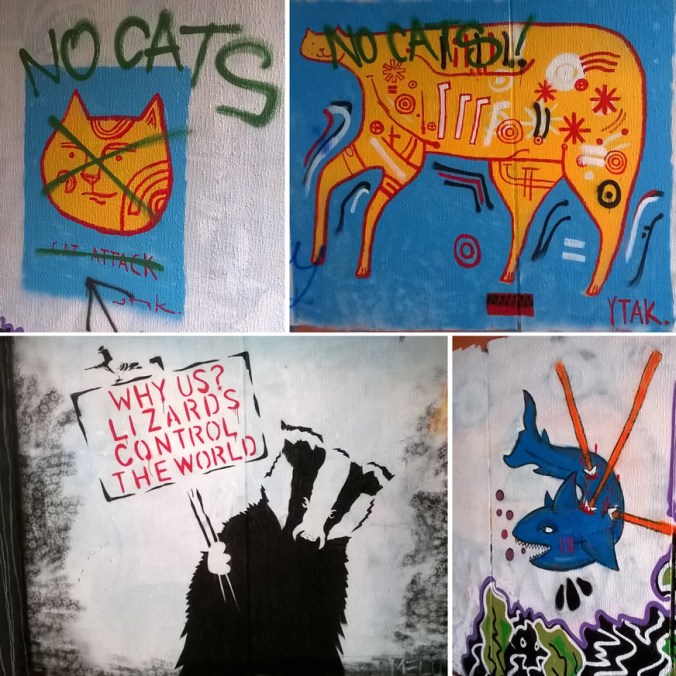
When walking from Cheltenham railway station to the town the other week along the off-road path I came across some graffiti in an underpass that reminded me of the flags, and particularly in the way the animals were used to goad. The images felt as if they were provoking and taunting rival groups by showing off their prowess in the way the artwork of the Asafo flags did. I could imagine the jibes represented in the images of the cats, and in the way the badger is attempting to deflect the attention away from his kind, to the lizards, maybe another urban tribe. I’ll share the images here.

CheltenhamGraffiti150images:

Asafo flags, scans of the pages from the book by Peter Adler & Nicholas Barnard, referenced in the text

Cheltenham graffiti, photograph by Kate Farley

print pattern show up and down… at Tent London

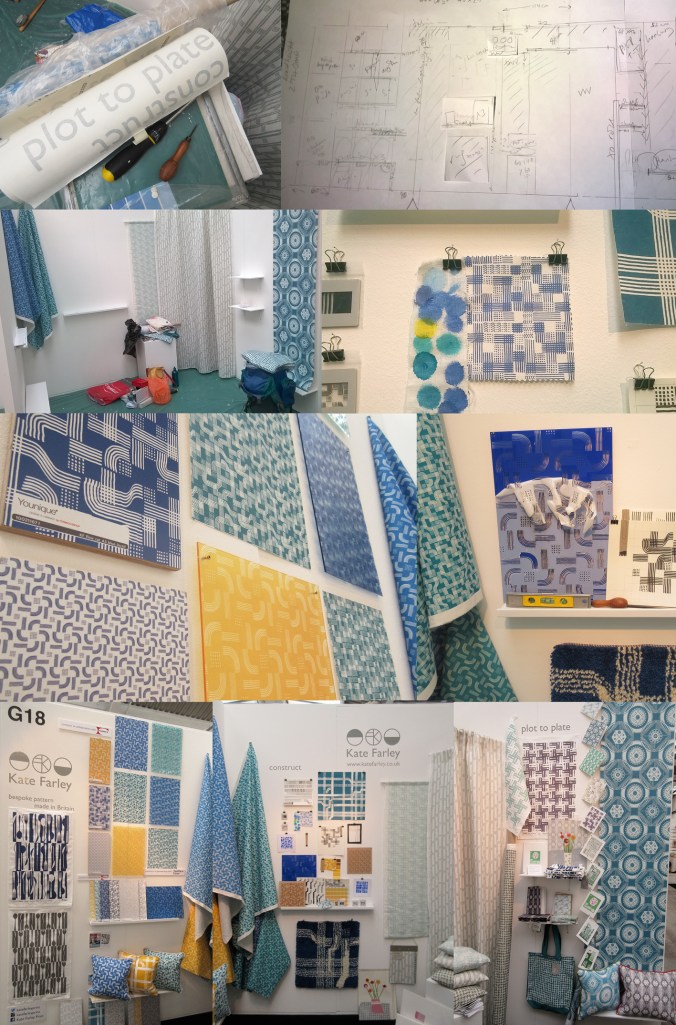
After months of planning, designing, making, printing, promoting and talking about the show… the time finally came… TENT LONDON! With very heavy bags, a display diagram, carefully planned tool kits, shelves, fabrics rolled, and so much more we set off to Brick Lane, London to put the show up. Our lives with small children are full of logistics, and this day tested us! Trains, tardy paint, luggage & childcare kept us busy and in relay between London and Birmingham so the show could take shape. By the end of the first day the majority of display items were on the right walls, fixed securely, and I headed home to the midlands.

The next day…. I set off again with ANOTHER heavy bag (these things don’t always get mentioned in trade show prep talks!) and completed the stand dressing, including the mood board for ‘construct’. It always takes longer than you think… I attached the vinyl, tidied up and left for a good nights sleep before the LONG first day of 10am – 11pm!

KF_tentstand1_G18_15web

The first day of a launch / show is always exiting and scary. Will people understand the new work, and will they like it? This particular morning was not helped by being stuck in a lift across town with my dear sister and only what sounded like a fax machine to talk to. Eventually after 20 minutes we were told the lift engineer couldn’t get the door open, “you are in a precarious position”!!! I’m not sure what customer care training he had received about talking to distressed people stuck in a lift. For anyone in this job, do not use the word ‘precarious’! We got out after nearly half an hour…

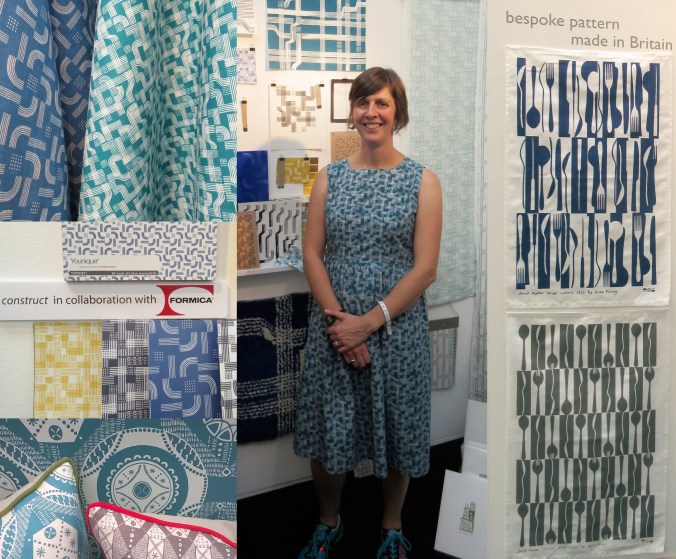
For the rest of the day I felt half an hour behind, but I launched my new collection with free limited edition screen prints which appeared to be gladly received by visitors. The collaboration with Formica Group was a really popular element to my new collection, and the mood board featuring my drawing tools as preliminary artwork inspired lots of really interesting conversations. Being a solo designer can be a very lonely, self-reflective existence so it’s great to get feedback from those you design the work for. Architects, interior designers, specifiers, stylists, press, retailers and many more visitors invested time to talk about all elements of my work, and for that I’m grateful. ‘Plot to Plate’ was launched in 2012 and has evolved over time to be a ready to buy interior and gift collection but ‘construct’ works differently. Only the cushions are available for immediate sale, and the rest is printed to order to allow for the distinctive element of the collection, the bespoke production. By working with Formica Group and Surface View my designs have been printed on a range of surfaces for the residential and contract markets.

When designing the stand I had to consider what I wanted to communicate and who I wanted to relate to. Over the years I’ve refined the ideas of what I want to do and the contexts in which I thrive creatively and this design show gave me the opportunity to put that understanding across. It was important to explain that I have lots of experience of creating bespoke pattern for clients and having just designed a new pattern for David Mellor celebrating the ‘Pride’ cutlery this was a great thing to show. It was really well received and orders have already been dispatched!

KF_tentstand2_G18_15web

It is very hard work minding a stand of your own, by yourself for several days. Every show I’ve done has been helped by the wonderful community of fellow stand holders nearby and this year at Tent London was no different. I met kind and sharing exhibitors I hope to stay in touch with, and I will certainly watch and support their practices on social media with interest. Thanks to you!

I’ve written this previously too, but as ever, I was visited by past students of mine from both my CSM teaching days as well as BCU Textile Design graduates, some visiting to inform their practices, others in their roles in industry. It makes me proud! I am also pretty good at spotting students and as long as they don’t just grab the postcards I support their efforts and questions as they are being proactive and engaging with the industry. London Design Festival offers something for any creative so it’s good to support the next generation.

Last year I made a dress using one of my new prints, and I did the same this year, much to the delight of the Tent London ladies! It was a great way to demonstrate the flexibility of my print designs, and a good way to make conversations; it became my uniform.

I also won a design competition for tote bags at the show to be printed with a ‘construct’ placement print, so some lucky people have a very limited edition screen printed bag!

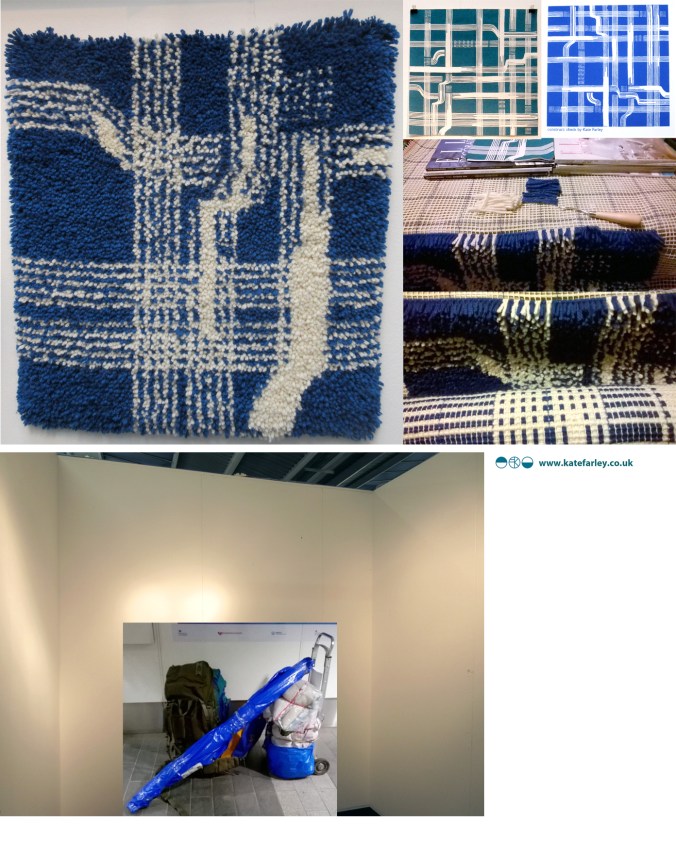
The end of the show has mixed blessings. After a long few days and months of preparation it’s great to have achieved a strong show – many kind people commented on how good my stand looked, but it also means the adventure is over, and it’s sad taking the show down, packing it up and saying farewells. Even in a few days routines are created. We struggled back on the trains with what we measured later as being 59Kgs of exhibition and assorted support luggage between two of us, ready to follow up the contacts made…. and to sit down!

So what have I learned?

  • I learned that I really am making the work that I want to make, and did manage to communicate that with the right people.
  • I’m really proud of both collections, and am delighted at the reception that ‘construct’ received
  • and latch hook rug making! I learned how to make a rug and now know why they cost so much… but really enjoyed making it… with British wool!
  • I learned how important it is to take risks, to put work out there to be judged… to keep learning

Thanks to all those involved: family helpers, the Tent team, Formica Group, Surface View, fellow exhibitors and for everyone who came to visit.

KF_tentstand3a_G18_15web