I’ve been busy printing and presenting my ongoing pattern research over the last few months, testing the design and print process, and receiving useful feedback – which may explain the lack of blog posts recently!
Last September I presented my work at the Fashion and Textiles Courses Association conference, Futurescan 6, held at De Montfort University in Leicester, and had a small exhibition of the work in progress during the conference. It was great to formalise my ongoing work at that time, and receive external feedback from the audience. It was useful to consider how I communicate the research, as the principle is simple but the process complex. I have also discussed this research as part of other presentations over the last few months, for colleagues, for undergraduate students as well as the audience of the Costume and Textiles Association’s programme of Heritage Open Week talks at the Forum in Norwich.
Last week I presented this research to the British Association of Paper Historians as part of their Spring Meeting held at St. Bride Foundation, having been invited to do so by the Wallpaper History Society. My fellow presenters covered wide ranging topics, from paper conservation, Japanese paper as cloth, the College of Arms and the current situation of the paper industry in the global context. It was a fascinating day with lots of common ideas and interests, and I received some very positive feedback to keep me on track.
I have further opportunities to share my research in a couple of months, so more news on that in due course!
I am continuing to develop both lino blocks as well as artwork for screen printing, which enables me to test different colour handling and substrate options, for wallpaper and cloth. Colour is an important element of this research and particularly the transparency of colour in the overprinting, so the palettes will continue to evolve as I continue the exploration of primary and secondary colours.
As I gear up to making larger work for an upcoming showcase opportunity I look forward to sharing more of the work in progress.
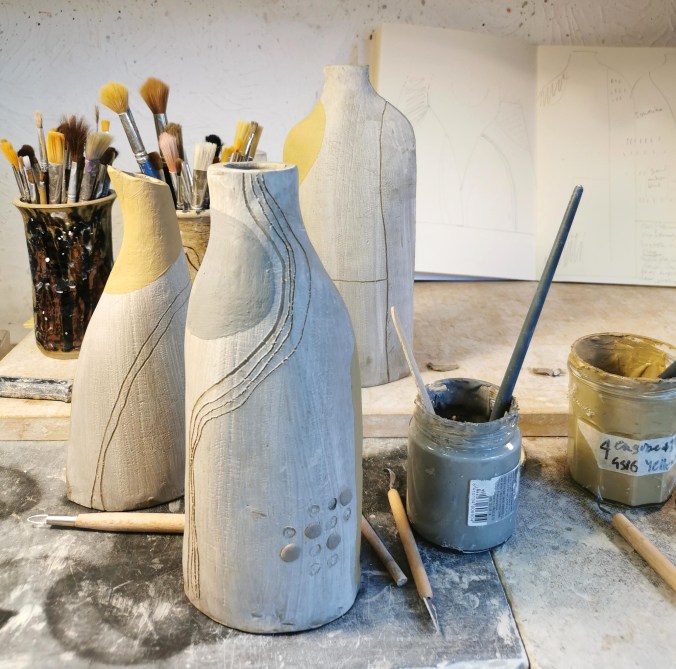
A little over a year ago I started to collaborate with my mum on a very special creative project. My mother has been a potter all of my life and family meals at home would mean eating from hand-thrown stoneware bowls, plates and cups made by her. During the 1970s and early ’80s she exhibited her goods at craft fairs in and around Wymondham, Norfolk and we would hang around watching as mum demonstrated her craft alongside her creative friends. We were lucky enough to have personalised birthday gifts made by mum during our childhood, and when I left home I was given a homemade teapot, cups and bowls that I still have, three decades later! My sister and I used to play at the potter’s wheel and hand build the odd ornament. I vividly remember the smell of burning clay dust on the bar heater and the feeling of dry clay on my hands.
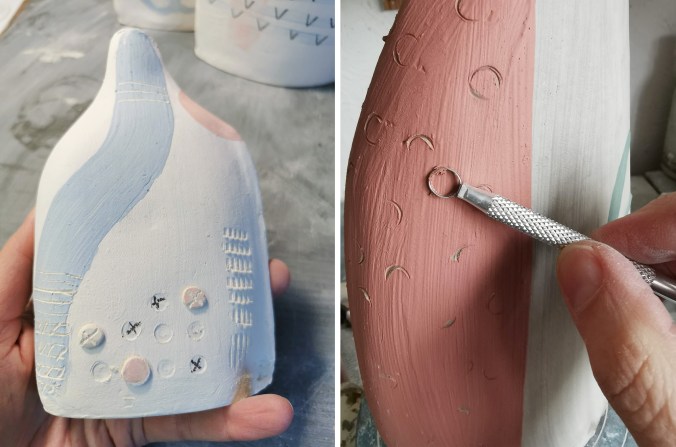
Last winter, as a way to spend time together at a sad time of family loss, I suggested we try collaborating, sharing our skills to see what we could come up with. I made a project sketchbook to outline a few thoughts and approaches to form and visual language, and handed it over for mum to think about what chimed with her. Although I’m a surface pattern designer, I’ve no experience of hand painting on ceramics beyond art school. Mum has switched to hand building her vessels in recent years so this was how we started. After a morning in my studio pressing tools into damp clay, drawing forms and testing colours, the project was underway.
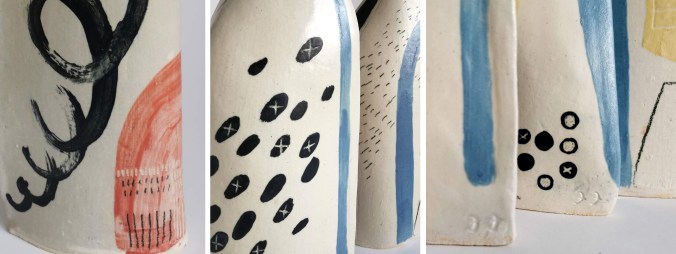
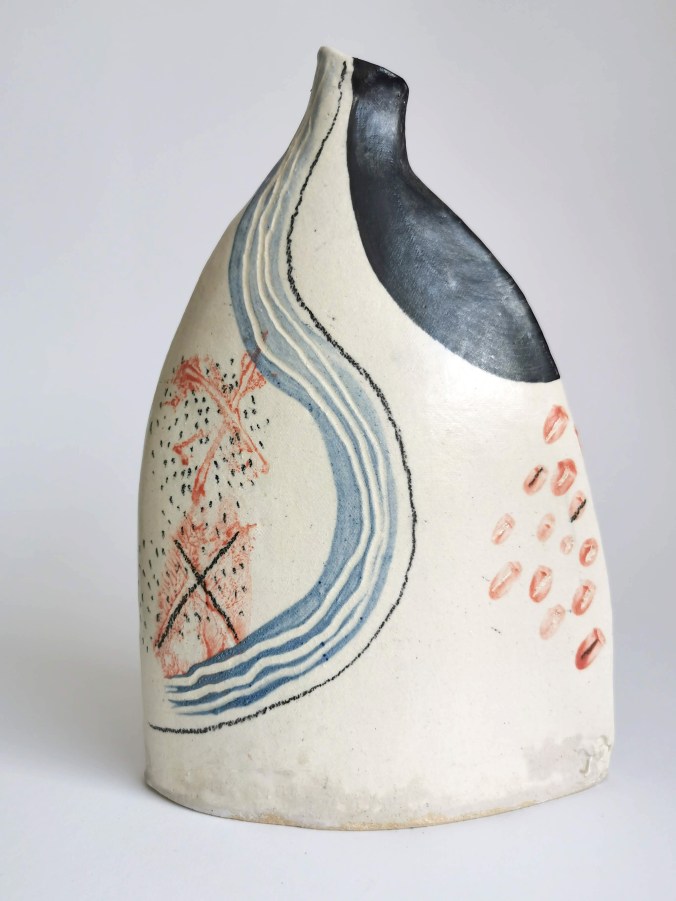
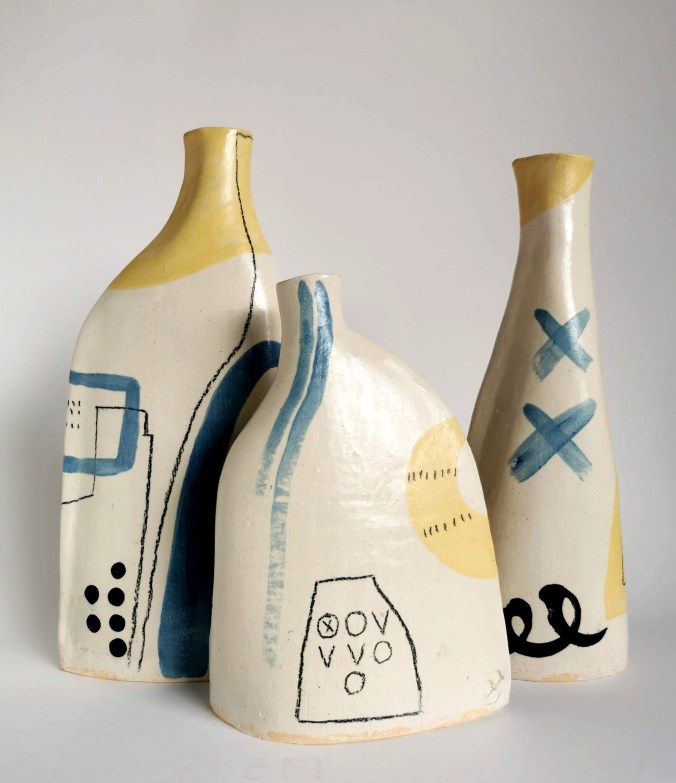
Mum tested a few ways to construct the vessels and I responded to the forms with drawn and painted marks inspired by our mutual appreciation for landscape. I had to learn how to load the brush and use the colour on the clay. I monoprinted texture and marks by painting newspaper with colour then drawing on the back of it on the damp clay. I drew with the ceramics pencil and scratched through shapes of colour with different tools. I’d hold my breath in anticipation as I planned a long line of colour, top to bottom, over the neck and shoulders of the form. We also added buttons as visual and textural interest. We had some gentle discussions about my preference for marks mum was less keen on, and we egged each other on each time we returned to the pottery. I’d receive a message, “Kate darling, I’ve made some more for you!” and soon the weekend arrived and we were nattering away, having our creative fun together again.
We have learned lots about what we have both wanted with the shapes and surface pattern of the pots, and I’ve tried my best to understand slips, engobes and underglazes. Our techniques have been refined, and standards raised during the year. I’ve definitely got better at drawing on three-dimensional forms – I’m even more in awe of Clarice Cliff! There are three series so far, exploring different forms, colourways and surface decoration, with approximately ten flasks in each.
I’ve thoroughly enjoyed the opportunity to work with mum on this project, it genuinely feels an absolute privilege to be able to work in this way. This collaboration has been one of united adventure, sharing each other’s creative decision making and discipline expertise to guide us, learning to make more than we could individually, sitting beside each other in a conversation between clay form and mark making.
I also think we may not be done yet … we shall see! We are looking at options to exhibit them and would very much like to share them with others.
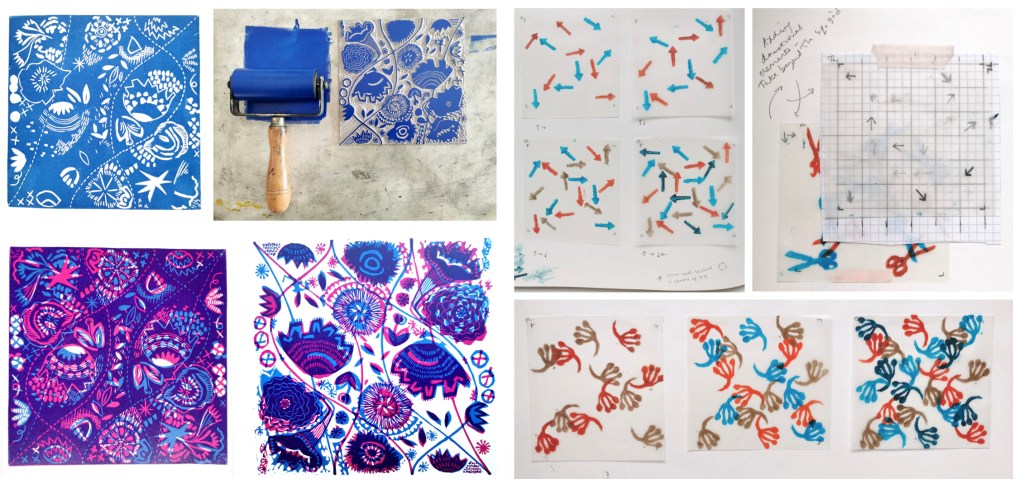
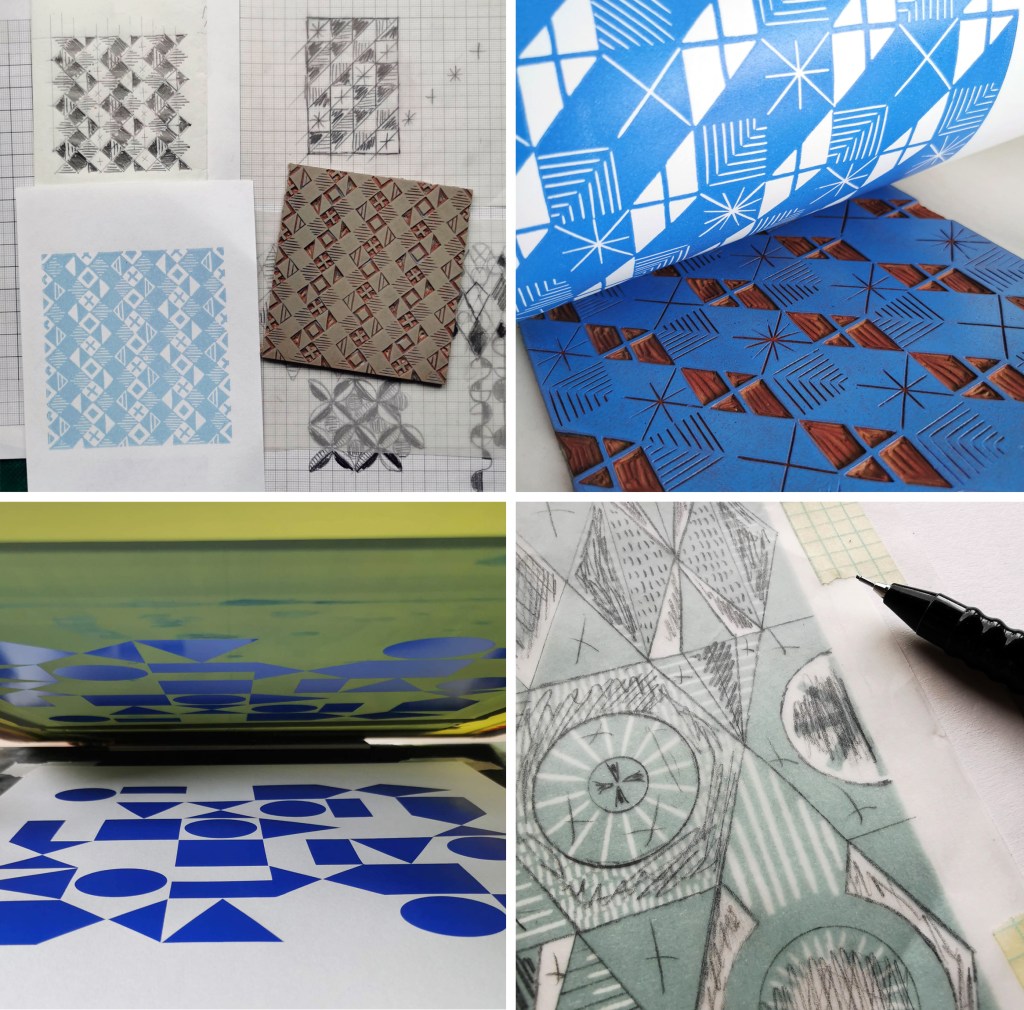
I’m currently working on some large scale lino blocks to print floral patterns as part of my continuing pattern research. At the same time I’m also teaching our BA2 group how to create repeating printed patterns, so it’s always nice when there is some parallels between what I’m up to and what the students are doing.
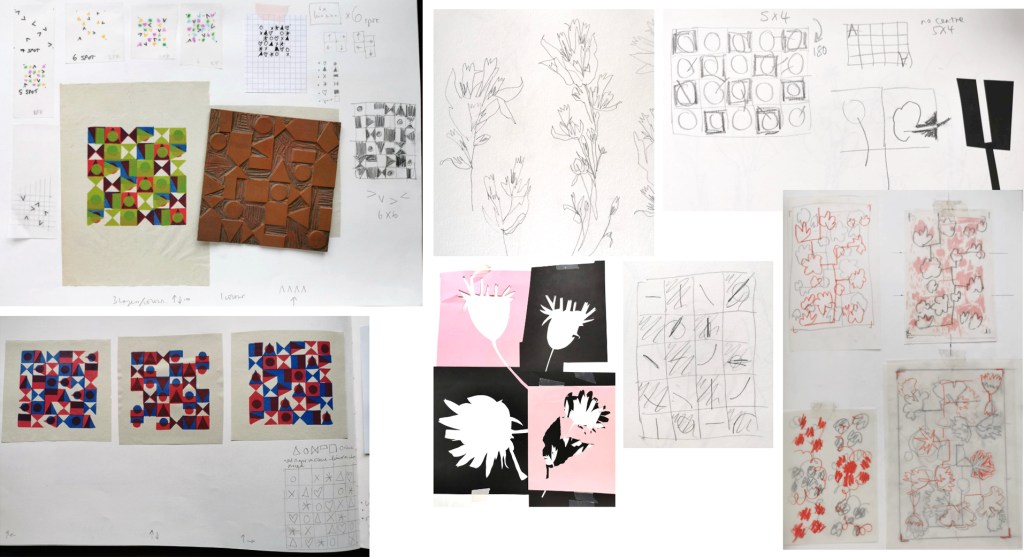
I have been returning to my sketchbook of floral drawings I made from my trip to the Italian Alps, and exploring them again with new paper cutouts as I think about overprinting and block rotation. I’ve not proofed the plate yet, but here’s some work in progress images from the studio.
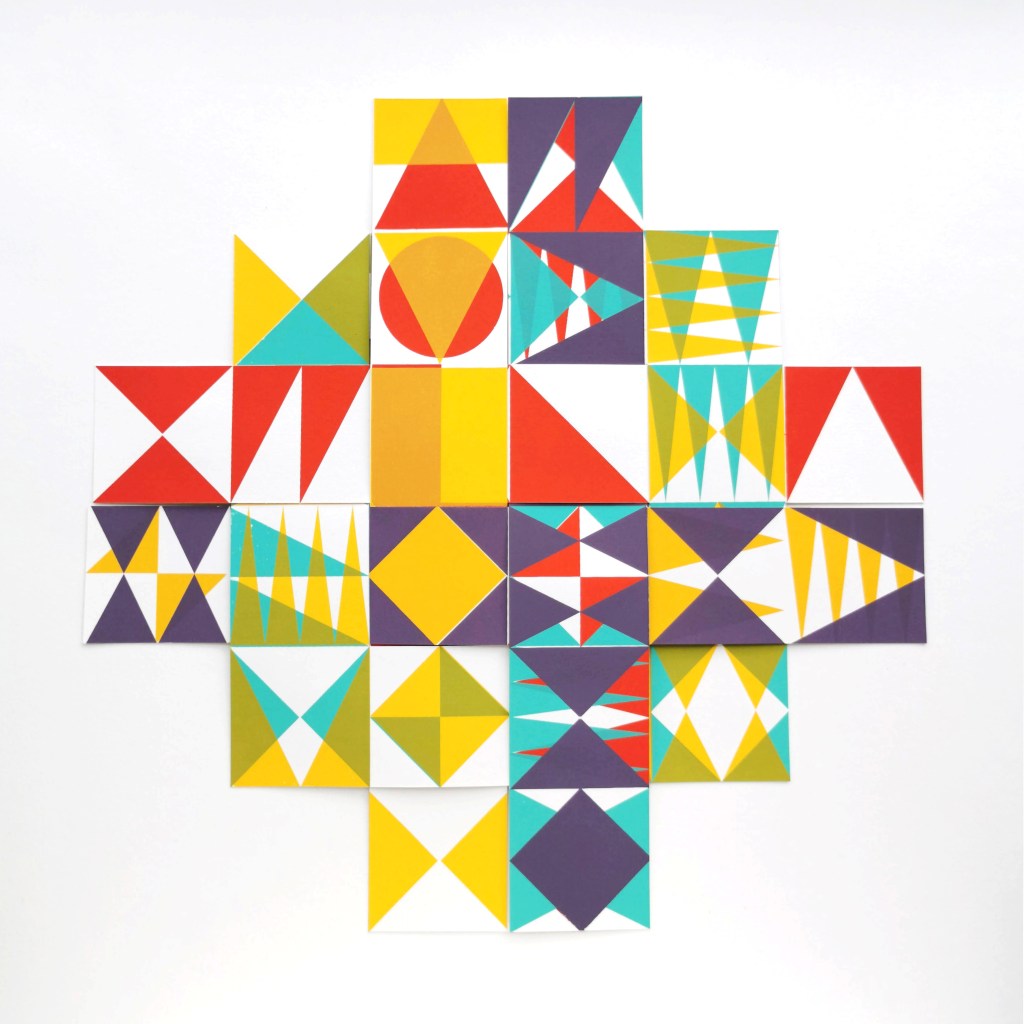
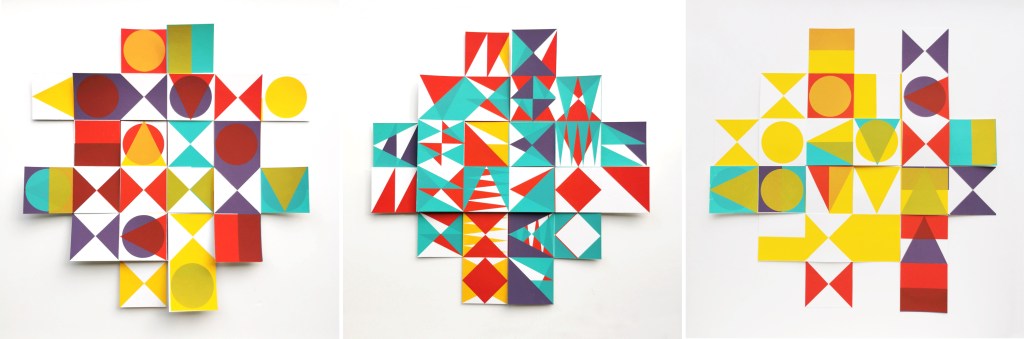
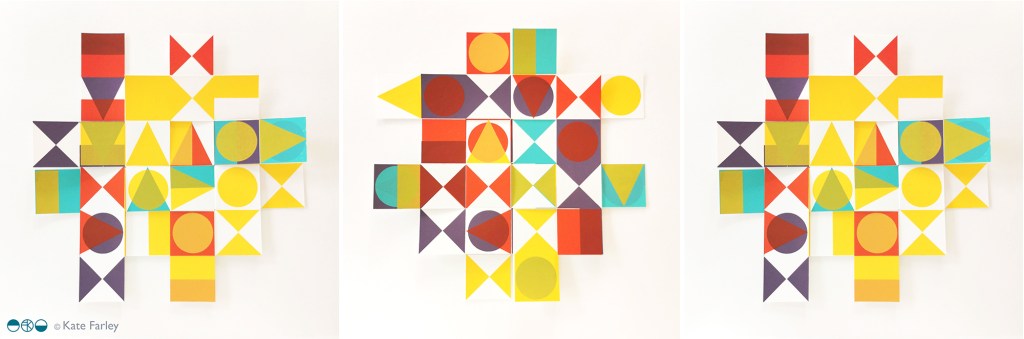
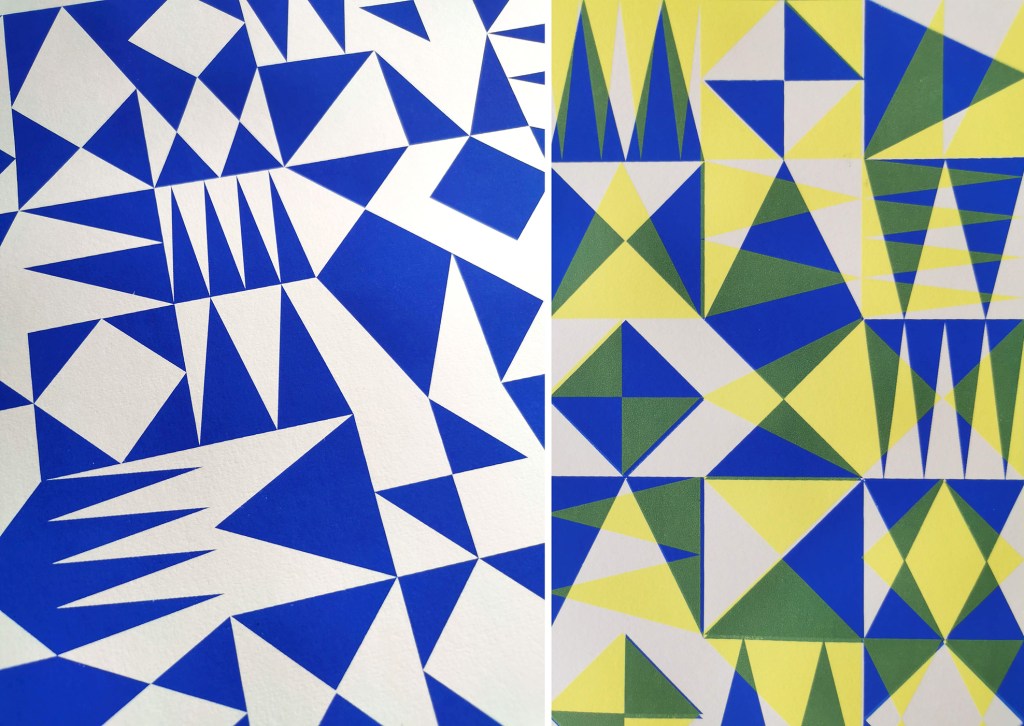
I am really pleased to have had two of my most recent works on paper selected to be included in the Print Cromerexhibition this summer, with the Private View on 19th July. This new body of work has been developed as part of my academic practice at Norwich University of the Arts where I have been exploring pattern structures and repeat blocks. I have explored new pattern iterations by rotating the screens to add additional colours of the same artwork, thereby building greater complexity from limited design information. In an age where digital design and the use of Artificial Intelligence provides limitless opportunities, I want to explore the fundamentals of pattern creation to generate new possibilities that are led by the designer, ensuring the creative path is transparent.
The theme of the exhibition is PLAY, and as a result the palette I created feels full of summer carnivals and fairgrounds. The overprinting of inks with differing levels of transparency provides a building of depth and subtlety of harmonious colour.
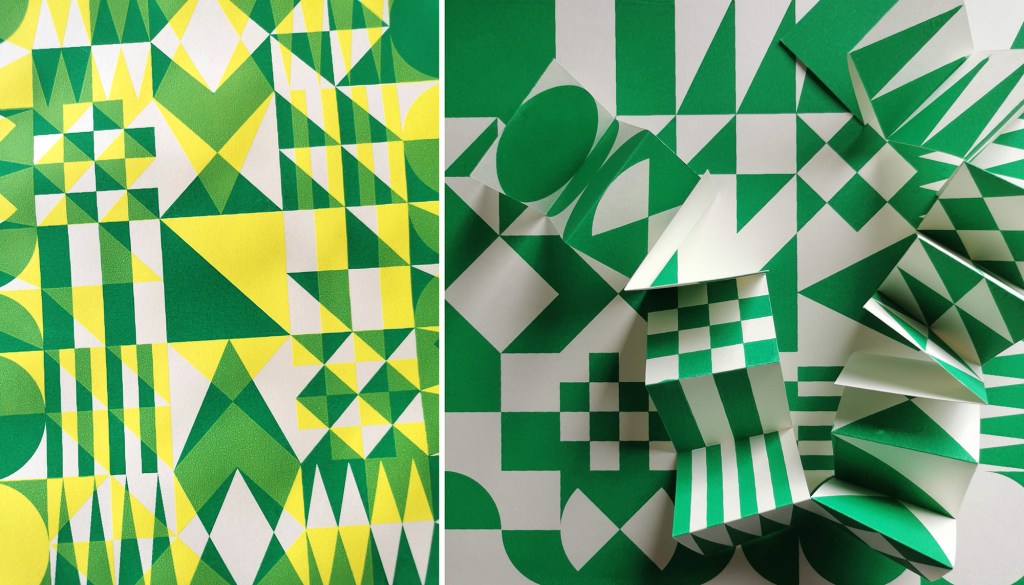
I created a number of one, two, three and four-colour prints initially, that featured the screen rotation in adding the colours. I then cut strips of the prints and with further rotation of the strips, interwove them into one base print that had been sliced to enable the slotting. I enjoyed bringing back an element of paper engineering from my book art practice into these new pieces.
In designing each piece, I considered the placement of motifs and relationships of colour. The collection provides variation within a collective identity and belonging. Some pieces feature only triangular motifs, while most incorporate the circular and rectangular elements too. My research utilises design thinking by Lewis Foreman Day, and his distribution of elements. This approach results in scattered focal motifs that work across repeating patterns. Although this is not a feature of my new work, I recognise the placement considerations are also useful in this work too.
A number of these pieces will be for sale during the show.
I’ve been enjoying some studio time to explore my print research as works on paper with the hope of exhibiting the work. I enjoy paper engineering and construction (that’ll be the book artist in me!) and have previously tested paper manipulation in relation to this current pattern research. I tend to work in this way, creating drawings or prints to exhibit / sell alongside forming pattern ideas, and it has been useful to see the evolution of the sampling in this way here too.
These new artworks utilise my screens of geometric artwork practically exploring research into motif distribution in printed pattern thinking formalised by Lewis Foreman Day in his book Pattern Design, published in 1901. Having printed the artwork in the first colour, I rotate the screen by 90-degrees and print the second colour, turning the artwork / screen up to four times for maximum complexity. To add a further dimension, I’ve been constructing works on paper that utilise several iterations of the prints to build new compositions by weaving and slotting strips of the printed papers in differing combinations of the four colours in the palette, providing the coherency across the series, and an injection of the spirit of summer fairgrounds through the colour and geometric visual language.
There are two screens of artwork used in this collection, therefore two series of original artwork (PLAY – circles and PLAY – triangles) and I shall continue to evolve the body of work over the coming months. I’d love to know your thoughts on this new work!
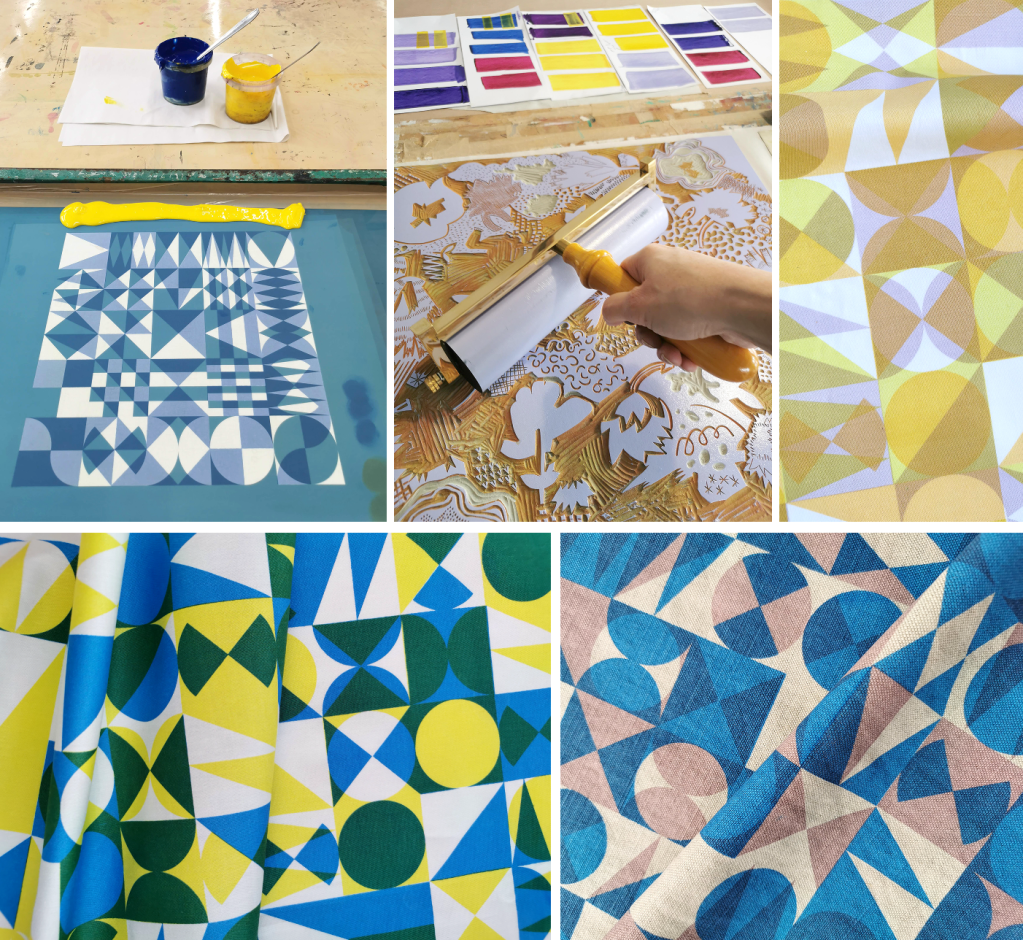
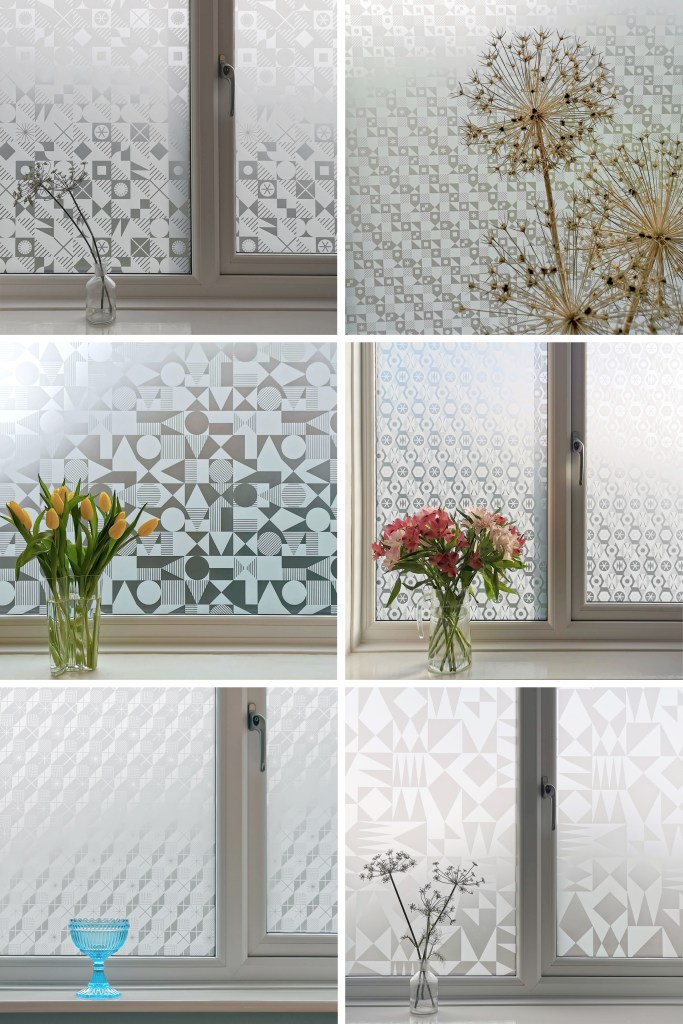
I’m excited to be finally bringing this collection of surface designs to market in collaboration with the Window Film Company. The inspiration for the patterns has stemmed from my fascination with geometric designs, taking the basic ingredients of triangles, circles and squares as my starting point.
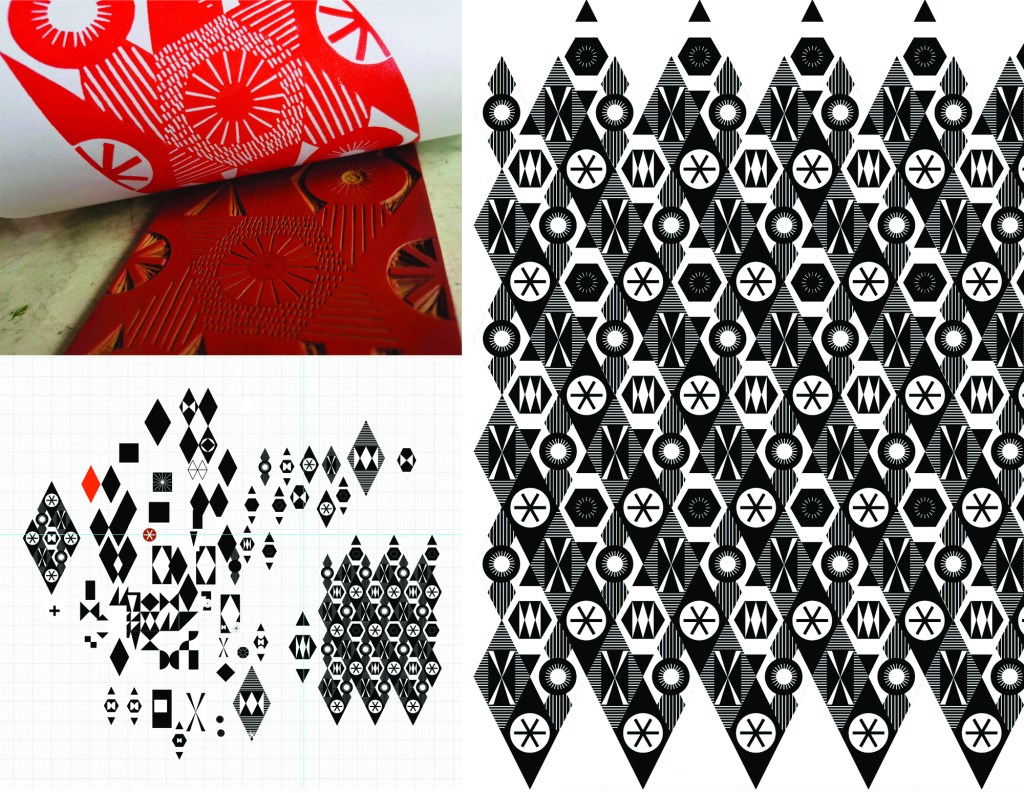
I’ve been exploring geometric pattern structures in relation to design principles established by Lewis F. Day at the turn of the Twentieth century, exploring the equal distribution of motifs within a repeating tile to alter the visual rhythm within two-dimensional surface designs. I have also explored expectation and disruption within the repeat tiles. On establishing an apparent small-scale repeat, I play with unexpected shifts in the placement of motifs to disrupt the rhythm, challenging the sense of order. This work belongs to my ongoing practical pattern research as Associate Professor in Design at Norwich University of the Arts.
The six designs each have their own identity and yet belong together like siblings in a family, with shared features of geometric motifs and formal compositions throughout this collection. Some of the designs started their life as self-initiated physiotherapy back in 2020 / 21 following abdominal surgery and my subsequent recovery. The design challenge, to make small-scale lino blocks of repeating patterns to print by hand, provided me with small physical and mental tasks to focus on between the naps. I had hoped some of the designs would one day be leaving my studio, and I’m pleased and proud to share them now.
Designing for window film requires consideration of motif, shape and pattern construction without the aid of colour, requiring an absolute focus on negative and positive shapes. I enjoy working within design limitations in relation to production requirements and technical specifications, believing the challenges become design opportunities. I spent some time testing the various scale of patterns across the collection, including a micro pattern (Step), through to a much larger scaled pattern (Triangulate), considering window sizes in both domestic and commercial spaces in relation to the motif sizes.
I’ve worked with the very patient Steve at the Window Film Company for all my designs available on film, including the large-scale bespoke design for Birmingham Airport back in 2017. Previous designs from my Construct collection available from the Window Film Company won a House Beautiful award in 2018 too!
Steve worked with me to sample some of the early versions of these designs generated as digital scans from lino prints initially, but I didn’t like the visual quality in the translation of the prints. The original artworks for this collection were generated using collage and screen printing alongside the lino prints as I prefer designing with a physical relationship to image creation. After further consideration I opted to create each of the designs as vector-based files for production, providing sharp graphic quality to the patterns.
Mike at Window Film Co. was also fundamental in getting this collection established, off the computer, on to window film and ready for sale. Our conversations focused on understanding my design identity in relation to previous work. He ensured the designs felt authentic to me, while building on the existing designs I already license to the company.
It’s always exciting to receive a delivery of samples, and I’ve had a few of those over the last few months. The final product is very different to a digital file, so it is important to inspect the artwork as film installed on the window, checking the scale of repeat as well as any discrepancies in the artwork – you must have sharp eyes for detail! With final decisions made and sampling approved, as well as the small matter of naming the designs, we have been able to sign off the artwork, and launch the six designs in the collection: Circulate, Diamonds, Shift, Triangulate, Step, Pairings
After the lovely summer I’ve been back printing in the studio, with some lino blocks on the go as well as two new screens I’ve had exposed as part of my pattern research. I’ve been exploring the rotation of the artwork as well as folding the prints to determine visual narratives.
I tend to not worry too much about colour palettes in this sampling phase, particularly as I’m focusing on the pattern building but also considering a range of material substrates for future outcomes. I appreciate this gives me freedom to test colours, some more successfully than others. After several days at the computer screen it can be a complete relief to spend time at another type of screen!
As a result of my current pattern research practice, I’ve been keen to get out and discuss print production methods with designers and manufacturers, particularly as I was restricted in doing so while writing my book during the pandemic. A couple of weeks ago I had the opportunity to visit designer Marthe Armitage in her showroom in west London, showing her my sketchbook / design work and discussing each of our design and production processes.
I’m not sure when I first became aware of Marthe’s patterns on wallpaper and cloth, but I’ve used her designs in my university lectures for the last few years to illustrate economic principles of building pattern, using a single block (one colour) to provide flowing and complex patterns, featuring varieties of visual texture within motifs. I bought the book on her life / design career, The Making of Marthe Armitage (published in 2019 by Graphical House) and was impressed by the beautiful drawings that accompany and support the design work I was familiar with. It is a thoughtfully produced book, with some copies available with a hand printed wallpaper wrap cover.
I’ve written before here about the time my ‘phone rang and Marthe was at the other end, ready to discuss her inclusion in my book and we went on to put the process of pattern design to rights. Meeting her more recently and showing her my sketchbook was a wonderful experience. There was straight talking about the current state of patterns available on the market and we agreed with each other about drawing on paper to map out the design on a grid to establish the composition for repeat. She was intrigued by my investigation in to block repeat and rotation of the tile and suggested some of my ideas more fruitful than others – I agree! We were joined by Marthe’s daughter Jo who leads the hand printing and is key to the future direction of the business, as well as Harriet, the Creative Project Manager and Christine, the hand printer who supports Jo in production. I was interested to learn of some new plans in development and gain an understanding of their experiences of print production in the UK.
The showroom in Brentford is a beautifully designed space which includes the printing press for hand printing their wallpapers and plenty of samples to admire, and is open to the public regularly. Tins of ink are displayed alongside samples of designs in progress and colour testing. It was also interesting to see the lino blocks featuring the designs cut by Marthe backed on metal plates ready for the press. Check out the instagram account for up to date news.
As our meeting came to an end, I grabbed the opportunity to ask Marthe for a photograph of her alongside the beautiful designs and to sign the copy of my REPEAT book in which I’m collecting signatures from the contributors. I am very grateful to Marthe and the team for making time to meet with me, thank you!
I’ve been keen to get back to designing and printing having spent my practice time writing and developing the book for publication over the last few years. I’ve been testing ideas of pattern evolution and pattern construction for some time in a limited way, specifically looking at pattern structure evolution through drawing investigations, but the ideas at the heart of this investigation have themselves evolved over the last couple of years.
With more time and fresh energy I’ve defined a new project brief and research rationale, and I’m excited to have got off to a good start. I’m looking at repeat tiles and construction of pattern formations, so cut shapes and sketches were an obvious way in for idea development. I’m trying not to be too precious with outcomes at this stage, so I’m trusting the process.
I’ve started by testing ideas with geometric shapes as subject matter to keep the aesthetic clean and graphic, focusing on the laying down of colour blocks. I’ve started by working up some ideas for screen printing but anticipate many more drawings, maybe lino prints and certainly digital work will be created over time too. The colour palette will certainly change, but with an exhibition I’m making work for at the same time dictating pieces to be black and one other colour I’ve gone with black and green.
I don’t want to give too much away at this stage, but look forward to discovering the potential over the next few months.
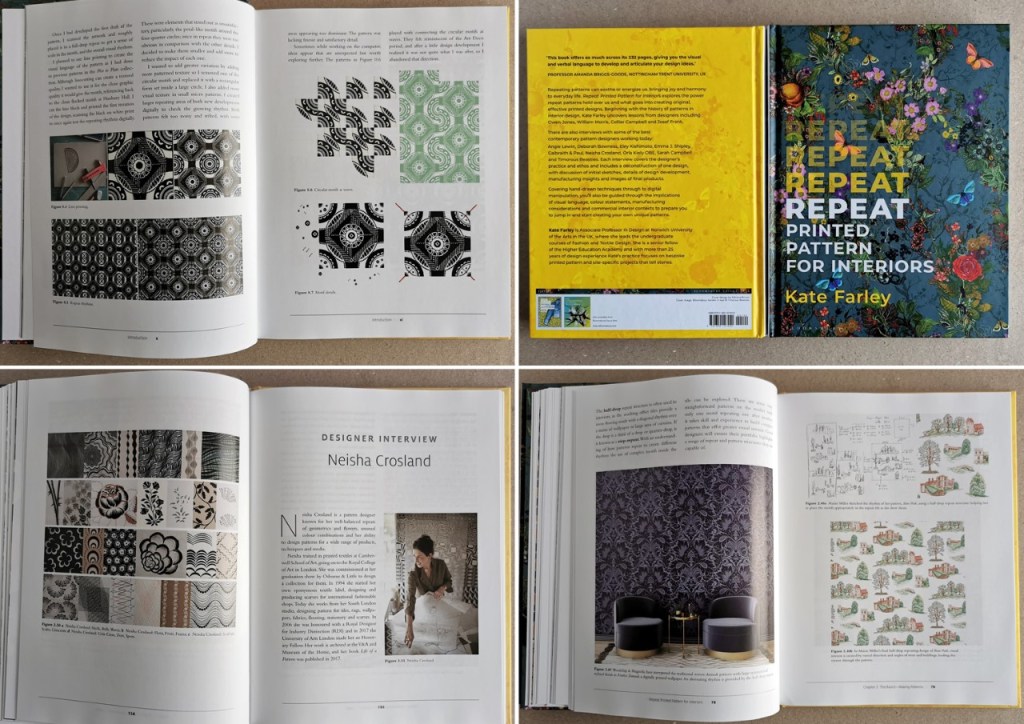
Here we are, the book project is complete with publication in the UK and US today. It’s been a journey!
With the first thoughts of writing a book about pattern back in late 2015, the development of some draft scopes, the contract signed with Bloomsbury in early 2019, a first draft of Chapter 1 delivered in late 2019, a global pandemic from 2020, unscheduled health issues requiring hospitalisation & surgery in 20/21, final manuscript submitted in June 2021, and proofreading / layout until June 2022 I have had to be very focused and patient – and all this while leading two degree courses until this Autumn (I now only lead one!).
Writing a design book had never previously been a consideration of mine, but since I’d been reviewing books a few years ago it got me thinking that this was the perfect place to bring together my design practice experience with my academic role. The idea grew on me. I’ve spent years teaching pattern design and as a result tried and tested hundreds of ways to deliver inspiring and informative design workshops. I spend lots of time analysing pattern to support my lectures, and in my spare time … and so in hindsight maybe it was a natural next step.
The introduction includes me taking the reader through my journey of designing Hanbury, my wallpaper, as well as my relationship with pattern. The three chapters are very different in nature which helped to focus the research and writing at each stage, and provides the reader with a broad look at the subject of pattern design in relation to history – Chapter 1, how to create pattern – Chapter 2, and how others do, through nine feature interviews in Chapter 3. I have to comment on the cover … I love the cover, so a huge shout out to Paul and Ali of Timorous Beasties and to my publisher Georgia at Bloomsbury who allowed me to have it just as I wanted. In fact I owe so much of this project to Georgia’s belief in me to get this done, and her unwavering support throughout. Who’d be a publisher?
Many years ago a previous boss asked me to take on delivering the design history lectures to first year undergraduates and with panic and fear I embarked on what I can now describe as one of the most overwhelmingly frightening but important career defining undertakings. I was given an opportunity to challenge myself while presenting to a lecture theatre of students on a Friday morning in Birmingham, and the result was empowerment. Without high school History qualifications behind me but a passion and base knowledge of design history I decided to engage students in how history is relevant to us now, what we can learn from, challenge and move on from. I needed it to be immediately relevant to their design projects to help them understand history is important to designers today. It took some years before I felt on top of it, but many years on I comprehend the legacy of those hours of learning in order to teach, and how that substantial investment of time led to the knowledge and experience to write Chapter 1 of this book. I could have written many thousands of words more to cover the history of pattern across the globe, but word limits provided boundaries, and without a deadline I may still be writing!
I enjoy learning. I am hugely grateful to all the students I have had the pleasure to work with over the years, for sharing their creative journeys as we discuss drawing, rhythms, compositions and colour proportions to make the most interesting repeating outcomes. I’ve learned so much along the way, and that’s what keeps me interested and passionate about the discipline of pattern design. Every studio session is an exchanging of ideas, with no single correct answer, but plenty of opportunities – a privilege to be a part of, and the inspiration behind Chapter 2. It explores the practice of repeat pattern making, presenting considerations to build stronger outcomes without stipulating one right answer. I encourage designers to embrace the process of testing variations in pattern construction so the final result has learned from all that has gone before. The designers I include to illustrate the text offer so many styles and approaches and have been so generous in sharing their working practice with me and future readers.
Just as I did with my degree dissertation back in 1996/97 there were times that required drastic measures to get things right in the writing of the book – many sheets of paper were laid out across the floor and I took scissors to the pages, literally cutting and pasting paragraphs in the process of reordering the narrative. Other times I had to diligently input data on a spreadsheet, chase consent forms or simply focus on writing.
Obtaining image permissions was probably the most arduous and stressful process of the project. Keeping to budget while securing the images from archives, individuals, estates and designers I really wished for was difficult, and sometimes I had to admit defeat and find alternatives. My editor and publisher (Faith & Georgia) were both brilliant at talking this over and I’ve been so pleased to include some absolute favourites such as Lucienne Day’s Spectators and Calyx and Josef Frank’s Mirakel – I danced when these came through! It’s also been a pleasure to include a number of works by students I have taught, some in the last five years, but also Emma J Shipley back in 2005/6 – I still remember her tour bus interior for Madonna in BA1 (one of the interviewees in Chapter 3). How time flies!
I’m grateful to all the designers / archivists who have contributed images and details of the patterns throughout the book. Quick check-ins to confirm the number of screens used, or what digital software the designer prefers was all part and parcel of getting details as correct as possible. One memorable highlight on a day of writing was a phone call from the brilliant pattern designer Marthe Armitage to talk through her contributing images for the book. I was so surprised I was rather lost for words initially, but soon we were chatting all things pattern, and I’m delighted to feature her printed wallpaper patterns in the book, as they regularly feature in my teaching presentations. A shout out goes to Sophie at Warner Textile Archive who went above and beyond tolerating last minute requests for photography to get just what I wanted! Much of my clear headed thinking happened late at night as I juggled leading two courses in the day job, and I’m grateful for all who made sense of my communications at this time.
Who knew it took so long and so many people to get a book to be a physical artefact? The proof reader was brilliant as we fired queries and answers to and fro for a frantic few weeks, and then she was gone. Then the layout was taking shape – and I think I must have been a nightmare – sorry Deborah! – I wanted every page to look its best and sent diagrams and descriptions to make that happen. Finally, following last minute queries while I was at New Designers showcase in London with my graduates in late June I had to step away and the book went off for print production.
I’ve been asked several times if there will be a second book, even before I held this one in my hands…! I’m not sure, maybe one day, but today I’m celebrating this one.
I’m grateful to all who have helped make this happen, from my tutors back at art school, to friends and colleagues who have tolerated and supported me in this project. Thanks to the brilliant team and associated individuals from team Bloomsbury and to everyone who buys a copy to share the joy of printed pattern – thank you!
I’d like to dedicate the book to my parents in deepest gratitude for providing an upbringing where experiencing art, design & culture was a given. Thanks to my mum who has survived the ups and downs of raising a creative child, I know it wasn’t always easy. My sorrow remains that I never had the chance to have an adult to adult conversation with my dad about the things we would have no doubt had as common passions, but who inadvertently taught us Farley girls that if you put your mind to something there is no reason why it won’t work out. A lasting legacy & mindset.









 Kate Farley - drawn to design