nature: holiday inspiration for the sketchbook

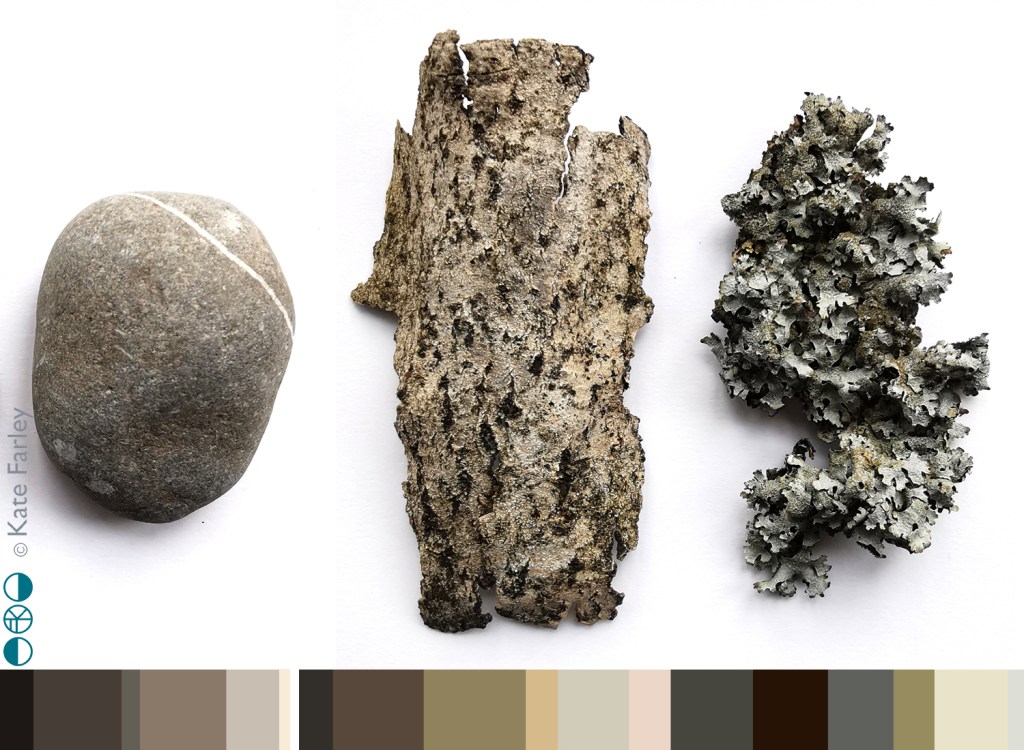
This holiday time has provided an opportunity to go to new places, see new things and return to the sketchbook just for fun. A week at Ilkley Moor enabled lots of time for walking and seeking out inspiration from the natural world, with distinct differences to the landscape I’m used to day to day. Up hill and down dale saw me amongst mosses and lichens, pebbles and boulders, grouse, larch trees, heathers and bogs … and even a fragment of pottery.

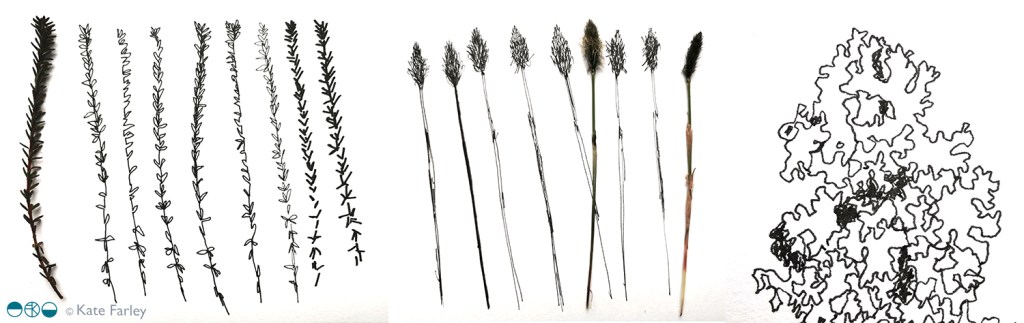
Rucksack pockets were filled with samples of treasure ready to investigate later. The process of drawing enables me to get to know an object, and by making several studies of each item I enjoy developing a stylised representation. I hope never to tire of the getting-to-know-you drawing process I have practised for thirty years.

By looking closely and seeing through drawing I can work out the essential elements of surface, form and texture to record, but also I love to play with the appearance of elevation and structure of three dimensional objects, such as the pebbles, to explore their new form as they appear on the page, as flat motifs.

The textures and colours of the items I gathered provide macro evidence of the vast landscape I walked through and connected with. As this was springtime there were pockets of fresh green bursting through winter foliage, demonstrating the natural cycle awakes again. The geology of Yorkshire provided variety in coloured greys and texture under hand and foot as we bouldered, scrambled and hiked, notable in contrast to the soft wet bogs and spongy moss beds amongst the heather.

Without going all John Ruskin about it, the natural world really is amazing, and full of inspiration for anyone inclined to notice. Anyway, back to the rather flatter fields of Norfolk …

drawing evolution – perspective and mapping

Several weeks ago I started, with no other intention other than to pass the time, making drawings of the trees across the fields I could see as we waited our turn at the farm shop. This was simply about making time for me to clear my head of all the other stuff and pressures of this new routine we find ourselves in. Drawing is such a key part of what makes me tick, whether it’s for rest or work.

Week 2 came so I took my sketchbook and made new drawings that naturally evolved from the first week’s observations. In the second week I also took scissors to capture the shapes as paper cutouts in contrast to the lines I had focussed on in pencil. Each week I’ve made these drawings and over time I’ve noticed the growth of leaves, making it harder to focus on the tree structures, but I’ve also moved the drawing on as a familiarity of my subject is developing. I wrote a blog post on those first weeks here.

I’ve spent the last quarter century drawing landscapes with trees and remember a significant moment as a student of design, when I discovered the water colours by Crome and Cotman in the gallery in Leeds – particularly strange given they were from the Norwich School and I’d left Norwich to study in Yorkshire, but maybe that was the initial pull. I studied the way they divided the landscape with brushed areas of paint and they helped me to see that I too could explore ways to stylise the way I saw the landscape.

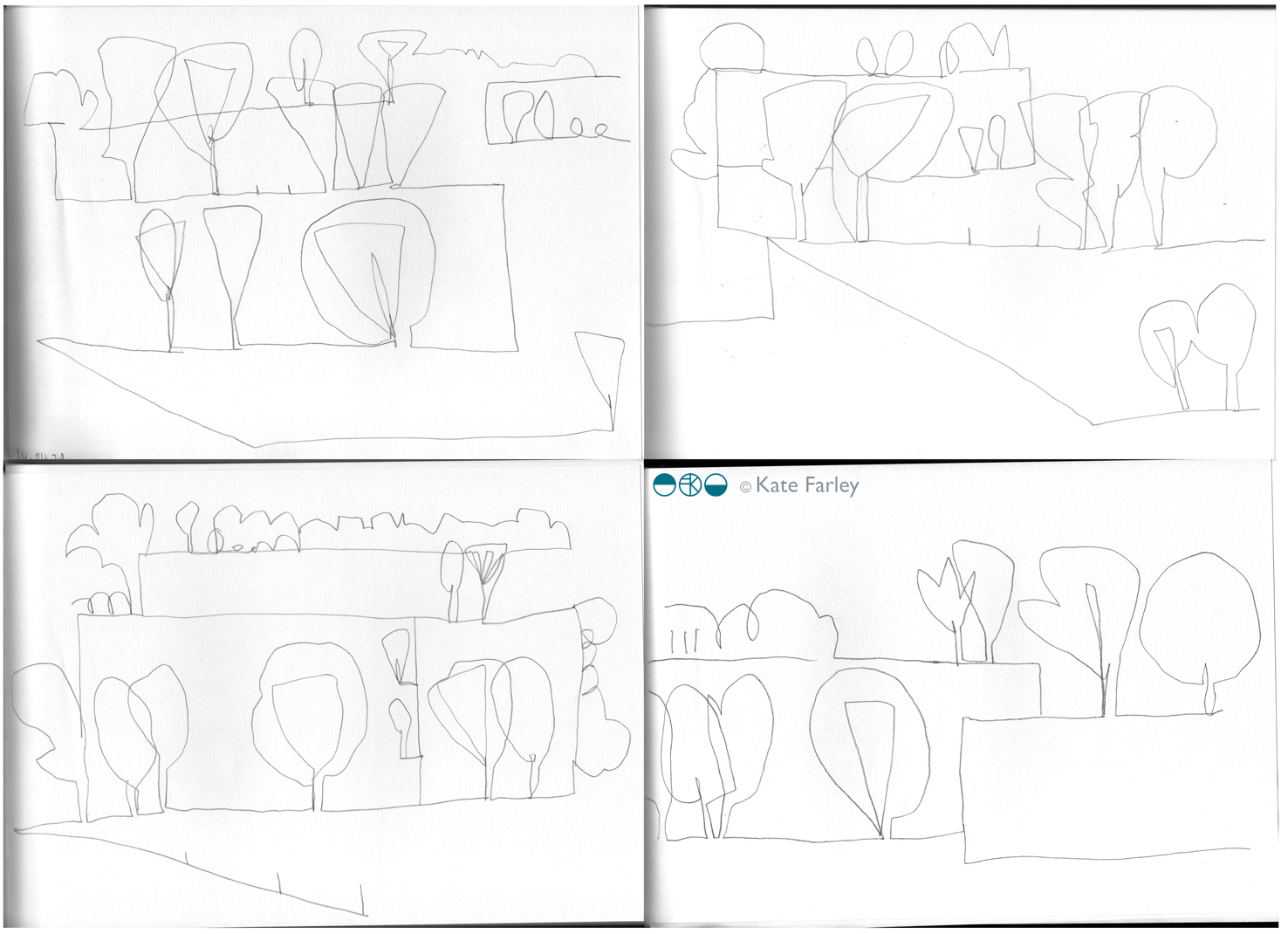
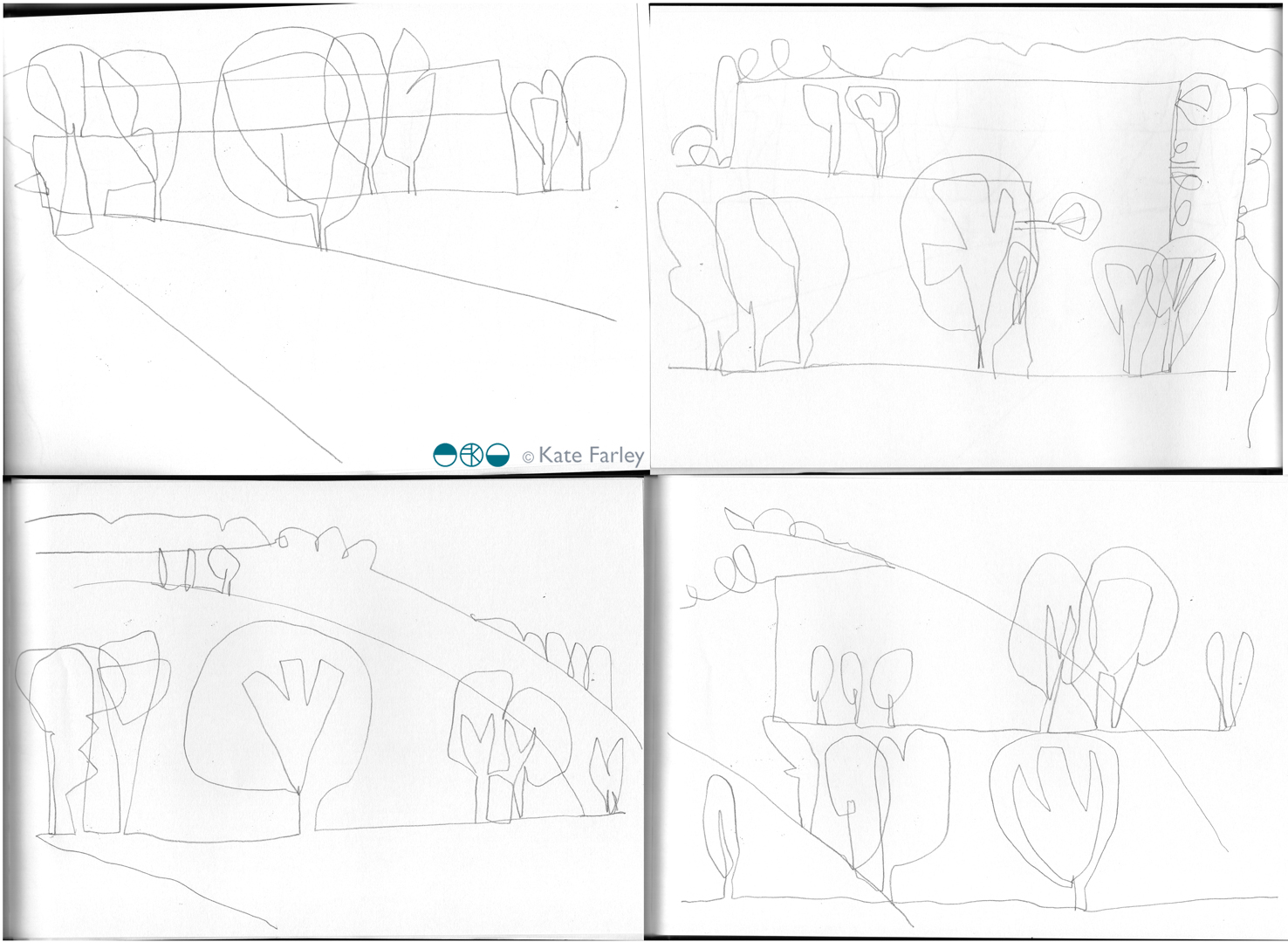
The drawings included in this post are all from week 5. I’ve added hints of fields containing the trees and those lines of containment are the edges holding the paths of trees. I’ve used the horizons from both a vertical and horizontal viewpoint and continued to stylise the tree forms throughout the five weeks. It’s getting harder as the trees flesh out their forms and we lost the details of the branches. I’m also suggesting depth of field with the scale of the trees near and far although I’m pulling the composition down to stretch out and extend the foreshortened landscape.

KFarley_Wk5_1_4

Throughout my career I’ve toyed with ways to map the perspective of landscape and use diagrammatic language, perspective and distorted elevations to represent viewpoints of 3D in 2D. The intention of the arcs was to suggest the sweeping viewpoint but in fact I think it hints at hillsides, and that really isn’t the case here in Norfolk. An undulating landscape maybe, but certainly not rolling hills – still, we can’t get it all right!

KFarley_wk5pics_4-8

I’ve thoroughly enjoyed this drawing exercise so far and look forward to week 6 and what the drawings will discover next time. I’m also, rather naturally I suppose thinking about pattern evolution and how these may become design work. I have lots of ideas to mull over and be excited by … but there’s no rush.

Having posted some of the drawings on instagram over the weeks I’ve received lovely comments and messages from people enjoying the drawings and I’m so grateful for the votes of confidence in what I am doing, I really appreciate that. Many thanks, I hope you continue to enjoy the drawing! ….

Save

photographic memories and a bit of a political rant…

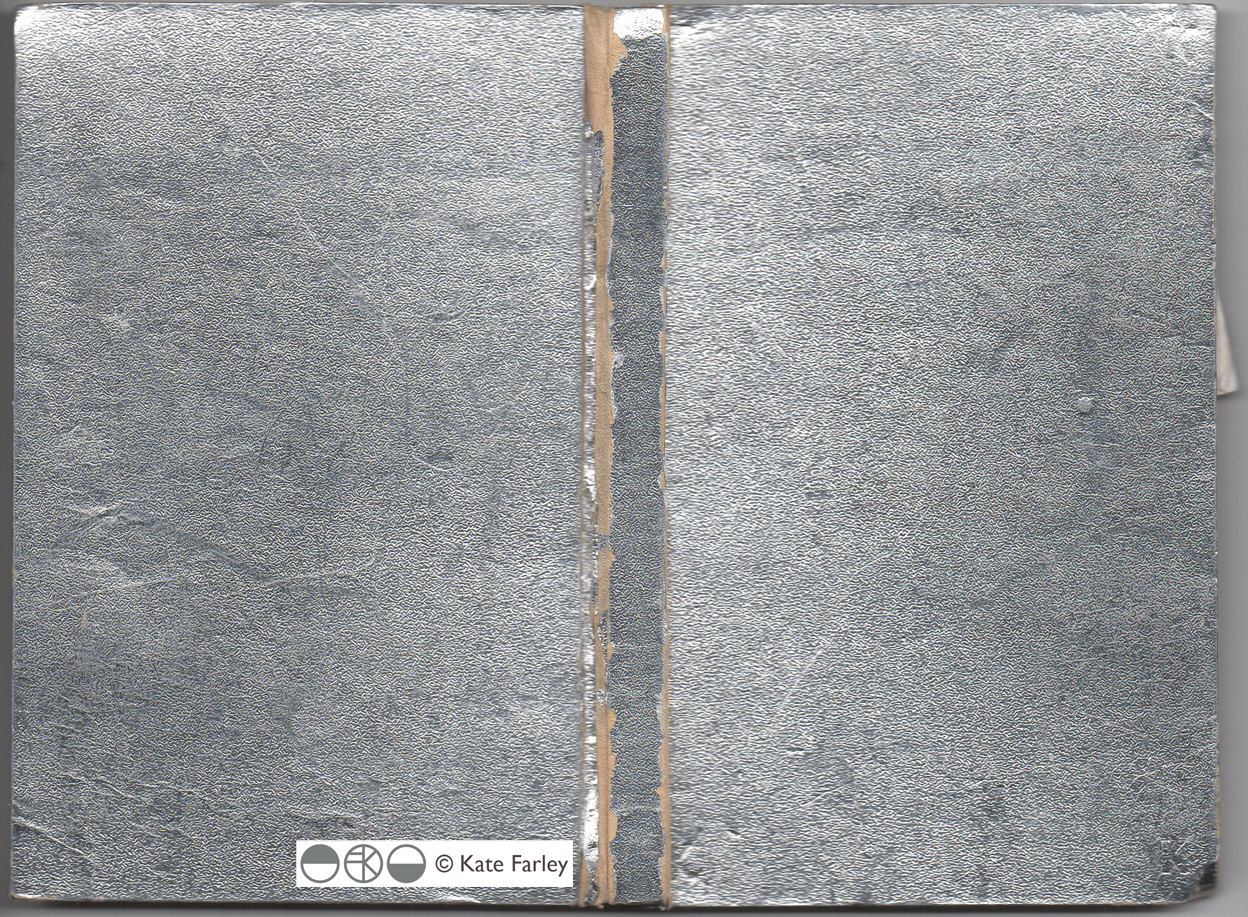
I’ve had rather a large sort through my creative archives in the last few days and I’ve been rediscovering drawings and designs from the last twenty years and more. I’ll share some of those finds another time. Amongst the formal sketchbook projects and portfolio sheets from art college days I found an old handmade notebook I used to record my photographic experiments and darkroom technical details / testing in. With it’s silver cover I chose to use, especially fitting with photographic techniques, I was reminded so distinctly of the days I spent in the dark room at Leeds College of Art and Design testing ways to create images and pattern – I could almost feel my Doc Martin boots on my feet!

silver photogrpahybookLCAD

The book reminds me of the hours I ‘played’ with creative and technical processes, with no sense of employ-ability issues burning, and I can’t really remember many project deadlines or talk of Learning Outcomes but assume there must have been. Those hours helped me to work out what I wanted to do, what sort of design language I would develop, and how my designs fit in the real world. Even now I can look back to that book and see creative sparks being established that have continue with me and what focuses my practice today. I feel lucky.

silverphotobookLCAD

It’s having this time to experiment and nurture creative ideas that all students at all stages of education need to have access to in order to understand the possibilities of aesthetics, innovation and design. This can’t be rushed and won’t be replaced if lost. It’s not just the artists and designers that lose out, its everyone! Maybe politicians who lack the understanding and foresight to retain sufficient art and design in formal education ought to consider how their material worlds came to be. It certainly isn’t all about money, even if it is beautifully designed and printed money!

This isn’t meant to be a rant, but somehow this luxury of creative time I remember having shouldn’t be considered a luxury, it’s a necessity, and my small silver notebook reminds me of the importance of learning time. We all need things designed and made, from the fork you eat with, to the car you might drive, and wouldn’t it be good if those things could be the best they could possibly be, and beautiful too, given half the chance! It’s no surprise to me that brilliant artists and designers don’t wake up one day, fully formed and ready for the off… It would be like a politician having had no time to live and work in the real world before becoming an expert on how to run the country for the rest of us.

Pattern design, outdoors and in…

If you are a regular reader of this blog you will already know that for the last few years my personal design practice has been inspired by garden design, and most specifically allotments and kitchen gardens in my ‘Plot to Plate‘ collection, launched in 2012. I have spent many hours walking, almost patrolling, up and down rows of National Trust cabbages and onions, armed with my sketchbook, annotating the patterns, translating them to motifs, documenting the small irregularities, the planting plans, the labeling – fruit and vegetables up and down the country, as well as our allotment, plot 8 in Birmingham. Upton, Packwood, Baddesley Clinton, Blickling, Felbrigg, to name a few National Trust gardens I have surveyed and taken inspiration from. Hanbury is my current favourite garden and I have been working on a number of patterns inspired by this property that will one day be complete, to launch at Tent London this September.

It is with this in mind that I write my thoughts. There are so many similarities between garden design and textile design they seem perfect companions in my practice. Long before Mr W. Morris picked up a pencil the natural world of flora has been a dominant subject of inspiration for pattern in the home. Rather than the bouquets and sprigs, posies and trellis it is the formal gardens, the parterres and kitchen gardens that hold the structure and compositional language that we textile designers and design educators regularly refer to…

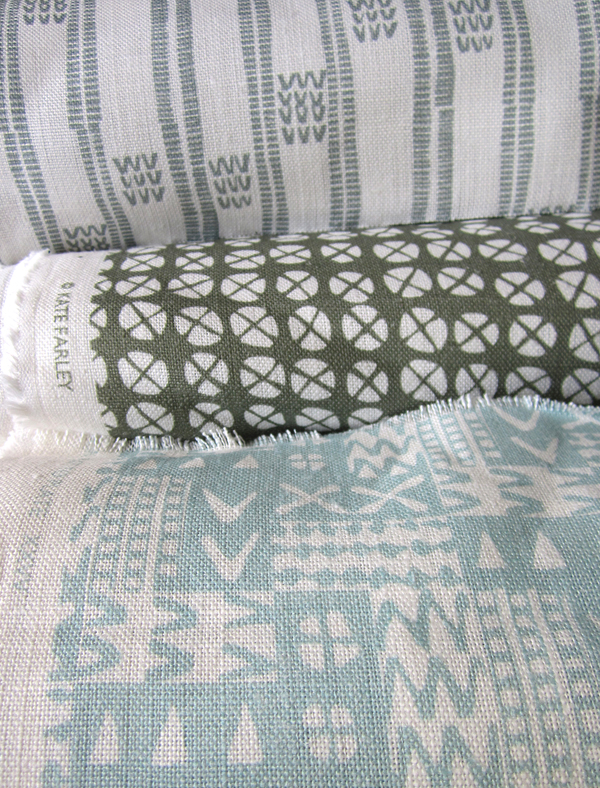
Stripes, spot repeats, all-overs and multi-directionals, geometric grids and diamonds, checks and plaids are all to see. And so it is, that it makes sense that I really have brought two things that I do enjoy together in my creative practice. It’s too early to share artwork for my new ‘Hanbury’ designs but I will share some garden pattern from Hanbury, and my ‘new’ fabrics by the metre, available very soon, in anticipation…

garden_textiles_hanbury_web  fabricrolls1_web

sharing the design process of Plot to Plate

Given that I am about to take my Plot to Plate collection of designs to Top Drawer this weekend I thought people might be interested in the design journey of ideas that result in such a collection of pattern.

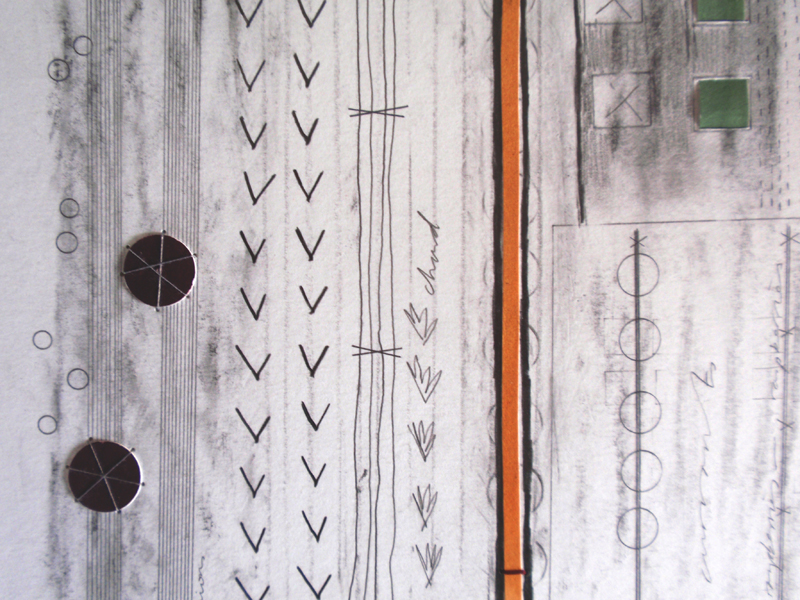
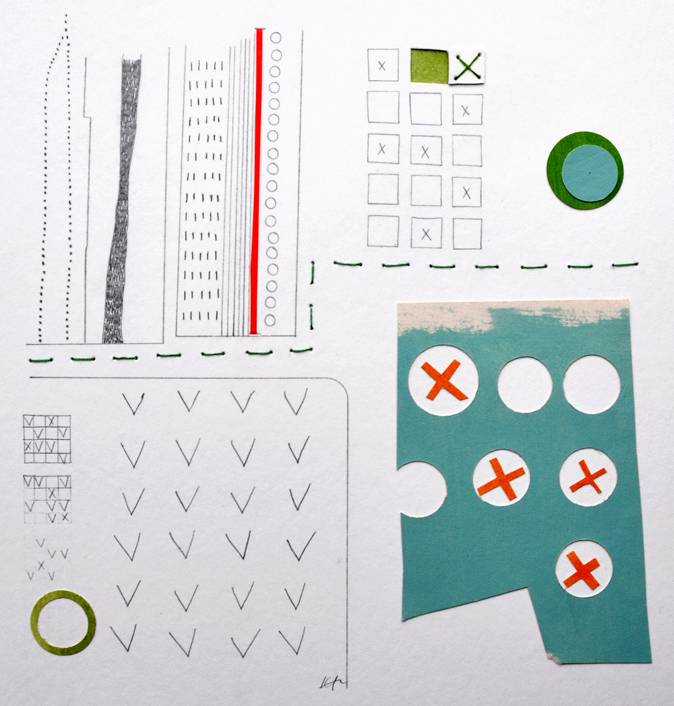
My ideas tend to belong as series of thoughts that I explore in a number of drawings over months, and sometimes years. I challenge myself to explore many ways to represent the same things, often resulting in simplified motifs, some would say scribbles. Drawings are often in rather utilitarian handmade sketchbooks that are not precious so there is no fear of the white blank page before I start. Sometime, in fact quite often, I draw while walking, and trying not to look conspicuous or weird as I track my way round a National Trust kitchen garden, almost creating a diagram, literally a planting plan as I go. Sometimes I make notes in my drawings, of colours, names of plants from the labels in the ground, or note references to research at a later date.

The titles of some of my designs are: xvo, xo, xxvv and these come from the shorthand I created in order to document gardens and allotments as I paced.


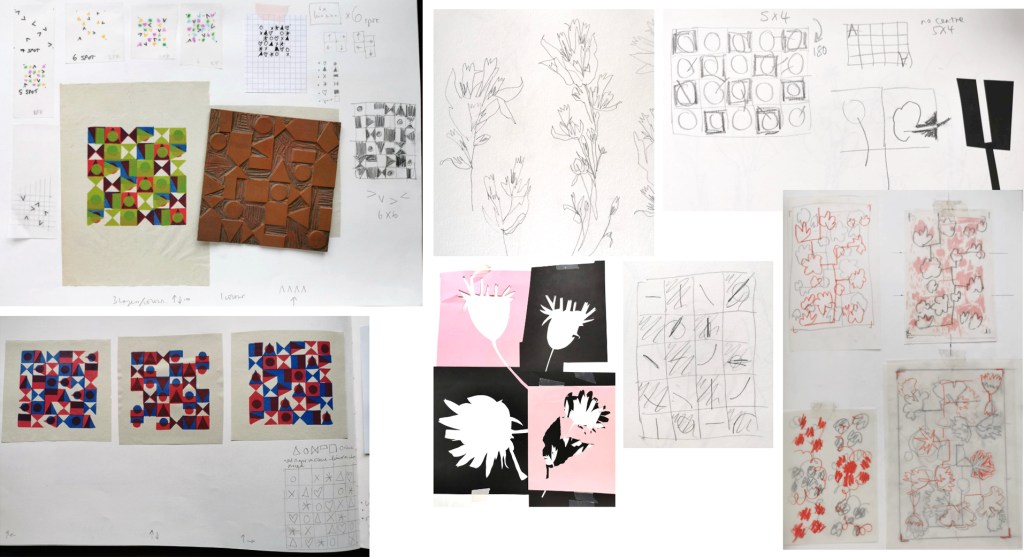
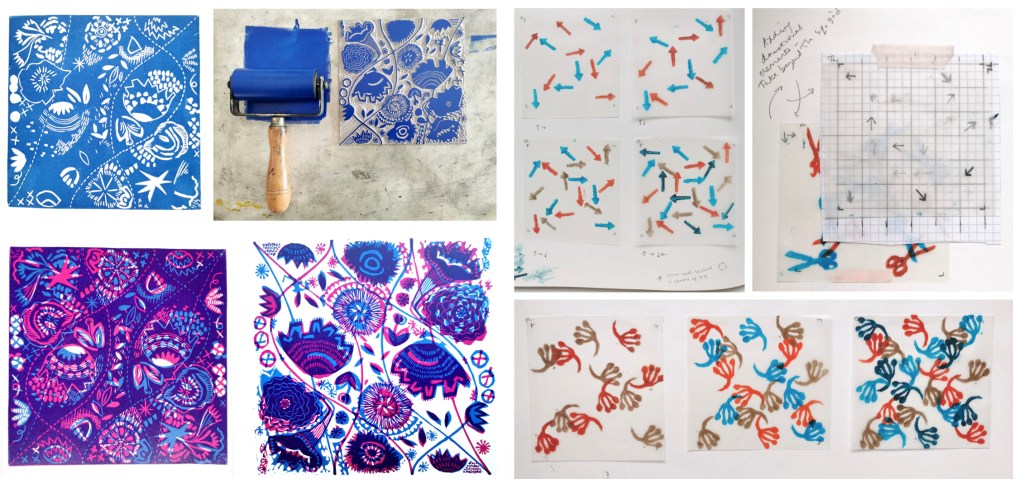
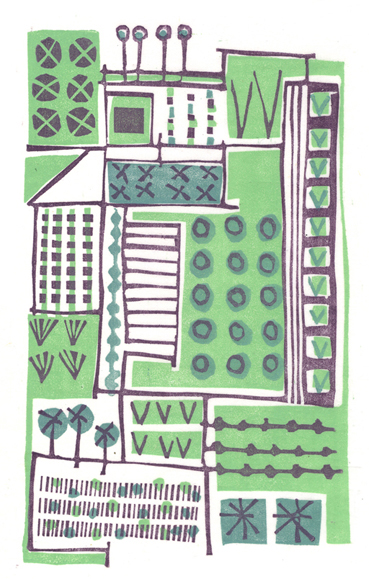
In the studio, and for sometime after I dwell, I study, I revisit the motifs, rhythms and compositions I gathered, I redraw, formalise and create new pieces, as one-off drawings in series to exhibit and sell. Some compositions lend themselves to self-contained lino prints or screenprints and so I spend time developing the designs, cutting the plates, and enjoying the process of editioning. I could never imagine getting bored (my edition sizes are small!) of lifting the paper from an inked block, each time to discover the image. So low-tech, yet engaging.

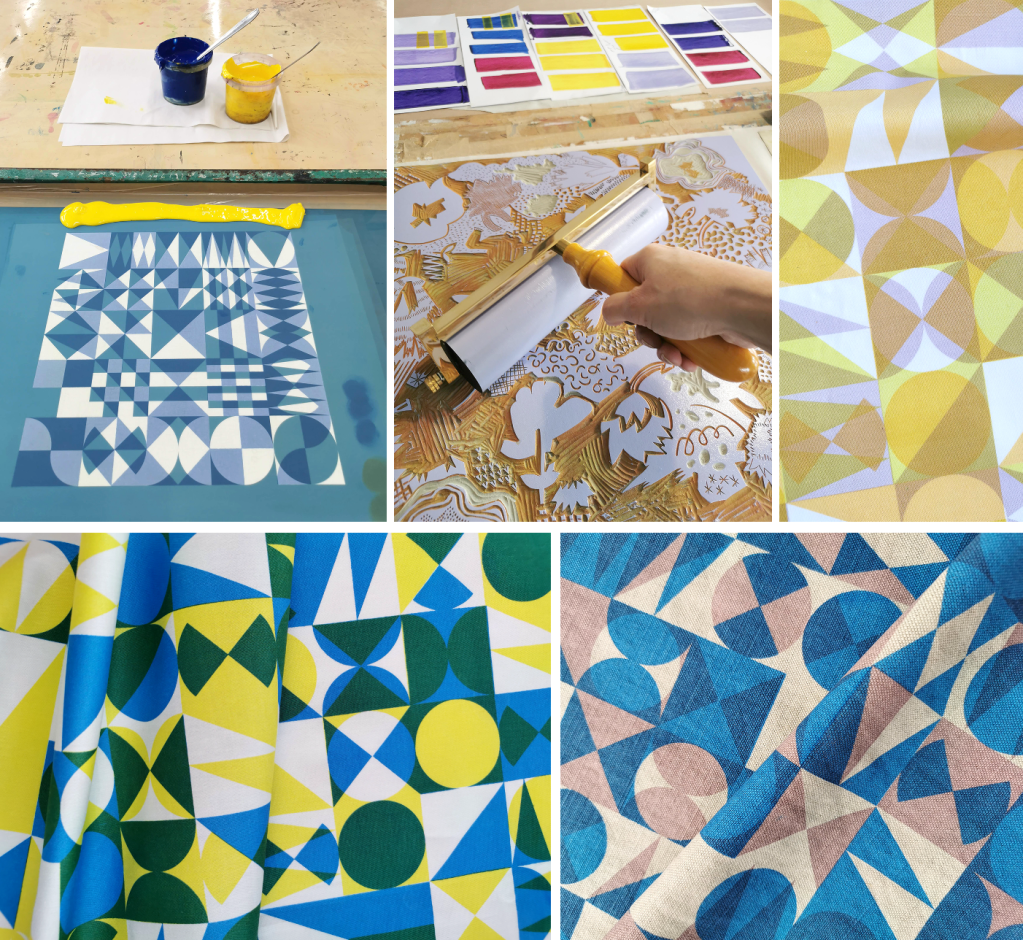
At this point I notice elements that can be scanned in and reworked in Photoshop or Illustrator software to create repeat designs and colourways for further potential – and this is how I created the design collection of ‘Plot to Plate’.

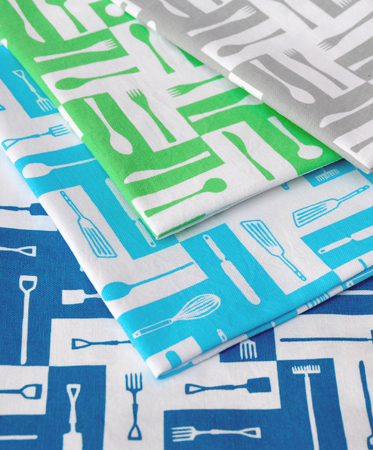
The Plot to Plate signature design of garden, kitchen and dining tools also came from my playing with the dog-tooth check as a classic rhythm, and my keen interest in telling a story as a visual narrative. Pattern can of course be pretty, but I enjoy the challenge of asking it to communicate something beyond itself. In this instance my drawings were made directly for this purpose and I translated them for screen.

I hope the images explain the fun I have had, and the pride that I feel in this collection.


More examples of prints and drawings can be found on my website gallery pages

www.katefarley.co.uk

Save

green leaves

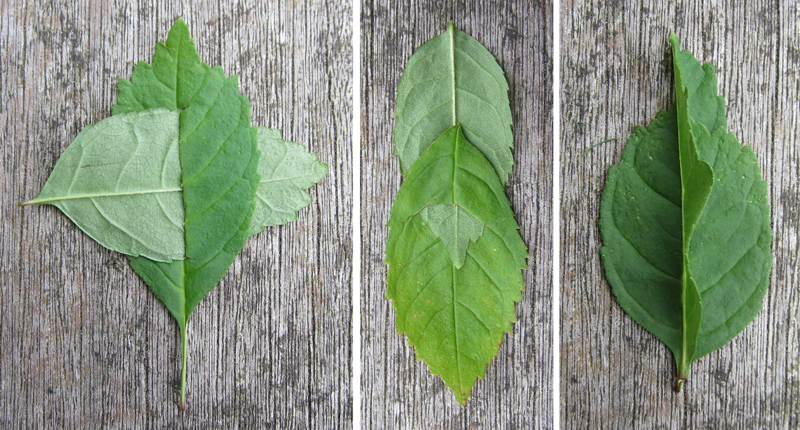
As the Summer seems to be on the turn towards Autumn I celebrate green leaves while I can. Being inspired by my paper manipulation history I played with slotting and folding to entertain the smaller members of the family while enjoying the garden.

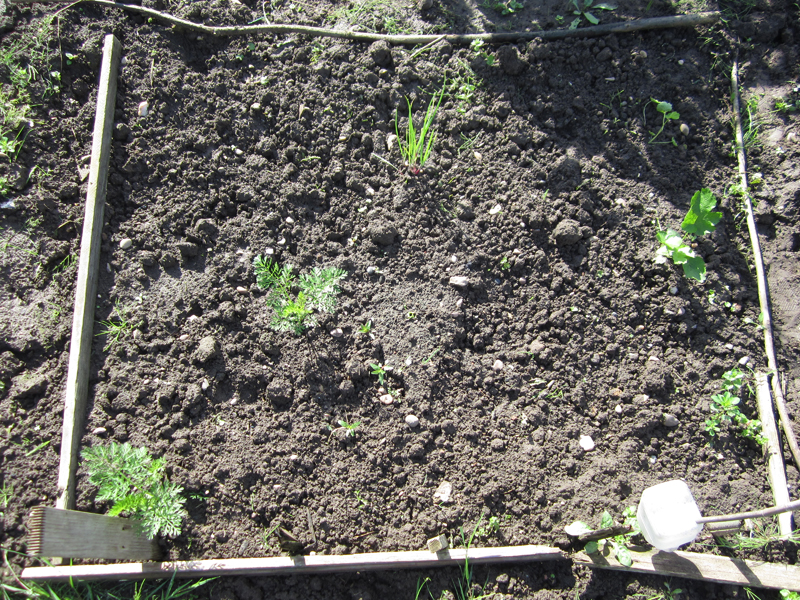
A short trip to the allotment this morning also enabled us to gather Autumn raspberries – yes, the clue is in the name. At least the sweet peas are still flowering as the slugs eat my harvest of carrots, onions, parsnips and beetroot! Now I’m not sure that would be worth getting the sketchbook out for!