pattern prints

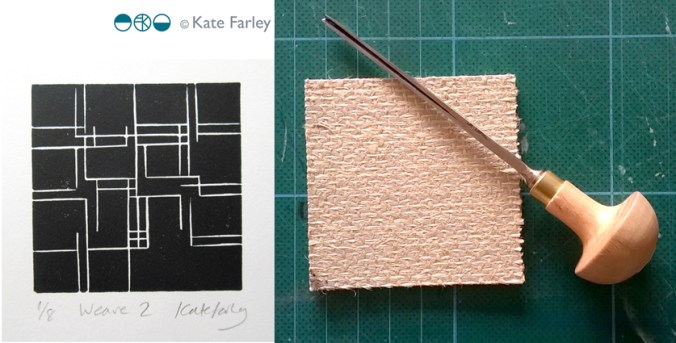
I’ve been working behind the scenes, offline at least, making new prints, mainly lino prints, and developing repeat patterns with them. I’ve not wanted to show the progress until I’ve worked out where I’m going with them, but finally I’ve decided to go public, in a small way, revealing one of the new prints, hinting at the direction my new patterns are going in…

KateFarley_weave2

I’m exhibiting at TentLondon again in September so between now and then I’ll show more on instagram, Twitter, Facebook and here on my blog.

textile fragments

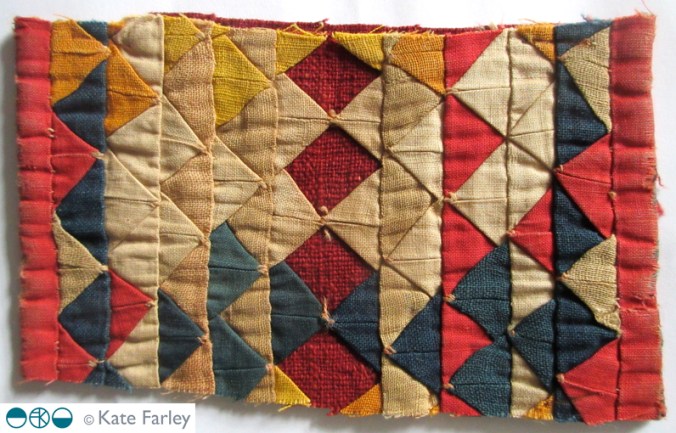
I have this textile ‘fragment’ that I think is beautiful in so many ways; the richness of colour, the manipulated folds of cloth as well as the resulting patterns of the geometric shapes of both the positive and negative folds of the fabric. There is aside to this, so much more connecting me to this old piece of cloth I acquired over twenty years ago, and when I see it, those thoughts come back to me in an instant. This is the power such materials and objects have over us.

I studied at art school, and although the main campus was in Norwich, I was at an outpost in Great Yarmouth. I loved being by the sea, and it was my first time away from home so it was a huge learning curve and time of growing up. I was learning textile and drawing skills and I have fond memories of it all. One day we had a visitor, a lady who had traveled the world collecting textiles, and she brought some of these to show us at the college. I had been interested in the Ghanaian flags of the Asafo, as well as Indian applique so I was fascinated to hear her talk and see the textiles from far-off lands.
KFarley_horsestrap_textile_web

Sadly excitement became upset as the textile pieces were laid out in front of us. I wonder now if I was the only one thinking what I was. When I saw the exquisite fabrics cut in to pieces and crudely stapled to paper with pencil written details of where they had come from I felt so concerned for the apparent brutal way they were being separated from the original whole, their link to their heritage and provenance. It occurred to me then that other nations were losing the heritage that they owned, as the fabrics became souvenirs for others. Had someone chosen to sell them; were they ‘acquired’?

That day holds further sad memories in actual fact. My dear Grandma had died that weekend, and I really wasn’t coping too well away from home, but I got through the day and decided to buy a piece of cloth from the lady as a way of treating my sorry self. I felt torn by the decision to buy it. Would my purchase make sure it was kept safe, or encourage more sourcing of cloth from across the globe? My piece states ‘fragment’ in its description and yet is has clearly been cut from a larger cloth. ‘Fragment’ suggests to me a museum piece, a fragment of history, a clue of a larger object salvaged from ruin rather than proactively separated from its other parts to form the sum – a folded patchwork Kathiawari horse strap from India.

The colours have altered over the years since its time of making no doubt, and the fabric has become worn too. I removed the rusty staples in an act of care and conservation. I also taught myself how to create the folds and layers of fabrics to understand, through making, the construction process. The piece inspired a fabric manipulation project during my time in Great Yarmouth – mostly lost to history and probably for the best! My fabric samples are nothing in comparison to my ‘original’ fragment. The pieces I made lack the authenticity, the ageing, the integrity of originality, but they too serve to remind me of the value of heritage, of belonging and remembering.

With so much talk in the media at the moment of cultural looting across the world both past and present, I am again reminded of this piece of cloth, its heritage and place in the world. The fabric also distinctively reminds me of the loss of my grandma at that time, and yet isn’t it strange that a piece of Kathiawari cloth – not any piece, ONLY this piece, can act as a token of a memory of my Grandma who as far as I know, had no connections with India?!
pattern at the pitch, up and down

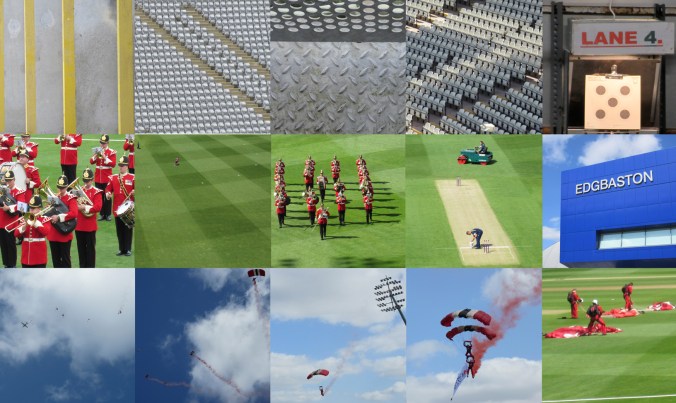
Despite having lived in Headingley, Oval and near Edgbaston I’m not a great fan of cricket but today I spent a number of hours at Edgbaston, the home of Warwickshire County Cricket Club as they hosted a charity community day. The highlight for me was the arrival of the Red Devils, from the skies in the most fantastic spectacle, bringing the ball for the 20-20 match. The marching band looked fabulous in red to the complimentary green of the grass and I also discovered I have a skill in rifle shooting, so there you go, a surprising day.

I gathered lots of images of patterns too. Here’s the day in grey, green & blue pictures…

edgbaston_com_day_100riflecard_100

the patterns of 2014

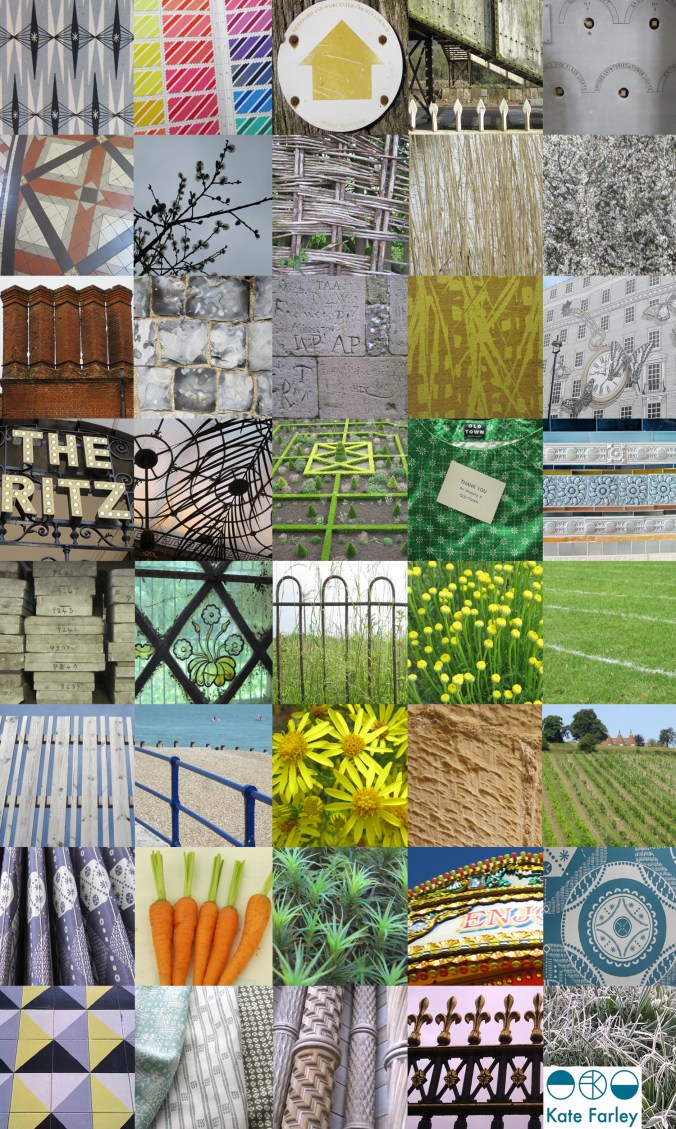
It’s been one of the years I shall remember as particularly busy, continuing to juggle the commitments of family life, my roles as artist, designer, lecturer and of course allotmenteer, and the small matter of a big Birthday. All the time spent doing any one of those things provided opportunities to spy inspiration, food for thought and visual stimuli for me so having looked back over the last twelve months I have enjoyed creating a record of the patterns I’ve seen. The record includes family holidays, research trips, and days out; from the school sports day track, Birthday celebrations, to the rivets in the railway bridge, the stately home and the walk to work, it’s a record of some of what I saw in 2014.

Key themes appear: geometry, stripes and railings and although in a chronological order, there are some great pairings in terms of colours, textures and pattern.

2014tiles_blog

Pattern design, outdoors and in…

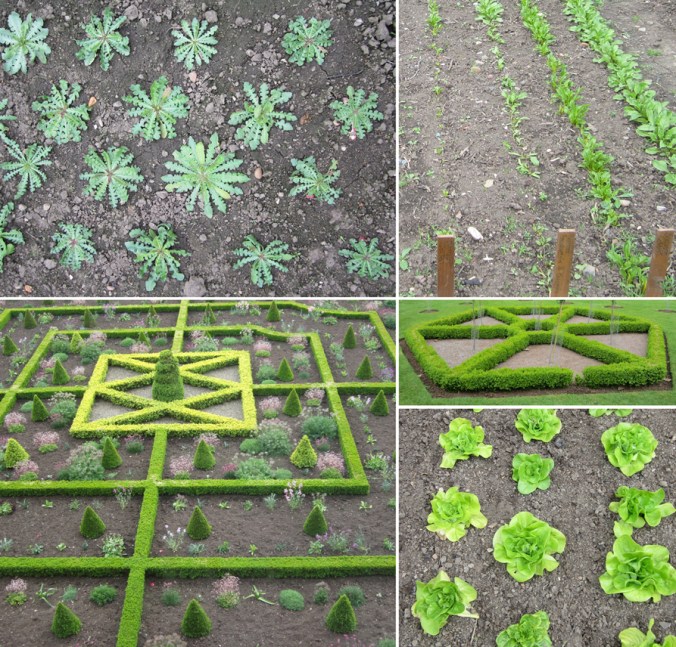
If you are a regular reader of this blog you will already know that for the last few years my personal design practice has been inspired by garden design, and most specifically allotments and kitchen gardens in my ‘Plot to Plate‘ collection, launched in 2012. I have spent many hours walking, almost patrolling, up and down rows of National Trust cabbages and onions, armed with my sketchbook, annotating the patterns, translating them to motifs, documenting the small irregularities, the planting plans, the labeling – fruit and vegetables up and down the country, as well as our allotment, plot 8 in Birmingham. Upton, Packwood, Baddesley Clinton, Blickling, Felbrigg, to name a few National Trust gardens I have surveyed and taken inspiration from. Hanbury is my current favourite garden and I have been working on a number of patterns inspired by this property that will one day be complete, to launch at Tent London this September.

It is with this in mind that I write my thoughts. There are so many similarities between garden design and textile design they seem perfect companions in my practice. Long before Mr W. Morris picked up a pencil the natural world of flora has been a dominant subject of inspiration for pattern in the home. Rather than the bouquets and sprigs, posies and trellis it is the formal gardens, the parterres and kitchen gardens that hold the structure and compositional language that we textile designers and design educators regularly refer to…

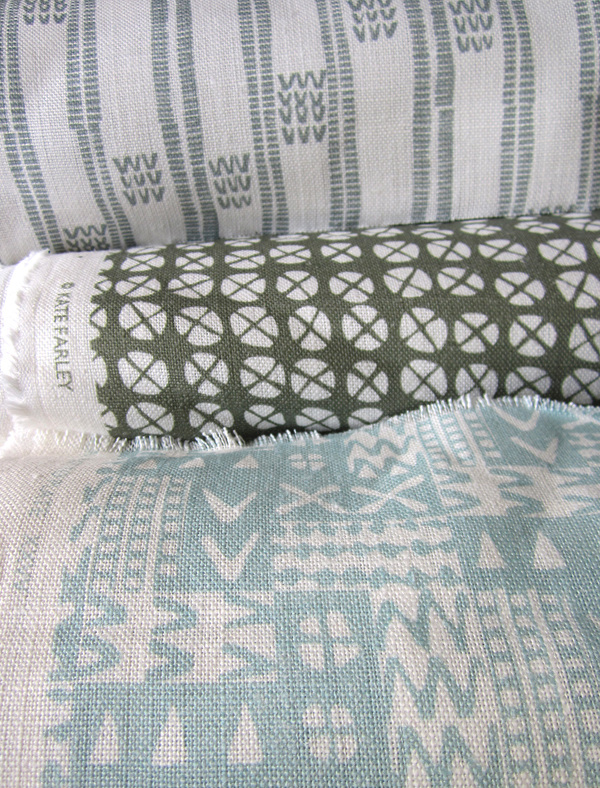
Stripes, spot repeats, all-overs and multi-directionals, geometric grids and diamonds, checks and plaids are all to see. And so it is, that it makes sense that I really have brought two things that I do enjoy together in my creative practice. It’s too early to share artwork for my new ‘Hanbury’ designs but I will share some garden pattern from Hanbury, and my ‘new’ fabrics by the metre, available very soon, in anticipation…

garden_textiles_hanbury_web  fabricrolls1_web

Norfolk lines

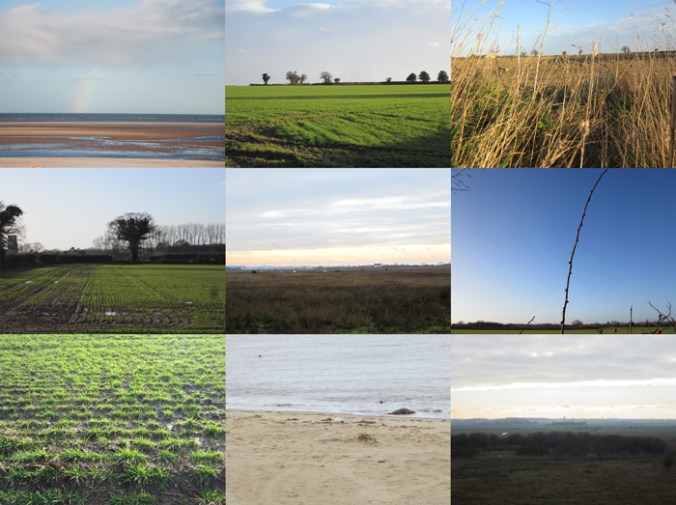
I’m naturally biased when it comes to the Norfolk landscape but seeing as it has shaped my aesthetic, colour preferences and my approach to drawing I am happy to consider it to be inspirational. I don’t spend enough of my time in Norfolk these days but every time I visit I take deep breaths, and big eye-fulls of the vast expanse of open landscape, the ever-changing light qualities and the endless colours of the land, sea and sky. Here’s a medley of Norfolk from this Christmas including sights of seals at Horsey Gap, a rainbow & the beach at Wells-next-the-Sea, and fields near Cawston and Alysham.

Norfolklines_web

The English countryside

We had a beautiful day yesterday involving a quick trip to Ledbury, and specifically Tinsmiths to sort out post-show details. Our visit to this lovely market town coincided with the poetry festival so we also picked up some verse, locally-made pork pies, beer and ice-cream!

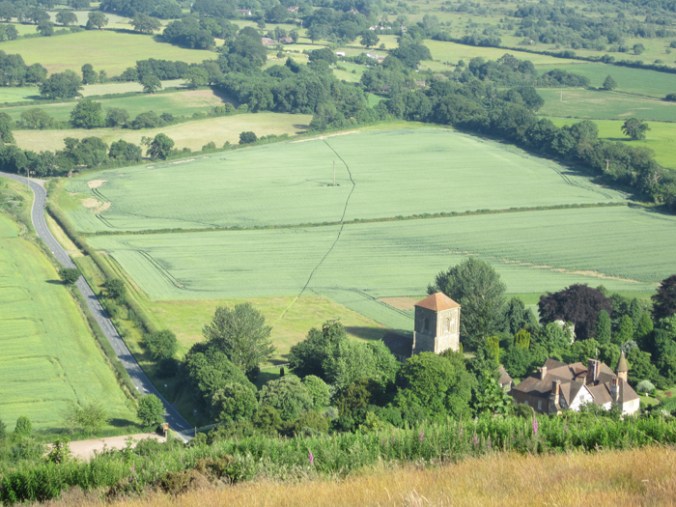
It was so hot in the afternoon sun but we did manage to enjoy the scenery around the Malvern Hills to-ing and fro-ing between trees for shade. It’s a stunning landscape, and one that feels so English. I first encountered the area when I cycled Lands End to John O’ Groats back in 1994 and it left its impression on me even then.

The views from the ridge make you feel as if you are a giant overseeing a toy model landscape but it is with this viewpoint I can capture my key interest in the landscape. If I was to draw the view I would have started with lines that recorded the field boundaries defined hundreds of years ago, the footpaths etched in to the land by endless walkers and roads enabling others to pass through. The lines become shapes and a record of that moment of my experience, but what is also captured is hundreds of experiences, of us, living in this English landscape.

summer2

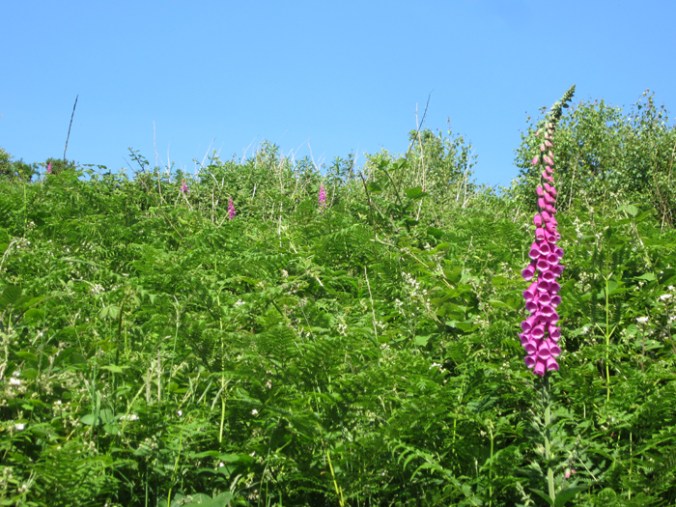
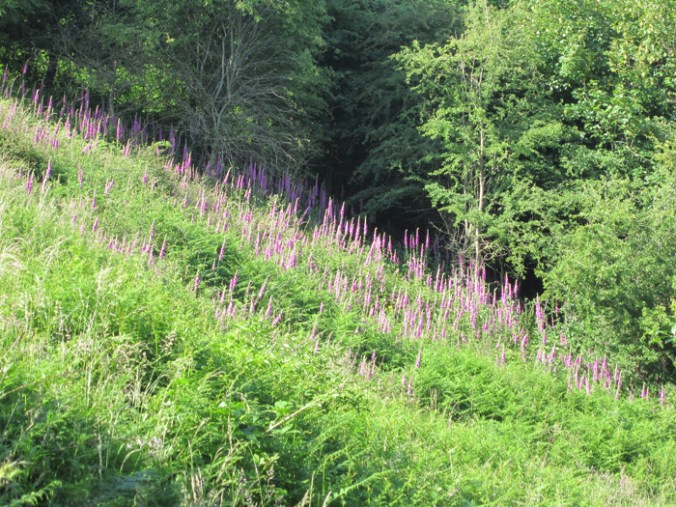
In terms of colours, I was struck by the stark contrast of the dry grass tones compared to the striking pink of the foxgloves and the very green bracken.

summer6 summer5

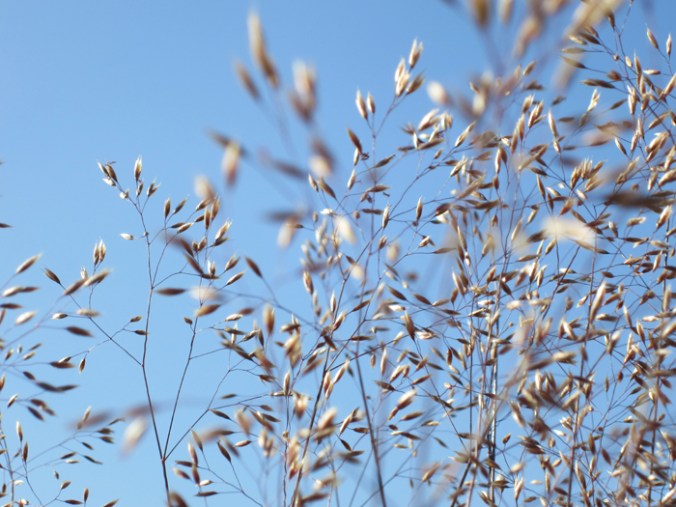
I’m also a collector of photos of grasses and such-like against blue skies, and so I happily added further imagesummer1s to that collection.

summer4

All in all, a very lovely English day.

geometrics out and about: PLAIDS

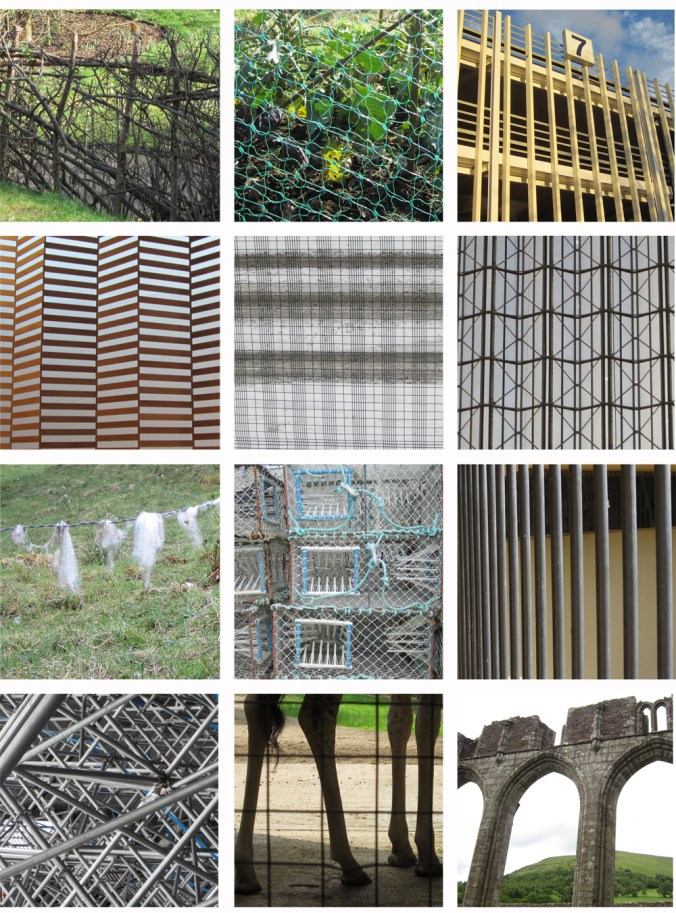
There are particular visual rhythms I seem to collect as photographs when out and about and so I thought it worth while putting them together as collections of patterns. I’ll leave you guessing what might also feature over the coming months but here’s the first: plaids.

Some are more obvious than others, and while you are looking, keep an eye out for the friendly robin. There’s a list of locations below for those who might be interested.

plaids_blog

1a Botanical Gardens, Birmingham
1b Plot 8, our allotment, Birmingham
1c University of Warwick car park

2a Aeneas Wilder, Mead Gallery, University of Warwick
2b Heeley Rd. Birmingham
2c Olympia, London

3a Newtonmore, Scotland
3b Hastings
3c Dudley Zoo

4a Hockey arena, London 2012
4b Dudley Zoo
4c Llanthony Priory, Wales

Looking up, looking down – X marks the YSP

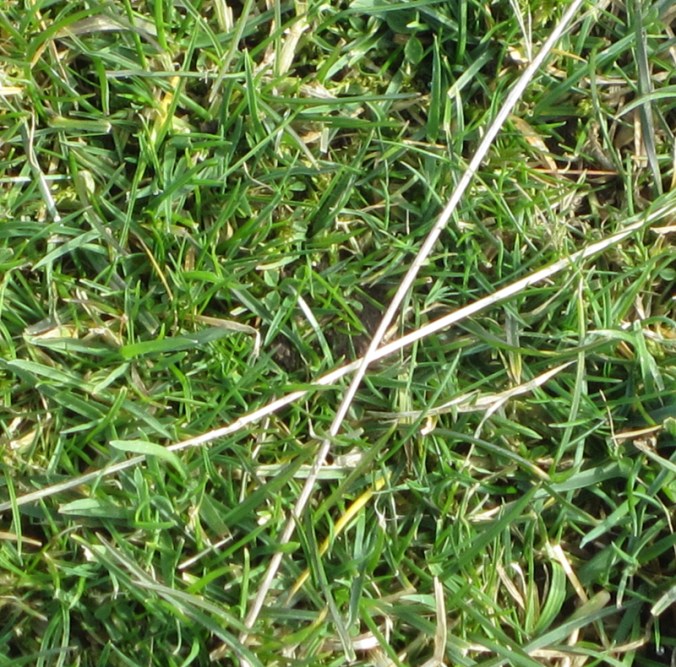
We had a fantastic time at the Yorkshire Sculpture Park en route north to friends this weekend catching the penultimate day of Mark Hearld’s show there. Its such a great venue and there’s always something to discover. We managed to walk some of the grounds and the weather was stunning for the time of year. One problem was the saturated ground, particularly on the slopes which had become rather slippery as a result of snow and rain over the last few weeks. (Three out of the four of us fell to the muddy ground – okay for toddlers, rather less stylish for fully-grown adults!)

While exploring the sculptures I noticed the cross being drawn in the sky, then looked down to the ground by my feet to notice the second made in the grass. With X, V & O letters featuring heavily in my current design collection it shouted out to me. X marked a really beautiful spot up there in Yorkshire.

http://www.ysp.co.uk

sky_X_yspgrass_X_ysp

Design inspirations 1: horizon lines

For a while now I’ve been thinking about what has shaped my visual language and informed my art and design tastes. As a result I have planned a few blog entries in which I will evidence some of my thoughts in terms of influence and my art / design practice.

In some recent press interviews I’ve been asked about my inspiration and I tend to consider the formative years as pretty vital in this regard. It makes sense that we develop strong feelings and bonds to what we experience as children, either to reject them or embrace them – either way I believe those early years help to form our adult judgements.

Looking beyond the windows of the house in rural Norfolk where I was brought up is what I consider one of the greatest inspirations to my work. The open fields, the clear horizon lines and sparse distractions across the farmland of Norfolk have stayed with me in relation to my way of seeing, composition and economy of information in much of my work. Why draw ten lines when I can say it with one? I had a particularly horrid visiting tutor in the beginning of my training who felt that I was lazy in my designing, when actually it was he who struggled with some of the simplicity I was aiming for.

Looking back over some of the works I have made in the last fifteen years there are a few key pieces that explain that relationship with the horizon.

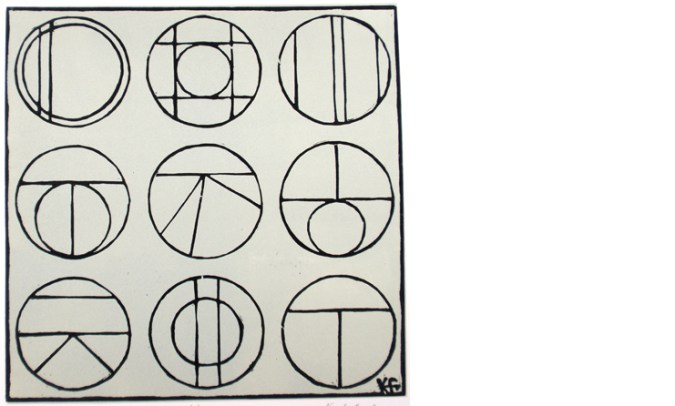
‘Nine Perspectives’, a linocut is made up of diagrams where I explore the land, sea and sky in a variety of ways. I consider the horizon in two-dimensional form, in plan view, elevations and diagrammatic perspectives in order to gain a sense of order.

9perspectives_web

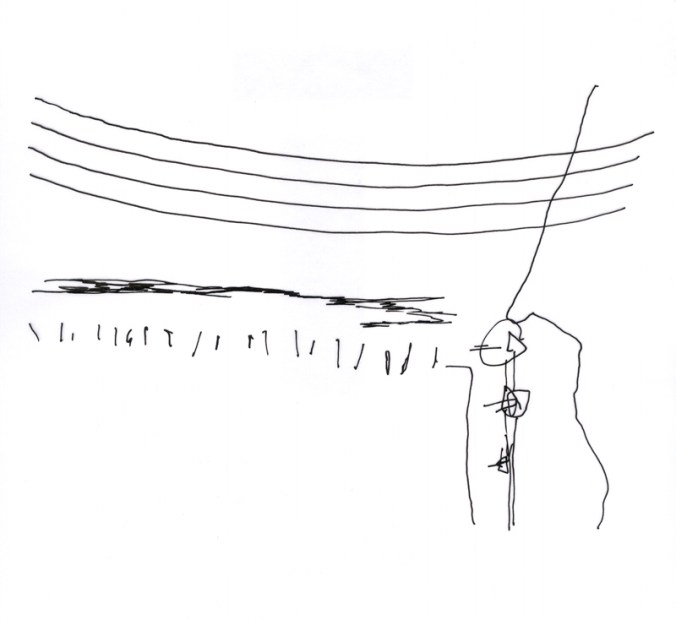
‘Meadows (France)’ is a drawing of a beautifully simple valley near Gourdon. It gave me a perfect view to explore further skewed interpretations of perspectives seen in the landscape. I worked with a sense of the view working round a set square, with two horizons, as I looked in front and to the side of me.

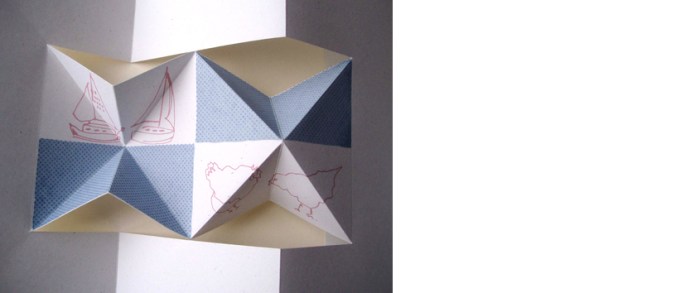
stgermain_webThe final image is from a screen printed artist’s book I made several years ago exploring the idea of ‘half full’ as a state of mind, but also from each side of the horizon line. I have used the blue areas as either half full of water (the Norfolk Broads specifically) or half full of sky above the chickens. The folded structure implies a view through the use of perspective, looking in to the distance or reflecting on oneself.

kf_half-full_web

These three works are very old as far as I’m concerned. I have new creative concerns now but they have helped me to test and explore principles in the way that I see and draw that have been important along the way.