I’m currently working on some large scale lino blocks to print floral patterns as part of my continuing pattern research. At the same time I’m also teaching our BA2 group how to create repeating printed patterns, so it’s always nice when there is some parallels between what I’m up to and what the students are doing.
I have been returning to my sketchbook of floral drawings I made from my trip to the Italian Alps, and exploring them again with new paper cutouts as I think about overprinting and block rotation. I’ve not proofed the plate yet, but here’s some work in progress images from the studio.
I’m always looking for other ways to explore my pattern ideas and have been keen to consider options for film making to explore sequential narratives. Animation processes fit well with the work I’ve been doing with pattern evolution I have been testing across pages of books over the years.
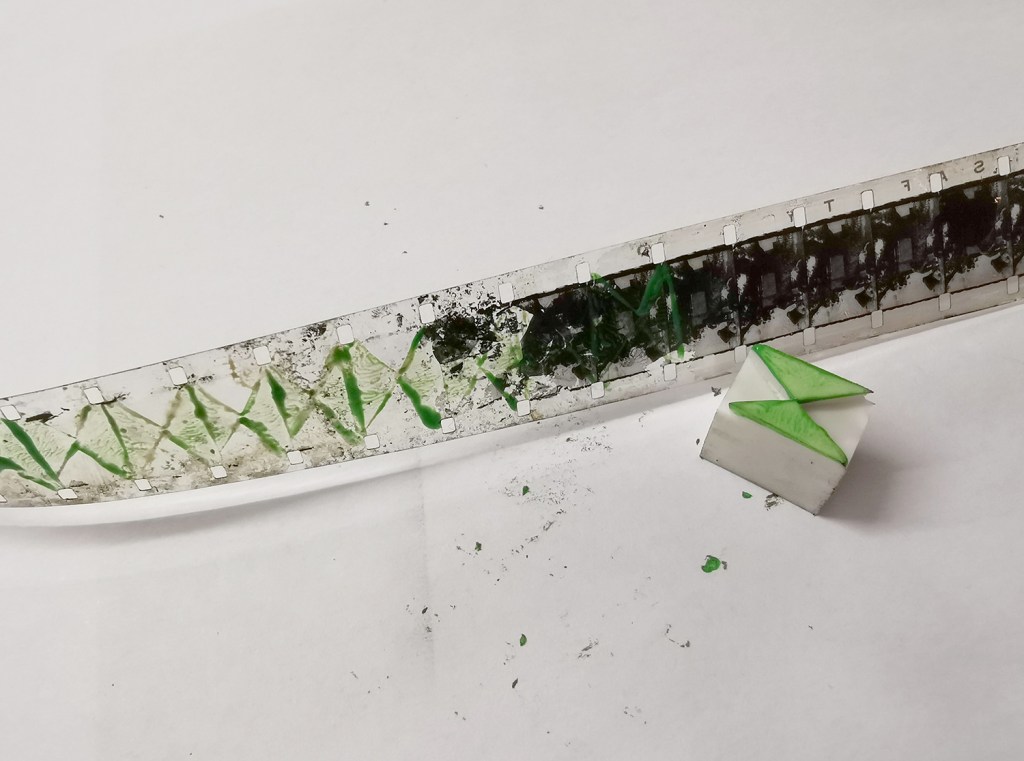
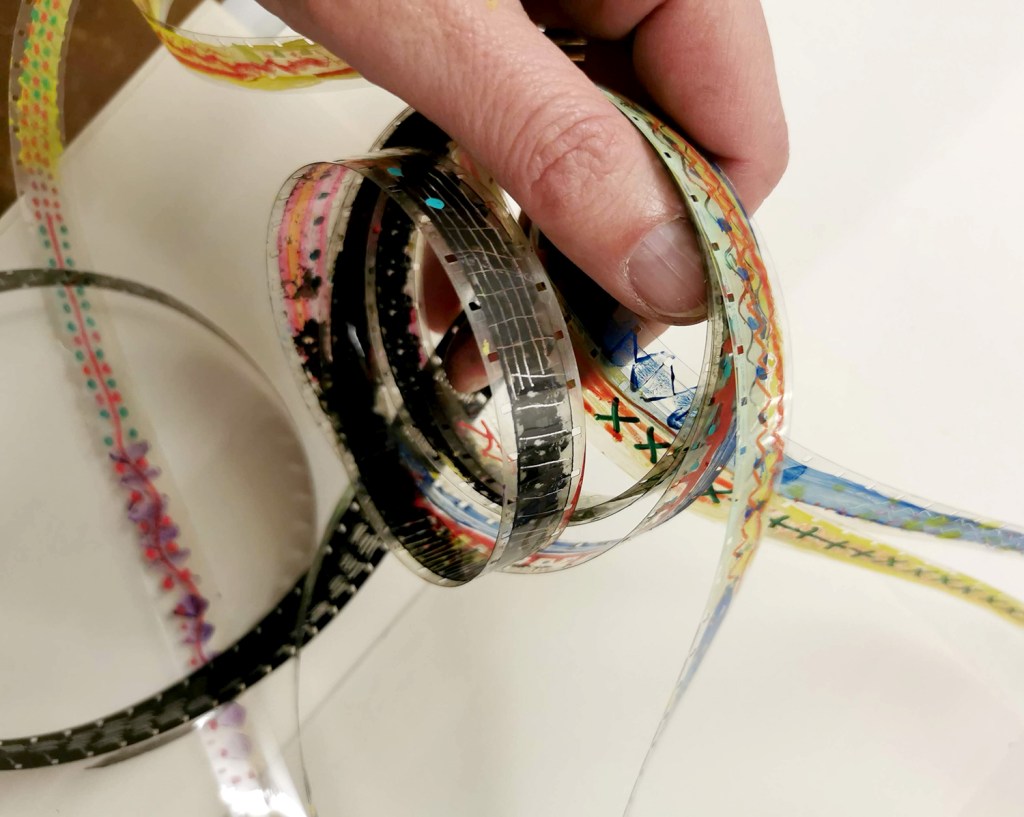
Having been a fan of Len Lye’s paintings on film from the 1930s, including A Colour Box from 1935 commissioned to promote the General Post Office I was pleased to be able to attend a workshop in Norwich to to spend a few hours working on strips of 16mm film to make my own experimental animation. We were shown some examples of other people’s films and could then explore the process ourselves. The workshop was led by Jacob Watkinson and was hosted by The Holloway in Norwich.
We were given strips of clear 16mm film I was able to use pens, paint, rubber stamps and Letraset on, as well as pre-exposed film with archive films that we could scratch away the black with a scalpel beautifully. I know it’s obvious to say, but 16mm is tiny, and I’d forgotten my glasses, so that added to the issue of seeing what I was working on! It’s a tiny space to include anything too complex and I was unsure initially how many times to repeat motifs and at what pace to move motifs across the film, but I just had a go and tried not to be too precious.
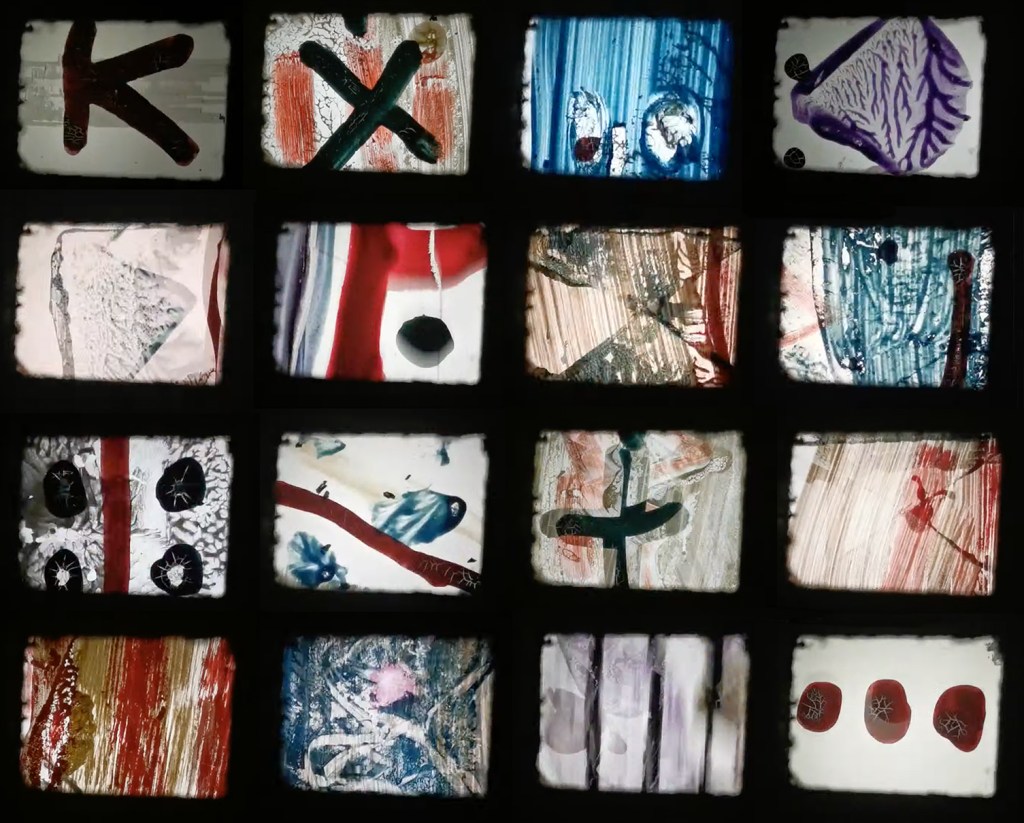
Once we’d all had a chance to work on several pieces Jacob spliced the pieces of film together and we ended the session with a screening of everybody’s efforts – it was great to see individual approaches with the same processes and the outcomes have certainly got me thinking about taking my pattern evolution ideas in this direction again. The image below shows some stills from the film I made – all 20 seconds of it! Len Lye’s films are brilliantly paired with music so maybe I need to think about that too – but I’m not sure today’s Post Office will be knocking on my door anytime soon!
If you want to read more about Len Lye this article from the Tate is a good one.
I’ve recently returned from a lovely family holiday, traveling by train from Norfolk to London and via Paris through France to the south and on in to Italy, up into the foothills of the Alps via Turin … and back again. I made lots of small sketchbooks so I could have one close at hand at all times, with a selection of pens and pencils. I’ve always enjoyed drawing from trains, preferably sitting backwards, looking, identifying shapes and details, then hastily capturing what I saw in a few lines.
It’s a great exercise to keep the hand, brain and eyes in check, and although I have previously used this sort of drawing for my design work – including my degree Final Major Project back in 1997 – I only really do it now as a good activity to check in with the view and focus on the places, stations and landscapes I journey between, and as exercise for keeping my drawing practice fit and healthy. A gable-end of a barn, a cluster of trees or mountain horizons can be documented and it’s amazing how these drawings are then able to capture and remind me of the journey years later.
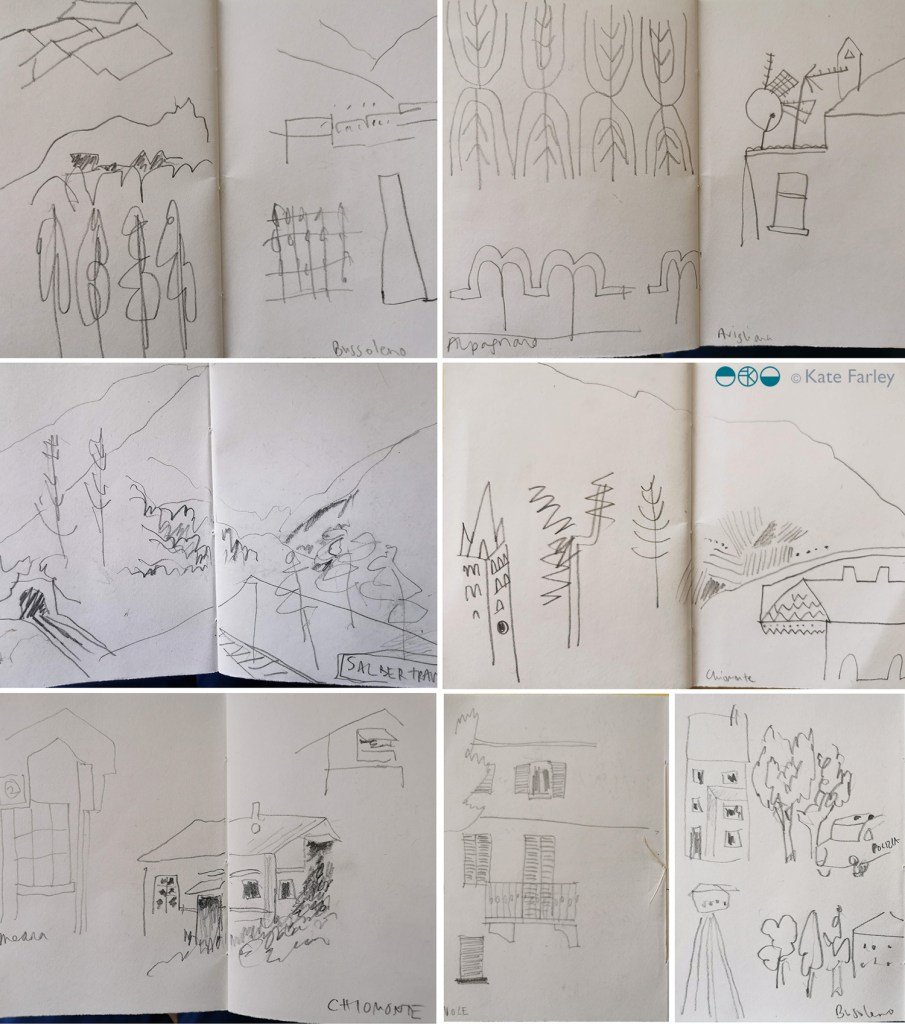
Here are some of the drawing from the trains. I sometimes get a bit more detail down if we sit in the station for a few minutes, and I jot the station name down for interest.
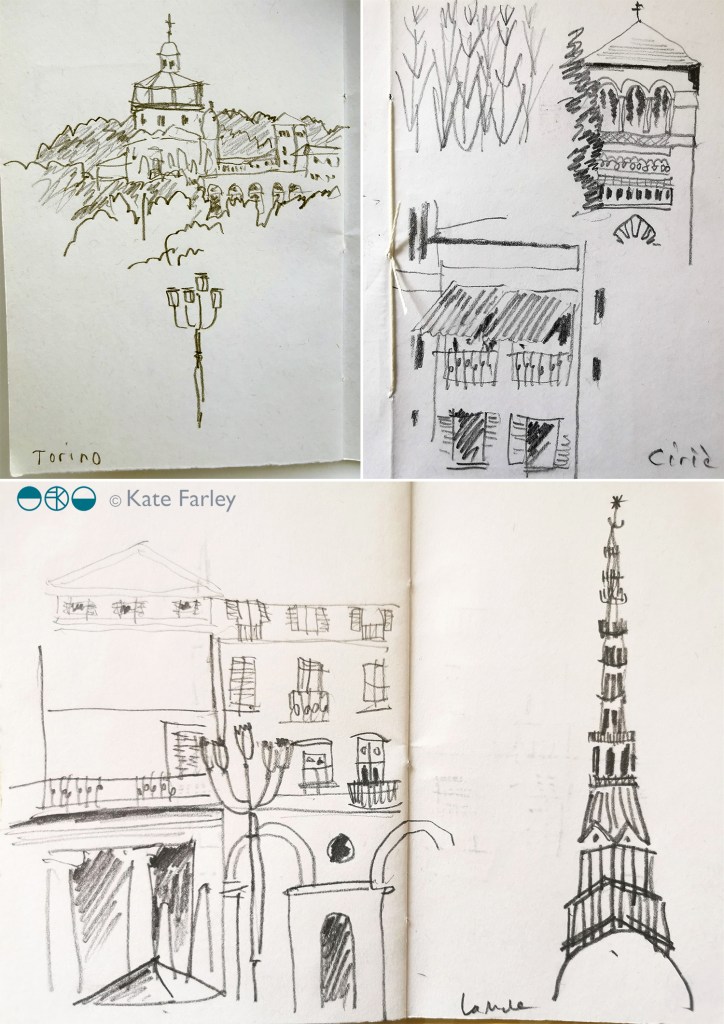
I also managed to do a small amount of drawing while sat in cafes or sheltering from sun while other family members were up to something else. They take a few minutes each, so still pretty quick observations. It’s clear my interest in pattern comes in to how I see the world. Rhythms of windows and balconies, railings, ornamental buildings….
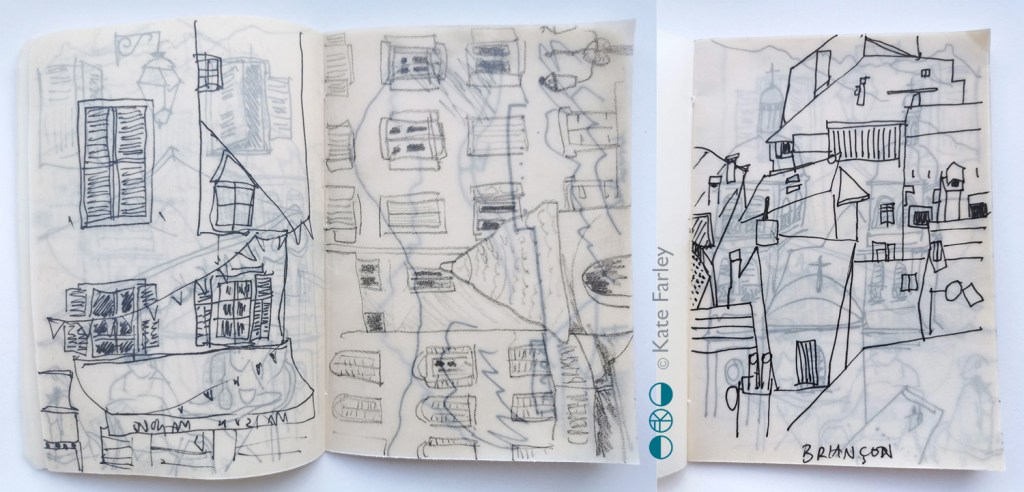
I also made a couple of sketchbooks using tracing paper as I was interested to see how I worked with the transparent pages as the drawings built. I quite like the results and reminds me of how I plan lino blocks and screen prints with the layers of tracing paper.
It was definitely good to spend time drawing and I’m thinking of revisiting some in the studio, no pressure, just a few ideas. I hope you like them, let me know if / how you make drawings from trains!
In the first term of arriving at Norwich University of the Arts I was welcomed as a member of the Pattern and Chaos research group. Colleagues from across the university would meet and discuss individual research practices and shared ambitions relating to the themes of the group. During one of those early meetings the idea of a Reader, a book featuring many contributions on the themes related to the research group, was being discussed. I enjoyed being involved in setting out early ambitions and five years on the book, edited by Sarah Horton and Victoria Mitchell, is a reality, having been published by Intellect Books in late 2023. Congratulations to Sarah & Victoria!
I’m delighted to be a contributor alongside many other researchers and practitioners, some I have the pleasure to know, others I shall get to know through their text and images in the book.
My contribution to the project is chapter ten. In conversation with both Sarah and Victoria several years ago I shared my ideas of pattern evolution, of taking motifs from one to another, an ogee to a diamond for example, through the process of drawing, transforming them from one to another across the sheet of paper. I gave them a quick sketch as part of my proposal and they patiently waited for more as I worked on the larger body of drawings. The link between themes and variations in music was apparent and I played with this idea as I made the drawings, layering tone and form, as a composer would do in building the greater composition.
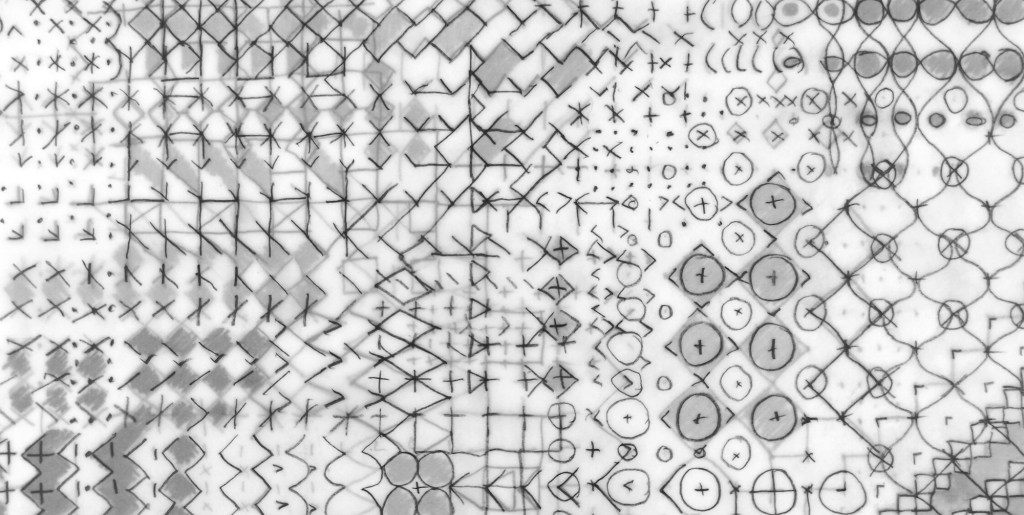
The chapter explores the practical research process of drawing and evolving the motifs across formal grids structures and across layers of tracing paper. Although the visual language of these drawings are significantly different to my current research the ideas initiated here were the seeds of my current investigation – I’ll share that progress soon!
A huge thank you to Sarah and Victoria for the ongoing support they provide, both to me and my practice. Between the two of them they always ask the pertinent questions and offer sound advice and encouragement.
Drawing has always been an important element of my design practice. It gives me time to refocus, to get away from everything else, to appreciate the beauty in things and keeps my eyes and hand working together in my lifelong investigation of how I look and how I record what I see.
The flowers drawn here were some of the last from the summer borders, consisting of dahlias, sunflowers, hollyhocks and verbena, captured quickly in pen, while I sat by the window, enjoying the warmth of the sun and the shadows that the flowers created while I drew.
My ongoing research practice of drawing and design regularly explores pattern structures within the family of geometrics. I enjoy testing motifs and rhythms that belong to traditional compositions, and deconstruct the scaffolding to look for new iterations.
In this recent work I am looking to the concept of themes and variations in music to drive the visual investigation. Repeat doesn’t feature, but it’s certainly a consideration for the future.
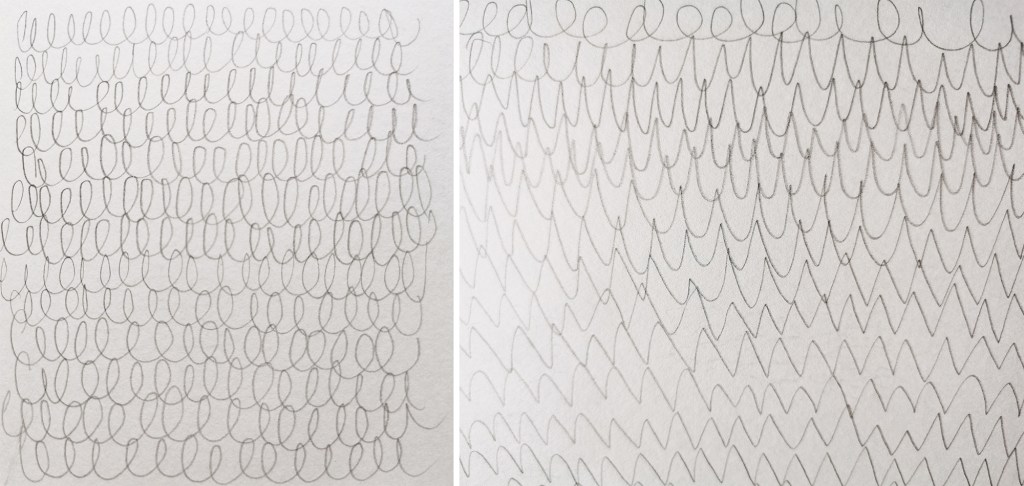
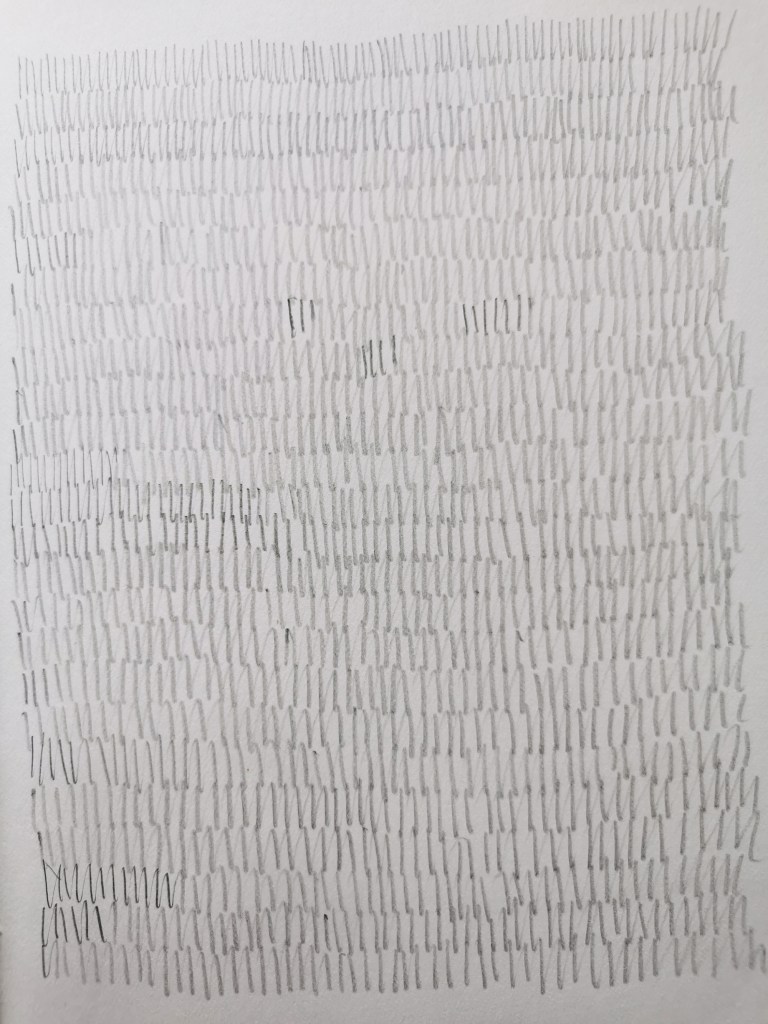
layers of tracing paper with graphite drawing
With a short break between academic years, and the book in production I hope to find some time to take this project forward over the coming few weeks.
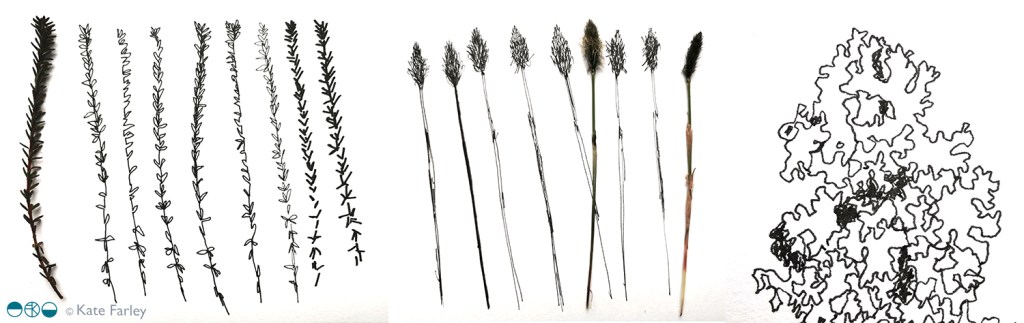
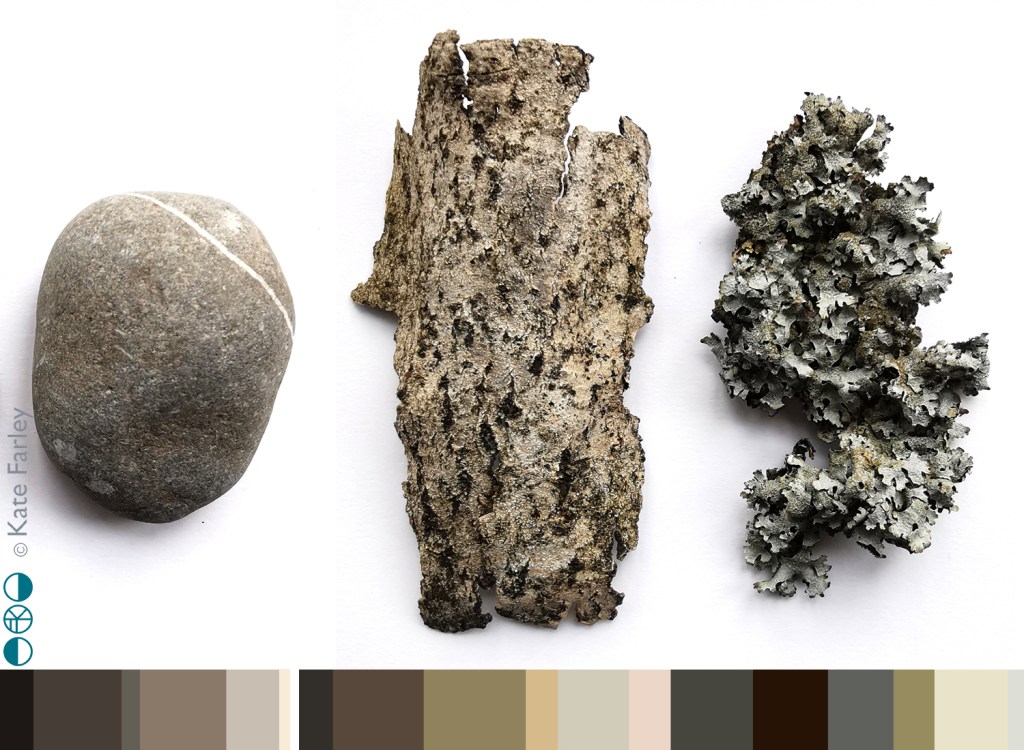
This holiday time has provided an opportunity to go to new places, see new things and return to the sketchbook just for fun. A week at Ilkley Moor enabled lots of time for walking and seeking out inspiration from the natural world, with distinct differences to the landscape I’m used to day to day. Up hill and down dale saw me amongst mosses and lichens, pebbles and boulders, grouse, larch trees, heathers and bogs … and even a fragment of pottery.
Rucksack pockets were filled with samples of treasure ready to investigate later. The process of drawing enables me to get to know an object, and by making several studies of each item I enjoy developing a stylised representation. I hope never to tire of the getting-to-know-you drawing process I have practised for thirty years.
By looking closely and seeing through drawing I can work out the essential elements of surface, form and texture to record, but also I love to play with the appearance of elevation and structure of three dimensional objects, such as the pebbles, to explore their new form as they appear on the page, as flat motifs.
The textures and colours of the items I gathered provide macro evidence of the vast landscape I walked through and connected with. As this was springtime there were pockets of fresh green bursting through winter foliage, demonstrating the natural cycle awakes again. The geology of Yorkshire provided variety in coloured greys and texture under hand and foot as we bouldered, scrambled and hiked, notable in contrast to the soft wet bogs and spongy moss beds amongst the heather.
Without going all John Ruskin about it, the natural world really is amazing, and full of inspiration for anyone inclined to notice. Anyway, back to the rather flatter fields of Norfolk …
I’m often juggling lots of tasks in my head, but when my mind is busy I can find focus and space to think within and around the process of drawing. The time occupied by my hand drawing gives my head some freedom to work things through. Distraction, mindfulness, process-led, thinking time…
Drawing also creates time to explore rhythms that are playing out more formally in other sketchbooks for other projects. I find it interesting that certain motifs appear in the margins of my notebooks time and time again, made while my mind is occupied. Often those shapes are geometric, but sometimes the circle dominates, at other times, squares. Regularly they link to designs I’m working on and resolving somewhere else, subconsciously seeking solutions.
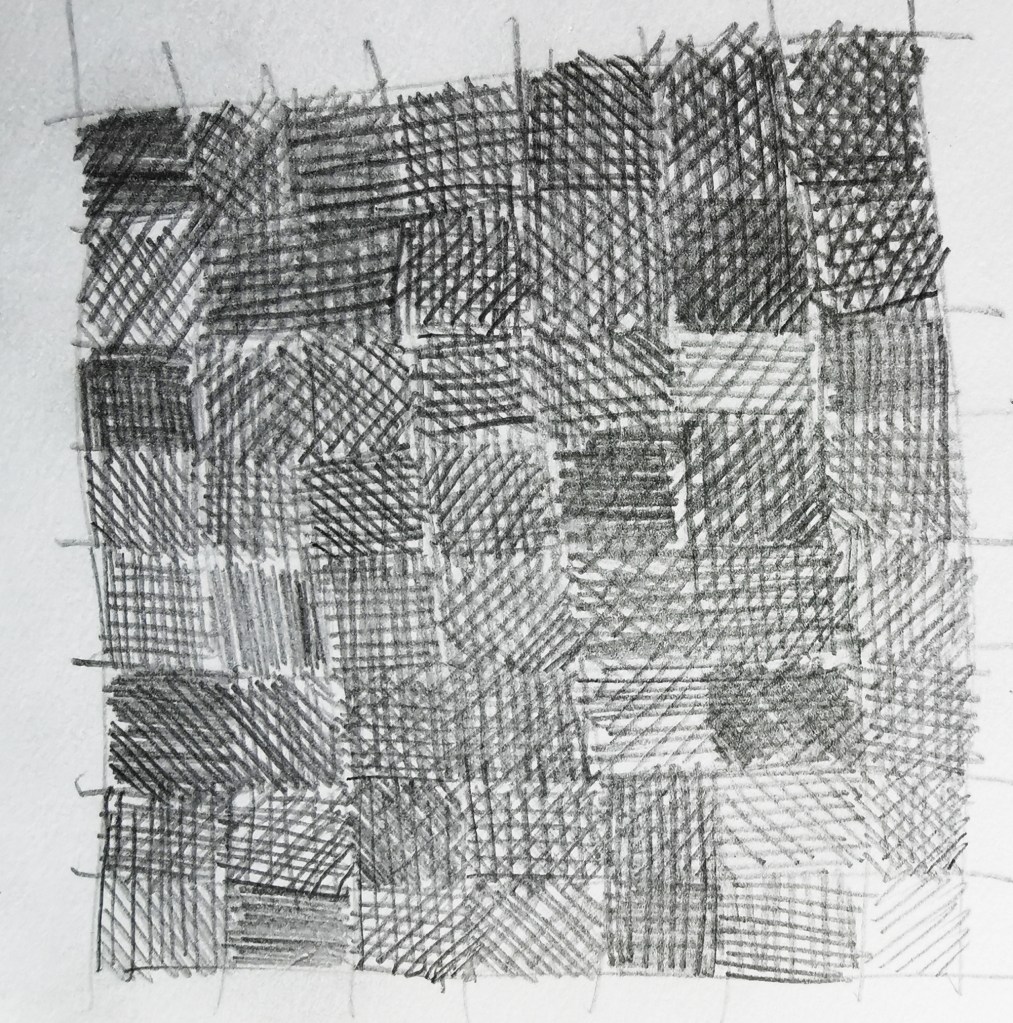
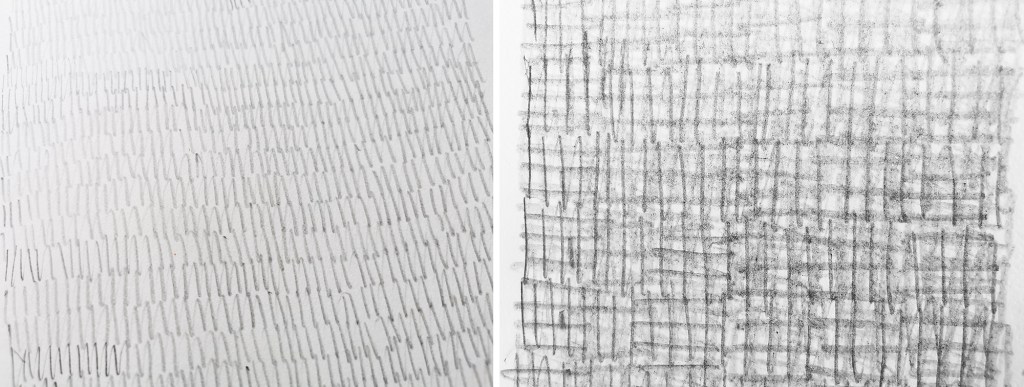
I enjoy the simplicity of paper and pencil in a world where so much of my time is spent in front of a screen. The physical process of drawing; the feel of the friction between graphite and paper, the sounds created by the rhythmic gestures, are vital to the experience. Satisfaction comes from a page of evolving rhythm and more pattern potential. We know there is seduction in the multiple; the repetition of tins on a supermarket shelf, for example.
I’m sure I’ve written about it before, but I’m often intrigued how an idea can rattle about in my head for years, exist as drawings or collages, but not quite feel right… then manifest in a way that makes those years of waiting make sense. I’ve recently created a sequence of three drawings that appear to have done just that.
Drawing is a key creative process for me. I don’t always find as much time as I’d like but I draw to capture the beauty of a flower, or the shape of a field, and often have no planned use for the image; the drawing exists for itself. Over the years I can see drawings are linked by a longer-term inquiry, and these single elements collectively define the aesthetic of my practice.
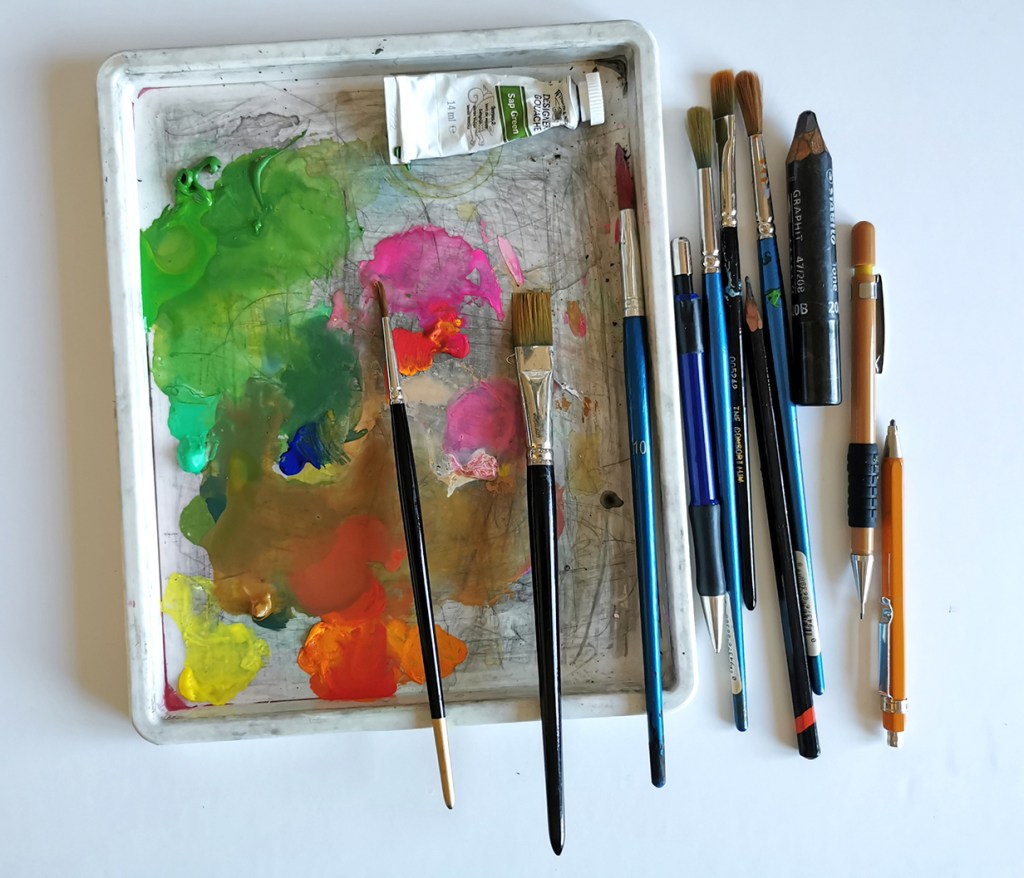
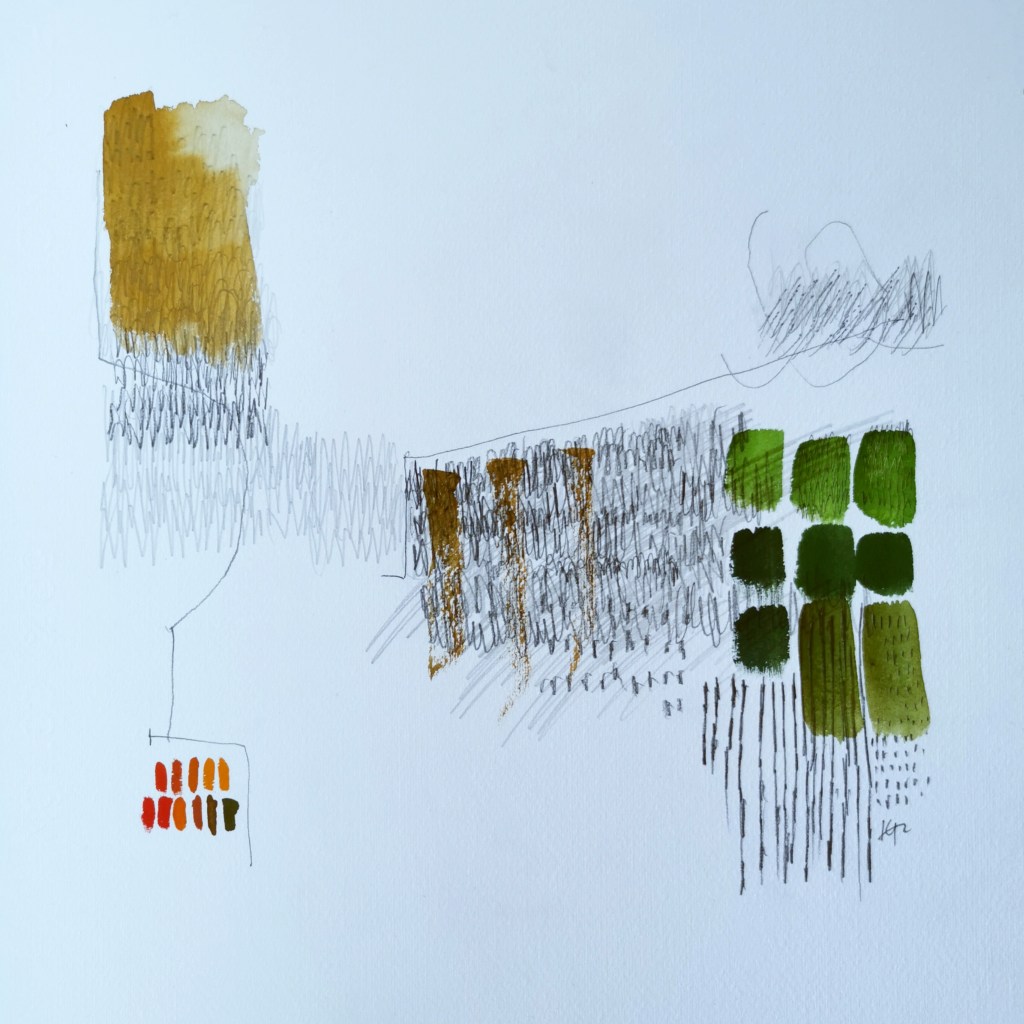
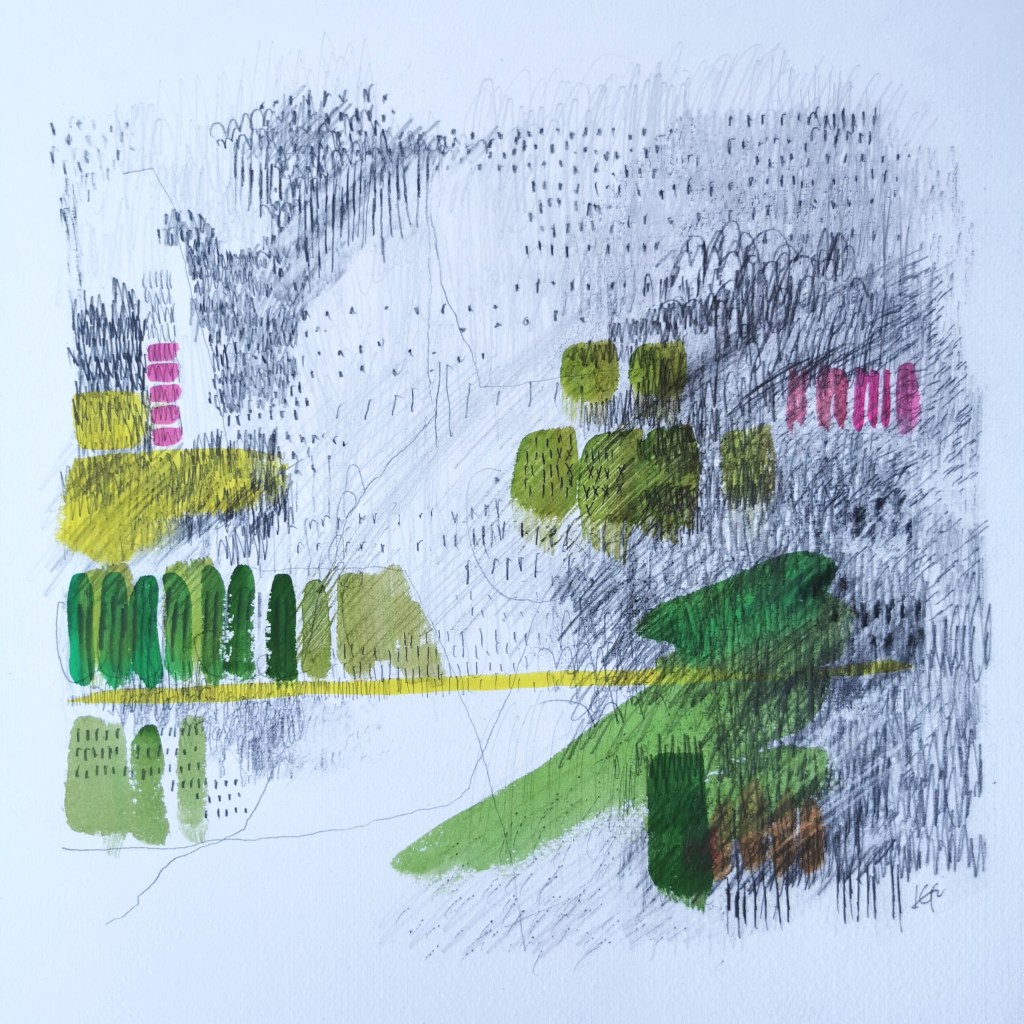
I’ve been working on some new landscape-inspired drawings, bringing together some colour mixing and the monochrome marks, rhythms and textures relating to the Norfolk landscape. I began with a journey through the drawers of my plan chest to pull together a dictionary of visual language to guide me, and following a cycle ride in the landscape I took pencil in hand, and began to draw. Painting features very little in my practice, really only for colour-mixing but this time it felt right to capture the colour in gouache and apply directly with brushes on to the paper, layered up with the graphite of the drawing.
These drawings are part of the ongoing journey, but I do think it’s important to stop and notice when something feels right, like a good fitting piece of jigsaw in the puzzle.
I’ve already shared the news via my other social media channels, but I’m delighted to announce here too I have been confirmed Associate Professor in Design at Norwich University of the Arts. This makes me extremely proud and at the same time reflective about the career I’ve had so far.
At eighteen years old I had very little idea what I wanted to do as a job or career, and considered widely contrasting options of occupational therapy, sports psychology, the army, teaching … something creative …. having grown out of the idea of being a bagpipe player, aged 4, and archeologist, aged 8. There are skills involved in roles across some of these that are required in my current post in academia but equally some a disastrous fit, at least to the me I am now.
Going through art school and university, even the post grad. masters course, I was petrified of the ‘real world’ of work, despite having Saturday and holiday jobs from a young age. I can clearly remember the months I earned nothing as a freelance designer, the humiliation of the job centre line and housing benefit application process, the years of no holidays unless they were working holidays to get free board, and watching peers become adults in an adult world, as I tried to work out what I wanted to do while keeping expenses low and resourcefulness high. The turning point was my first role as Print and Photomedia technician at Central Saint Martins, London, where I met people like me, dividing their weeks with practice and educational roles – this could be my real world too!
Today I can look back over a twenty-plus year academic career and so much makes sense; the joy of hindsight. Since school I have taught at play schemes, Sure Start projects, NHS trust projects, community projects, adult education workshops, school outreach, FE & HE courses. Every project taught me something that informs the educator I am today, and clarified my preferred environment for teaching and learning. For over twenty five years I’ve led a creative practice that has evolved substantially from the one I led in my studio / bedroom in south London, making books at a tiny desk, using the bathroom as a darkroom in the middle of the night, and the print room at CSM when the students had left. Artwork on the London underground network, designs on a huge hospital roof, in an airport, selling products to Japan and America … Projects happen but it’s easy to forget they were all unimaginable to the eighteen year old self. At art school I learned the value of drawing, of playing with the design process, of dedication to make something the best it could be and commitment to colour mixing. Those tutors shaped my rigorous approach to my practice today. Incidentally, my minimalist aesthetic was defined lazy by one visiting tutor I had the displeasure to be taught by – he missed the point I remember thinking, I knew he had got me wrong.
As an academic I’ve learned to continue to learn, continually … One instance: I was thrown in to the deep end to deliver design history lectures to undergraduates many years ago, with no GCSE in basic history, and only faint memories of my own design history education for support – that was a particularly low point. Hundreds of hours investment, much reading and learning, and a fair amount adrenaline got me through those early years. Some students have told me since then, that those lectures were among their highlights, and I feel pleased – retrospectively I can’t help feel grateful to my then boss for not giving me the get-out option. This skill and knowledge is now something I hugely enjoy and benefit from. I love to share my passion for design history – who would have thought? Not the eighteen year old me!
In running my design practice in parallel with my academic career I am busy. It would be easier if I was content to focus on one rather than juggling my headspace and waking hours. I’m not alone in wondering why I maintain both, but it is simple – they need each other, and I need each of them. My teaching is filled with current industry experience, my design practice feeds the lectures, workshops and tutorials I deliver. The design experience feeds my research and my practice validates my teaching. My own creative struggles and insecurities support my understanding and empathy for the students I teach and nurture to be brave soles, out in the real world, like I had to be and continue to be. I love to learn, and if I can share what I learn and understand, I can help others to enjoy the design industry too.
I’ve stood at trade shows, on my stand for 12-hour days, promoting my new collections while checking my uni emails on my phone, to make sure things are running okay in my absence. I’ve spoken to industry partners interested in my work, while at the same time my head is working out how I can link the students to the opportunities they may hold too. I’ve formed relationships with wonderful industry friends who now form a network of support for the graduates I’ve taught. The important thing to learn is that we are all in this, learning together, helping others and together making the world a better place to be. The response to me achieving this recognition has been overwhelming. Colleagues past and present, students and graduates, manufacturers and past collaborators, and so many more people have got in touch – reminding me of many precious moments along the way.
I’m grateful to have this recognition from the university. The contribution I’ve made to both the design industry and academia is acknowledged as valuable to others, and united in potential – and that’s a good starting point for the next twenty years!