creative sparks in Armenia

Combining a design career with an academic role often means my weeks are busy and varied, but I had a week at the beginning of this month that was very different to the rest! I’ve been lucky enough to be given an amazing experience as academic at Norwich University of the Arts – a trip to Armenia. The university was successful in securing a British Council bid to work with students at the Tumo Institute in Yerevan, Armenia to help students to create design work with the aim of making products to sell when they come to work at the university in a few weeks time. This is speed educating! A team of three of us, Will – a business mentor from the university, Mia – a graduate from the BA in Textile Design and me – the lead subject academic. Fortunately we all got on brilliantly, complimenting each others’ skills and all being very happy to adapt in order to make the most of the experience. I was only able to be there a few days, while the other two stayed longer.

The journey was long, transferring in Istanbul and we arrived in Yerevan in the middle of the night so it wasn’t until the morning that we could see what the city looked like. We had some time to rest, so we didn’t! … and instead got up and explored … of course! The architecture was a mix of Modernist Brutalism, Art Deco and Post-Modernism mainly and a pink stone was dominant. Many of the buildings featured wonderful carvings and at many points all three of us were heads and cameras up capturing the city. The food in Yerevan was a complete hit with us and I could have stayed far longer and become far wider. Everywhere we went there was wonderful fresh produce: cheeses and meats, pastries, vegetables and breads, all beautifully presented. Luckily we were all happy to share the dishes to ensure we could try as much as possible.
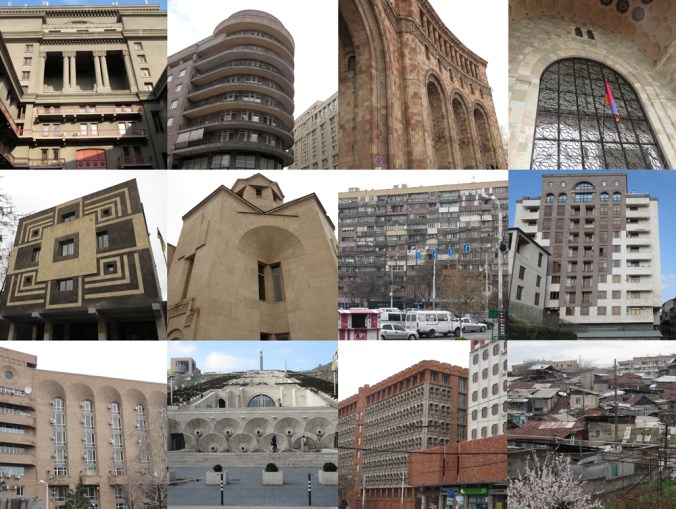
Armenia_architecture_1000

There was much excitement as we went to meet the team of students we were going to be working with, and we took examples of our work to introduce ourselves as well as a general plan, and open ears, so we could discuss with them all their own creative ambitions. These first few days were really important to get the project up and running before I had to return to the UK. Tumo studios was set up on the first floor of what was previously home to a wealthy family and there were signs of the better days including murals on the ceilings and ornate tiles. The workshop spaces were really inspiring, catering for print, ceramics, jewellery, sewing and more. Products made by students were available for sale too.

Everyone was very friendly and helpful, as well as really excited to get stuck in. We shared our ideas and thoughts about the project and Mia and I talked briefly through some of our own work. The first afternoon went by quickly and then the three of us were off to explore the city again – I really wanted to see Mount Ararat – the mountain taller than Mont Blanc, (and apparent resting place of Noah’s ark) that has in history been on Armenian soil, but is now behind a Turkish border. We climbed steps and more steps to the highest part of the city giving us views over the varied levels of prosperity in the capital . With sunglasses on, when there was a break in the clouds we could just spot the snow and shady top of Ararat, but sadly the view was not easily captured on camera – Wikipedia has better pics!

The next day was a very long but hugely inspiring one. With our local guides and our researcher eyes in we set off to visit three fabulous places to gain inspiration. The city museum presented the history of Armenia. We learned about traditions, society, historic events and politics, and of course the section about the Armenian genocide was hugely upsetting. We were not allowed to take photographs there but we had other places to go so we crossed the city, including a short trip on the metro (it has one line) to get to the Folk Museum. This was a smaller museum but packed with so much beauty! Here we heard about and saw the traditional crafts and our guide explained the processes, tools and materials involved. I took many photographs! The lace and filigree were particular favourites of mine.
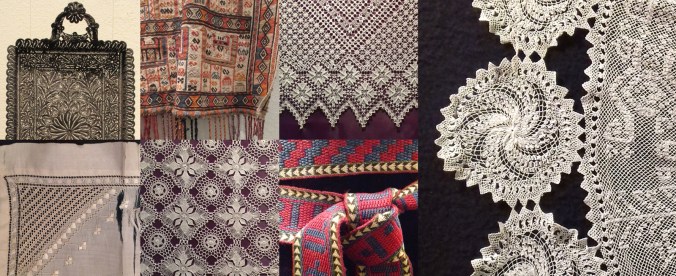
KFarley_folkmuseum_blog1600

We were full of inspiration but needed energy so lunch was in a restaurant with our hosts helping us to navigate a menu of local dishes – I had lamb soup with pomegranate and mint – it was very good! Soon we were whisked off to the carpet museum / factory and the journey was a great opportunity to see more of the city and suburbs. It was fascinating to hear the history of carpet / rug making in Armenia and I even had a go at learning the right knot but I was very slow in comparison – there is video footage somewhere – and in the picture below, top row, right hand side, you can see my four cream coloured tufts that they have no doubt got rid of once I turned my eyes!
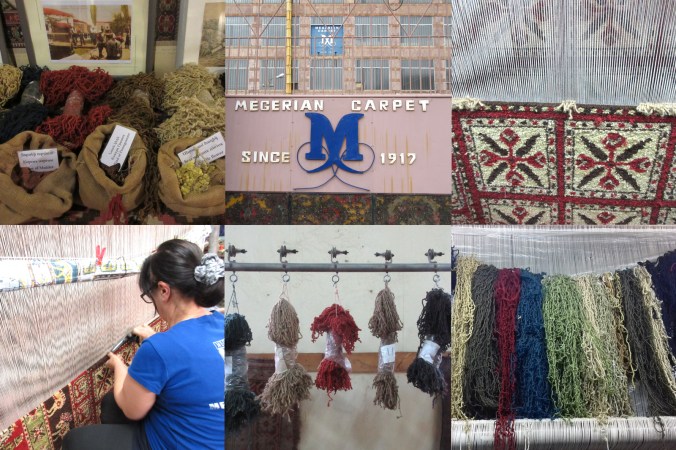
KFARLEY_Megerian_carpets_blog1600

The colours used to dye the yarns are still made from natural ingredients and it was right up Mia’s street! There were some secret ingredients of course! We were all inspired by the sights, stories and the motifs, border patterns and processes involved. What an amazing day. We headed back to the studio to think about what we had seen, captured some ideas on some post-it notes and discussed the plans for the next day. Another evening of foraging fabulous food in the restaurants of Yerevan did us well – we all ate too much again.

My final full day was spent in Tumo studios leading some workshops to develop the projects. Will, Mia and I planned the next week of workshops and activities, sharing all our different knowledge and experience, alongside talking through the individual ideas with the participants. I ran a session about motif and composition development and it was fascinating to see how differently these young people took on the challenge compared to the undergraduates in England I have worked with. These students were far happier to play with the process and not worry about it not working, and gave the testing much more time. Can this be the different schooling? Several attempts at the same thing, sharing and much discussion, lots of giggling and trying again got us to where we needed to be, lunch!
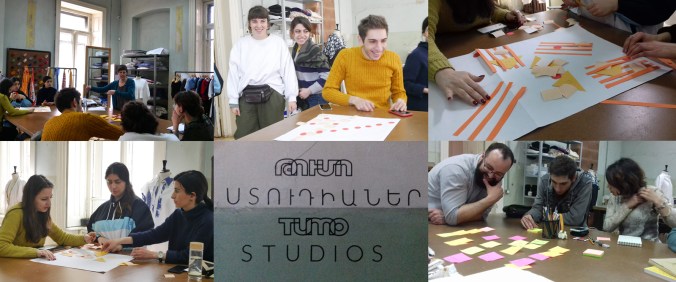
KFARLEY_tumo_workshops_blog

We decided to eat all together in the studio so we ordered in food, (I tried cheese soup – it really is like fondue) and as we sat together we tried to learn some of the language … we laughed a lot. We were also bought a local honey cake to try which was very good. In the afternoon I led a practical session about repeat patterns and design rhythms, and again we talked through individual ambitions for design ideas and product potential. The participants will be heading to Norwich next month to develop and resolve product outcomes to test in a commercial setting. We discussed differences between Norwich and Yerevan and about the next phase of the project. At times we had visitors popping in to see what was going on but we kept on track and too soon I was having to say my farewells and leave the group – with the silver lining of knowing I’d see them in Norwich in May.

One more meal, a final evening with Will and Mia, a supermarket sweep around a 24/7 shop to buy gifts, back to the hotel to pack up, a twenty minute nap and that was that, it was Thursday – I flew out of Yerevan in the very early hours, swapping ‘planes in Istanbul and on to home.

I was so sad to leave the people and city, and was so envious that Mia and Will had another week to see more. In only a few days I had experienced somewhere so interesting that before getting there had felt daunting. Everyone we met were so friendly, helpful and proud of the city and country. I had the chance to learn about a different country and textile culture while working on a really different project, testing my teaching in a very different situation. It really was a great opportunity, hooray for saying yes!
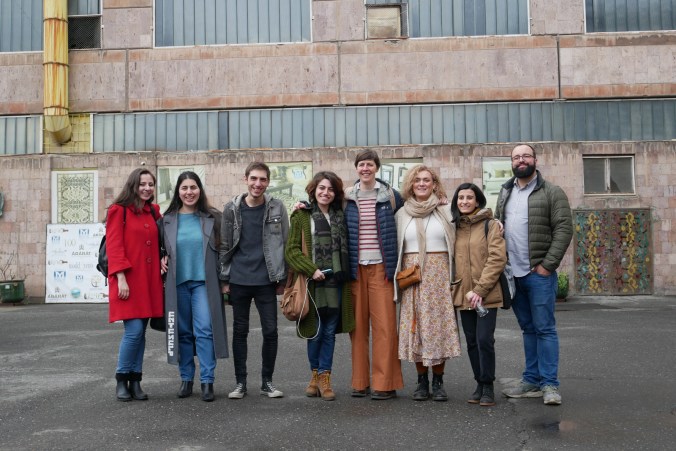
factory_groupimage_blog

Thanks to Will and Mia for some of the photography and being such great team mates!
women designers, lost and found

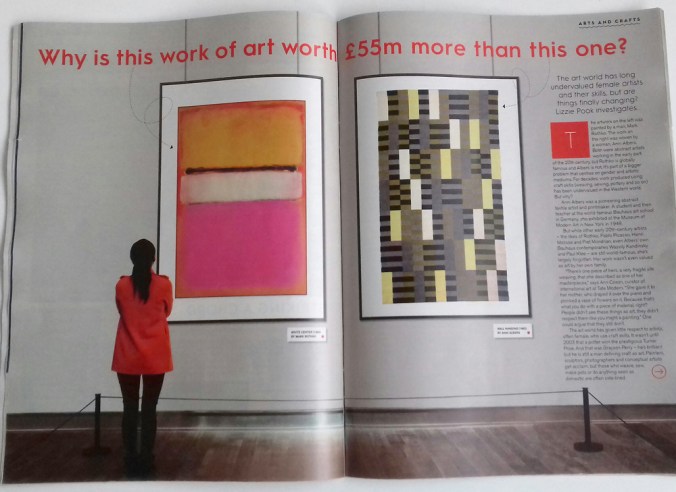
Sometimes themes seem to rattle around in my head, connecting with other dialogues I have had. Last week I attended a really interesting Study Day at the House of Illustration as part of the Women in Print series organised by Desdemona McCannon on the theme of Enid Marx and contemporaries. The subject of women’s careers, and specifically their profile compared with their male counterpoints was discussed – not a new idea, but as a recurring theme I thought it worth revisiting here. In the same week Stylist magazine featured an article about the price of artwork made by women compared to men. It was such a coincidence I’ll expand some thoughts here.

It’s not a secret that women often have a harder time gaining recognition in many lines of work in comparison to their male peers. I wrote in a previous blog post about Eric Ravilious and friends at Compton Verney that it certainly wasn’t lack of skill that kept the women such as Helen Binyon from comparable public attention, and therefore further opportunities through their careers. There are highly talented women in history who we are only just giving air-time to, but the fact is their careers may not have excelled in the way their male counterparts did, or if they did they may well have been paid less for the work because they were women.

Enid Marx chose not to take issue with gender-bias in her career, and got on with a multi-disciplined design portfolio, with impressive outputs including books, textiles and patterns which were beautifully communicated through the exhibition at the House of Illustration (sorry it’s just ended!) – but you can visit Compton Verney instead. We got to see the exhibition as well as listen to knowledgeable speakers such as Enid Marx expert Lottie Crawford giving a really insightful illustrated paper about the legacy that Enid Marx and her peers have created for us today, as well as Jane Audas taking us through a fascinating journey of clients and sales put in to a broader context of who’s who.

I have heard people wonder why we need to make a point about this being a gender issue, but I would say that this has been said from a male perspective, and not from those being subjected now and in the future to selective opportunities due to gender. As a woman designer, and female academic training mostly women to have design careers where there is a history of undervaluing female contribution, I remain concerned.

EnidMarx_patterns

It is sometimes the case that research can be discovered more easily about men because they were promoted more and as a result have a higher profile, whether through greater self-confidence, the social / commercial networks or marketing material, from family or company archives, past exhibitions or publications. During the study day in London the point was made that there was also a sense that women got on with the designing, often alongside raising a family or carrying out other domestic tasks. Did they lack the opportunity to promote themselves, didn’t see the need, or couldn’t find the time? Working in isolation at home can certainly challenge one’s self-belief compared to working in an office with colleagues who can praise you and your work as and when required. This reminds me of the freelance work of Sheila Bownas, almost accidentally discovered and collected by Chelsea Cefai, and brought to a new appreciative public in the last few years. The family knew little of the extent of her prolific output of designs as a textile designer until Chelsea pieced the jigsaw together, and thank goodness we know of her now!

There is another consideration here. Does the discipline these women are working in make a difference to their profile? Enid Marx worked across illustration and textiles, but her illustrations are better known. Is this because as an illustrator your name is usually on the cover of the book, even if it is on the inside, or on the poster? For freelance textile designers it can be quite different. The name of the company is usually printed as legend details on the selvedge, but historically not always the name of the designer. If this is the case we may never trace the designer. This remains the case today in industry when big name brands buy in freelance patterns and the designer’s name is not carried through.

The article in Stylist compares Mark Rothko and his fine art paintings to Anni Albers’ textile practice; the subject of a show coming to Tate this Autumn. When the Bauhaus opened its doors in Germany in the Twentieth century the founder, Walter Gropius, stated anyone could study any discipline, and yet the women were rather heavily steered towards the weaving workshop, considered suitable for women. That was where Anni Albers learned her skill, fell in love with the teacher Josef Albers, took his name on marriage and continued to live in his shadow; he led a fine art practice of painting while she made textiles. I can’t wait to see the Anni Albers show – and for Anni to have the publicity men with lesser creative careers have had before.

stylist_magazine_Sept18

Craft, seen as a second-rate subject to Fine Art is part of the discussion throughout the article in Stylist, and it also makes the point that textiles is seen as a domestic activity, thanks to the increased leisure time during Victorian era. Grayson Perry has made significant strides in opening up the conversation about value of craft, but far more needs to be done to change opinions. As an academic one of my biggest concerns is the lack of respect textile design currently receives as a subject in the education curriculum and agenda. It’s becoming one of my catch phrases but I really mean it – we all wear pants! How can textiles be seen predominantly as a past-time, a hobby – when we all wear textiles, sleep under textiles and protect ourselves with textiles? How dare this government puts at risk the supply chain of future textile designers because it doesn’t see it as important enough to be a GCSE? Fashion is nothing without textiles, and this industry is one of the big ones on the global stage – don’t get me started on that!

Refocusing back on the study day, we also discussed the nature of research carried out by women, and that the particular approach / nature of research writing holds a female voice that may not be considered intellectual enough; often relating to social networks, domestic arrangements and family life. Several female audience members agreed that they doubted their own confidence when finding their research voice alongside the traditional academic tone / content they believed was expected by their male counterparts. Are women undermining themselves and lacking confidence in their own abilities?

I don’t have the answers but this is not a conversation that should stop. More dialogues involving men and women about historical and contemporary design practice, craft and textiles are needed. There is not one way, this is not binary, but we need to make sure the different voices, approaches, strategies and practices in the creative subjects and beyond are given a platform. The diverse ways of being whatever it is we are should be valued, and represented by a diverse community. Wouldn’t it be lovely if talent and opportunity were really the key ingredients for building profiles, gaining opportunities, and writing about it!

Save

Save

Plot plants and design musings

It’s that time of year when the weeds seem to grow faster than the vegetables, and with so much rain this last month, the slugs have found it very easy to slide across the plot to our crops. The courgettes have started cropping but the peas lost the fight. This has got me thinking… This gardening game is very much like the designing game.

There are highs and lows with both, rewards and lessons to learn too. Progress can at times come easy, and with other situations hindrance can be everywhere, and not of your doing. There are also joys in the changing seasons, the changing pace, the focus of attention. Preparation is needed in both garden and design studio; good tools, knowledge of good practice, even ethics come in to both!  Experience and maturity can guide you, but even then, elements beyond your control can create a set-back. How the gardener, and how the designer copes and picks themselves back up also has similarities. Both disciplines demand attention, can’t quite be put down, often filling my mind with excitement of what is happening, what is growing in to something beautiful, edible, or with great potential.

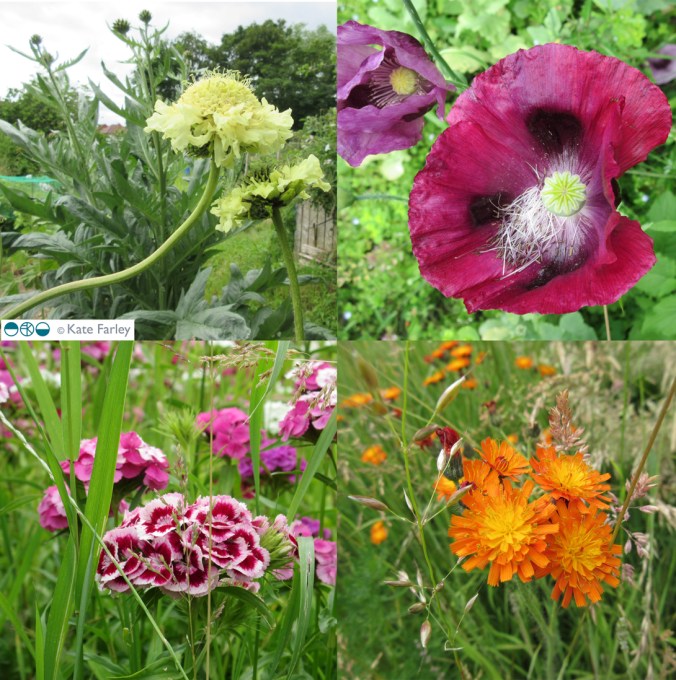
plotflowers_100

I hadn’t really thought of this before, but now I can see the similarities I can see the sense of purpose in both, as well as the patience required. Neither can be rushed if you really want quality outcomes. You can buy a box of plants ready to put straight in the ground but the satisfaction is never the same as when you nurture the seed in to a strong plant, eat the fruit, gather the seeds and start again. Isn’t that exactly the same with designing? You can start from the very beginning, and own the entire idea, or you can take a short cut, see someone’s beginning, and take it from there. Not at all as satisfying.

There’s many ways of being a gardener, and there’s many ways of being a designer. I think what’s important is that find the thing that feels right, and works for you. Then, tired from the tasks, you can sleep well, knowing the process will keep you strong.

For reference, sadly none of the flowers above were grown by me, but by my fellow gardeners at the allotment. I did take the photos though!


patterned walls and windows

They have been a while in the making, with lots of drawing, designing, discussions and sampling over the last ten months but my designs for Tektura Wallcoverings have been launched, and I’m delighted to be able to share them here. There are five in total so do visit the Tektura website to see them all. The images of the drawings are mine, the product shots are courtesy of Tektura.

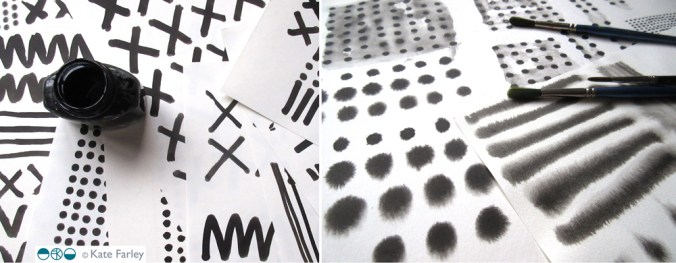
I was working on the designs at the same time that I was developing my ‘construct’ collection and Tektura really liked the look and potential of those designs but I needed to build two distinct looks to avoid a conflict of interest. You will see similarities but I utilised different drawing tools and pattern systems to explore a variety of options in my markmaking. I created many sheets of paper full of inky motifs that eventually, after a lot of design development over several weeks both on paper and at the computer screen, became digital artwork to hand-over for production. At Tektura the colours and scale of pattern were sampled and marketing / sales information was created for the launch. One thing I find hard is naming the designs, and this was no exception. The thesaurus was called upon, as was Google to check existing references, and a colleague at BCU also contributed – thanks Clare! In the end the names pretty much describe the pattern. I won’t be a poet anytime soon!

KFarley_TekturaDrawings_blog

My past experiences of working on large interior / public art projects enabled me to work with the scale of the potential interior environments that Tektura provide for in my mind the whole time. These designs for Tektura can be customised and applied to wall and glass surfaces and so as I designed I maintained modular components that can be re-coloured or omitted for each client’s specifications. This is a wonder that digital production can provide; enabling bespoke solutions.

KFarley_point_tektura_blog

For me this project highlights key values in my practice: the importance of drawing and hands on image-making, knowledge and understanding of digital production and product context, and the value of working relationships and good communication. Each client I’ve had the pleasure of working with over the last fifteen years or more, whether it’s the design director, art officer or buyer can really shape the design process they are commissioning. From outlining the brief, to negotiating the design direction as well as final sign off, these things make a big difference to the designer, often working far beyond the hours intended in order to allow sufficient time to reflect on the design process and outcomes. Digital communication allows artwork and thoughts to be shared and discussed in minutes, and decisions can be made together.

The great thing about working with companies such as Formica and Tektura is that they are industry experts with fabulous products, trusted by the market. By working with this expertise I learn more and get to understand the design world from their standpoint. Who would have thought my patterns would be on such a stunning shiny surface as Glint (below)! Working with Tektura Wallcoverings has been a pleasure and I’m proud to show the designs off. Thanks to Angela and the team!

KFarley_splodgeTektura_Blog