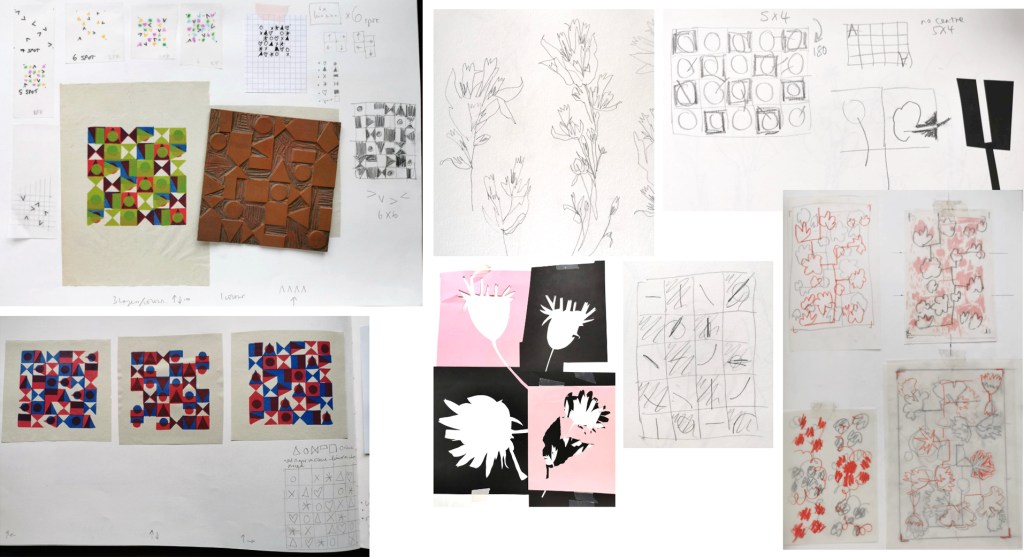
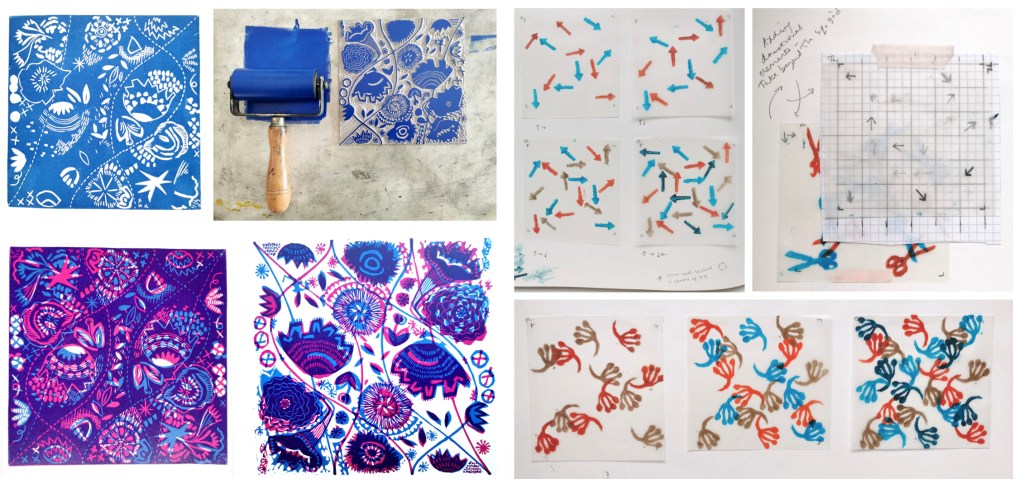
I’m currently working on some large scale lino blocks to print floral patterns as part of my continuing pattern research. At the same time I’m also teaching our BA2 group how to create repeating printed patterns, so it’s always nice when there is some parallels between what I’m up to and what the students are doing.
I have been returning to my sketchbook of floral drawings I made from my trip to the Italian Alps, and exploring them again with new paper cutouts as I think about overprinting and block rotation. I’ve not proofed the plate yet, but here’s some work in progress images from the studio.
Dates and anniversaries matter to me, personally and professionally. They record the passing of time, the gaining of experience, the rhythms of life and death. I bemuse my family & friends by remembering apparently irrelevant dates, including the birthday of Roland Rat, (12th March if you are wondering!).
Seven years ago this week I started working at Norwich University of the Arts as Course Leader of both the Fashion and Textile Design degree courses. I undertook this role for four years before focusing on the BA Textile Design course for the last three. I am immensely proud of the course and community I lead, with a strong network of colleagues supporting me with the wobbles while celebrating the wins.
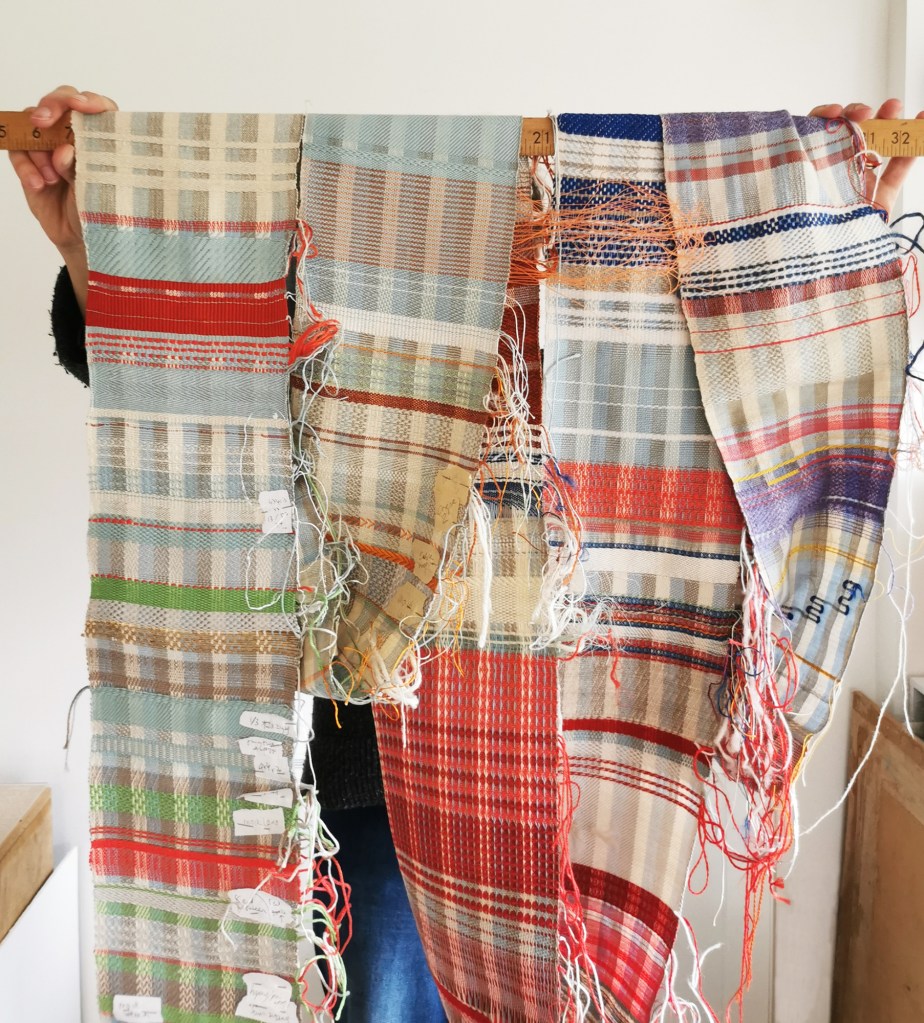
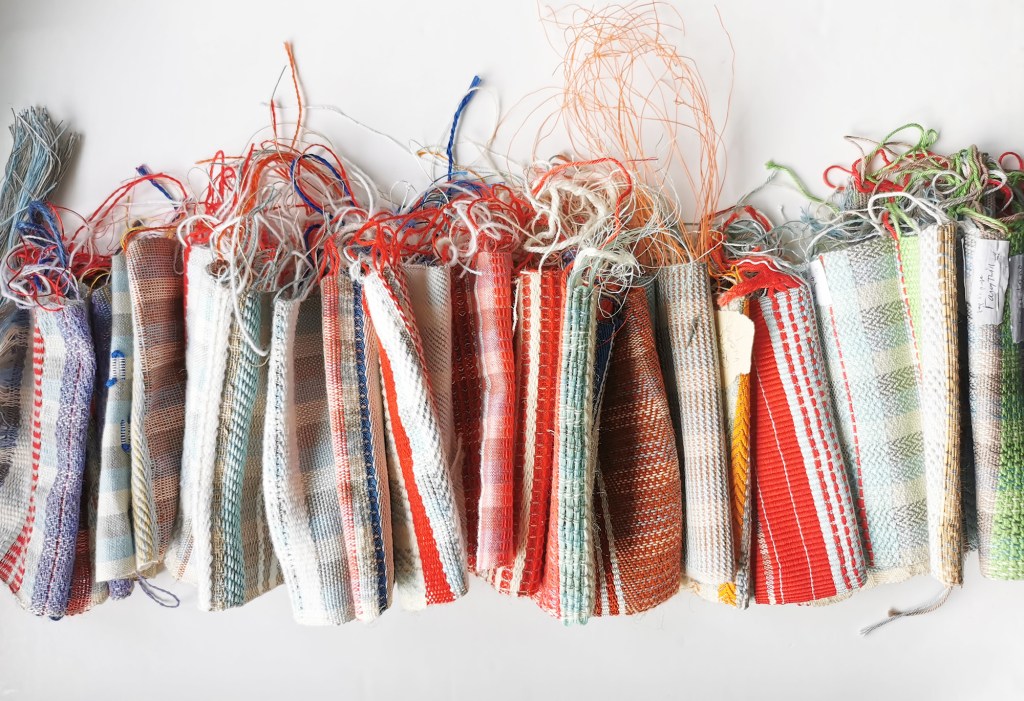
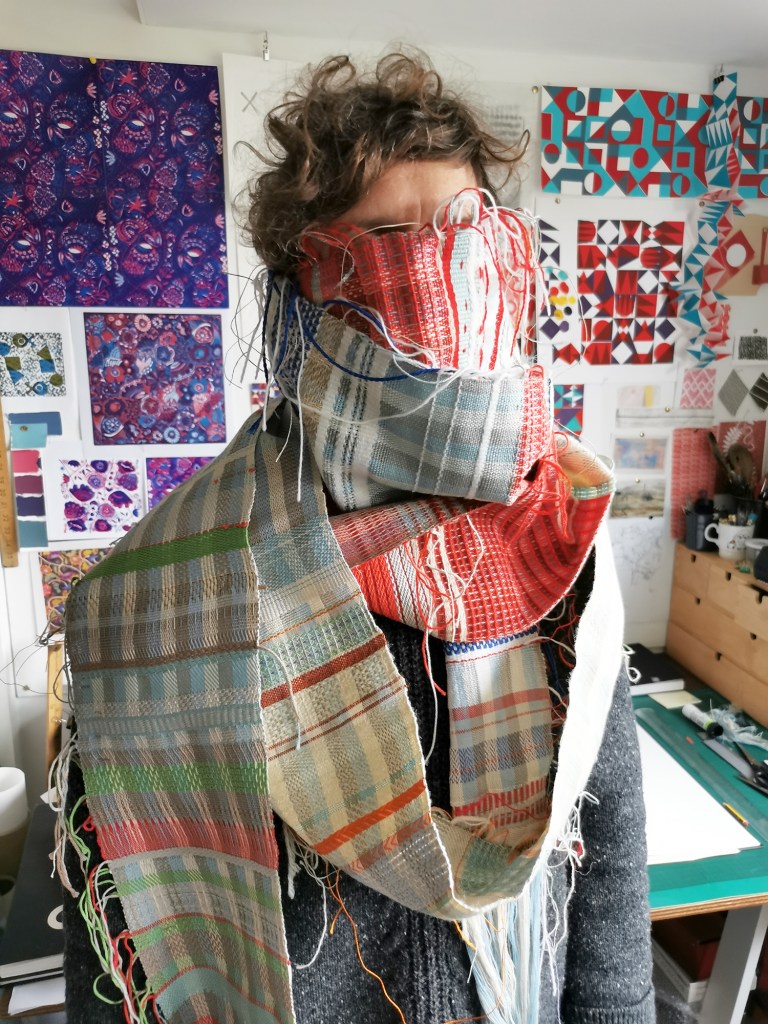
One of my leaving gifts from my colleagues at Birmingham City University back in 2018 was a warped-up 8-shaft Harris loom – it’s important to note I’m a printed textile designer, not a weaver! This week I have finished weaving the warp – over 5 and a half metres of weaving – certainly not a commercially viable rate! I haven’t committed a huge amount of time, more short bursts over the years when the mood took me. I was surprisingly sad as well as excited that there was no more cloth to weave and I’d be able to see the entirety of the weaving away from the loom.
The completion of the warp coinciding with this work anniversary has made me reflect on these years, there have been highs and lows in both work and life. Learning to weave has given me a process to occupy my head with away from everything else, without any pressure but to play and explore. It has been so helpful for me to have this space and activity. As I cut the warp threads and unwound the length the bands of colour and materials I selected at various times revealed themselves, reminding me of how I was feeling as well as specific experiences.
In parallel to making this cloth, I’ve developed my role in academia – developing curriculums and strong student experience, achieving the title of Associate Professor in Design, writing a book, and developing my role of advocate for others and the discipline of textiles both in education and industry. It’s nice to have something tangible to mark these years. I’m ready to get stuck into the next chapter of academia but I’ll have to find another hobby or learn how to warp the loom up myself … here’s to the next year of learning and teaching!
A very overdue post – and while the summer is very definitely behind us, I’m still remembering the hot summer and the family adventures we went on, as the days grow shorter and I reach for the jumper.
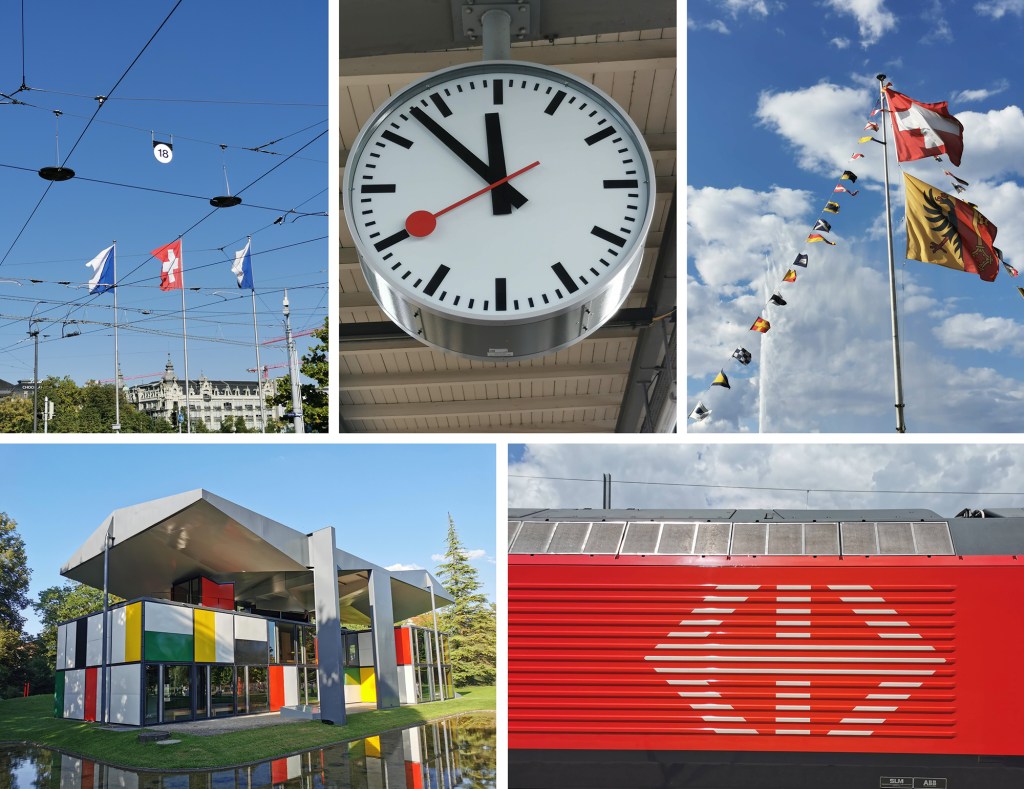
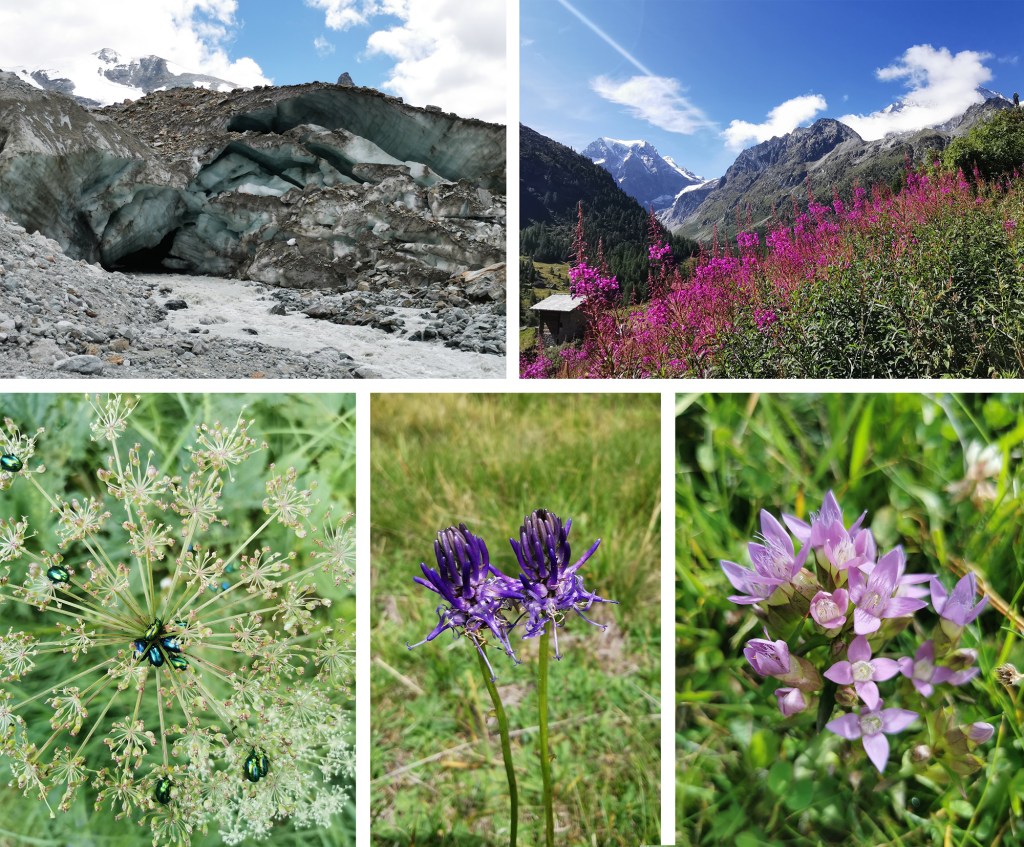
This summer we travelled overland to Switzerland, firstly to Geneva, then up into the mountains from Sion to a little village called Arolla where we explored the mountains and glaciers as well as the flower-filled meadows – precipitous paths and all! Back down from the mountains to Sion via the post bus, we then journeyed into Italy and up to a Swiss hilltop village above Locarno, called Intragna. I remember excellent fig ice-cream and cakes from the brilliant bakery and an early morning swim in the river. We ended the trip with a couple of nights in Zurich exploring the city and found time to swim in the lake too, before getting the train back home via Paris.
Switzerland tested my language skills, particularly as we travelled through French speaking Geneva, Italian speaking Locarno and German speaking Zurich, but we did our best. The food was fairly heavy on cheese and potatoes, and I can recommend the Swiss wine that apparently tends to stay in the country rather than being exported. Of course we sampled the chocolate too!
The landscape was beautiful and varied during our holiday, from vineyards to pastures, wide glacial rivers to narrow streets of Geneva. It is sobering to see the pace at which the glaciers are retreating, with dates marked on rocks along the walk up the valley to meet the ice of years gone by. The flowers were stunning and in abundance lower down the mountain passes. We were fortunate with good weather during our time in the mountains so on one day we were able to climb to nearly 3000 metres and lunch at a refuge hut before a rather long decent including steep drops, rickety bridges and large staples to hold on to – via ferrata – some rather scary!
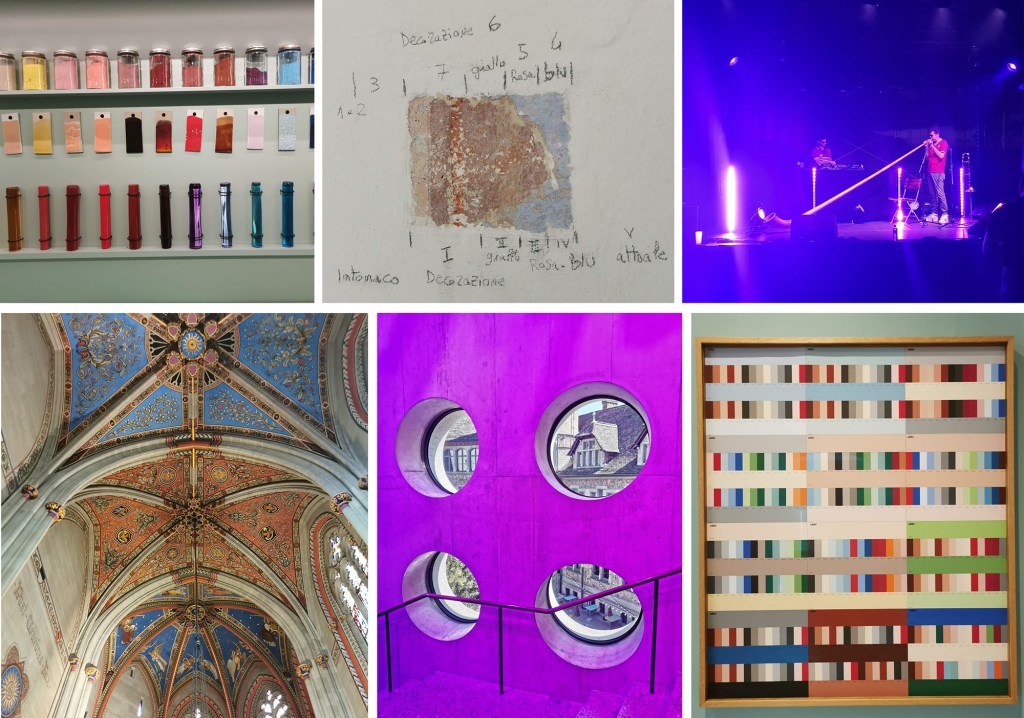
We enjoyed some excellent galleries and museums during our trip including:
Musée Ariana – the Swiss museum for ceramics and glass in Geneva
The Regional Museum for the Centovalli and Terre di Pedemonte in Intragna which also included a climb of the bell tower
Landesmuseum (Swiss National Museum) Zürich – which housed an exhibition on all things Techno, as well as a sizeable collection of Swiss art and design through the ages and an incredible collection of rings of all shapes and sizes
The Pavillon Le Corbusier, also in Zurich, nestled in a park by the lake
A surprise cultural highlight was a festival in Geneva on Swiss National Day (1st August), where we were treated to a performance by Alpenhorn Sound System, as we watched fireworks over Lake Geneva – amazing!
A great holiday, lots of good memories and plenty of inspiration!
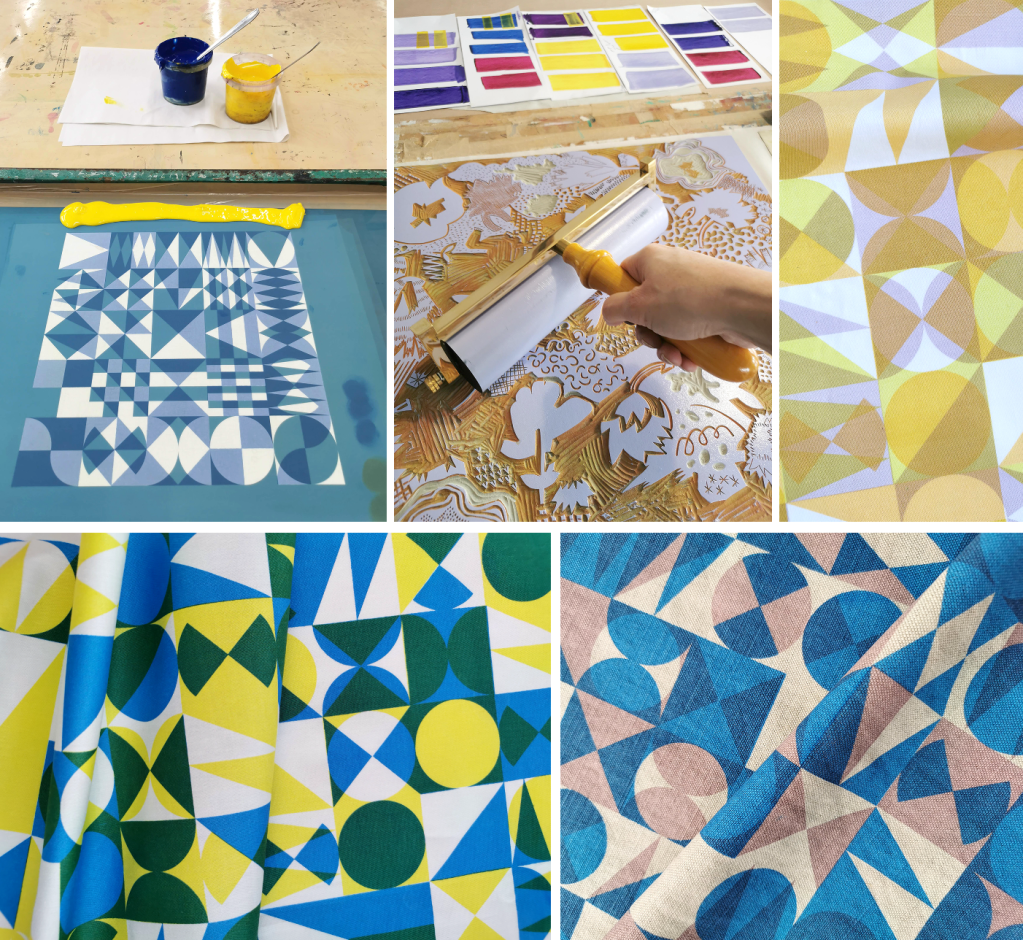
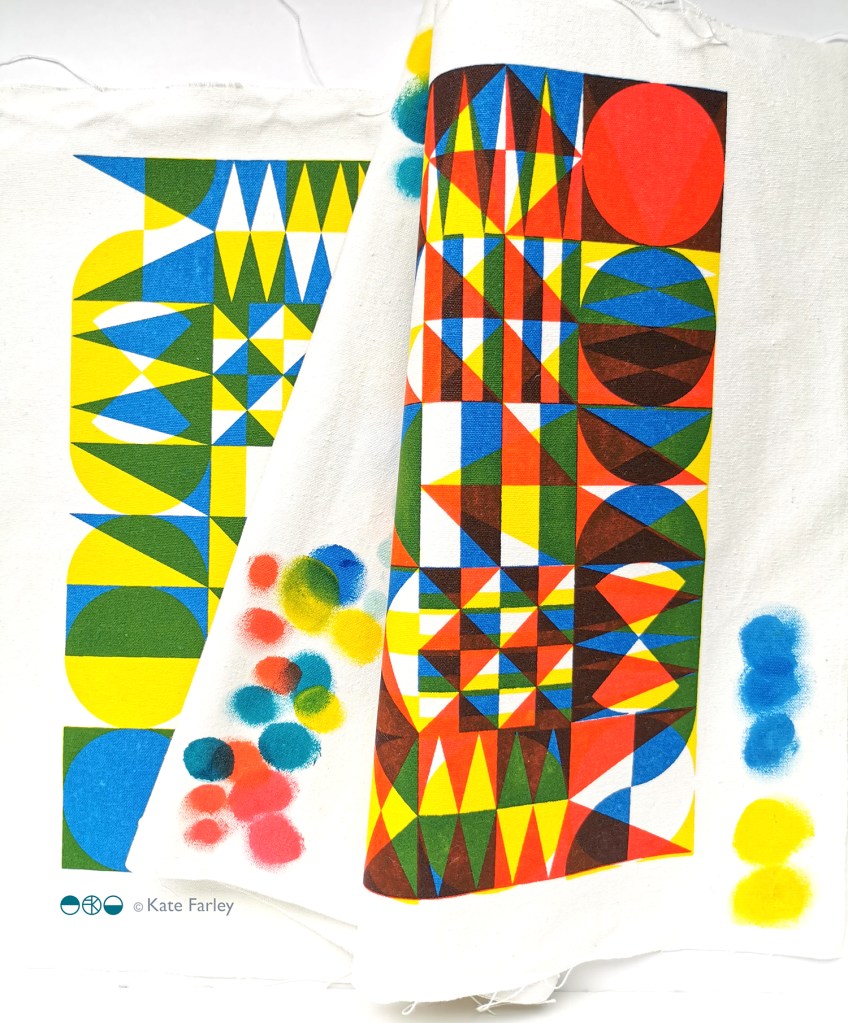
After a long academic term leading the Textile Degree at Norwich University of the Arts I finally found some time to get in to the workshop and sample some designs on fabrics. I developed the patterns rather a while ago. I love the process of screen printing, from mixing the colours, exposing the screens, pulling the squeegee and of course lifting the screen to see the new print. I even enjoy washing the screens ready for the next time!
I’m not going to share all the outcomes at this point, but here’s a taster of the colours and a glimpse of one of the designs. I was working with transparencies in the pigment and binder to create the extra colours… and I’m really excited about the results!
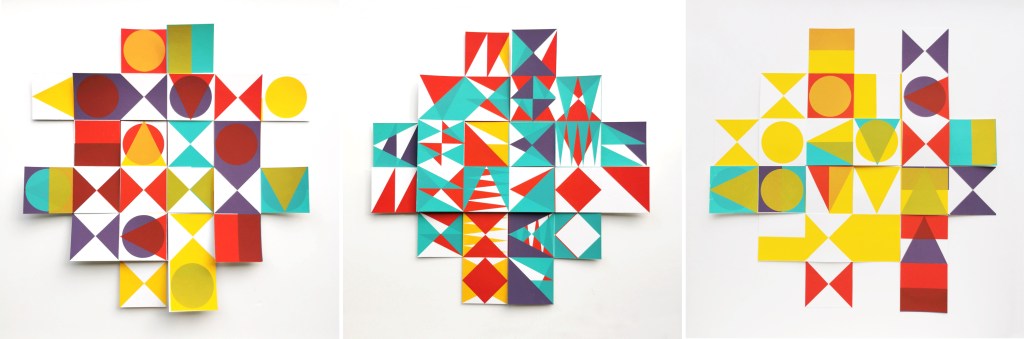
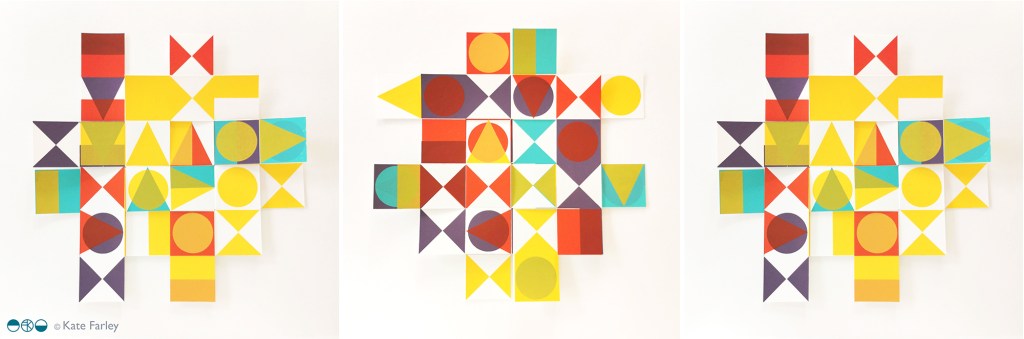
I am really pleased to have had two of my most recent works on paper selected to be included in the Print Cromerexhibition this summer, with the Private View on 19th July. This new body of work has been developed as part of my academic practice at Norwich University of the Arts where I have been exploring pattern structures and repeat blocks. I have explored new pattern iterations by rotating the screens to add additional colours of the same artwork, thereby building greater complexity from limited design information. In an age where digital design and the use of Artificial Intelligence provides limitless opportunities, I want to explore the fundamentals of pattern creation to generate new possibilities that are led by the designer, ensuring the creative path is transparent.
The theme of the exhibition is PLAY, and as a result the palette I created feels full of summer carnivals and fairgrounds. The overprinting of inks with differing levels of transparency provides a building of depth and subtlety of harmonious colour.
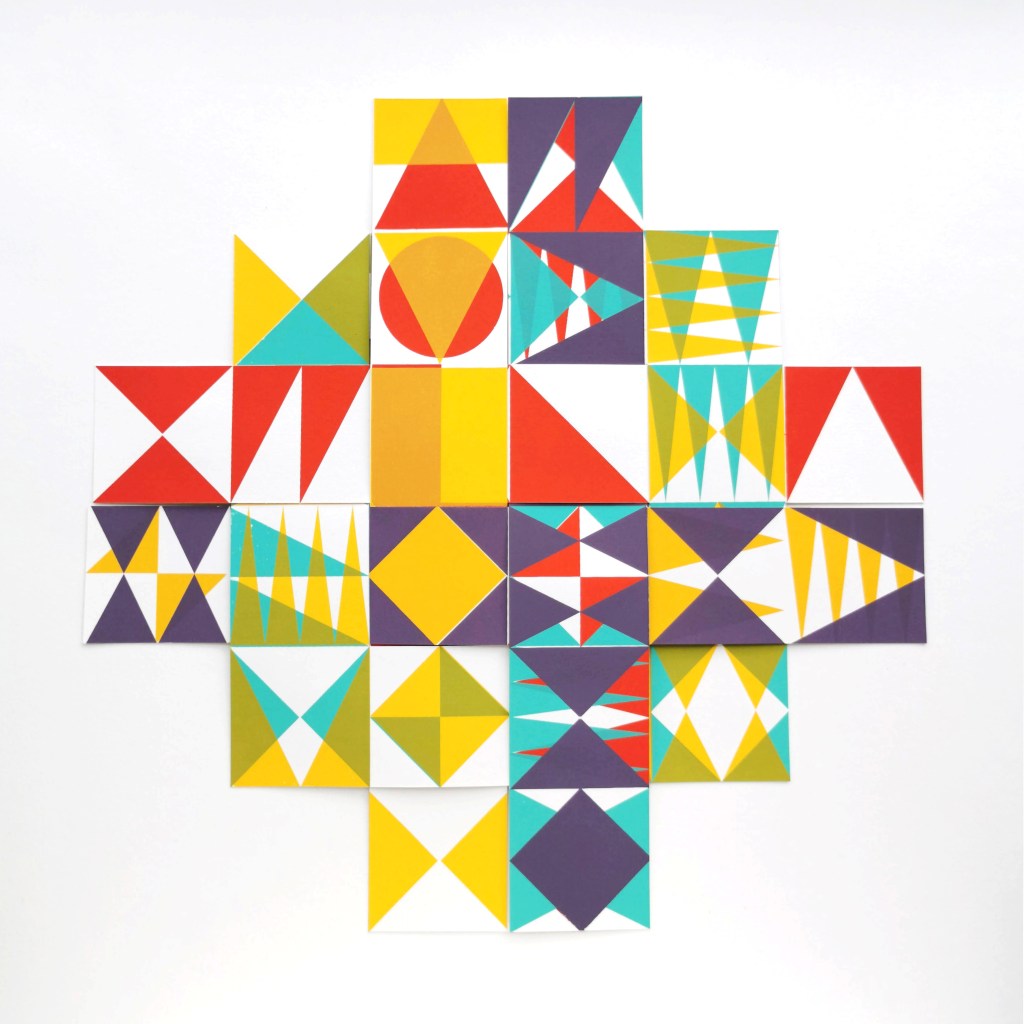
I created a number of one, two, three and four-colour prints initially, that featured the screen rotation in adding the colours. I then cut strips of the prints and with further rotation of the strips, interwove them into one base print that had been sliced to enable the slotting. I enjoyed bringing back an element of paper engineering from my book art practice into these new pieces.
In designing each piece, I considered the placement of motifs and relationships of colour. The collection provides variation within a collective identity and belonging. Some pieces feature only triangular motifs, while most incorporate the circular and rectangular elements too. My research utilises design thinking by Lewis Foreman Day, and his distribution of elements. This approach results in scattered focal motifs that work across repeating patterns. Although this is not a feature of my new work, I recognise the placement considerations are also useful in this work too.
A number of these pieces will be for sale during the show.
I’ve been enjoying some studio time to explore my print research as works on paper with the hope of exhibiting the work. I enjoy paper engineering and construction (that’ll be the book artist in me!) and have previously tested paper manipulation in relation to this current pattern research. I tend to work in this way, creating drawings or prints to exhibit / sell alongside forming pattern ideas, and it has been useful to see the evolution of the sampling in this way here too.
These new artworks utilise my screens of geometric artwork practically exploring research into motif distribution in printed pattern thinking formalised by Lewis Foreman Day in his book Pattern Design, published in 1901. Having printed the artwork in the first colour, I rotate the screen by 90-degrees and print the second colour, turning the artwork / screen up to four times for maximum complexity. To add a further dimension, I’ve been constructing works on paper that utilise several iterations of the prints to build new compositions by weaving and slotting strips of the printed papers in differing combinations of the four colours in the palette, providing the coherency across the series, and an injection of the spirit of summer fairgrounds through the colour and geometric visual language.
There are two screens of artwork used in this collection, therefore two series of original artwork (PLAY – circles and PLAY – triangles) and I shall continue to evolve the body of work over the coming months. I’d love to know your thoughts on this new work!
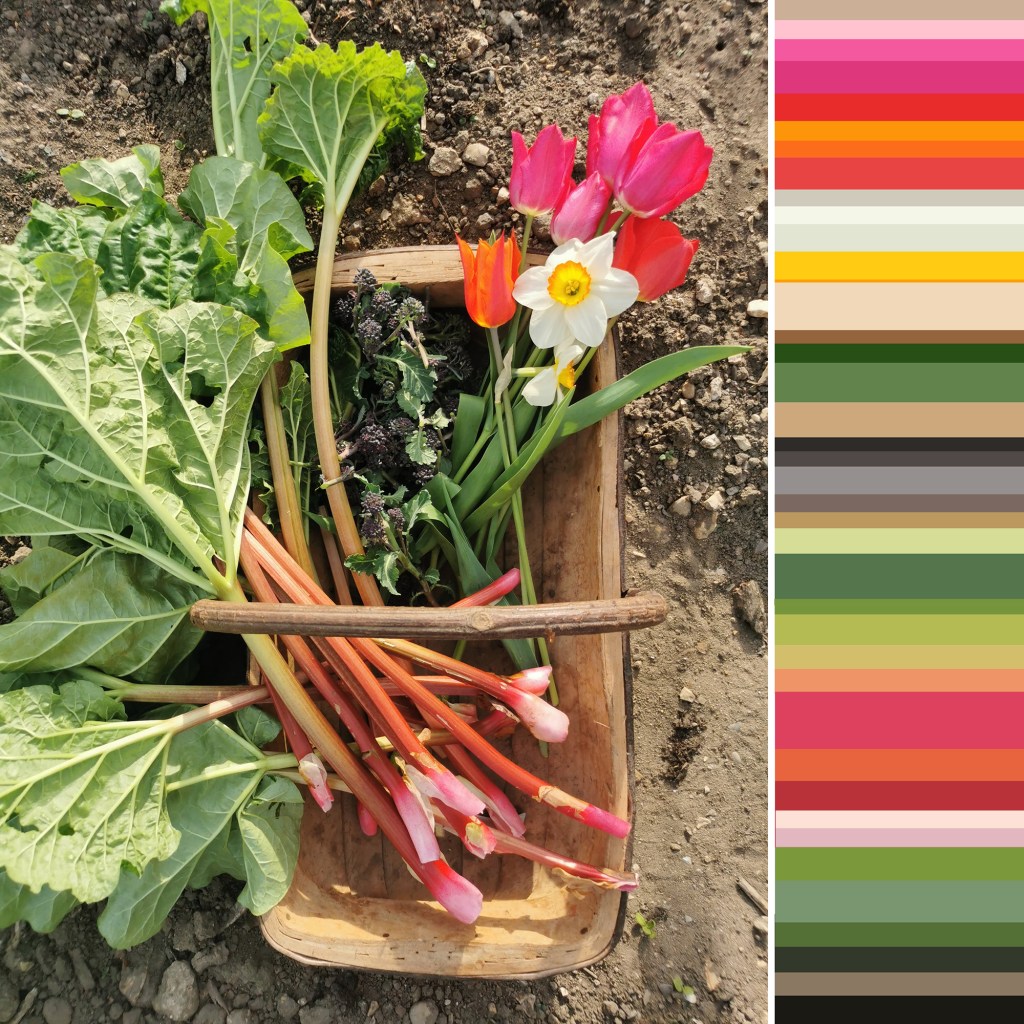
I love the signs of Spring. The yellow of the primroses in the banks, and the brighter yellow of the daffodils. The optimistic pink of the blossom on the fruit trees is here and the fresh green leaves are unfurling in the hedgerows. The garden has transformed in the last two weeks, from the yellows of the daffodils to the shocking pink, orange and red tulips. The rhubarb is in full swing and the purple sprouting continues. The garden is full of activity, with birds building nests, and plants reawakening. We’ve made it through the cold of winter, the days are longer and with any luck, warmer!
In celebration I’ve made two colour palettes from the photographs I took this weekend. Making coloured stripes from photographs was a holiday project we were set before starting art school, but we had to paint the stripes, rather than digitally capture them in pixels. Some things change, but my love of capturing colour continues! I’ve made a few palettes over the years, so check back over the blog posts and you can see more.
A trug of harvest – rhubarb, purple sprouting, tulips and daffodils, and a vase of daffodils and tulips
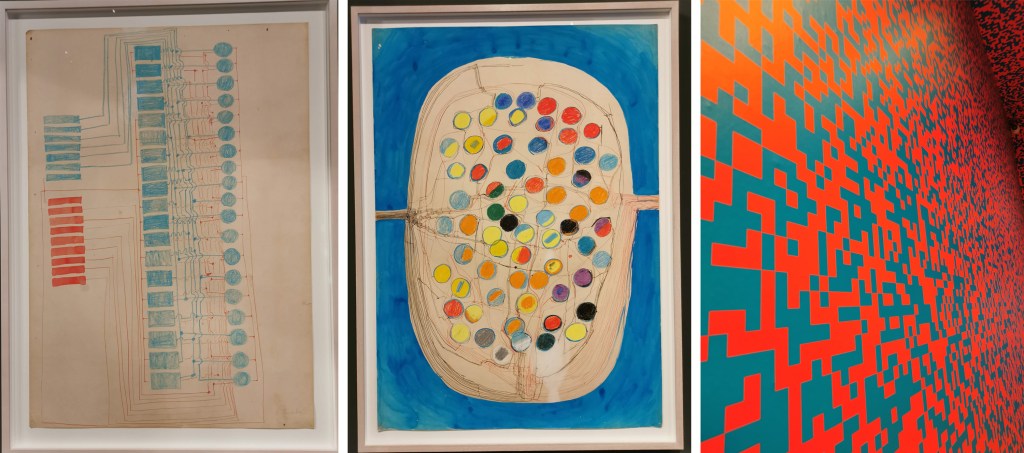
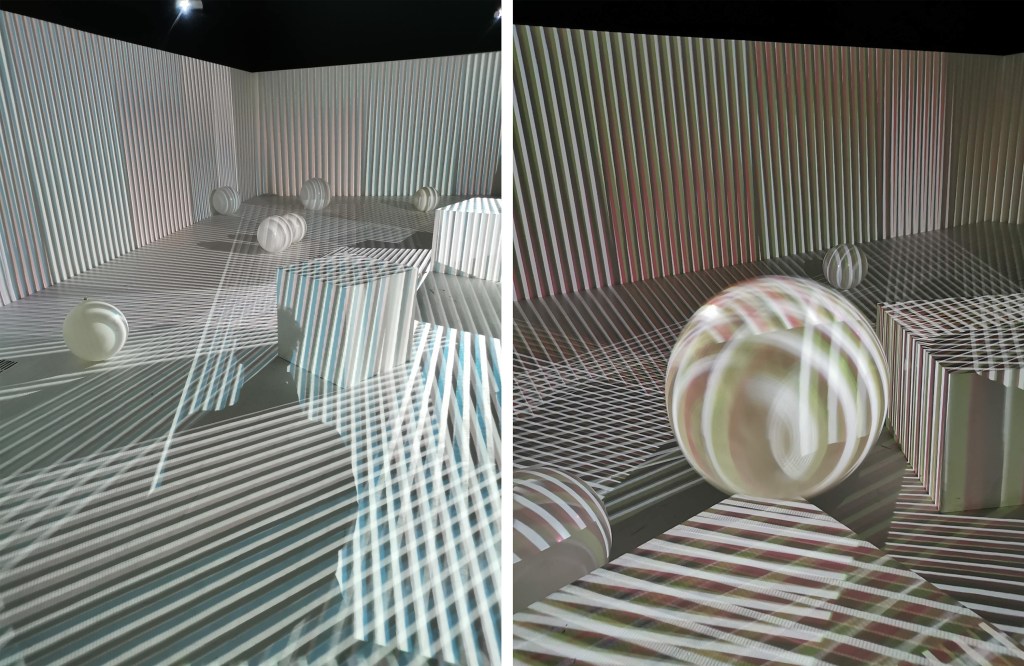
I visited the Electric Dreams exhibition on at Tate Modern, London, until 1st June 2025 and thoroughly enjoyed the exhibition that ranged from 2D artworks, sound, kinetic sculpture, light projections and installations, featuring international artists and groups. Mathematical systems and rules, machine-controlled movement as well as material and pattern play resulted in a fascinating show I thoroughly recommend.
The exhibition was described as ‘art and technology before the internet’ and included C20th items from the Pop Art era through to early computing and video work. Our perception and senses were being challenged in many ways as we experienced the installations and artefacts. Some exhibits performed constantly, others, often featuring movement or light were timed, so I worked my way back and forth between the rooms to ensure I’d seen all I could in performance mode. The current trend for immersive gallery experiences were put in to context in this exhibition.
Left to right: Atsuko Tanaka (pic 1 & 2), Francois Morellet
Left to right / top to bottom: Otto Pine, Julio Le Parc, Martha Boto, Alberto Biasi, Analivia Cordeiro
installation: Carlos Cruz-Diez
Left to right: Mariana Apollonia, Lucia Di Luciano
I’m always looking for other ways to explore my pattern ideas and have been keen to consider options for film making to explore sequential narratives. Animation processes fit well with the work I’ve been doing with pattern evolution I have been testing across pages of books over the years.
Having been a fan of Len Lye’s paintings on film from the 1930s, including A Colour Box from 1935 commissioned to promote the General Post Office I was pleased to be able to attend a workshop in Norwich to to spend a few hours working on strips of 16mm film to make my own experimental animation. We were shown some examples of other people’s films and could then explore the process ourselves. The workshop was led by Jacob Watkinson and was hosted by The Holloway in Norwich.
We were given strips of clear 16mm film I was able to use pens, paint, rubber stamps and Letraset on, as well as pre-exposed film with archive films that we could scratch away the black with a scalpel beautifully. I know it’s obvious to say, but 16mm is tiny, and I’d forgotten my glasses, so that added to the issue of seeing what I was working on! It’s a tiny space to include anything too complex and I was unsure initially how many times to repeat motifs and at what pace to move motifs across the film, but I just had a go and tried not to be too precious.
Once we’d all had a chance to work on several pieces Jacob spliced the pieces of film together and we ended the session with a screening of everybody’s efforts – it was great to see individual approaches with the same processes and the outcomes have certainly got me thinking about taking my pattern evolution ideas in this direction again. The image below shows some stills from the film I made – all 20 seconds of it! Len Lye’s films are brilliantly paired with music so maybe I need to think about that too – but I’m not sure today’s Post Office will be knocking on my door anytime soon!
If you want to read more about Len Lye this article from the Tate is a good one.
I’m excited to be finally bringing this collection of surface designs to market in collaboration with the Window Film Company. The inspiration for the patterns has stemmed from my fascination with geometric designs, taking the basic ingredients of triangles, circles and squares as my starting point.
I’ve been exploring geometric pattern structures in relation to design principles established by Lewis F. Day at the turn of the Twentieth century, exploring the equal distribution of motifs within a repeating tile to alter the visual rhythm within two-dimensional surface designs. I have also explored expectation and disruption within the repeat tiles. On establishing an apparent small-scale repeat, I play with unexpected shifts in the placement of motifs to disrupt the rhythm, challenging the sense of order. This work belongs to my ongoing practical pattern research as Associate Professor in Design at Norwich University of the Arts.
The six designs each have their own identity and yet belong together like siblings in a family, with shared features of geometric motifs and formal compositions throughout this collection. Some of the designs started their life as self-initiated physiotherapy back in 2020 / 21 following abdominal surgery and my subsequent recovery. The design challenge, to make small-scale lino blocks of repeating patterns to print by hand, provided me with small physical and mental tasks to focus on between the naps. I had hoped some of the designs would one day be leaving my studio, and I’m pleased and proud to share them now.
Designing for window film requires consideration of motif, shape and pattern construction without the aid of colour, requiring an absolute focus on negative and positive shapes. I enjoy working within design limitations in relation to production requirements and technical specifications, believing the challenges become design opportunities. I spent some time testing the various scale of patterns across the collection, including a micro pattern (Step), through to a much larger scaled pattern (Triangulate), considering window sizes in both domestic and commercial spaces in relation to the motif sizes.
I’ve worked with the very patient Steve at the Window Film Company for all my designs available on film, including the large-scale bespoke design for Birmingham Airport back in 2017. Previous designs from my Construct collection available from the Window Film Company won a House Beautiful award in 2018 too!
Steve worked with me to sample some of the early versions of these designs generated as digital scans from lino prints initially, but I didn’t like the visual quality in the translation of the prints. The original artworks for this collection were generated using collage and screen printing alongside the lino prints as I prefer designing with a physical relationship to image creation. After further consideration I opted to create each of the designs as vector-based files for production, providing sharp graphic quality to the patterns.
Mike at Window Film Co. was also fundamental in getting this collection established, off the computer, on to window film and ready for sale. Our conversations focused on understanding my design identity in relation to previous work. He ensured the designs felt authentic to me, while building on the existing designs I already license to the company.
It’s always exciting to receive a delivery of samples, and I’ve had a few of those over the last few months. The final product is very different to a digital file, so it is important to inspect the artwork as film installed on the window, checking the scale of repeat as well as any discrepancies in the artwork – you must have sharp eyes for detail! With final decisions made and sampling approved, as well as the small matter of naming the designs, we have been able to sign off the artwork, and launch the six designs in the collection: Circulate, Diamonds, Shift, Triangulate, Step, Pairings